Weekend links 290

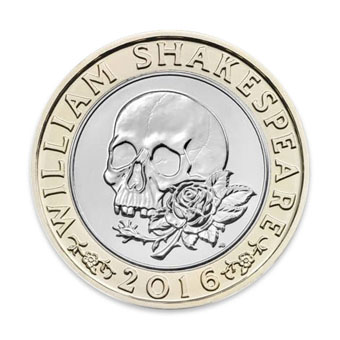
coin

The Royal Mint celebrates 400 years of William Shakespeare with new £2 coins. The “Tragedies” design gives Britain the Gothiest coin of all time.

• “I hate successful films that travel on an easy wave of ‘good taste’: for me, that is simply anti-culture.” Cinematographer Luciano Tovoli talks to Alexandra Heller-Nicholas about photographing Dario Argento’s masterwork, Suspiria.

• Mixes of the week: Für die Liebe II, an hour of ambient drift by Matthew Dekay, and Carwyn Ellis Mixtape No. 354 by The Voice Of Cassandre.

• Americans in Europe: Frances Mayes on the enduring mystique of the Venetian lagoon, and David Farley on the trail of Kafka in Prague.

“We’d read that Brion Gysin and William Burroughs had played around with some scientific equipment from Columbia University,” [Jim] Jarmusch recalls. It was “some kind of strobe light that they claimed, by placing eidetic pulses on the outside of your eyelids, could cause states of hallucination and trance. We found out how to check out this machine and experimented with … not fantastic results! In a way though, Luc [Sante] channels ghosts: he’s able to imagine and mentally reconstruct events and places from the past and weave them into stories. He can cross influences like Blaise Cendrars and JG Ballard with James M Cain and Raymond Roussel.”

[…]

If New York celebrates amnesia, perpetual transformation, accelerated obsolescence – and offers newcomers a blank slate, a chance to be born again – then Sante offers a mordantly heretical vision of the city. For him it’s full of layers and depths, of echoes and eerie reverberations, of occult whispers. “The tech crowd thinks that we can’t afford the past to be sitting on our shoulders. It’s a burden, a dead weight. We’ve got to innovate constantly. We have to … disrupt. But the 20th century is littered with valuable stuff – writers, ideas, daily certainties – that gets discarded and that needs to be picked up and looked at again.”

Sukhdev Sandhu profiles writer Luc Sante

The Edge Question for 2016: What do you consider the most interesting recent (scientific) news? What makes it important?

Bradley L. Garrett’s foreword for Secret Tunnels of England: Folklore and Fact (2015), a book by Antony Clayton.

Caitlin R. Green on the monstrous landscape of medieval Lincolnshire.

Mistaken Memories of Mediaeval Manhattan by Brian Eno.

Arche (live, 2013) by Master Musicians of Bukkake.

A Year In The Country returns for another year.

Kafka (1982) by Masami Tsuchiya | Manhattan (1984) by Seigen Ono | Tunnel (1997) by Biosphere

Painting the Henge

stonehenge1.jpg

Wiltonia sive Comitatus Wiltoniensis; Anglice Wilshire (1649) by Atlas van Loon.

Avebury doth as much exceed Stonehenge in grandeur as a Cathedral doth an ordinary Parish Church.

John Aubrey

John Aubrey (1626–1697) was the pioneering antiquarian and archaeologist whose interest in the ancient sites of southern England made him the first person to subject Avebury to any serious study. As a consequence his comparison between Avebury and Stonehenge may contain some bias—Stonehenge’s site on the desolate Salisbury Plain made its presence well-known even if it was little understood—but it should be noted that in Aubrey’s time there were more stones at Avebury than there are today, and the long avenues leading to and from the outer circle were still intact. The stones of Avebury were unfortunately small enough to be broken up by the locals for building materials.

stonehenge2.jpg

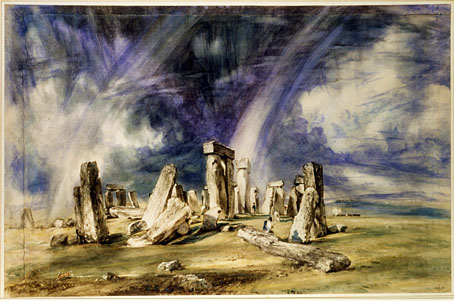
Stonehenge (1835) by John Constable.

The size of the stones, and the isolation of the site explains why Stonehenge has proved more attractive to the arts than other Neolithic monuments. William Macready in the 19th century added Stonehenge-like trilithons to his stage designs for King Lear, an addition that persisted for decades; Thomas Hardy’s Tess of the d’Urbervilles (1891) famously ends with a scene at the stones, while in the 20th century Stonehenge was shoehorned into Night of the Demon (1957), Jacques Tourneur and Charles Bennett’s film adaptation of Casting the Runes by MR James. James was an antiquarian himself so may well have approved of the inclusion, especially the way the stones are used in the opening scene.

stonehenge3.jpg

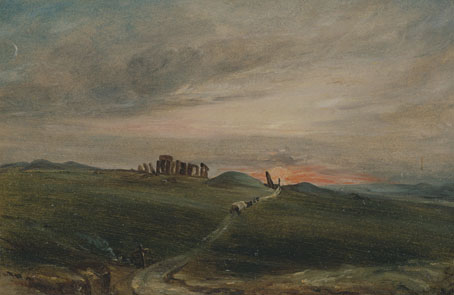
Stonehenge at Sunset (1835) by John Constable.

Painted renderings of the stones tend to be a mixture of archaeological studies and depictions like those featured here. The site had an understandable attraction to the Romantics, and drew both Constable and Turner there. (See Turner’s paintings and sketches here.) Constable’s watercolour of the stones against a turbulent sky is oft-reproduced. Some of the stones seen in 19th paintings and drawings lean more than they do today, having been restored to the vertical in the 20th century.

stonehenge4.jpg

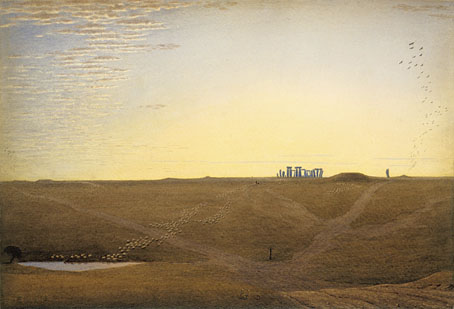
Stonehenge – Twilight (c. 1840) by William Turner of Oxford (not to be confused with his more famous namesake).

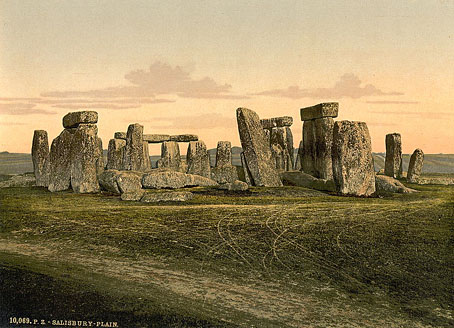
Closer to our own time there’s Henry Moore’s marvellous series of lithograph prints from 1973 which study the stones from a variety of angles. These include close views, something few other artists seem to attempt. The photo print below shows the site as it was in the 1890s with cart tracks passing nearer to the stones than visitors today are allowed to venture.

stonehenge5.jpg

Previously on { feuilleton }
Stonehenge
Stonehenge panorama

Weekend links 90

varo.jpg

Portrait of Dr. Ignacio Chavez (1957) by Remedios Varo (1908–1963) some of whose Surrealist paintings can be seen at Frey Norris, San Francisco, from 19th January. There’s also In Wonderland: The Surrealist Adventures of Women Artists in Mexico and the United States at the Los Angeles County Museum of Art from 29th January.

The current crop of Republicans jostling for the Presidential nomination have reminded me of the Downunder people in Harlan Ellison’s post-apocalypse novella A Boy and His Dog (1969): a retrograde, fear-ridden community who send troublesome individuals to be exterminated at “the farm”. Rick Santorum (unforgettably pictured here with family in 2006 after losing an election) almost received the majority of Iowa’s votes for his nomination last week, prompting renewed scrutiny of his negative views about gay people, sexually active people, foreign people (especially Arabs and Mexicans), and anyone generally who isn’t a white, Catholic, Downunder person. Santorum is against gay marriage, of course—it’s hard to find a Republican who isn’t—but he also wants to ban abortion even in cases of rape and incest, and given the opportunity would allow US states to prevent any use of contraception. Add to this his pro-torture stance (which offends current Catholic church policy), and his willingness to wage war with Iran, and it’s easy to see why his name prompts reactions such as this:

I have a history with Rick Santorum. In 2003, when Santorum, in an interview with the Associated Press, first compared gay relationships to child rape and dog fucking (have I mentioned that Santorum has compared gay relationships to child rape and dog fucking?), I held a contest to redefine Santorum‘s last name. The winning definition: “the frothy mix of lube and fecal matter that is sometimes the byproduct of anal sex.” (“Sometimes” is the most important word in the new definition of santorum; if you’re doing anal sex correctly, there won’t be any santorum – lower- or upper-case.) And since 2003, the new definition has been the No. 1 Google return when you search “santorum“.

Rick Santorum’s homophobic frothing by Dan Savage

Related: Santorum was named one of the three “most corrupt” Senators in 2006 | “Homohater fosser fram” which is how Dagbladet, Norway’s second largest tabloid newspaper, introduces Santorum to its readers | “Rick Santorum channels Saint Augustine” an article at Slate exploring the Handmaid’s Tale extent of Santorum‘s attitudes towards sex and morality | Rick Santorum quotes as New Yorker cartoons.

marlin.jpg

The Rod (1973) by Brigid Marlin.

• Ballardian posts a long-overdue interview with Brigid Marlin, famous now for having brought two lost Paul Delvaux paintings back to life for JG Ballard, but also a woman with an extensive career as a fantastic artist using Ernst Fuchs‘s laborious mische painting technique.

Quentin Blake on Ronald Searle, in which Blake notes that his hero was given a full-scale exhibition of his work at the Bibliothèque Nationale, France, in 1973 whilst being ignored throughout his life by the major institutions in Britain.

Alfred Jarry: A Pataphysical Life by Alastair Brotchie is reviewed by Michael Moorcock who tells me the Guardian cut out his references to Boris Vian, Maurice Richardson and David Britton.

Ian McKellen stirs things up by suggesting (not for the first time) that Shakespeare was bisexual.

• Ten posters by Only More Never Less inspired by Pink Floyd’s Dark Side of the Moon.

An end to bad heir days: The posthumous power of the literary estate.

Peace Eye! Fug! A Long Talk With Ed Sanders.

• Sand sculptures by Carl Jara.

Letterheady

• Skylab: These Are The Blues (1995) | Beyond The Breeze (1995) | Red Light, Blue Light (1995) | Indigo (Sabres of Paradise remix, 1995) | Seashell (Nobukazu Takemura mix, 1995).

Weekend links 75

darde.jpg

Eternal Pain (1913) by Paul Dardé. (And also here)

Rain Taxi caused a stir this week with its savaging of Hamlet’s Father by science fiction writer Orson Scott Card. The book is another of Card’s blatherings about the hell of being homosexual dressed in garments stolen from the unfortunate William Shakespeare. Rain Taxi made the obvious point about many of Shakespeare’s sonnets being homoerotic. For my part I was more appalled by the quoted extract which reduced one of the greatest plays in the language to that lifeless, cardboard-character-speak which is endemic in bad genre writing. News of the travesty quickly spread to gay news blogs, The Outer Alliance and elsewhere, ensuring that what’s left of Card’s reputation continues to spiral down a Mel Gibson-shaped black hole.

• “Sounds only like itself, like no one before or after.” Julian Cope on Tago Mago by Can which will be reissued in a new edition in November. Nice to see the return of the original sleeve design, something I saw once in a record shop then didn’t see again for years. For a long time I thought I’d imagined it. Related: two German art exhibitions inspired by the group.

The Responsive Eye (1965), a catalogue for the MoMA exhibition that launched Op Art. Also at Ubuweb: La femme 100 têtes, a film by Eric Duvivier based on the collage work by Max Ernst.

• More apocalyptic art: William Feaver on John Martin whose exhibition will be opening at Tate Britain later this month. There’s a trailer here.

Borges and I, an essay by Nandini Ramachandran. Related: Buenos Aires: Las Calles de Borges, a short film by Ian Ruschel.

• “Who was JG Ballard? Don’t ask his first biographer,” says Robert McCrum.

Biologically-inspired fabric and material design by Neri Oxman.

• Cross-pollinating subgenres: “Steampunk ambient” at Disquiet.

In the Shadow of Saturn, a photo by the Cassini spacecraft.

• The art and fashion designs of Alia Penner.

Fleet of hybrid airships to conquer Arctic.

• RIP Jordan Belson, filmmaker.

• Ten years of Ladytron whose new album is released on the 12th of September: Playgirl (2001), Seventeen (2002), Destroy Everything You Touch (2005), Sugar (2005), Ghosts (2008), Ace Of Hz (2011).

Wildeana 6

robinson1.jpg

“The rich making merry in their beautiful houses, while the beggars were sitting at the gates.” Above and below: illustrations by Charles Robinson from The Happy Prince and Other Tales, an edition from 1920.

Continuing an occasional series. I’ve yet to see a copy of the recent annotated and unexpurgated edition of The Picture of Dorian Gray but Alex Ross wrote a marvellous essay for the New Yorker about the novel, its creation, its public reception, and Wilde’s decision to tone down the overt homoeroticism of its earlier drafts. This is one of the best pieces I’ve seen for a while about Wilde, replete with choice detail:

The gay strain in Wilde’s work is part of a larger war on convention. In the 1889 story “The Portrait of Mr. W. H.,” a pseudo-scholarly, metafictional investigation of Shakespeare’s sonnets to a boy, Wilde slyly suggests that the pillar of British literature was something other than an ordinary family man. In the 1891 play “Salomé,” Wilde expands a Biblical anecdote into a sumptuous panorama of decadence. Anarchists of the fin de siècle, especially in Germany, considered Wilde one of their own: Gustav Landauer hailed Wilde as the English Nietzsche. Thomas Mann expanded on the analogy, observing that various lines of Wilde might have come from Nietzsche (“There is no reality in things apart from their experiences”) and that various lines of Nietzsche might have come from Wilde (“We are basically inclined to maintain that the falsest judgments are the most indispensable to us”). Nietzsche and Wilde were, in Mann’s view, “rebels in the name of beauty.”

As for the novel, I’m feeling rather Dorian Grayed-out at the moment, having recently completed ten illustrations based on the story for a forthcoming anthology. More about that later.

Elsewhere, the William Andrews Clarke Memorial Library in Los Angeles has been running an exhibition, Oscar Wilde & the Visual Art(ists) of the Fin-de-Siecle, since July, and will continue to do so until the end of September. No word about what’s on display but this page on their website has details of their collection of Wilde materials which they say is the most comprehensive in the world.

Finally, the majority of visits to these pages in recent days have come from this post about Ivan Albright’s astonishing Dorian Gray painting in the Art Institute of Chicago. The post links to an earlier one of mine about the paintings used in Albert Lewin’s 1945 film of the book.

robinson2.jpg

Elsewhere on { feuilleton }
The Oscar Wilde archive