Aldous Huxley on Piranesi’s Prisons

piranesi.jpg

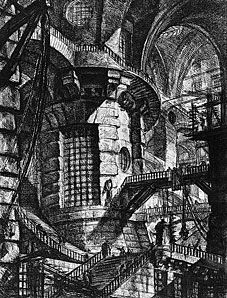
I scanned this essay years ago from a library copy of a 1949 edition of Piranesi’s Carceri d’Invenzione (Trianon Press, London). It’s worth reproducing here since it’s still one of the best analyses I’ve read of these fascinating and enigmatic drawings. Online reproduction quality of Piranesi’s work is dismayingly low for the most part. And nothing matches seeing these etchings in their original printed state, of course. But you can start here then search around for more.

AT THE TOP OF THE MAIN STAIRCASE in University College, London, there stands a box-like structure of varnished wood. Somewhat bigger than a telephone booth, somewhat smaller than an outdoor privy. When the door of this miniature house is opened, a light goes on inside, and those who stand upon the threshold find themselves confronted by a little old gentleman sitting bolt upright in a chair and smiling benevolently into space. His hair is grey and hangs almost to his shoulders; his wide-brimmed straw hat is like something out of the illustrations to an early edition of Paul et Virginie ; he wears a cutaway coat (green, if I remember rightly, with metal buttons) and pantaloons of white cotton, discreetly striped. This little old gentleman is Jeremy Bentham, or at least what remains of Jeremy Bentham after the dissection ordered in his will—a skeleton with hands and face of wax, dressed in the clothes that once belonged to the first of utilitarians.

To this odd shrine (so characteristic, in its excessive unpretentiousness, of that nook-shotten isle of Albion) I paid my visit of curiosity in company with one of the most extraordinary, one of the most admirable men of our time, Albert Schweitzer. Many years have passed since then; but I remember very clearly the expression of affectionate amusement that appeared on Schweitzer’s face, as he looked at the mummy. “Dear Bentham!” he said at last. “I like him so much better than Hegel. He was responsible for so much less harm.” And of course Schweitzer was perfectly right. The German philosopher was proud of being tief, but lacked the humility which is the necessary condition of the ultimate profundity. That was why he ended up as the idolater of the Prussian state, as the spiritual father of those Marxian dogmas of history, in terms of which it is possible to justify every atrocity on the part of true believers, and to condemn every good or reasonable act performed by infidels. Bentham, on the contrary, had no pretensions to tiefness. Shallow with the kindly, sensible shallowness of the eighteenth century, he thought of individuals as real people, not as trivial bubbles on the surface of the river of History, not as mere cells in the brawn and bone of a social organism, whose soul is the State. From Hegel’s depths have sprung tyranny, war and persecution; from the shallows of Bentham, a host of unpretentious but real benefits—the repeal of antiquated laws, the introduction of sewage systems, the reform of municipal government, almost everything sensible and humane in the civilisation of the nineteenth century. Only in one field did Bentham ever sow the teeth of dragons. He had the logician’s passion for order and consistency; and he wanted to impose his ideas of tidiness not only on thoughts and words, but also on things and institutions. Now tidiness is undeniably a good—but a good of which it is easily possible to have too much and at too high a price. The love of tidiness has often figured, along with the love of power, as a motive to tyranny. In human affairs the extreme of messiness is anarchy, the extreme of tidiness, an army or a penitentiary. Anarchy is the enemy of liberty and, at its highest pitch, so is mechanical efficiency. The good life can be lived only in a society in which tidiness is preached and practised, but not too fanatically, and where efficiency is always haloed, as it were, by a tolerated margin of mess. Bentham himself was no tyrant and no worshipper of the all-efficient, ubiquitous and providential State. But he loved tidiness and inculcated the kind of social efficiency which has been and is being made an excuse for the concentration of power in the hands of a few experts and the regimentation of the masses. And meanwhile we have to remember the strange and rather alarming fact that Bentham devoted about twenty five years of his long life to the elaboration in minutest detail of the plans for a perfectly efficient prison. The panopticon, as he called it, was to be a circular building, so constructed that every convict should pass his life in perpetual solitude, while remaining perpetually under the surveillance of a warder posted at the centre. (Significantly enough, Jeremy Bentham borrowed the idea of the panopticon from his brother, Sir Samuel, the naval architect, who, while employed by Catherine the Great to build ships for Russia, had designed, a factory along panoptical lines, for the purpose of getting more and better work out of the industrialised mujiks.) Bentham’s plan for a totalitarian housing project was never executed. To console him for his disappointment, the philosopher was granted, by Act of Parliament, twenty-three thousand pounds from the public funds.

Continue reading “Aldous Huxley on Piranesi’s Prisons”

Rembrandt’s vision

rembrandt.jpg

The Netherlands celebrate four hundred years of Rembrandt’s genius.

While looking around for links I noticed this story for the first time:

Margaret S. Livingstone and Bevil R. Conway, neurobiologists at Harvard Medical School, say Rembrandt’s many self-portraits reveal that his eyes are focused in slightly different directions, depriving him of the “stereo” effect that makes vision three-dimensional. As a result, they argue, Rembrandt would have struggled with depth perception – though he may never have known he had a vision defect.

Rembrandt’s flat world view may have helped him more precisely capture reality on a flat canvas, where painters create the illusion of three-dimensions through techniques such as shading. In fact, Livingstone and Conway say that visual artists are far more likely to be “stereoblind” than the general public, suggesting that limited depth perception may actually be an advantage over normal sight.

“Art teachers often instruct students to close one eye in order to flatten what they see,” the researchers write in today’s New England Journal of Medicine, explaining their theory about Rembrandt. “Stereoblindness might not be a handicap – and might even be an asset – for some artists.”

Similar assertions from doctors about conveniently dead artists surface from time to time; we had Michelangelo suffering from Asperger’s recently and I recall a story about Shakespeare having a brain tumour based solely on scrutiny of very vague portraits. The Rembrandt story is significant for me because my eyes have always been mis-aligned and I don’t see stereoscopically. I have permanent double-vision as a result, something people are always surprised to hear, although I only notice this when I think about it. My brain treats the mis-aligned (and weaker) data from my right eye as redundant information and so ignores it.

The point is, whether Rembrandt had a similar defect or not (and I’m sceptical; how can you be so sure by looking at a few paintings?), it’s very difficult, if not impossible, to judge what effect this has on artistic ability without conducting a mass survey. Even then I doubt that you’d discover much. The doctors in this case want to imply that Rembrandt’s damaged eyesight gave him an extra edge with regard to depth perception but I find this incredibly difficult to demonstrate with any degree of certainty. What gives Rembrandt more of an edge (and keeps us looking at his work) is his exceptional drawing skill and peerless mastery of the oil medium, something that’s partly innate talent but mostly prodigious ability and the result of years of labour. Whatever assistance stereoblindness might lend him would be a very small thing next to this combination of natural gifts and hard work.

Previously on { feuilleton }
“One measures a circle, beginning anywhere?”

The life and work of Derek Jarman

angelic.jpg

The Angelic Conversation, 1985.

An unseen woman recites Shakespeare’s sonnets—fourteen in all—as a man wordlessly seeks his heart’s desire. The photography is stop-motion, the music is ethereal, the scenery is often elemental: boulders and smaller rocks, the sea, smoke or fog, and a garden. The man is on an odyssey following his love. But he must first, as the sonnet says, know what conscience is. So, before he can be united with his love, he must purify himself. He does so, bathing a tattooed figure (an angel, perhaps) and humbling himself in front of this being. He also prepares himself with water and through his journey and his meditations. Finally, he is united with his fair friend.

History of the skull as symbol

7.jpg

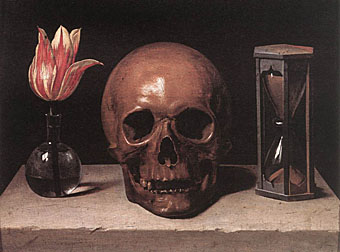
Still-life with a skull (vanitas) by Philippe de Champaigne.

vanitas
think of the scene from shakespeare’s hamlet where the prince holds a skull of yorick, a former servant, bemoaning the pointlessness and temporary nature of worldly matters. certain themes characteristic of a specific philosophy have been commonly represented during an era, and an iconography has been developed to express them. an example is the still life vanitas vanitatum of the middle ages, a reminder of the transitory quality of earthly pleasure symbolized by a skull. pictorial arrangements are dealing with the vanity of the intellectual world (globe, books), and of the ‘vita voluptaria’ (musical instruments, smoking implements). often painters continued the old tradition of including appropriate captions or texts on their pictures. the favourite was the admonition from ecclesiastes I: ‘vanity of vanities; all is vanity’. the transience of human existence is often brought out also by other symbols like the candle and the hourglass.

David Rudkin on Carl Dreyer’s Vampyr

Vampyr_Rudkin.jpg

Vampyr, Der Traum des Allan Gray (1932) is one of the founding and defining works of psychological horror cinema, adapted from Gothic stories by Sheridan Le Fanu, a disturbing narrative of vampirism, obsession and posession of the soul. But it is also a film directed by Carl Theodor Dreyer, the revered and legendary Danish director of La Passion de Jeanne d’Arc (1927). Shot in France with private money and a largely nonprofessional cast and primitive sound equipment, Vampyr is to some extent a ruin. There is no definitive print and English versions are marred by poor image quality and subtitles. And yet it is unquestionably extraordinary, a vivid and haunting manifestation of Dreyer’s power to make visible on screen the inner human state, and to convey a dreamlike imagery of textures of nature amidst which transient, solitary human figures pass, some illuminated by an inner light, others threatened by a malign or demonic presence. In relation to Dreyer’s long but often frustrated career, Vampyr is often thought of as an uneven or disappointing film. But, according to David Rudkin, this is to misunderstand what it sets out to do, which is systematically to set the spectator adrift in a mysterious world. In a meticulous formal analysis of Vampyr, Rudkin expands on this contention, pinpointing the sources of the film’s uniquely disquieting effect. And yet, however strange it is, Vampyr remains a profound and troubling artwork concerned at the last to communicate human meanings—and none more so than the essence of death—in remarkable filmic imagery.

David Rudkin is a dramatist and screenwriter of forty years’standing. His theatre work is mainly associated with the Royal Shakespeare Company. Having collaborated with Tony Richardson, François Truffaut and Fred Zinnemann, his recent screenplays include Testimony (1987), for which he was awarded the New York Film Festival Gold Medal for Screenplay.