If….

if1.jpg

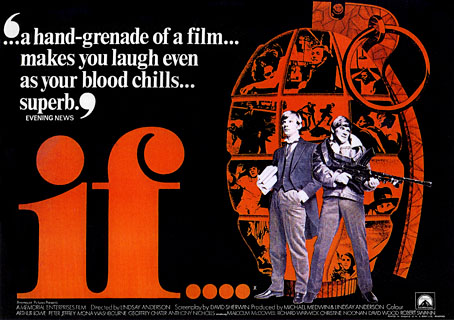
Lindsay Anderson‘s masterpiece, If…., is finally given a DVD release in the UK in June. Anderson’s film—the dramatic resistance to authority by three boys at an unnamed British school—was made in 1968 but I didn’t get to see it until (as I recall) 1977. I was 15 at the time and feeling increasingly desperate and hidebound by school-life so this film was explosive in its psychological impact as well as its story (that grenade on the poster was very apt). Given my age and the year, I’m supposed to have cult yearnings toward the wretched Star Wars but it was If…. that made the lasting impression.
if3.jpg

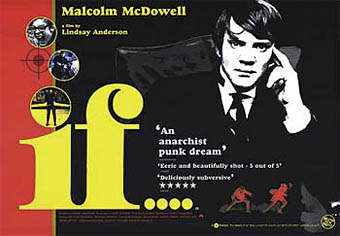
Poster for the 2002 re-release.

If…. was important for a number of reasons, not all of them obvious during that first viewing. I didn’t go to an all-boys public school (note for Americans: “public school” in Britain actually means an expensive, private establishment) but my grammar school had been an all-boys place a few years before I arrived. Some teachers wore gowns at assembly and many of the older teachers there were of a rigid, brutalist mindset exactly like the ones in Anderson’s film. Bullying was endemic, uniform rules were enforced to a degree that would make an army colonel proud and you stood out from the crowd at your peril; I had friends there but I hated every minute. So here comes young Malcolm McDowell on the television screen, effortlessly charismatic and insouciant in his first film role, portraying the ultimate Luciferan rebel, one who (as Anderson writes in the screenplay preface below) says “No” in the face of overwhelming odds. Reader, I identified so very much…. The famous ending (borrowed from Jean Vigo’s Zéro de Conduite) where Mick and the other “Crusaders” fire guns and throw grenades at the rest of the school was headily wish-fulfilling. (And given recent events, you’ll also see below that Anderson and screenwriter David Sherwin regarded that ending as metaphorical, not literal.)
Continue reading “If….”

Alla Nazimova’s Salomé

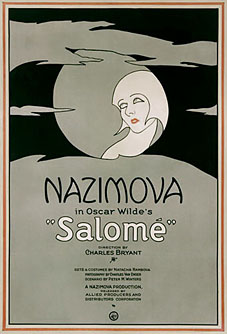
salome1.jpgWe tend to think of cinema as a modern medium, quintessentially 20th century, but the modern medium was born in the 19th century, and the heyday of the Silent Age (the 1920s) was closer to the Decadence of the fin de siècle (mid-1880s to the late-1890s) than we are now to the 1970s. This is one reason why so much silent cinema seems infected with a Decadent or Symbolist spirit: that period wasn’t so remote and many of its more notorious products cast a long shadow. Even an early science fiction film like Fritz Lang’s Metropolis has scenes redolent of late Victorian fever dreams: the vision of Moloch, Maria’s parable of the tower of Babel, the coming to life of statues of the Seven Deadly Sins, and—most notably—the vision of the Evil Maria as the Whore of Babylon. Woman as vamp or femme fatale was an idea that gripped the Decadent imagination, and it found a living expression in the vamps of the silent era, beautiful women with exotic names such as Pola Negri, Musidora (Irma Vep in Feuillade’s Les Vampires) and the woman the studios and press named simply “the Vamp”, Theda Bara (real name Theodosia Burr Goodman).
Alla Nazimova was another of these exotic creatures, and rather more exotic than most since she was at least a genuine Russian, even if she also had to amend her given name (Mariam Edez Adelaida Leventon) to exaggerate the effect. Like an opera diva or a great ballerina she dropped her forename as her career progressed, and is billed as Nazimova only in her 1923 screen adaptation of Oscar Wilde’s play, Salomé. Nazimova inaugurated the project, produced it and even part-financed it since the studios, increasingly worried by pressure from moral campaigners, regarded it as a dangerously decadent work. Nazimova had a rather colourful off-screen life and the stories of orgiastic revels at her mansion, the Garden of Allah, probably didn’t help matters.

salome2.jpg

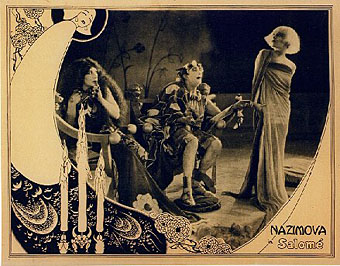
Salomé lobby card (1923).

Continue reading “Alla Nazimova’s Salomé”

The Angelic Conversation

angelic_jarman.jpg

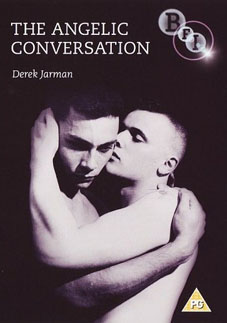
Title by John Dee, words by William Shakespeare, narration by Judi Dench and music by Coil; Derek Jarman’s oneiric film/poem is released on DVD, along with two other works.

The BFI releases three Derek Jarman films together—Caravaggio (1986), Wittgenstein (1993) and The Angelic Conversation (1985)—all digitally restored and re-mastered for DVD and each with extensive and illuminating extra features.

The films were made with the BFI Production Board, whose aim was to foster innovation in British filmmaking, thus providing a natural home for Jarman’s artistic sensibility. These three films represent highpoints in his career and are perhaps the most enduring in their appeal and relevance to contemporary audiences.

Intense, dreamlike, and poetic, The Angelic Conversation is one of the most artistic of Derek Jarman’s films. With his painter’s eye, Jarman conjured, in a beautiful palette of light, colour and texture, an evocative and radical visualisation of Shakespeare’s love poems.

Of the 154 sonnets written by Shakespeare, most were written to an unnamed young man, commonly referred to as the Fair Youth. Here, Judi Dench’s emotive readings of 14 sonnets are coupled with ethereal sequences; figures on seashores, by streams and in colourful gardens. The disruption of these magical scenes with images of barren and threatening landscapes echoes perfectly the celebration and torment of love explored in the sonnets.

Shot on Super-8 before being transferred to 35mm film, the unique technical approach results in a striking aesthetic, with Coil’s languorous soundtrack completing the intoxicating effect.

Previously on { feuilleton }
James Bidgood
Kenneth Anger on DVD…finally
Un Chant d’Amour by Jean Genet

All you need is…

love.jpg

In which the lovable moptops get the official mashup treatment courtesy of George Martin’s son, Giles. Very creditable it sounds to these ears although it strains a bit much in places to shoehorn tiny bits of the very familiar songs into other very familiar songs. The added sound effects are pretty superfluous, some of them are probably only there for the multi-channel DVD mix.

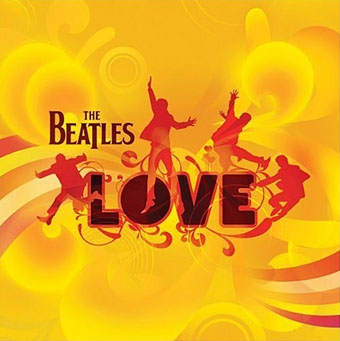
The Beatles are where my music listening began, thanks to a mother who was a fan for a while (until they started taking drugs and weirding out), and I can never quite forget this when I listen to them. As with all mashups, it’s the juxtaposition that fascinates, the moment when you think, “wow, song A fits really well with song B!”. So Strawberry Fields Forever ends with Piggies and the end of Hello Goodbye running together, while Within You, Without You really benefits from the addition of the drums from Tomorrow Never Knows. And the sound is fantastic, serving to highlight once more EMI’s disgraceful refusal to properly remaster these albums. I like the cover, a successful combination of the youthful exuberance of the Hard Day’s Night band with the later psychedelic period.

I keep wondering if this is the future of these cultural monuments. Just as Shakespeare’s plays are given new life by fresh interpretation, further reappraisal would help revitalise some of those stale back catalogues. The problem, of course, is that the whole question of copyright has been getting worse in recent years. Much as I’d like to see EMI’s vaults thrown open to sound collagists like John Oswald or Holger Czukay, it isn’t going to happen, is it?

1 “Because”
2 “Get Back”
3 “Glass Onion”
4 “Eleanor Rigby” / “Julia” (transition)
5 “I Am the Walrus”
6 “I Want to Hold Your Hand”
7 “Drive My Car” / “The Word” / “What You’re Doing”
8 “Gnik Nus”
9 “Something” / “Blue Jay Way” (transition)
10 “Being for the Benefit of Mr. Kite!” / “I Want You (She’s So Heavy)” / “Helter Skelter”
11 “Help!”
12 “Blackbird” / “Yesterday”
13 “Strawberry Fields Forever”
14 “Within You Without You” / “Tomorrow Never Knows”
15 “Lucy in the Sky with Diamonds”
16 “Octopus’s Garden”
17 “Lady Madonna”
18 “Here Comes the Sun” / “The Inner Light” (transition)
19 “Come Together” / “Dear Prudence” / “Cry Baby Cry” (transition)
20 “Revolution”
21 “Back in the USSR”
22 “While My Guitar Gently Weeps”
23 “A Day in the Life”
24 “Hey Jude”
25 “Sgt. Pepper’s Lonely Hearts Club Band (Reprise)”
26 “All You Need Is Love”

Another masterpiece from Cormac McCarthy

The road to hell

Cormac McCarthy’s vision of a post-apocalyptic America in The Road is terrifying, but also beautiful and tender, says Alan Warner.

Saturday, November 4, 2006
The Guardian

The Road
by Cormac McCarthy
256pp, Picador, £16.99

Shorn of history and context, Cormac McCarthy’s other nine novels could be cast as rungs, with The Road as a pinnacle. This is a very great novel, but one that needs a context in both the past and in so-called post-9/11 America.

We can divide the contemporary American novel into two traditions, or two social classes. The Tough Guy tradition comes up from Fenimore Cooper, with a touch of Poe, through Melville, Faulkner and Hemingway. The Savant tradition comes from Hawthorne, especially through Henry James, Edith Wharton and Scott Fitzgerald. You could argue that the latter is liberal, east coast/New York, while the Tough Guys are gothic, reactionary, nihilistic, openly religious, southern or fundamentally rural.

The Savants’ blood line (curiously unrepresentative of Americans generally) has gained undoubted ascendancy in the literary firmament of the US. Upper middle class, urban and cosmopolitan, they or their own species review themselves. The current Tough Guys are a murder of great, hopelessly masculine, undomesticated writers, whose critical reputations have been and still are today cruelly divergent, adrift and largely unrewarded compared to the contemporary Savant school. In literature as in American life, success must be total and contrasted “failure” fatally dispiriting.

But in both content and technical riches, the Tough Guys are the true legislators of tortured American souls. They could include novelists Thomas McGuane, William Gaddis, Barry Hannah, Leon Rooke, Harry Crews, Jim Harrison, Mark Richard, James Welch and Denis Johnson. Cormac McCarthy is granddaddy to them all. New York critics may prefer their perfidy to be ignored, comforting themselves with the superlatives for All the Pretty Horses, but we should remember that the history of Cormac McCarthy and his achievement is not an American dream but near on 30 years of neglect for a writer who, since The Orchard Keeper in 1965, produced only masterworks in elegant succession. Now he has given us his great American nightmare.

Continue reading “Another masterpiece from Cormac McCarthy”