Weekend links 502

wilson.jpg

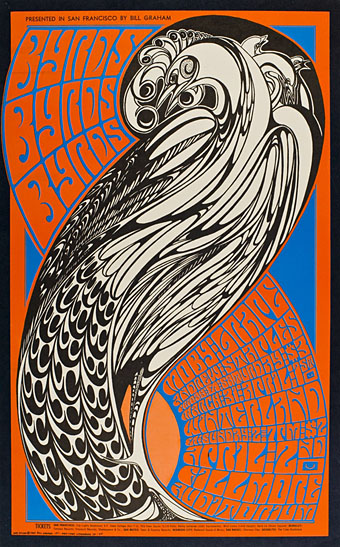
The Byrds (1967) by Wes Wilson.

• RIP Wes Wilson, one of the first of the San Francisco psychedelic poster artists of the 1960s, and also one of the more visible thanks to the popularity of his compressed type designs, some of which were derived from a style developed by Alfred Roller for the Vienna Secession circa 1900. When Playboy magazine wanted a cover that reflected the psychedelic art trend in late 1967 it was Wilson they called. Related: Wes Wilson’s posters at Wolfgang’s.

• “In the ’70s, New Age music offered listeners, trapped in the urban rat-race, audio capsules of pastoral peace to transform their homes into havens. Today the Internet and social media form a kind of post-geographic urban space, an immaterial city of information whose hustle ‘n bustle is even more wearing and deleterious to our equilibrium.” 2010–19: Back To The Garden: The Return Of Ambient And New Age by Simon Reynolds.

• “This pointed-finger symbol goes by many names: mutton fist, printer’s fist, bishop’s fist, pointer, hand director, indicule, or most unimaginatively as ‘a hand’. Scholarly consensus has pretty much settled on the word ‘manicule’, from the Latin maniculum, meaning ‘little hand’.” John Boardley on the typographic history of the pointing hand.

Tales Of Purple Sally (1973) by Alex. All instruments by Alex Wiska apart from bass by Holger Czukay, and drums by Jaki Liebzeit. The latter pair also produced the album. Related: Jah Wobble talking to Duncan Seaman about working with Czukay and Liebeziet.

• “On Jan 25, 2020, tired of negative film lists on Twitter, I asked people for ‘obscure [or] underseen films you adore and think more people should know about.’ This was the result.”

Flash Of The Spirit by Jon Hassell & Farafina “hails from a time when the possibilities of music seemed less well-defined, and borders felt more open,” says Geeta Dayal.

The Art Of Computer Designing: A Black and White Approach (1993) by Osamu Sato. There’s more of Sato’s print work at the Internet Archive.

• At the Morgan Library: Jean-Jacques Lequeu: Visionary Architect. Drawings from the Bibliothèque nationale de France.

• New from Strange Attractor: Inferno: The Trash Project: Volume One by Ken Hollings.

• At Dennis Cooper’s: Storm de Hirsch Day.

Celeste by Roger Eno & Brian Eno.

Ben Watt‘s favourite music.

The Inferno (1968) by The Inferno | Inferno (1990) by Jah Wobble’s Invaders Of The Heart | Inferno (1993) by Miranda Sex Garden
Weekend links 487

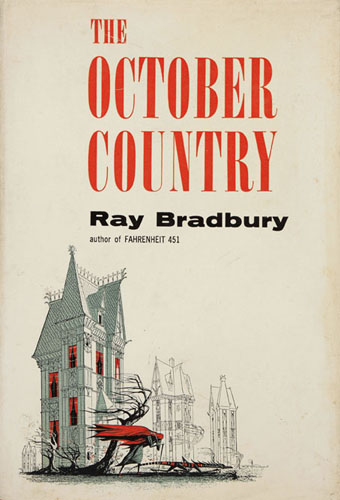
october.jpg

Art by Joe Mugnaini (1955).

• Mixes of the week: The Ivy-Strangled Path Vol. XIX by David Colohan, and The Ephemeral Man’s Teapot 2—Atmosphere insomniac by The Ephemeral Man.

• Patrick Clarke talks to Morton Subotnick and Lillevan about Subotnick’s pioneering synthesizer composition, Silver Apples Of The Moon (1967).

• A second volume of London’s Lost Rivers, a walker’s guide by Tom Bolton with photography by SF Said, is published by Strange Attractor next month.

“That country where it is always turning late in the year. That country where the hills are fog and the rivers are mist; where noons go quickly, dusks and twilights linger, and midnights stay. That country composed in the main of cellars, sub-cellars, coal-bins, closets, attics, and pantries faced away from the sun. That country whose people are autumn people, thinking only autumn thoughts. Whose people passing at night on the empty walks sound like rain.”

Ray Bradbury quoted by Sam Weller in an examination of Bradbury’s dark tales and autumnal horror stories

Lumberjacks In Heat is 11 minutes of music from Mechanical Fantasy Box by Patrick Cowley, the latest Cowley collection from Dark Entries.

They Poured Out Their Light Until Only Darkness Remained: new eldritch vibrations from The Wyrding Module.

• Carmen Villain on the magic of Jon Hassell’s Aka / Darbari / Java: Magic Realism.

• An Evil Medium: Elizabeth Horkley on the films of Kenneth Anger.

• Cosmic gardens and boulder boulevards by Charles Jencks.

• At Dennis Cooper’s: Murray Melvin Day.

Richard Dawson‘s favourite music.

• RIP John Giorno.

My Girlfriend Is A Witch (1968) by October Country | The October Man (1982) by Bill Nelson | Late October (1984) by Harold Budd

Weekend links 481

gaussot.jpg

L’Hamestoque (1977) by Christine Gaussot.

• Another announcement from Strange Attractor Press: Of Mud & Flame: A Penda’s Fen Sourcebook edited by Matthew Harle and James Machin will be published at the end of October. Among the contents will be the screenplay of David Rudkin’s cult television play, an item that’s always been impossible to find in print.

• A trailer for Journey to the Beginning of Time (1955), another semi-animated fantasy film by Karel Zeman which will released on disc next month by Second Run.

• “There was craziness in getting lost and dizzy.” Stereolab choose favourite songs from their back catalogue.

E=MC² (1976), an album of spacey jazz-electronica by Teddy Lasry which has never been reissued.

• “Why do so many book covers look the same? Blame Getty Images,” says Cory Matteson.

• Mix of the week: The Ephemeral Man’s Teapot by The Ephemeral Man.

Masataka Nakano has been photographing a deserted Tokyo for almost 30 years.

• Beyond the bounds of depravity: an oral history of David Cronenberg’s Crash.

Woodblocks in Wonderland: The Japanese Fairy Tale Series.

• A new novel by M. John Harrison is always a good thing.

Hamid Drake‘s favourite music.

Warm Leatherette (1980) by Grace Jones | Crash (1980) by Tuxedomoon | A Crash At Every Speed (1994) by Disco Inferno

Hawkwind: Days of the Underground

hawkwind.jpg

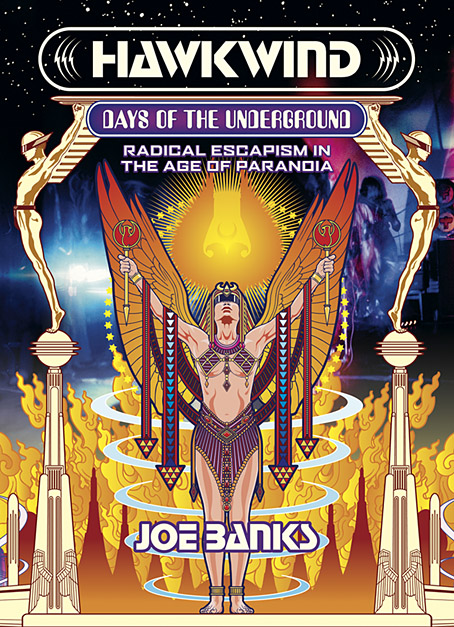
As mentioned at the weekend, Joe Banks’ account of the first ten years of Hawkwind will be published by Strange Attractor Press later this year with a wraparound cover of my design. I never expected to be doing anything else for Hawkwind after moving on to other things in 1985, but it was the group’s first decade of music that fuelled the drawings which brought me to their attention, so this cover design brings everything full circle. The earliest of my Hawkwind drawings dates to 1979 which means this cover is also an anniversary piece.

The design combines Barney Bubbles’ Space Ritual template with elements of the art he created before and afterwards, notably the inner and outer sleeve of Doremi Fasol Latido, and the futuristic Art Deco of his tour poster for The “1999” Party. All the Bubbles Hawk-art up to and including Space Ritual is a blend of the ancient (Egypt, tribal motifs, characters that resemble pirates or barbarians), the previous century (Art Nouveau in particular), and the far future as depicted in comics and pulp magazines. I wanted to reflect this blend without being too imitative of the details, so the cover works a variation on Space Ritual, with a similar hieratic woman as the focus, and a margin of stylised flames separating the foreground from Laurie Lewis’s photos of the band (the latter are unused shots from the same session used for Space Ritual).

haberfield.jpg

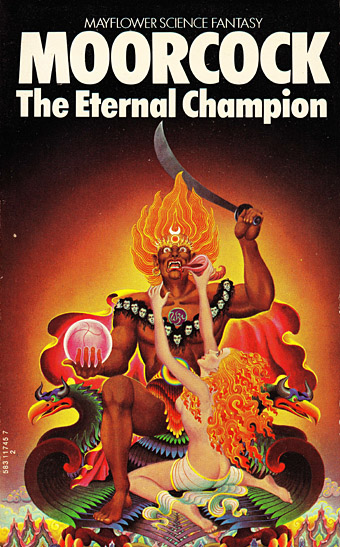
Art by Bob Haberfield, 1970.

All the background elements run across the wrap but this hasn’t been revealed yet so you’ll have to wait a while to see the full design. The flames are based on Tibetan designs in a nod to the ancient side of the equation, as well as Bob Haberfield’s covers for the Moorcock novels published by Mayflower in the early 70s, many of which featured art derived from Tibetan Buddhism. (And one of the Mayflower Moorcocks, The Black Corridor, is the origin of the monologue of the same name on Space Ritual.) The full wrap shows a futuristic city whose Frank R. Paul-derived architecture is either on fire or menaced by a wall of encroaching flames. Many of Hawkwind’s songs of the period concern flight from cities or from the Earth itself—Born To Go, Time We Left (This World Today)—so the back cover also has a number of vehicles fleeing the scene: the radical escapism of the book’s subtitle in literal form. “Sign my release from this planet’s erosion,” as Nik Turner sings in Brainstorm.

Continue reading “Hawkwind: Days of the Underground”

Weekend links 480

yokoo.jpg

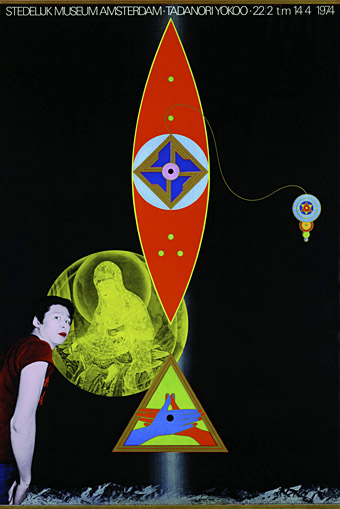
Tadanori Yokoo (1974) by Tadanori Yokoo and Will van Sambeek. A poster from the Colourful Japan exhibition at the Stedelijk Museum, Amsterdam.

• The first decade of space-rock pioneers Hawkwind is explored by Joe Banks in Hawkwind: Days of the Underground — Radical Escapism in the Age Of Paranoia, coming soon from Strange Attractor Press. I created the wraparound cover for this one, and will be talking about it here in a later post. Those interested in the book should note that the special edition hardback will include an extra book, plus a print and postcards. Limited to 500 copies so don’t wait around.

• “What we look for in our formative years can be very different from the demands we make later as analytical adults, and it was certainly more important to me that representations of gayness were complex or colourful than that they were positive, whatever that meant.” Ryan Gilbey on 50 years of Midnight Cowboy.

• Mixes of the week: Through A Landscape Of Mirrors Vol. II – France I by David Colohan, and As Imperceptibly As Grief The Summer Lapsed Away by Haunted Air.

If we imagine the material world about us having a concealed component of the fictional and the fantastic, visions buried in its stones and mortar waiting for their revelation, then we may suppose that 18th-century Lambeth was a teeming hub of such imaginal biodiversity. Bedlam alone could account for this ethereal population boom, but then nearby was the Hercules Buildings residence of William Blake, which can have only added to the sublime infestation.

Alan Moore on the visionary art of William Blake

• At the Internet Archive: Ten issues of Ed Pinsent’s The Sound Projector Music Magazine (1996–2002), with bonus Krautrock Kompendium.

• “Like many dictators Franco considered himself an artist.” Jonathan Meades on how fascism disfigured the face of Spain.

Occulting Disk is a new album from the master of unnerving doomscapes, Deathprod, which will be released in October.

• Making MAD: Chris Mautner on the beginning and end of MAD magazine.

John Margolies’ photographs of roadside America.

Fair Sapphire by Meadowsilver.

Jarboe‘s favourite music.

Theme from Midnight Cowboy (1969) by John Barry | Astral Cowboy (1969) by Curt Boettcher | Dayvan Cowboy (2005) by Boards Of Canada