Clocks of the Midnight Hours: The Work of Max Eastley

eastley1.jpg

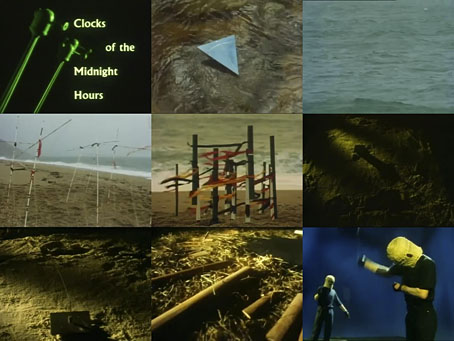
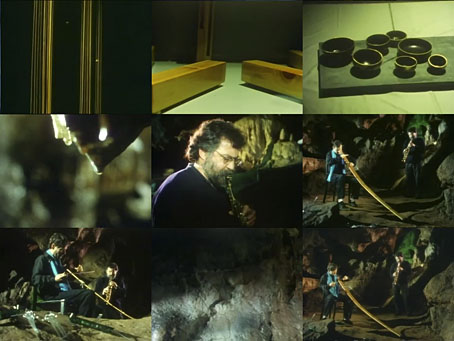
I was hoping this might turn up on YouTube eventually, my copy being stuck on a VHS tape. Clocks of the Midnight Hours (1986) is a 25-minute film about the music of Max Eastley directed by Simon Reynell. The title is taken from a Borges poem. What makes Eastley’s music special is that all his instruments are unique “sound sculptures” that range through autonomous devices, to wind- and water-activated instruments, to creations requiring human performance. Some of the sounds, if not the look of the instruments, will be familiar to anyone who’s heard Buried Dreams, the album Eastley made in 1994 with frequent collaborator David Toop. Both Eastley and Toop appear in the film (the latter masked by a wicker helmet), as does Evan Parker in a performance in Kent’s Cavern, Torquay. An earlier Eastley & Toop collaboration, New and Rediscovered Musical Instruments (1975), may be heard at Ubuweb.

eastley2.jpg

Previously on { feuilleton }
Max Eastley’s musical sculptures

Marienbad hauntings

marienbad1.jpg

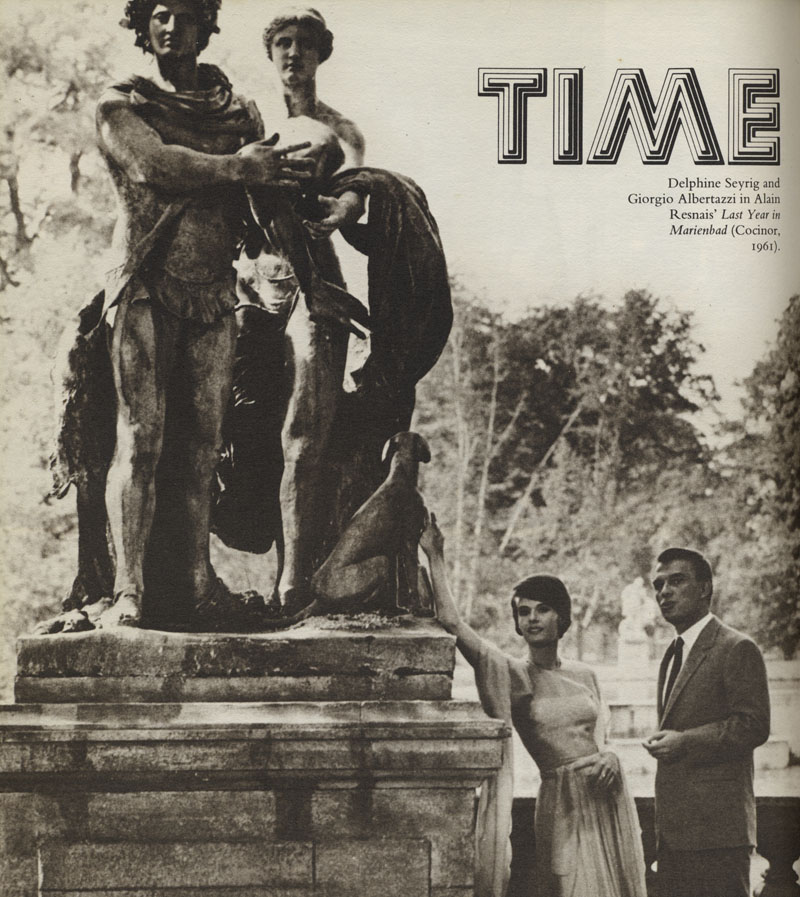
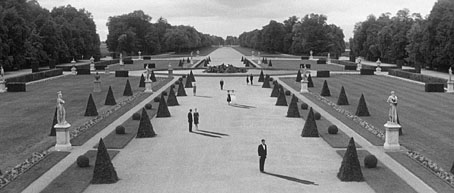
Last Year in Marienbad (1961). Via.

In our age of cultural plenitude it can be salutary to remember the time when many things were easy to discover but often impossible to experience; albums, books, and especially non-American films could all too frequently exist as rumours, referenced but always out of reach. Two films in particular dogged me for years in this remote manner: The Saragossa Manuscript (1965) by Wojciech Has, and Last Year at Marienbad (1961), the film that Alain Resnais made from a very novelistic screenplay by Alain Robbe-Grillet. Philip Strick alerted me to this pair of films with tantalising descriptions in a time-travel chapter of his book-length study, Science Fiction Movies (1976). Marienbad isn’t a time-travel film as such (a later Resnais film, Je t’aime, je t’aime [1968] does deal with the subject, however, and even features an actual time machine), but it is sufficiently open-ended to allow a science-fictional rationale into its enigmatic spaces. Strick’s book covered all the familiar SF territory as well as looking beyond the clichés of Hollywood and the SF genre, hence the inclusion not only of Marienbad and Saragossa, but also Je t’aime, je t’aime, Chris Marker’s La Jetée (1962), Bergman’s The Hour of the Wolf (1968), Pasolini’s Teorema (1968), and Buñuel’s Discreet Charm of the Bourgeoisie (1972). Most of these films, which were seldom shown on TV, I had to wait years to see.
marienbad2.jpg

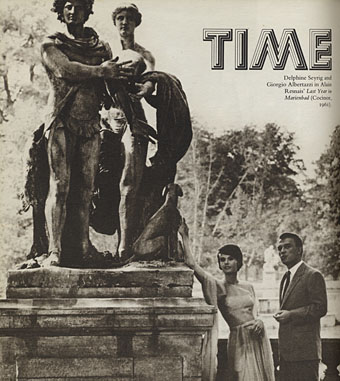
Marienbad page from Strick’s Science Fiction Movies.

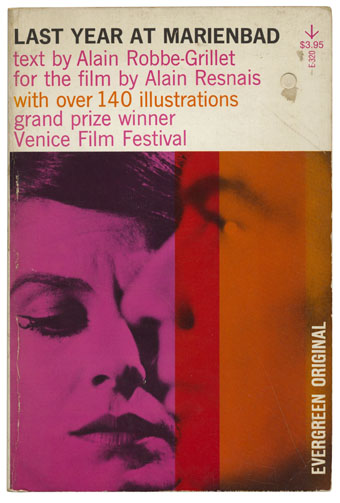
I was reading Strick’s book in 1979, and since I was bored with generic clichés, and also reading a lot of reprinted stories from New Worlds magazine, I became a little obsessed with these inaccessible films, Marienbad especially. It’s difficult to say what was so fascinating about a few words of description, and a single photograph, but the picture seemed an unlikely inclusion amid so many pages filled with robots and spaceships. It promised a film that approached the themes of science fiction at the same oblique angle as many of the stories in New Worlds. A couple of years later I found a copy of the Robbe-Grillet screenplay whose pages of dogged description read like the kind of forbidding and formal exercise that Brian Aldiss had attempted in Report on Probability A (1967), a novel that first appeared in New Worlds. Among other similarities, both works share a dismissive attitude to character, presenting a trio of ciphers indicated by no more than their gender, and some initial letters. This confluence of influences, Marienbad included, fed into the chunks of New Worlds-derived prose I was writing at the time, trying to fix inchoate impressions on the page. I always failed each time I returned to that photo from Marienbad, the real charge—as I didn’t see at the time—being a result of the gap between the promise of the image and the inaccessible film itself. Finally seeing Marienbad in the late 1980s was a curious thing, like meeting somebody face-to-face after years of remote correspondence; the same readjustments needed to be made to accept that this was the reality of the work of art, not Robbe-Grillet’s embryonic version, or my own baroque imaginings.
marienbad3.jpg

Screenplay book, 1962. Cover design by Roy Kuhlman.

If the above seems to strain for association by hauling a celebrated work of the Nouvelle Vague into a disreputable area then this essay by Thomas Beltzer is worth a read. Beltzer’s “Intertextual Meditation” compares Marienbad to The Invention of Morel (1940), a science-fiction novel by Adolfo Bioy Casares which Jorge Luis Borges described as “perfect” (and which I really ought to read). If I’ve not written much about Marienbad itself that’s because it really needs to be experienced rather than described or explained. It’s a film that’s easier to admire than actually enjoy—I need to be in the right mood to accept its formalities—and given the choice I’d often sooner watch Providence (1977). But where Providence and other Resnais films have inevitably dated, Last Year in Marienbad remains out of time, a 20th-century dream held captive in 18th-century architecture where the airless rococo chambers might easily share a labyrinth with the hotel waiting-room at the end of 2001: A Space Odyssey.

• Alain Resnais obituaries: The Guardian | The Telegraph
Last Year in Marienbad at film|captures
Marienbad (2012) by Julia Holter
Planète magazine covers

planete01.jpg

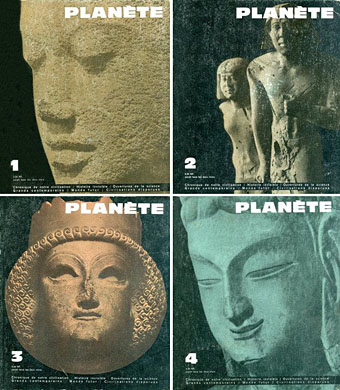
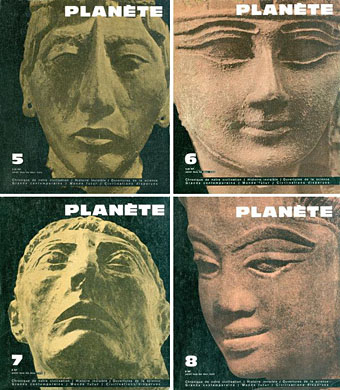
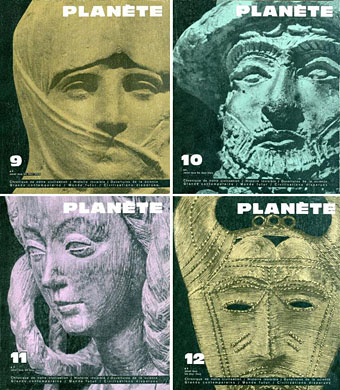
Planète was a French magazine of “Fantastic realism” which ran throughout the 1960s. I’ve never seen a copy but sight of the immediately recognisable covers has always fascinated because this was the magazine established in the wake of the huge success of The Morning of the Magicians (1960), a unique “Introduction to Fantastic Realism” by Louis Pauwels and Jacques Bergier. Rather than enthuse at length about The Morning of the Magicians I’ll simply point you to this piece by the late RT Gault from his now-defunct website.

Pauwels and Bergier’s book was oft-imitated but never equalled during the 1970s. Where later authors such as Erich von Däniken tended to plough a single, narrow furrow, Pauwels and Bergier leapt breathlessly from one subject to another: alchemy in the 20th century, Forteana, a lengthy examination of the occult preoccupations of the Third Reich, speculations about nuclear physics, speculations about biological mutation, Hollow Earth theories, etc, etc, all the time dropping quotes from HP Lovecraft, Arthur Machen and Albert Einstein. It’s a very heady mix which is great fun to read even though there’s nothing like a solid argument that comes out of it all.

planete02.jpg

Planète continued the blend of Futurology and fringe philosophy while using the magazine format to print translations of science fiction and fantasy stories; among other things it was notable for bringing the stories of Jorge Luis Borges to a wider audience in France. The magazine’s name may have been science fictional but the magazine as a whole is closer to the kind of borderline sf/art magazine that New Worlds became under Michael Moorcock’s editorship in the late 1960s. I’ve never seen Moorcock or anyone connected with New Worlds mention Planète but the covers at least pre-empt the style adopted by New Worlds during its large-format run: consistently bold typography and imagery that only obliquely relates to the contents.

planete03.jpg

All these covers are from Noosfere where the story contents for each issue are also listed. No credits for the designer, unfortunately. If anyone knows who was responsible for the magazine design then please leave a comment.

Continue reading “Planète magazine covers”

Weekend links 192

fournier.jpg

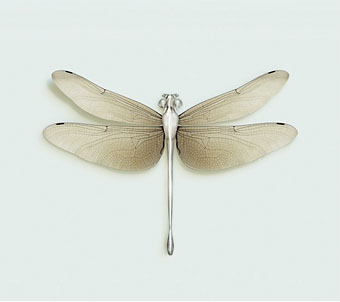
“Chloromgonfus detectis, a dragonfly that can detect volatile pollutants.” A speculative insect by artist Vincent Fournier.

• “…a modern taxonomist straddling a Wellsian time machine with the purpose of exploring the Cenozoic era…” Butterflies tied together Vladimir Nabokov’s home, science, and writing, says Mary Ellen Hannibal.

• More ghosts: Kira Cochrane on the Victorian tradition of the Christmas ghost story, and Michael Newton on why Jack Clayton’s The Innocents (1961) remains one of the very best ghost films. No argument there.

• Should you require further persuasion, Daniel Barrow reviews I Am The Center: Private Issue New Age Music In America 1950-1990, an album still receiving heavy rotation in these quarters.

Swords, daggers—weapons with a blade—retained a mysterious, talismanic significance for Borges, imbued with predetermined codes of conduct and honor. The short dagger had particular power, because it required the fighters to draw death close, in a final embrace. As a young man, in the 1920s, Borges prowled the obscure barrios of Buenos Aires, seeking the company of cuchilleros, knife fighters, who represented to him a form of authentic criollo nativism that he wished to know and absorb.

The Daggers of Jorge Luis Borges by Michael Greenberg

The Junky’s Christmas (1993): a seasonal tale from William Burroughs turned into a short animated film by Nick Donkin and Melodie McDaniel.

• Mixes of the week: Secret Thirteen Mix 101 by Jan Jelinek, and The Conjuror’s Hexmas by Seraphic Manta.

• Meet the 92-year-old Egyptian [Halim El-Dabh] who invented electronic music.

The Mysterious Lawn Home of Frohnleiten, Austria.

The Peacock Room at Sammezzano Castle in Italy.

The Quay Brothers’ Universum.

Alan Bennett‘s diary for 2013.

Butterfly (1968) by Can | Butterfly (1974) by Herbie Hancock | Butterfly (1998) by Talvin Singh

Weekend links 178

bantjes.jpg

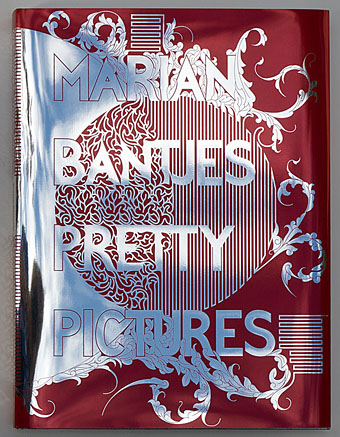
Pretty Pictures, a new book by designer Marian Bantjes, is out on October 1st.

• A writer admired by Angela Carter, Michael Moorcock, Harlan Ellison, Anthony Burgess, Jonathan Meades and Iain Sinclair; a “writer’s writer…[whose] best stories bear comparison with the Ficciones of Jorge Luis Borges”; a writer with an “unsettling quality to his writing, a whiff of brimstone that links him to fin-de-siècle occult figures such as HP Lovecraft—and even, at a further remove, Aleister Crowley”. David Collard explains why you may want to read something by Gerald Kersh (1911–1968), four of whose books are being republished.

• The Eccentronic Research Council and Maxine Peake pay homage to Delia Derbyshire’s The Dreams project with a new single out at the end of the month (Pye Corner Audio and Carol Morley appear on the flip). Ms Peake’s barm-cake reverie may be heard here.

• “Applying for grants, writing artist statements, showing up to openings—artists have to do far more than just make art if they want to find an audience for it.” Jen Graves on lies and deception in the art world.

The material does not make the work. The life does not make the art. Exactly the opposite. The work creates the material. The art creates the life. Did Trinidad exist before Naipaul? Did cargo ships exist before Joseph Conrad? Did Newark and the New Jersey suburbs exist before Philip Roth? Did women in playgrounds in New York City exist before Grace Paley? See how the writer invents the material? These places did not exist as literary subjects. They were invisible to literature. The magic of a great book is that it makes its own subject seem inevitable. The danger is, it makes the subject seem like the source of power in the work.

Phyllis Rose on life and literature.

• Mix of the week: Secret Thirteen Mix 087, 40 minutes of original electronic music by Geistform (Rafael Martinez Espinosa).

• “You’ve Got This“, an It Gets Better-style video support campaign for people recently diagnosed with HIV.

• At Dangerous Minds: Babalon Working: Brian Butler’s trippy occult odyssey with Paz de la Huerta.

Manfred Mohr‘s computer-created artwork, from the 1960s to the present.

Robert Macfarlane on the strange world of urban exploration.

Rick Poynor on Bohumil Stepan’s Family Album of Oddities.

• Oli Warwick talks to Martin Jenkins, aka Pye Corner Audio.

• The 384-page BUTT calendar for 2014 is now on sale.

• Pye Corner Audio: We Have Visitors (2010) | Toward Light (2011) | The Mirror Ball Cracked (2012)