Weekend links 75

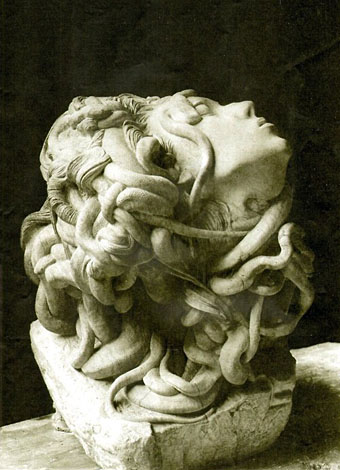
darde.jpg

Eternal Pain (1913) by Paul Dardé. (And also here)

Rain Taxi caused a stir this week with its savaging of Hamlet’s Father by science fiction writer Orson Scott Card. The book is another of Card’s blatherings about the hell of being homosexual dressed in garments stolen from the unfortunate William Shakespeare. Rain Taxi made the obvious point about many of Shakespeare’s sonnets being homoerotic. For my part I was more appalled by the quoted extract which reduced one of the greatest plays in the language to that lifeless, cardboard-character-speak which is endemic in bad genre writing. News of the travesty quickly spread to gay news blogs, The Outer Alliance and elsewhere, ensuring that what’s left of Card’s reputation continues to spiral down a Mel Gibson-shaped black hole.

• “Sounds only like itself, like no one before or after.” Julian Cope on Tago Mago by Can which will be reissued in a new edition in November. Nice to see the return of the original sleeve design, something I saw once in a record shop then didn’t see again for years. For a long time I thought I’d imagined it. Related: two German art exhibitions inspired by the group.

• The Responsive Eye (1965), a catalogue for the MoMA exhibition that launched Op Art. Also at Ubuweb: La femme 100 têtes, a film by Eric Duvivier based on the collage work by Max Ernst.

• More apocalyptic art: William Feaver on John Martin whose exhibition will be opening at Tate Britain later this month. There’s a trailer here.

• Borges and I, an essay by Nandini Ramachandran. Related: Buenos Aires: Las Calles de Borges, a short film by Ian Ruschel.

• “Who was JG Ballard? Don’t ask his first biographer,” says Robert McCrum.

• Biologically-inspired fabric and material design by Neri Oxman.

• Cross-pollinating subgenres: “Steampunk ambient” at Disquiet.

• In the Shadow of Saturn, a photo by the Cassini spacecraft.

• The art and fashion designs of Alia Penner.

• Fleet of hybrid airships to conquer Arctic.

• RIP Jordan Belson, filmmaker.

• Ten years of Ladytron whose new album is released on the 12th of September: Playgirl (2001), Seventeen (2002), Destroy Everything You Touch (2005), Sugar (2005), Ghosts (2008), Ace Of Hz (2011).

Weekend links 70

swinburne1.jpg

Faustine (1928) by Harry Clarke.

• This week’s Harry Clarke fix: 50 Watts reposts the Faust illustrations while Golden Age Comic Book Stories has the illustrated Swinburne.

• What Goes Steam in the Night is an evening with contributors to The Steampunk Bible hosted in London by The Last Tuesday Society on September 6th:

Co-author S. J. Chambers invites you to the official U.K. celebration of her book The Steampunk Bible (Abrams Image). Part lecture, part signing, and part entertainment, S. J. will be accompanied by contributors Jema Hewitt (author of Steampunk Emporium ) and Sydney Padua (Lovelace & Babbage) for a discussion of the movement, a special performance by Victorian monster hunter, Major Jack Union, and inevitable hi-jinks and shenanigans to later be announced.

• RIP Conrad Schnitzler, an incredibly prolific electronic musician, and founder member of Tangerine Dream and Kluster/Cluster.

• Golden Pavilion Records reissues fully-licensed late 60’s and 70’s psychedelic, progressive, acid-folk & art-rock music.

• Dressing the Air is “an exclusive consulting and online resource for the creative industries”.

• Luke Haines explains how to cook rabbit stew whilst listening to Hawkwind.

• Wood pyrography by Ernst Haeckel from his home, the Villa Medusa.

swinburne2.jpg

Satia Te Sanguine (1928) by Harry Clarke.

The truth is, the best novels will always defy category. Is Great Expectations a mystery or The Brothers Karamazov a whodunnit or The Scarlet Letter science fiction? Does Kafka’s Metamorphosis belong to the genre of fantasy? In reality men don’t turn into giant insects. And it’s funny. Does that mean it’s a comic novel? […] At a time when reading is in trouble, those readers left should define themselves less rigidly.

Howard Jacobson: The best fiction doesn’t need a label.

• Pace the redoubtable Jacobson, Alan Jacobs believes We Can’t Teach Students to Love Reading.

• How Ken Kesey’s LSD-fuelled bus trip created the psychedelic 60s.

• Salvador Dalí creates something for Playboy magazine in 1973.

• JG Ballard: Relics of a red-hot mind.

• Electric Garden (1978) by Conrad Schnitzler | Auf Dem Schwarzen Kanal (1980) by Conrad Schnitzler.

Elizabeth Taylor, 1932–2011

liz.jpg

Remember her for her incomparable beauty, her great performances in great films, the camp confections like Cleopatra and Boom, and years of activism on behalf of gay people:

There is no gay agenda, it’s a human agenda. Why shouldn’t gay people be able to live as open and freely as everybody else? What it comes down to, ultimately, is love. How can anything bad come out of love? The bad stuff comes out of mistrust, misunderstanding and, God knows, from hate and from ignorance.

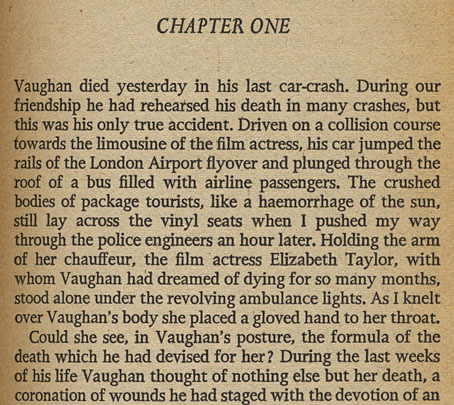
It would also be remiss of me (since no obituaries will be tasteless enough to mention it) if I didn’t note her presence at the heart of one of the more notorious novels of the past fifty years. I often used to wonder whether anyone had told her about Crash. Not that she’d want to know about it if they did; who would be eager to read detailed plans for their own horrific death? But it was her status as a 20th century icon, the nonpareil of film stardom, that made her the perfect choice as the focus of Vaughan’s obsessions in Ballard’s novel.

crash.jpg

• Elizabeth Taylor: a career in clips
• RIP Elizabeth Taylor: A Ballardian Primer

Weekend links 50

selski1.jpg

Invisible Light by Margo Selski.

The Glass Garage Fine Art Gallery has an online collection of paintings by Margo Selski, many of which feature her cross-dressing son, Theo. Coilhouse profiled artist and model earlier in the week. Some of these paintings mix oil with beeswax which is something I’ve not come across before.

• The Periwinkle Journal‘s first issue will be available online, free, from March 22nd until mid-June, featuring work by filmmaker and artist Hans Scheirl (Dandy Dust), artwork and collages by Genesis Breyer P-Orridge, a 7-page colour comic by Mavado Charon, artwork by Timothy Cummings, artwork and installations by Cody Chritcheloe/SSION, photos by Megan Mantia, Science-Heroes by Peter Max Lawrence, an illustration portfolio by Diego Gómez, selections from the queer photography pool on Flickr, reviews and other stuff. More later.

• The Quietus wanted to remind us that this year is the 25th anniversary of the NME‘s C86 compilation tape, a collection that sought to capture a moment of ferment but which inadvertently inspired too much dreary sub-Velvet Underground pop. I’d rather celebrate the 30th anniversary of the NME‘s C81 compilation, a far more diverse collection and musically superior. If you want to judge for yourself, both tapes can be downloaded here.

selski2.jpg

Machine in the Garden — Our Island Shall Know Abundance Without End by Margo Selski.

• Rick Poynor continues his exploration of Ballardian graphics with a piece about the paintings of Peter Klasen. Related: Where Will It End? JG Ballard interviewed by V. Vale & introduced by Michael Moorcock (Arthur No. 15/March 2005).

In his autobiography, Miracles of Life, JG Ballard suggested that illustrated versions of The Arabian Nights helped prepare him for surrealism.

Robert Irwin, author of The Arabian Nightmare, on the illustrators of The Arabian Nights.

• Another Coulthart cult movie surfaces, Jerzy Skolimowski’s Deep End (1970), out of circulation for many years but newly restored by the BFI. A re-release is scheduled for May so I’m hoping now that a DVD release will follow soon after.

• Thom Ayres’ photostream at Flickr, and more long-exposure photos.

• Fuck You, A Magazine of the Arts, number 5, volume 8.

• Nicolas Roeg: “I don’t want to be ahead of my time.”

• MetaFilter looks at the films of René Laloux.

• The Eerie covers of Frank Frazetta.

• Indie Squid Kid.

• Requiem (for String Orchestra) by Toru Takemitsu.

Void City

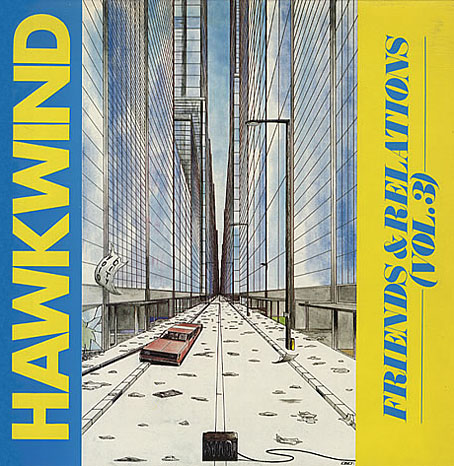
hawkwind.jpg

Friends & Relations Vol. 3 (1985) by Hawkwind.

Unless you assiduously collect everything you’ve ever worked on—which I don’t—you occasionally have to rely on the web to remind you of something you created years ago. This Hawkwind album is a good example, being one of the last releases by the band to use a piece of my artwork. (And I’ll quickly note that the accompanying type design was nothing to do with me; my design suggestions were always ignored, hence a growing frustration at that time with album cover work.) The album itself was the third in a series of odds and ends compilations gathering stray tracks by, yes, friends and relations of Mr Brock and co. Subsequent CD reissues used different packaging so the original vinyl is the only place you’ll see this illustration.

The reason I don’t have a copy is that the record label never sent me anything so unless Dave Brock put something in the post I had to buy them myself. (This happens more often than you’d expect.) I evidently didn’t think this one was worth it even though I much prefer the artwork to many of the earlier things of mine that were used. The drawing was a couple of years old, being inspired by the track Void City on the Choose Your Masques album from 1982. Void City is an atypical piece of electronica which I liked for its resemblance to some of the higher level synth pop and industrial music that was around in the early 1980s. 1982 to ’84 was the height of my JG Ballard obsession so Ballard is also a slight influence here. I had in mind his 1981 novel Hello America, which takes place in a post-apocalypse United States. And there’s also a trace influence from one of my early pieces of writing, a mercifully unpublished splurge of intense prose influenced by the New Worlds school of speculative fiction in which someone wanders around a vast and almost completely depopulated city. Looking at this drawing now it seems emblematic of my loss of interest in doing any kind of science fiction art; it also no longer seems futuristic. I produced my last album cover for Hawkind, The Chronicle of the Black Sword, in 1985; in January 1986 I started adapting HP Lovecraft’s The Haunter of the Dark. This took me out of the public eye for a few years but it was a more rewarding place to be for many other reasons.

Elsewhere on { feuilleton }
• The album covers archive

Previously on { feuilleton }
• Hawk things
• The Sonic Assassins
• New things for July