Weekend links 58

delpozo1.jpg

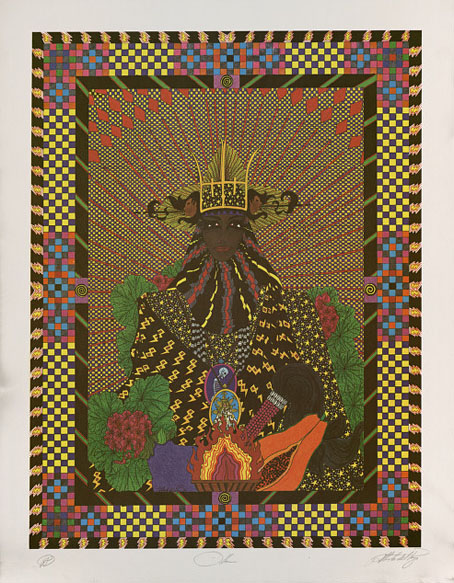
Oya by Alberto del Pozo (1945–1992). Also known as Yansa, Oya is Changó’s third wife. She is the goddess of the winds and of lightning and is mistress of the cemetery gates. Passionate and brave she fights by her husband’s side if needed. Her favorite offerings are papaya, eggplant and geraniums. From Santeria at BibliOdyssey.

Austin Osman Spare is a good example of the dictum that quality will out in the end, no matter how long it remains buried. Overlooked by the art establishment after he retreated into his private mythologies, a substantial portion of his output was equally ignored by occultists who wanted to preserve him as a weird and scary working-class magus. One group dismissed his deeply-felt spiritual interests in a manner they wouldn’t dare employ if he’d been a follower of Santeria, say (or even a devout Christian), while the other group seemed to regard his superb portraits as too mundane to be worthy of attention. Now that Phil Baker’s Spare biography has been published by Strange Attractor we might have reached the end of such short-sighted appraisals and can finally see a more rounded picture of the man and his work:

[Kenneth] Grant preserved and magnified Spare’s own tendency to confabulation, giving him the starring role in stories further influenced by Grant’s own reading of visionary and pulp writers such as Arthur Machen, HP Lovecraft, and Fu Manchu creator Sax Rohmer. Grant’s Spare seems to inhabit a parallel London; a city with an alchemist in Islington, a mysterious Chinese dream-control cult in Stockwell, and a small shop with a labyrinthine basement complex, its grottoes decorated by Spare, where a magical lodge holds meetings. This shop – then a furrier, now an Islamic bookshop, near Baker Street – really existed, and part of the fascination of Grant’s version of Spare’s London is its misty overlap with reality.

Austin Osman Spare: Cockney visionary by Phil Baker.

Austin Osman Spare: The man art history left behind | A Flickr set: Austin Osman Spare at the Cuming Museum | HV Morton meets Austin Spare (1927).

• More quality rising from obscurity: Jerzy Skolimowski’s Deep End. Skolimowski’s drama is one of unpleasant characters behaving badly towards each other. Anglo-American cinema featured a great deal of this in the 1970s when filmmakers disregarded the sympathies of their audience in a manner that would be difficult today. John Patterson looks at another example which is also given a re-release this month, the “feral, minatory and menacing masterwork” that is Taxi Driver.
delpozo2.jpg

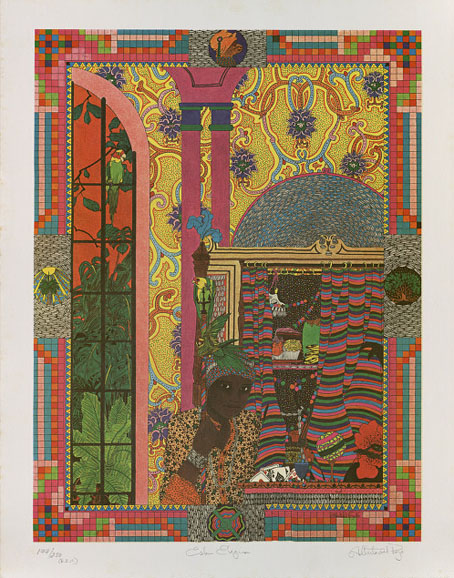
Echú Eleguá by Alberto del Pozo. Among the most ancient of the orishas Echú Eleguá is the messenger of the gods, who forges roads, protects the house, and is heaven’s gate-keeper. In any ceremony he is invoked first. He owns all cowrie shells and is the god of luck. A prankster, Echú Eleguá frequently has a monkey and a black rooster by his side. Like a mischievous boy he enjoys gossip and must be pampered with offerings of toys, fruit, and candy.

Minutes, a compilation on the LTM label from 1987: William Burroughs, Jean Cocteau, Tuxedomoon, Jacques Derrida, The Monochrome Set, and er…Richard Jobson. Thomi Wroblewski designed covers for a number of Burroughs titles in the 1980s, and he also provided the cover art for this release.

Mikel Marton Photography: a Tumblr of erotic photography and self-portraits.

From Death Factory To Norfolk Fens: Chris & Cosey interviewed.

NASA announces results of epic space-time experiment.

Oritsunagumono by Takayuki Hori: origami x-rays.

Plexus magazine at 50 Watts.

Mother Sky (1970) by Can | Late For The Sky (1974) by Jackson Browne.

Jean Genet… ‘The Courtesy of Objects’

chaimowicz.jpg

Jean Genet… ‘The Courtesy of Objects’ is an exhibition by Anglo-French artist Marc Camille Chaimowicz currently running at The Gallery at Norwich University College of the Arts. Chaimowicz presented a show entitled Jean Cocteau in Norwich last year; this new exhibition will include “works on paper, theatrical props, furniture, slide projections, documentation and an imaginary casting session for Genet’s 1947 play The Maids and videos charting Chaimowicz’s pilgrimages to the author’s childhood home in Burgundy, France, and to his grave on the Moroccan coast.” (More.) About Genet, Chaimowicz has this to say:

Jean Genet, in his fashion, loved Jacky Maglia. Jacky was the stepson of Genet’s lover Lucien Senemand. Genet was generally attracted to heterosexual men, often delinquents or petty criminals… and Jacky stole cars… Genet actively encouraged Jacky to take up motor racing and later managed his fledging career. In Norfolk he bought Maglia a Lotus Elan… They grew very close, travelling widely together and illicitly entering the US to cover the 1968 Chicago Democratic Convention for Esquire. Fame and critical success were suddenly and violently echoed by financial gain… Genet was at one point Gallimard’s highest-earning author… This having the converse effect in that the more rich and famous he became, the less he was able to write. For so long the outsider and now the literary celebrity, it was as though he felt alienated from his own unique and cherished sense of alienation.

The exhibition is free and runs until May 21st when it will move to Nottingham and then New York. See here for opening times and other details.

Previously on { feuilleton }
Querelle again
Saint Genet
Emil Cadoo
Exterface
Penguin Labyrinths and the Thief’s Journal
Un Chant D’Amour by Jean Genet

The writhing on the wall

hands9.jpg

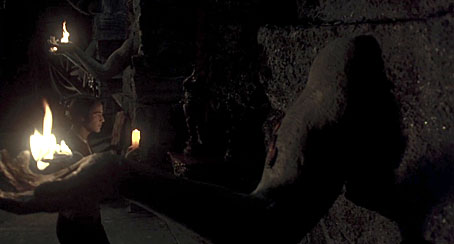
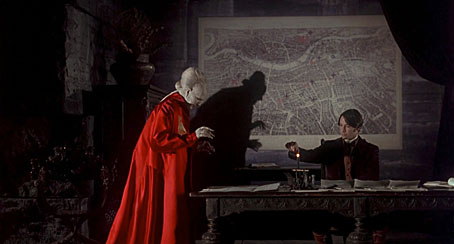
Dracula (1992).

This is the closest you’ll get to a guest post here even though it’s been done remotely and I’ve changed things around a little. Following my mention yesterday of the Cocteau-derived lantern-arms in Francis Coppola’s Dracula, Jescie sent me an abandoned blog post which collected similar examples of the arms-through-the-walls motif. I’ve done this kind of thing here in the past so it’s good {feuilleton} material. Almost all these examples are fantasy- and horror-related which isn’t too surprising, and I’m sure there’ll be other examples in films I haven’t seen. If anyone has any suggestions just remember that hands grasping through doors and windows don’t count with this, it’s through the wall or not at all.

hands1.jpg

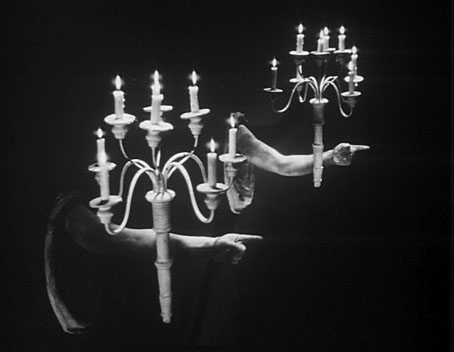
La Belle et la Bête (1946).

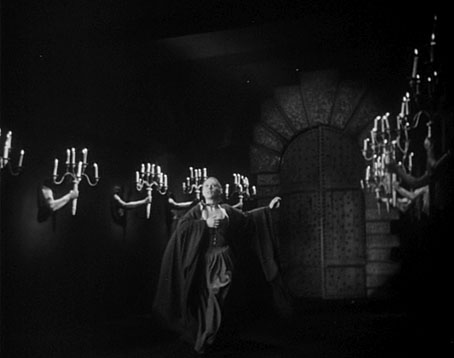
Jean Cocteau sets things off in 1946, a perfect piece of fairytale Surrealism and one of the many memorable aspects of this film.

hands2.jpg

La Belle et la Bête (1946).

Continue reading “The writhing on the wall”

Symbolist cinema

dracula1.jpg

Symbolist? Arguably. Decadent? Certainly. Watching Francis Ford Coppola’s Dracula (1992) again this weekend I thought it worth making note of some of these resonances. The real age of Symbolist cinema was the Silent Era from around 1910 onwards, something I discussed in more detail here. That being so, several films made since can be taken as Symbolist (more usually Decadent) productions even if this was never their original intention. Kenneth Anger‘s Magic Lantern Cycle comes immediately to mind, so too Sergei Parajanov’s The Colour of Pomegranates.

dracula3.jpg

Bram Stoker’s novel was published in 1897 at the ebbing of the fin de siècle but vampires and vampirism were already recurrent Symbolist themes. Aesthetic magus Walter Pater wrote of the Mona Lisa in 1893, “She is older than the rocks among which she sits; like the vampire, she has been dead many times, and learned the secrets of the grave…” Dracula almost demands a Symbolist interpretation, and for now Coppola’s production is the closest we get. I’ve found this makes the film more satisfying in a way: you can ignore the shoddy performances by secondary characters and concentrate on the decor and details (and the tremendous score by Wojciech Kilar). Some of the following screen grabs argue my point.

dracula2.jpg

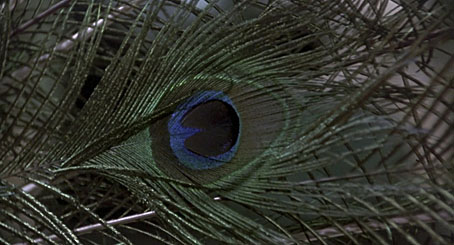
Oh look, peacock feathers. I loved the artificiality of this film, the excessive palette, the obvious models and miniatures, the layering of images. The dissolve from a peacock feather to Jonathan Harker’s infernal train journey is a great moment.

Continue reading “Symbolist cinema”

Weekend links 32

ji1.jpg

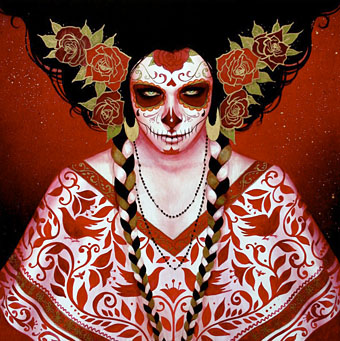
Red Quechquemitls (2010) by Sylvia Ji.

• The Blackout Mix, a pay-what-thou-wilt 49-minute mixtape, “specially designed to accompany (or simulate) a human-plant interaction”. Art by Arik Roper, music selection by Jay Babcock.

An ode to the many evolved virtues of human semen: “the penis is capable of dispensing a sort of natural Prozac” says Jesse Bering.

• The new John Foxx CD & DVD release, D.N.A., has a Jonathan Barnbrook cover, a new collaboration with Harold Budd and a disc of short films.

• “I have been copying Margaret Hamilton my whole life, and I am proud to admit it. The Wicked Witch of the West, the jolie laide heroine of every bad little boy’s and girl’s dream of notoriety and style, whose twelve minutes of screen time in The Wizard of Oz can never be topped … I’m a big butch-lesbian hag. I love the ones with chips on their shoulders and heavy attitude. They’re my real favorites.” John Waters always gives great interviews.

• Listen to a track from the forthcoming Brian Eno album while you’re reading Kristine McKenna’s interview with the man himself at Arthur mag. Includes an appreciation by Alan Moore.

ji2.jpg

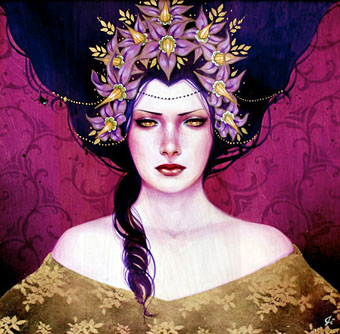
Atropa Bella Donna (2009) by Sylvia Ji.

• Steven Severin is touring the UK this month, performing a live accompaniment to screenings of Jean Cocteau’s The Blood of a Poet. He’s at the Tyneside Cinema this Tuesday. Other dates can be found on his website.

• “I know it’s a very emotive subject and you’re either for it or against it but for a jobbing self-employed musician such as me – bootlegging (CD copying) is just killing us.” Finding The Spaces Between: musician Chris Carter (Throbbing Gristle, Chris & Cosey, et al) interviewed.

Mile End Pugatorio (1991), a one-minute film-poem by Guy Sherwin and Martin Doyle. Related: four one-minute movies by The Residents.

• Gijs Van Vaerenbergh installed an Upside Dome at the St. Michiel Church in Leuven, Belgium.

• Sidney Sime illustrates Lord Dunsany at Golden Age Comic Book Stories.

Europe according to gay men. There’s more at Mapping Stereotypes.

• There’s never a dull moment in the High Desert.

• Generative art by Leonardo Solas.