Weekend links 91

santosh.jpg

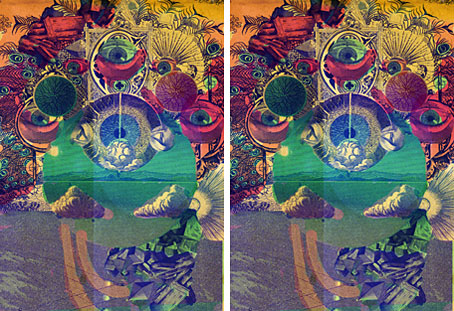
Untitled (1978) by GR Santosh at 50 Watts.

Evertype Publishing produces a range of Lewis Carroll special editions including Ailice’s Àventurs in Wunnerland (a translation in Scots), Alicia in Terra Mirabili (a Latin version), and an edition printed in the Nyctographic Square Alphabet devised by Carroll.

• This week’s bookshop animations: Type Books, Toronto presents The Joy of Books while at Shakespeare and Company, Paris, Spike Jonze and Simon Cahn explore the erotic life of book covers in Mourir Auprès de Toi.

• Invisible Girls and Phantom Ladies, a 1982 article on sexism in (US superhero) comics by Alan Moore. Thirty years on, things haven’t improved much at all.

I reread it now, 35 years later, and I am struck by its capacity to change like a magic mirror. Where I had originally seen it as a book about writing, about becoming a writer, I now see it as a book about reading, about taking one’s place in the chain. Where I once assumed it was a book about eternal youth, I now see it as a book about growing up, about learning to live.

Tilda Swinton on Virginia Woolf’s Orlando

Dark Water, Lovecraftian carpet designs (yes, carpets) by Kirill Rozhkov. Danish carpet manufacturer Ege has a catalogue showing the finished products.

Neil Gaiman ventures into the treacherous labyrinth of M. John Harrison’s Viriconium.

Nicholas Lezard reviews The White People and Other Weird Stories by Arthur Machen.
rousseau.jpg

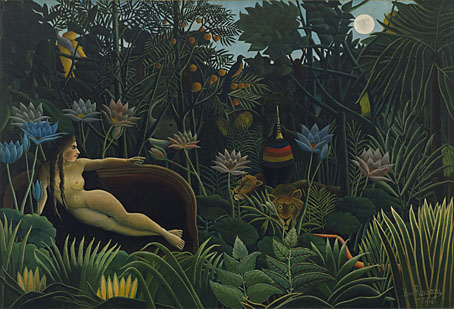
The Dream (1910) by Henri Rousseau at the Google Art Project.

• Reassessing the Saul Bass and Alfred Hitchcock Collaboration by Pat Kirkham.

• Getting There Too Quickly: Peter Bebergal on Aldous Huxley and Mescaline.

Hidden in the Open: A Photographic Essay of Afro-American Male Couples.

Filles En Aiguilles, a new musical work by Schütze+Hopkins.

RubiCANE’s Erotic Illustrations.

Laurie Anderson has a Godplex.

Alan Bennett on Smut.

The Jungle Line (1975) by Joni Mitchell | The Jungle Line (1981) by Low Noise (Kevin Armstrong, Thomas Dolby, JJ Johnson & Matthew Seligman) | The Jungle Line (2007) by Herbie Hancock with Leonard Cohen.

Weekend links 89

gnoli.jpg

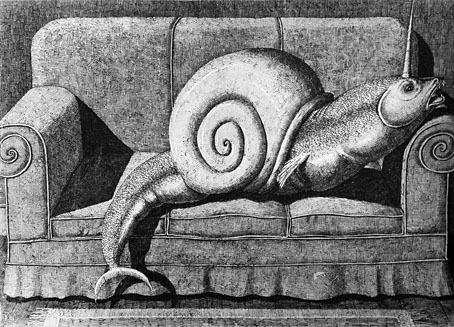
A drawing from Bestiario Moderno by Domenico Gnoli (1933–1970).

RIP Russell Hoban. Nina Allan celebrates a favourite writer while David Mitchell, writing in 2005, pays tribute to Riddley Walker. For me the gulf between Hoban and many of his contemporaries could be measured by his entry in the Writer’s Rooms feature the Guardian Review was running for a couple of years: Hoban’s room was the only one that admitted to being cramped and chaotic.

A wristwatch could be “a tiny flowering hell, a wreath of roses, a dungeon of air” and still tell time. A short story could take the shape of an instruction manual for the most routine of tasks (crying, singing, winding said dungeon, killing ants in Rome), or a compendium of tales about fantastical but oddly familiar species. A novel didn’t have to progress from the first page to the last, hung on a rigid skeleton of plot: it could proceed in oblong leaps and great steps backward, like a game, say, of hopscotch. “Literature is a form of play,” said Cortázar. […] It is perhaps because he so stubbornly resists categorization, as much as for the ludic complexity of his work, that Cortázar is in these parts more admired than he is read. The Anglophone literary imagination (or perhaps just its material substrate: the market) appears to have room for only one Latin American giant per generation—Borges, García Márquez, the freshly beatified San Bolaño. Cortázar was too weird, too difficult, too joyously slippery to make the cut.

Eels Über Alles: Ben Ehrenreich on Julio Cortázar

• Alfred Jarry is another writer the Anglophone world has often found “too weird, too difficult”. Jarry has been dead for over a century but Alastair Brotchie’s recently-published full-length biography is the first such work in English. Mark Polizzotti reviews a life of “the poster boy for literary cult figures” at Bookforum.

• “A Beautiful Trip”: Frances Morgan interviews David Lynch about music and sound. And Robert Wyatt talks for 95 minutes to Tony Herrington about his favourite music.

• Twilight Science: Paul Schütze presents solo musical work and various collaborative projects in new digital editions.

occupy.jpg

Jonathan Barnbrook‘s logo design for Occupy London.

• Winter reads: Myths of the Norsemen by Roger Lancelyn Green. Related: What became of illustrations in fiction?

The White People and Other Weird Stories by Arthur Machen is a new Penguin Classic out in January.

• “This Christmas, why not give Viriconium, city of sex, syphillis & consubstantiation?”

• The Casual Optimist announces its Favourite Book Covers of 2011.

The Collect Call of Cthulhu

Living with Burroughs

Function (2011) by Emptyset | Aftertime (2011) by Roly Porter with Cynthia Miller on the Ondes Martenot.

Weekend links 58

delpozo1.jpg

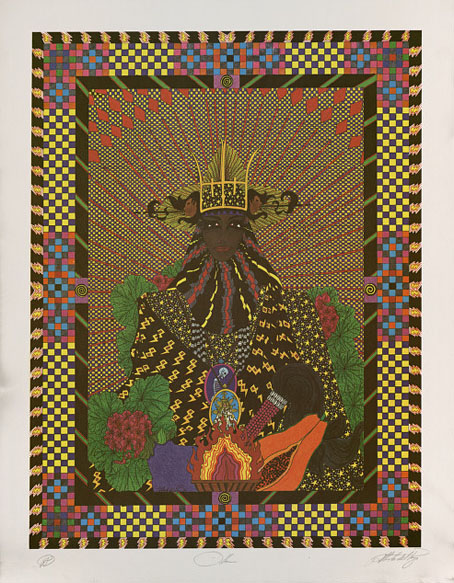
Oya by Alberto del Pozo (1945–1992). Also known as Yansa, Oya is Changó’s third wife. She is the goddess of the winds and of lightning and is mistress of the cemetery gates. Passionate and brave she fights by her husband’s side if needed. Her favorite offerings are papaya, eggplant and geraniums. From Santeria at BibliOdyssey.

Austin Osman Spare is a good example of the dictum that quality will out in the end, no matter how long it remains buried. Overlooked by the art establishment after he retreated into his private mythologies, a substantial portion of his output was equally ignored by occultists who wanted to preserve him as a weird and scary working-class magus. One group dismissed his deeply-felt spiritual interests in a manner they wouldn’t dare employ if he’d been a follower of Santeria, say (or even a devout Christian), while the other group seemed to regard his superb portraits as too mundane to be worthy of attention. Now that Phil Baker’s Spare biography has been published by Strange Attractor we might have reached the end of such short-sighted appraisals and can finally see a more rounded picture of the man and his work:

[Kenneth] Grant preserved and magnified Spare’s own tendency to confabulation, giving him the starring role in stories further influenced by Grant’s own reading of visionary and pulp writers such as Arthur Machen, HP Lovecraft, and Fu Manchu creator Sax Rohmer. Grant’s Spare seems to inhabit a parallel London; a city with an alchemist in Islington, a mysterious Chinese dream-control cult in Stockwell, and a small shop with a labyrinthine basement complex, its grottoes decorated by Spare, where a magical lodge holds meetings. This shop – then a furrier, now an Islamic bookshop, near Baker Street – really existed, and part of the fascination of Grant’s version of Spare’s London is its misty overlap with reality.

Austin Osman Spare: Cockney visionary by Phil Baker.

Austin Osman Spare: The man art history left behind | A Flickr set: Austin Osman Spare at the Cuming Museum | HV Morton meets Austin Spare (1927).

• More quality rising from obscurity: Jerzy Skolimowski’s Deep End. Skolimowski’s drama is one of unpleasant characters behaving badly towards each other. Anglo-American cinema featured a great deal of this in the 1970s when filmmakers disregarded the sympathies of their audience in a manner that would be difficult today. John Patterson looks at another example which is also given a re-release this month, the “feral, minatory and menacing masterwork” that is Taxi Driver.

delpozo2.jpg

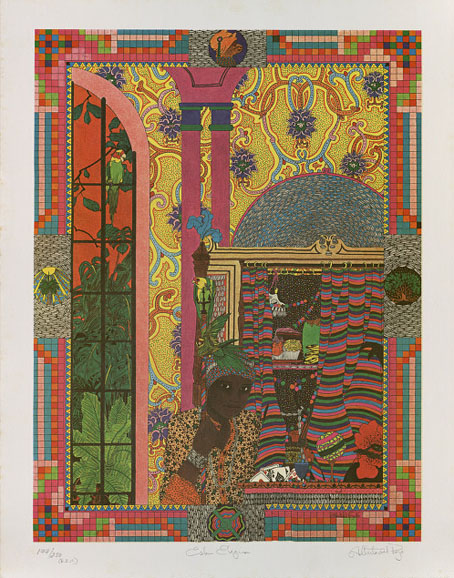
Echú Eleguá by Alberto del Pozo. Among the most ancient of the orishas Echú Eleguá is the messenger of the gods, who forges roads, protects the house, and is heaven’s gate-keeper. In any ceremony he is invoked first. He owns all cowrie shells and is the god of luck. A prankster, Echú Eleguá frequently has a monkey and a black rooster by his side. Like a mischievous boy he enjoys gossip and must be pampered with offerings of toys, fruit, and candy.

Minutes, a compilation on the LTM label from 1987: William Burroughs, Jean Cocteau, Tuxedomoon, Jacques Derrida, The Monochrome Set, and er…Richard Jobson. Thomi Wroblewski designed covers for a number of Burroughs titles in the 1980s, and he also provided the cover art for this release.

Mikel Marton Photography: a Tumblr of erotic photography and self-portraits.

From Death Factory To Norfolk Fens: Chris & Cosey interviewed.

NASA announces results of epic space-time experiment.

Oritsunagumono by Takayuki Hori: origami x-rays.

Plexus magazine at 50 Watts.

Mother Sky (1970) by Can | Late For The Sky (1974) by Jackson Browne.

Weekend links 49

ceranic1.jpg

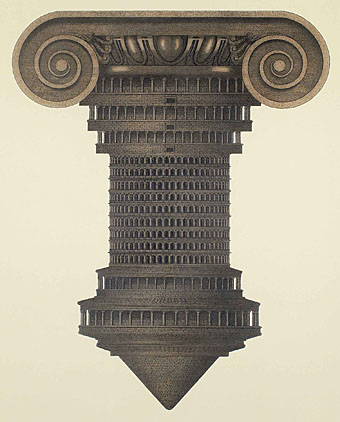
Star City by Tomislav Ceranic.

• Noted in the blogosphere this week: A Journey Round My Skull underwent a transmutation into 50 Watts; a blog devoted to artist, designer & illustrator Jessie M King; “The arts and musicks of the supranatural” at Secret Lexicon; From the Farm, Railroads, Sewing Machines & Beyond, lengthy reminiscences from a long life in America.

Barney Bubbles in Wonderland, in which the designer and his chums indulge in some Carrollian shenanigans somewhere in the 1960s. The resulting footage is now a promo video for Balloon Race by Bear Driver.

HP Lovecraft’s favourite words, the desert island books of Jorge Luis Borges, a profile of Christopher Isherwood, and Edward Gorey again.

[Arthur] Machen explicitly talks about the strength of London, as opposed to Paris, in that London is more chaotic. Although he doesn’t put it in these words, I think what partly draws him to London is this notion that, in the absence of a kind of unifying vision, like Haussmann’s Boulevards, and in a city that’s become much more syncretic and messy over time, you have more room to insert your own aestheticizing vision.

China Miéville in a great interview at BLDGBLOG.

Matryomin is “the unique, original erectronic [sic] musical instrument invented by Masami Takeuchi in 2000”. Yes, a theremin inside a Russian doll. The Mable ensemble playing Duke Ellington’s Caravan is, well…I’m still speechless. And there’s also this.

Conductor turns the New York subway system into an interactive string instrument.

ceranic2.jpg

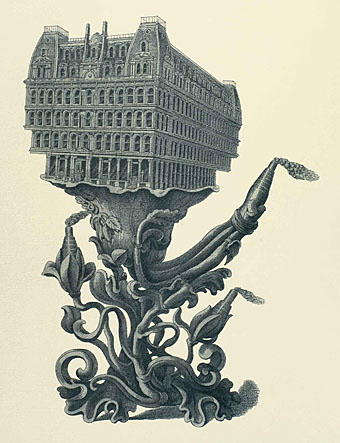
Discordia by Tomislav Ceranic.

Amazingly enough, prostitution was legal during the Victorian period. There were tons of brothels all over the major cities of England, and of all different kinds. There were lots of flagellation brothels; these were places where primarily men would go to be whipped by women or by men. There were also gay male brothels. You could go to a park in London at night, pick up what were called the “park whores” and give them a very small amount of money to have sex openly in the park. I also write about gay “cruising,” which was quite common. If you knew the right place to go and knew the right signals, you could pick up a man on the street and have sex in an alley.

Deborah Lutz is interviewed about her book Pleasure Bound: Victorian Sex Rebels and the New Eroticism.

Cult-ure: Ideas can be dangerous, a book by Rian Hughes.

Chernobyl: Europe’s strangest wildlife refuge.

The Eadweard Muybridge Online Archive.

Aubrey Beardsley at Tumblr.

Caravan (1959) by Martin Denny | Caravan (1961) by 80 Drums Around The World | Caravan (1962) by Sir Julian | Caravan (1965) by The Ventures | Caravan (1973) by Enoch Light & The Light Brigade | Caravan (1997) by Jimi Tenor (I could go on and on, yes I could…)

Weekend links 45

sa4.jpg

That essential journal of esoteric culture, Strange Attractor, announced a fourth number this week sporting a psychedelic cover which may be the work of Julian House (no credit is given on the SA site). As to the contents:

From Haiti and Hong Kong to the fourth dimension and beyond: discover the secrets of madness in animals; voodoo soul and dub music; ancient peacock deities; Chinese poisoning cults; the history of spider silk weaving; heathen mugwort magic; sentient lightning; Jesuit conspiracy theories; junkie explorers; Dali’s Atlantis; the resurgence of Pan (in London’s Crouch End); anarchist pirates on Madagascar; an ancient Greek Rip Van Winkle; French anatomical waxworks; Arthur Machen’s forgotten tales and Alan Moore’s unpublished John Dee opera.

Further details and the means to order a copy can be found here.

• Resonance FM’s Weird Tales For Winter has returned beginning with a presentation of The Gateway of the Monster, one of the better Carnaki tales by William Hope Hodgson. The story is read by Moon Wiring Club‘s Ian Hodgson (no relation) and the musical atmospheres are provided by The Advisory Circle. I ought to have posted this news yesterday since you’ll have missed the broadcasting of the first half but the second half will go out at midnight (UK time) on Monday. Details here, and the next release on the Café Kaput label in February will be the soundtrack, Music for Thomas Carnaki (Radiophonic Themes & Abstracts).

keepcalmcthulhu2.jpg

• The Keep Calm and Carry On Image Generator lets you work your own variations on the ubiquitous poster. It wouldn’t work for me, however, so I rolled up my sleeves and made my own. This may be good as a CafePress design, yes?

Interplay is an album by John Foxx and The Maths due to be released on March 21st. As with last year’s collection of Foxx instrumental pieces, DNA, the package design is by Jonathan Barnbrook. John Foxx first came to prominence as the lead singer in Ultravox (do I need to say “of course”? Okay…“of course”) and Ultravox’s debut album was part-produced by Brian Eno. It’s been painfully obvious recently (and it pains me to say it) that Foxx’s DNA was a far more accomplished and engaging work than Eno’s recent collection of over-hyped instrumentals. Related: Barnbrook Design’s albums of 2010.

Word Horde 2.0, “a substantial archive of manuscript material, correspondence, and books and printed matter, mostly signed” from the William Burroughs archives can be yours for $260,000. Related: William Burroughs’ Wild Boys photos. Also: Rudy Rucker on David Cronenberg’s Naked Lunch.

• “Nabokov described how ‘a modern taxonomist straddling a Wellsian time machine with the purpose of exploring the Cenozoic era’ would encounter the following series of events in the evolution of these butterflies…” The Royal Society confirms that a contentious theory of Vladimir Nabokov’s concerning the descent of butterfly populations was accurate.

• The work of Gérald Bertot aka Thomas Owen, a Belgian author of weird fiction, is explored at A Journey Round My Skull.

The Other Side of the Wind, Orson Welles’ unfinished film from 1972, may finally be given a release.

• Jon Savage celebrates Roy Harper and his extraordinary Stormcock album.

Philip Pullman wants the Tory philistines to leave our libraries alone.

• Rick Poynor takes a dérive through the arcades of Paris.

Space music new and old.

Young Savage (1977) by Ultravox | Clicktrack (2010) by John Foxx & Jonathan Barnbrook.