The Magic Shop by HG Wells

magic.jpg

The Magic Shop (1964).

I discovered this TV adaptation by accident while looking for something else (more about the something else tomorrow). The Magic Shop is a 45-minute drama directed by Robert Stevens in 1964 for The Alfred Hitchcock Hour. Writer John Collier adapted a script by James Parish that’s loosely based on the short story by HG Wells. The story is one I know very well, having read it many times, but I hadn’t come across this TV version before. It’s a surprise finding it so close to Christmas since I first read the story in the only Christmas present that’s survived from childhood, a hefty collection of HG Wells’ short stories that I pestered my parents into buying me in 1973. I mostly wanted to read The Time Machine but the other stories seemed promising, especially the ones illustrated by Richard Gilbert on the (miraculously intact) dustjacket: The Sea Raiders (sailors attacked by octopuses), The Flowering of the Strange Orchid (man attacked by tentacular plant), The Valley of Spiders (attacking spiders falling from the sky), and so on. The book as a whole runs to over 1000 pages, and proved to be a revelation with Wells ranging through fantasy, science fiction, horror, and oddities which don’t fit any category other than Robert Aickman’s indispensable label, “strange stories”. The book made me a lifelong Wellsian, and also spoiled me a little when I moved on to more recent science fiction and found many of the alleged greats to be appalling writers. Wells’ prose can’t compete with Robert Louis Stevenson but it’s still well-crafted in that no-nonsense late Victorian manner familiar to readers of Arthur Conan Doyle.

wells.jpg

Design and illustration by Richard Gilbert (1970).

The Magic Shop is one of the strange stories, the shop in question being a mysterious establishment somewhere in Regent Street, London, one of those premises one discovers by accident then can’t find again. The narrator is informed by the proprietor that this is a Genuine Magic Shop, as distinct from the kind selling mere conjuring tricks. The meaning of this isn’t clear at first but while the narrator’s young son is being beguiled by the marvels on display we follow his father’s growing alarm when he realises there’s more to the shop than he anticipated, not all of it pleasant or fun. The story was published in Twelve Stories and A Dream in 1903, and can be read here.

The TV version takes the bare bones of the tale—curious shop, indeterminate location, friendly yet sinister proprietor—and blends it with the nasty-child-with-magic-powers theme that was dramatised so memorably by The Twilight Zone in It’s A Good Life. The Hitchcock show was made three years after the Twilight Zone episode so it’s easy to see It’s A Good Life as an influence. Leslie Nielsen is the father who takes his son, Tony (John Megna), to the fateful shop on his birthday. The proprietor informs the pair that Tony is “the right boy” since he found the shop in the first place, the subtext being that he’s also possesses the right character to be the recipient of some heavy voodoo abilities. The boy’s bad seed status has been telegraphed from the outset by a birthday gift from an uncle of a black leather jacket; throughout the scene in the shop he looks like a miniature hoodlum. More American anxiety about its troublesome youth? Maybe, although the episode ends so poorly that the whole thing comes across as a lazy piece of filler. This is, of course, a long, long way from the Wells story which is all the more effective for being elusive, understated and, yes, magical.

Previously on { feuilleton }
HG Wells in Classics Illustrated
The night that panicked America
The Door in the Wall
War of the Worlds book covers

Chronopolis by Piotr Kamler

chronopolis3.jpg

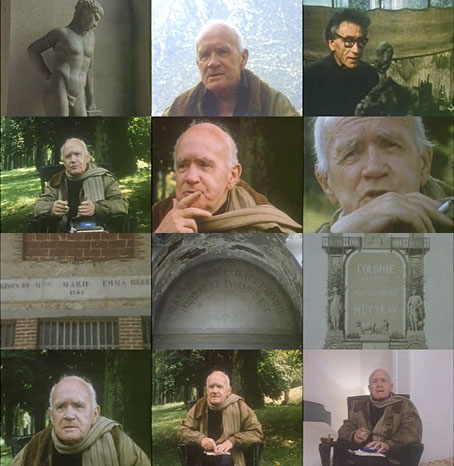
Another gem at Ubuweb, and nothing to do with JG Ballard’s SF story of the same name, Piotr Kamler’s Chronopolis (1983) is a 50-minute animated science fiction film, albeit science fiction of a much more abstract variety than one usually finds in cinema. I’m generally exasperated by the way film and TV SF does little more than play Cowboys & Indians in space so it’s refreshing to see something that’s unashamedly strange and doesn’t feel the need to explain itself. There is apparently a version of this with some English narration for those benighted American audiences everyone feels a need to pander to but the Ubuweb version is wordless, and if you can’t read French then you won’t understand the few lines of text prologue at the opening.

chronopolis1.jpg

Accompanying Kamler’s beautifully crafted and quite inexplicable scenes there’s an electronic score by composer Luc Ferrari, mostly analogue timbres whose origin is as mysterious as the events taking place on-screen. Kamler’s statuesque figures remind me of the gods and aliens that Moebius and co. were drawing in Métal Hurlant during the 1970s. Chronopolis was a French production begun in 1977 so it’s possible that French comics were an influence. Moebius himself worked on another animated SF film during this period, René Laloux’s Time Masters (1982). Chronopolis is closer in tone to the weirdness of Laloux’s earlier Fantastic Planet (1973), and all the better for it.

chronopolis2.jpg

Previously on { feuilleton }
Les Jeux des Anges by Walerian Borowczyk
Les Temps Morts by René Laloux

Calendars galore

calendars.jpg

It’s those calendars again. I’ve had requests recently to put my Lewis Carroll-themed psychedelic designs back on sale but the past few months have been pretty work-heavy, and since I deleted the original product pages it was going to require some effort to make new ones. This weekend I finally found the time to tackle the CafePress upload system and make them available again. I’ve taken the year date off the covers so both calendars will remain available in the future. See below for details.

Meanwhile, this year’s Cthulhu Calendar is still on sale and proving almost as popular as the Wonderland one did in 2009. Thanks again for the support!

wonderland.jpg

A Mad Tea-Party from Psychedelic Wonderland (2009).

• Psychedelic Wonderland at CafePress | See preview pages here.

lookingglass.jpg

Jabberwocky from Through the Psychedelic Looking-Glass (2010).

• Through the Psychedelic Looking-Glass at CafePress | See preview pages here.

Previously on { feuilleton }
Scenes from a carriage
Through the Psychedelic Looking-Glass: the 2011 calendar
Jabberwocky
Alice in Acidland
Return to Wonderland
Dalí in Wonderland
Virtual Alice
Psychedelic Wonderland: the 2010 calendar
Charles Robinson’s Alice’s Adventures in Wonderland
Humpty Dumpty variations
Alice in Wonderland by Jonathan Miller
The Illustrators of Alice

Weekend links 139

barnes.jpg

Lucy in the Sky with Diamonds (2012) by Lesley Barnes. She also has peacock wrapping paper.

Big thanks to Dennis Cooper for including this blog in his favourite music, fiction, poetry, film, art & internet lists for 2012. Lots of good company there. One benefit of end-of-year lists is the way they suggest things to look for in January.

• “…the best pictures of dicks that I’ve ever seen…” Rudy Rucker reviews Malcolm McNeill’s The Lost Art of Ah Pook Is Here and Observed While Falling, out at last from Fantagraphics. Rucker notes that William Burroughs’ text is still only available in out-of-print editions in which case you’ll need a book dealer. Elsewhere, Burroughs: The Movie has cleared 50% of its restoration Kickstarter goal but still needs supporters.

• Julia Holter has been a recurrent presence in these posts since the release in March of her acclaimed second album, Ekstasis. FACT has an alternate version of the album’s opening song, Marienbad, one of the extra tracks on the recent UK reissue.

Suttree’s saga carried me down, down, down to the bottom of a heightened surrogate reality, a nadir where the rarest jewels of clarity are found. The fourth time through the novel I arrived at a state of barometric equipoise, a balancing between my mental state and Suttree’s. Then, as he descended again, I began to rise. There was a hypnotic poetry to his fall — his life disintegrated, then the fragments disintegrated, then those fragments followed suit ad infinitum.

Jim White on the life-preserving qualities of Suttree by Cormac McCarthy.

• “An 18-year-old boy who discovers he has a fetish for the aged gets a job in a nursing home and develops an intimate relationship with one particular old man.” Gerontophilia, a proposed film by Bruce LaBruce, is looking for funding.

• Can’t wait for this: Groenland Records announces Who’s That Man?, a four-CD set of music produced and performed by Conny Plank. FACT has a track list.

• At BUTT magazine: Pink Courtesy Phone Mix by Richard Chartier, a great selection of electronica old and new.

• Another end-of-year list: Volumes 1 & 2 of The Graphic Canon are in NPR’s Indie Bookseller best of 2012 selection.

The Nightmare Paintings: art by Aleister Crowley currently touring Australia.

• Christmas with Monte: Colin Fleming on the ghost stories of MR James.

• “The war on drugs is a war on human nature” says Lewis Lapham.

Alan Moore: why I turned my back on Hollywood.

• More electronica: Chris Carter discusses synths.

Saul Bass poster sketches for The Shining.

• At Pinterest: The Pan Within.

Ah Pook Is The Mayan God Of Death (1975) by William Burroughs | Panic (1985) by Coil | Light Shining Darkly (1992) by Coil.

Witkinesque

supervert.jpg

Arriving in the post this week, a Christmas gift from Supervert, a chapbook featuring a new piece of writing that purports to be the unauthorised biography of American artist/photographer Joel-Peter Witkin. The premise is that the facts of the real Witkin’s life are far too mundane to account for his extraordinary photo tableaux so Supervert supplies details such as “Mary Witkin [his mother] worked as a bookkeeper in a DDT plant, slowly saving to enrich the unfathomable reservoirs of the absurd.” A metaphysical portrait of the artist, then, with echoes of David Lynch or Bruno Schulz. Inside the chapbook was a promo postcard bearing pictures of the delightful Ms. Stoya whose reading of Necrophilia Variations has now gained over four million YouTube views.

The Witkin book isn’t for sale but copies are available to those who enter the Supervert contest which is running throughout December. All you need do is enter an email address here then keep your fingers crossed.

witkin.jpg

Sanitarium, New Mexico (1983) by Joel-Peter Witkin.

Witkin’s tableaux made an immediate impression circa 1993 when I bought a copy of PhotoVision, a Spanish photography journal which had devoted an entire issue to his work. This arrived at a point when I was halfway through drawing the Reverbstorm comic series, and Witkin’s parade of unorthodox humanity, crucified apes and sundry body parts seemed an ideal complement for the parade of similar grotesqueries (and sundry body parts) we were putting into the comic pages. I also liked the way Witkin worked his own variation on familiar scenes from art history, something we were doing throughout Reverbstorm (Witkin’s Vase: Study For the Base of the Crucifix just happens to combine a partly dissected human skull with Picasso’s Guernica, a recurrent motif throughout the series).

reverbstorm1.jpg

Above and below, some of the more Witkinesque details from part seven of Reverbstorm. The main figure above was a direct reference to Witkin’s Sanitarium, New Mexico. Many figures in other drawings are given Witkin-like blindfolds.

Continue reading “Witkinesque”