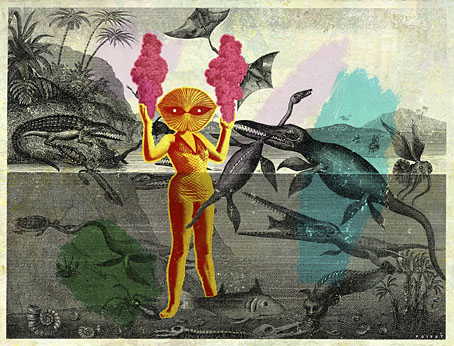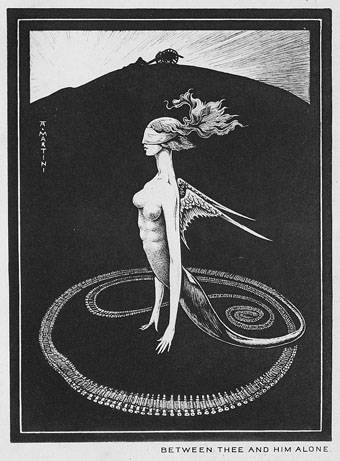
I never used a graphics tablet for drawing, in the past if I needed to draw something I’d use pencil and paper then scan the results. In recent years, however, I’ve grown dissatisfied with this process, especially after I rearranged my work area and packed away the space-hogging Ikea table I used to use as a drawing surface. This left me without a decent drawing area so this week I’ve finally capitulated and bought an Wacom Intuos tablet. The Giger-esque mess above is the result of playing around in Photoshop for a couple of hours. Having spent years using the blunt instrument of a mouse for Photoshop painting the combination of pen and tablet had immediate benefits, and I’ve found them both very easy to use. The sensitivity of the pen is impressive, something I was always dubious about. With the right brush selection it’s almost exactly like using a pencil or pen. Almost. I’m still not feeling as entirely in control of the end result as you do when drawing on paper, but I’ve not even used the thing for a whole day yet so I imagine that will change. I’m also surprised by how quickly the nib wears down; fortunately the pen comes supplied with a small stock of fresh nibs. The next week or so will be spent in further experimentation so if any interesting results materialise I’ll post them here.
Category: {technology}
Technology
London zoom
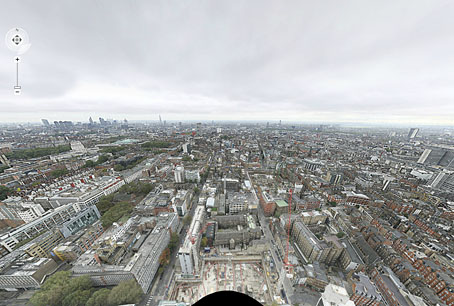
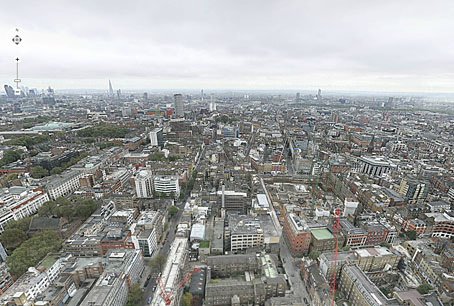
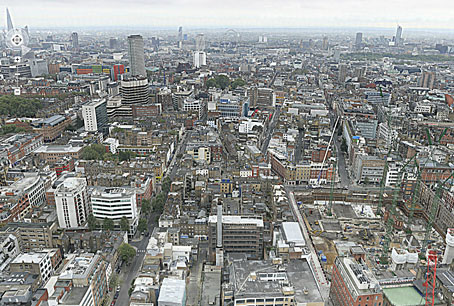
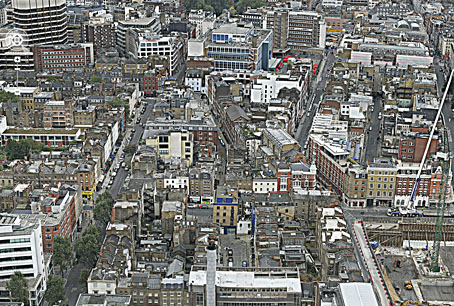
I’m generally indifferent to panoramic views of cities, especially London where the sprawl lacks the distinct contours of Manhattan or the Napoléonic severity of Hausmann’s Paris. This view is different, however, being a 320 gigapixel panorama of the capital seen from the top of the BT Tower. This view is currently the world’s largest panoramic photo, and while the wide view is of the usual grey cloudscape and undifferentiated vista of 19th-century roofs and 20th-century ducting, the ability to zoom down into the streets (and, in some cases, into windows) is unprecedented at this resolution.
These screengrabs show a zoom towards the river from the widest angle down to the painted sign of the Duke of York pub on the corner of Rathbone Street and Charlotte Place in Fitzrovia. At the end of the zoom there’s a reverse view from Google Maps showing the pub itself, and the tower, the one landmark you won’t otherwise see. MetaFilter’s members have bookmarked various points of interest. I’m surprised there are so many roof gardens in this area of London although I think Paris still has the edge in that department.
Weekend links 141

From the Beautiful Faces series (2012) by Tran Nguyen.
• “What possessed a generation of young European artists, and a few Americans, to suddenly suppress recognizable imagery in pictures and sculptures? Unthinkable at one moment, the strategy became practically compulsory in the next.” Peter Schjeldahl on the birth of abstraction.
• “A profanely mystical work of hyperpurple theory-porn, ObliviOnanisM is an auto-erotic intellectual fiction envisioning the phantastical unending odyssey of a young woman, Gemma, whom you will never know.”
• Psychedelia—An Ancient Culture, A Modern Way of Life, a 520-page history of psychedelic culture by Patrick Lundborg. Related: Ken Kesey talks about the meaning of the Acid Tests.
[Hodges] made a convincing case that Turing’s teenage crush on a fellow schoolboy, Christopher Morcom, was an important catalyst for his lifelong preoccupation with the relationship between brain and mind. Morcom’s unexpected death at the age of eighteen was a shattering blow to Turing, who began to reflect on whether his friend’s consciousness might survive after death or whether it was simply a result of complex material processes and expired when life did. Hodges also linked the famous “Turing Test”, in which a computer attempts to pass as an intelligent human being, to Turing’s own dilemma as a gay man in a homophobic world. (Turing called his test the “imitation game”, and Hodges observed, “like any homosexual man, he was living an imitation game, not in the sense of conscious play acting, but by being accepted as a person that he was not”.)
Michael Saler reviews three books about computing pioneer Alan Turing
• Paul Gallagher at Dangerous Minds looks at Flowers, Lindsay Kemp’s theatrical staging of Genet’s Our Lady of the Flowers.
• David Pearson designed a new edition of George Orwell’s Nineteen Eighty-Four for Penguin.
• Quadtone – Lumisonic Rotera: Mariska de Groot plays a light-to-sound instrument.
• “Cash Mobs” Go Global—Battle Spreads Against Chain Store Dominance.
• Cities and the Soul: a feast of Italo Calvino links at MetaFilter.
• 25 dessins d’un dormeur, Jean Cocteau, 1929.
• Haunted Decor: a Flickr group.
• Computer In Love (1966) by Perrey & Kingsley | Computer Love (1981) by Kraftwerk | Computer Love (1992) by The Balanescu Quartet
How It Works
Yes, it’s all happening this month… Unlike other work that’s surfaced recently the cover art for issue 41 of How It Works magazine was completed less than a month ago. Headlines obscure much of the artwork but the picture is also run full-page inside, something I wasn’t expecting. How It Works has major newsstand distribution so people in the UK may see this on shelves in newsagents and supermarkets throughout December.
The theme is the Industrial Revolution but the brief was for something similar to a couple of my recent steampunk illustrations, with a request for a colour scheme like that used for the Bookman Histories cover. The main visual requirement was the train looming out of the picture. I thought this wouldn’t be a problem, I have the old Dover Publications’ Transportation book which features many copyright-free engravings of trains, in addition to other books and source material downloaded from the Internet Archive. One of these would be sure to have a decent front elevation of a steam locomotive, right? Wrong. When you start looking for pictures of locomotives you quickly find that 99% of them show the machines from the side or from an angle, as on the Bookman cover. I downloaded three entire books of over 500-pages each from the Internet Archive, fantastic volumes in themselves, especially Modern Locomotive Construction (1892) which contains meticulous descriptions of every last part of a steam locomotive, down to the smallest screw. But none of their drawings were usable.
Weekend links 135
Two Grove Press covers by Roy Kuhlman. From Arden Kuhlman Riordan’s Pinterest page collecting her father’s cover designs.
• “When people asked me what boylesque was, I’d say I’m doing burlesque and I have a penis,” said Mr. Ferguson.
• Sequence5: 42 tracks of new, atmospheric/ambient music. A free download in a variety of formats.
• The trailer for Jimmy’s End, the forthcoming film by Alan Moore and Mitch Jenkins.
As a porn performer, I can say from experience and with confidence that I’ve never been objectified by other performers. Nor have I been objectified by viewers. At least not in a way that seemed to confuse them into thinking I was an object. What happens instead is that I shift in and out of object-hood. Athletes do this too—they engage with their bodies for a specific task. At the end of the game or the shoot, the context changes.
Conner Habib on The Virtues of Being an Object
• Secret Weapons (1972), David Cronenberg’s lost TV movie resurfaces.
• Joseph Burnett reviews Nude, the new album by The Irrepressibles.
• Over a third of e-readers are used just once before being set aside.
The guarded, the cautious, the small-scale, the modest, the well-crafted—such books may be rewarded (in our own time, at the national level), but they are rarely preserved. They are not preserved because guardedness, caution, smallness, modesty, and craft can be replaced in any given generation. What is irreplaceable is excess: Of verbal kinesis, religious intensity, intellectual voracity.
Amit Majmudar on Entertainment and Excess: The Great Literary Audiences
• Miniature Book Interviews with Louis Wain Bound by Hand.
• A Tour Inside Salvador Dalí’s Labyrinthine Spanish Home.
• Horror fiction should be deep, not cheap, says Nina Allan.
• RIP Peter Kuhlmann aka Pete Namlook
• More is More by Alex Trochut
• Lost In The Sea (1992) by Sequential (Pete Namlook & DJ Criss) | Angel Tech (1994) by Bill Laswell & Pete Namlook | Yenlik (Part II) (1996) by Burhan Öçal & Pete Namlook