Weekend links 360

sasaki.jpg

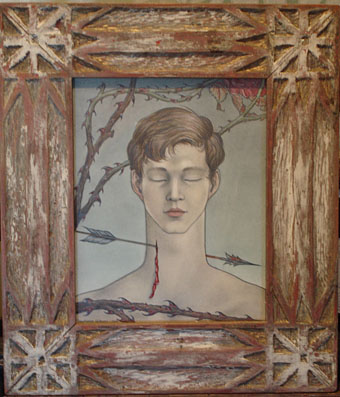
Threshold (2008) by Roku Sasaki.

• A previously unseen interview with Angela Carter from 1979 in which she talks to David Pringle about her evolution as a writer, literary influences and genre fiction.

• Among the highlights in the latest edition of Wormwood there’s Doug Anderson on Panacea by Robert Aickman, a “vast unpublished philosophical work”.

• The London Review Bookshop podcast: Marina Warner and Chloe Aridjis discuss Leonora Carrington.

The prose works, conversely, read like surrealist poetry. They were written according to a compositional method Roussel called le procédé (the procedure), in which a complicated system of puns rather than traditional narrative logic determines the progression of the story. In Locus Solus, the mad scientist Martial Canterel takes his colleagues on a tour of his country estate—“the lonely place” of the title—to show them the bizarre inventions generated by Roussel’s procédé. These include a device that constructs a mosaic made out of human teeth; a water-filled diamond in which a dancer, a hairless cat, and the head of Danton are suspended; and a series of corpses Cantarel has brought back to life with the fluid “ressurectine,” which compels them to act out the most important event of their former lives, to the scientists’ astonishment.

Ryan Ruby on Raymond Roussel, The Accidental Avant-Gardist

• The latest manifestation of paranormal electronica by The Electric Pentacle is entitled Black Ectoplasm.

Sergey Bessmertny‘s account of working as a camera technician on Andrei Tarkovsky’s Stalker.

• City Of Fallen Angels: The Bug vs. Earth. In conversation with Kevin Martin and Dylan Carlson.

• Sex and art by the Grand Canal: Judith Mackrell on Peggy Guggenheim in Venice.

• A Guide Through the Darkened Passages of Dungeon Synth.

• Mix of the week: XLR8R Podcast 489 by Samuel Rohrer.

• The late Mika Vainio/Panasonic live in 1996.

Xan Brooks on Cary Grant’s 100 acid trips.

Resurrection (1968) by Steppenwolf | Resurrection (1975) by Master Wilburn Burchette | Resurrection (1987) by Demons Of Negativity

Weekend links 358

higuchi.jpg

Painted beetle (2016) by Akihiro Higuchi.

David Horbury: The Tate’s Queer British Art exhibition ignores the pioneering scholarship of Emmanuel Cooper, author of The Sexual Perspective: Homosexuality and Art in the last 100 years in the West (1986).

L’Androgyne Alchemique is an exhibition at the Azzedine Alaïa Gallery, Paris, by pascALEjandro, a collaboration between Pascale Montandon-Jodorowsky and Alejandro Jodorowsky.

• At Strange Flowers: an interview with DJ Sheppard, biographer of poet Theodore Wratislaw (1871–1933), one of the models for Max Beerbohm’s hapless Enoch Soames.

Eloise or, the Realities is a new 122-page comic book by Ibrahim R. Ineke “inspired in part by Children of the Stones and The Owl Service“.

• Cormac McCarthy hasn’t published a novel for over ten years now but this new piece of writing addresses the mysterious origin of language.

• “…she invented a kind of symbolic code that channelled the occult and the Renaissance masters”. Yo Zushi on Leonora Carrington.

John O’Reilly on the Samuel Beckett cover designs created by Russell Mills and Gary Day-Ellison for Picador.

Porter Ricks (Thomas Köner & Andy Mellwig) have announced their first album in 18 years.

• At The Daily Grail: Alan Moore on science, imagination, language and spirits of place.

• All 66 issues of Performance Magazine (1979–1992) are now available online.

• The Throbbing Gristle catalogue is being reissued (again).

Lost Soul In Disillusion (1967) by The Power Of Beckett | Liquid Insects (1993) by Amorphous Androgynous | Biokinetics 2 (1996) by Porter Ricks

Weekend links 355

carrington.jpg

Quería ser pájaro (1960) by Leonora Carrington.

• Artist and author Leonora Carrington was born 100 years ago this week. Marina Warner, an advocate of Carrington’s work in the years when the artist was “forgotten” (ie: ignored by those who should have known better), remembered her friend as someone adept at making “visible the invisible”. Elsewhere, Carrington’s centenary was noted by Phantasmaphile (with many links), Strange Flowers and the LRB, the latter being a Leonora Carrington A-Z by Chloe Aridjis.

Geeta Dayal on Ikutaro Kakehashi who died this week. The synthesizers, drum machines, effects units and other gear produced by Kakehashi’s Roland Corporation are inextricably entwined with the development of electronic music in the 1970s and 80s.

• Do we really need a compilation of singles by Can? Not when all the music has been available for years on albums and compilations. Of more interest is Rob Young‘s forthcoming (well…not until next year) biography of the band, All Gates Open.

• Out from Thames & Hudson this week: Vinyl . Album . Cover . Art: The Complete Hipgnosis Catalogue by Aubrey Powell.

• At Dangerous Minds: The Master of Moorcock: The psychedelic sci-fi book covers and art of Bob Haberfield.

Abigail Ward on Queer Noise: the history of LGB music & club culture in Manchester.

FullFathom5, home of “something rich and strange” makes a welcome return.

• At Flickr: Occult Beliefs and Themes in British Popular Culture (1875–1947)

• At I Love Typography: Jamie Clarke on the evolution of chromatic fonts.

• Mix of the week: a mix for The Wire by Patterned Air Recordings.

Invisible Cities (1990) by Invaders Of The Heart | Invisible Architecture (1997) by John Foxx | Invisible (2005) by Monolake

Nights as Day, Days as Night by Michel Leiris

leiris.jpg

“Le rêve est une seconde vie,” says Gérard de Nerval in the epigraph to the dream journal of Michel Leiris, a collection of oneiric texts published as Nuits sans nuit et quelques jours sans jour in 1961, and which appears this week in a new translation—Nights as Day, Days as Night—from Spurl Editions.

If dreams for Nerval were a second life, for the Surrealists they were a life as important as the waking one, their significance distilled in the declared desire of Max Ernst to keep one eye open on the wake world while the other remained closed and fixed upon the interior. Michel Leiris was a friend of André Masson, and was involved with the Surrealists in the early days until a falling out with André Breton saw him expelled from the “official” ranks. The fatuously doctrinaire Breton seemed to fall out with everyone at some point, and Leiris wasn’t alone in being undeterred by any tinpot Stalinism. Nights as Day, Days as Night is a major Surrealist text, a journal covering the years 1923 to 1960 which may be read as a straightforward transcription of one person’s dream life, or as a series of fragmented narratives, anecdotes and fantasies many of which, in their brevity, operate like condensed fictions. Dreams as raw material for fiction have a long history but are seldom presented en masse in an undiluted form. One problem is that a naked description of a dream is unlikely to be interesting to anyone other than the dreamer unless the description is artfully presented. In his lecture on nightmares, Jorge Luis Borges describes his most terrifying dream—an old Norwegian king appearing at the foot of his bed—which he says was terrifying not because of the appearance of a spectral presence but because of the atmosphere in the room, an atmosphere he found impossible to convey to others.

This quality of incommunicability (or a general lack of interest, since “strange dreams” are universal) may be sidestepped if the dreamer is already noteworthy, as with the case of William Burroughs whose My Education: A Book of Dreams is the most obvious equivalent to Leiris’s collection. Burroughs had been mining his dreams for years, however, so the contents of My Education were already very familiar to his readers when the book appeared in 1995. Leiris has the advantage of novelty, and even more than Burroughs he works consciously to make his dreams interesting to a reader. (There’s also some intersection in the Parisian locations; Burroughs included Paris as one of the omnipresent zones in his personal dream landscape.) As with Burroughs, there seem to be occasions when the transcription turns into outright fictioneering. I’ve tried keeping a dream journal myself a few times, and found it difficult to recall anything more than the merest fragments of most dreams. Leiris is selective—many of the entries are separated by several months—but many of his selections run over several pages, and contain detailed descriptions of sequential events. Unless you’re blessed with exceptional recall, some elaboration would seem inevitable given the elusive nature of dreams and their tendency to quickly evaporate in the bleary-eyed morning. From a Surrealist perspective (a non-doctrinaire one, naturally), any subsequent embellishment might be regarded as a literary parallel to the Ernst intention of keeping one eye open while the other remains closed; the dreams become Surrealist texts collaged from Leiris’s dream life and whatever enhancement he applies to the raw transcription. Many of the shorter transcriptions remain faithful to the abrupt disjunctions of the dream state, replete with sudden changes of location, personality and even reversals from subject to object. Literature has the ability to convey these disjunctions much more accurately than other media. Painting, drawing and collage only ever create a single, static image; film has the advantage of movement but, like other visual media, can’t help but make everything seem all too tangible. In film, animation comes the closest to dreams but still lacks the ability to put you inside the consciousness of the dreamer the way that Leiris’s texts do, fictional or otherwise.

Spurl’s Nights as Day, Days as Night is translated by Richard Sieburth, and features a foreword by Maurice Blanchot. Order it here.

Weekend links 351

burgkmair.jpg

Herald on Griffin (1516-1518) from The Triumphal Procession of Emperor Maximilian I series by Hans Burgkmair the Elder.

• My design and illustration work for Pirate Utopia by Bruce Sterling continues to gain favourable comments, a novelty when reviewers often pass over the visual component of the books under their consideration. One of the most recent examples is in the latest edition of Locus Magazine; this can only be read in full by subscribers but the Tachyon Tumblr has an extract.

Paul La Farge on the complicated friendship of HP Lovecraft and Robert Barlow. Related: The Night Ocean, a short story by Barlow & Lovecraft. Meanwhile, Lovecraft enthusiasts are still raising money for a Providence statue (spot my art and design work in the photo of the Lovecraft Art and Sciences Council).

• At The Quietus this week: Children Of Alice talk to Patrick Clarke about audio collage and English Surrealism, Lottie Brazier enters The Strange World of Annette Peacock, and Manuel Göttsching tells Robert Barry how Ash Ra Tempel became the loudest band in Berlin.

• “Mind the doors!” Eight reviewers pick ten films featuring the London Underground. Not a bad list but choosing a Doctor Who film while ignoring the great Quatermass and the Pit (1967) is an error.

• Mixes of the week: Swedenborgian Hobos by acephale, Secret Thirteen Mix 214 by Fabio Perletta, and a mix for NTS by Six Organs Of Admittance.

• More Surrealism: Leonor Fini, Surrealist Sorceress, a lecture by Dr Sabina Stent, will take place at Treadwell’s Bookshop, London, on 19th May.

• “Michael Chapman’s road-weary guitar resonates with a new generation,” says Joel Rose.

A Journey Round my Room (1794), a book by Xavier de Maistre.

Lyrical Nitrate (1991), a film by Peter Delpeut.

The Sorcerer (1967) by Miles Davis | Impressions Of Sorcerer (1977) by Tangerine Dream | Venom Sorcerer (2014) by Cultural Apparati