More trip texts

parry1.jpg

More psychedelia of a sort. Anthologist Michel Parry, who died last year, was a familiar name to British readers of fantasy, horror and science fiction for his themed collections: Beware of the Cat (1972; horror stories about cats), The Devil’s Children (1974; horror stories about children), The Hounds of Hell (1974; horror stories about dogs), Jack the Knife (1975; Jack the Ripper stories), The Supernatural Solution (1976; occult investigators), Sex in the 21st Century (1979), and so on.

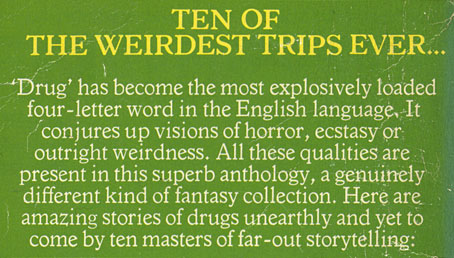
Parry also compiled multi-volume anthologies throughout the 1970s, two of which have always stood out for me: the Mayflower Books of Black Magic Stories ran to six volumes presenting a wide range of occult fiction that included a number of obscure tales from Victorian and Edwardian writers; for Panther Books he compiled three collections of drug-related fantasy and SF stories that are just as varied, and may even be unique for the way they place authors as such as Lord Dunsany and Norman Spinrad together in the same volume. Both series are very much of their time—occult psychedelia!—and are worth seeking out, if you can find them. I emphasise the last point because it’s taken me a while to find a copy of Strange Ecstasies that wasn’t being offered for bizarrely inflated prices; my paperback habit has its limits… None of these anthologies have been reprinted so they’ll become increasingly scarce. For more invented drugs, there’s a good list at Wikipedia.

parry2.jpg

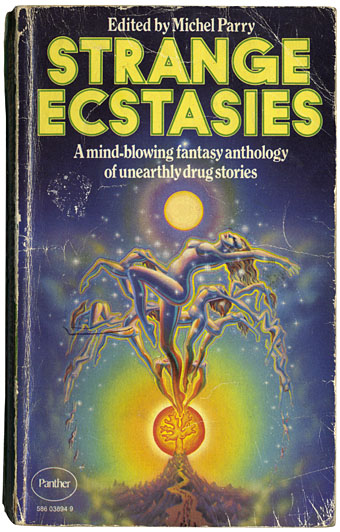
Cover art by Bob Haberfield.

Strange Ecstasies (1973)
The Plutonian Drug (1934) by Clark Ashton Smith
The Dream Pills (1920) by FH Davis
The White Powder (1895) by Arthur Machen
The New Accelerator (1901) by HG Wells
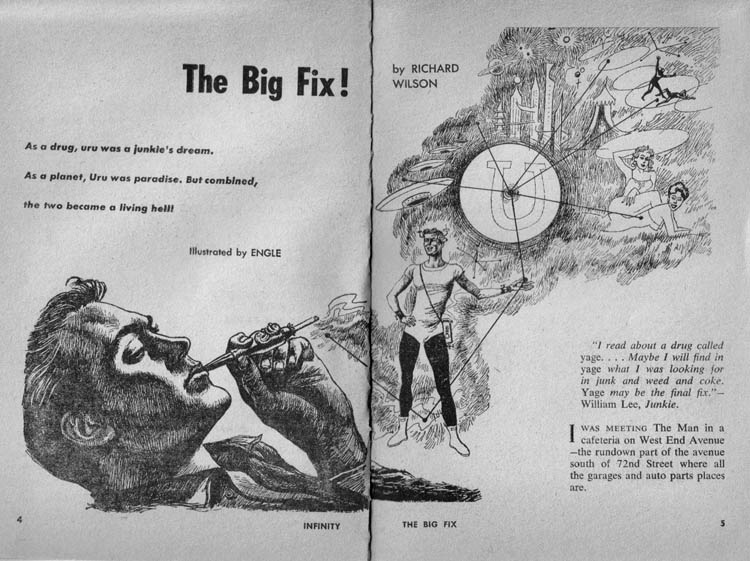
The Big Fix (1956) by Richard Wilson
The Secret Songs (1962) by Fritz Leiber
The Hounds of Tindalos (1929) by Frank Belknap Long
Subjectivity (1964) by Norman Spinrad
What to Do Until the Analyst Comes (1956) by Frederik Pohl
Pipe Dream (1972) by Chris Miller

parry3.jpg

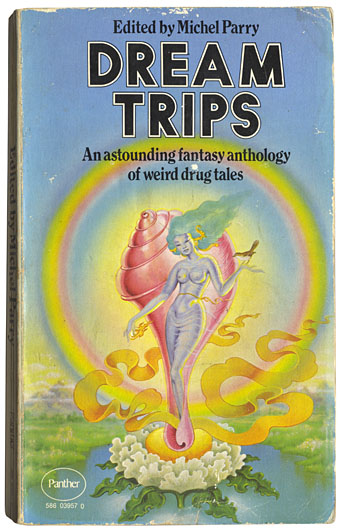
Cover art by Bob Haberfield.

Dream Trips (1974)
The Hashish Man (1910) by Lord Dunsany
As Dreams Are Made On (1973) by Joseph F. Pumilia
The Adventure of the Pipe (1898) by Richard Marsh
Dream-Dust from Mars (1938) by Manly Wade Wellman
The Life Serum (1926) by Paul S. Powers
Morning After (1957) by Robert Sheckley
Under the Knife (1896) by HG Wells
The Good Trip (1970) by Ursula K. Le Guin
No Direction Home (1971) by Norman Spinrad
The Phantom Drug (1926) by AW Kapfer

parry4.jpg

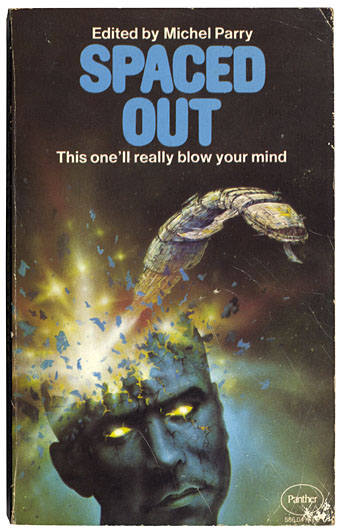
Cover art by Brian Froud.

Spaced Out (1977)
The Deep Fix (1964) by Michael Moorcock
All the Weed in the World (1961) by Fritz Leiber
The Roger Bacon Formula (1929) by Fletcher Pratt
Smoke of the Snake (1934) by Carl Jacobi
Melodramine (1965) by Henry Slesar
My Head’s in a Different Place, Now (1972) by Grania Davis
Sky (1971) by RA Lafferty
All of Them Were Empty— (1972) by David Gerrold

Previously on { feuilleton }
Trip texts
Acid albums
Acid covers
Lyrical Substance Deliberated
The Art of Tripping, a documentary by Storm Thorgerson
Enter the Void
In the Land of Retinal Delights
Haschisch Hallucinations by HE Gowers
The art of LSD
Hep cats

Weekend links 258

stalenhag.jpg

Simon Stålenhag‘s SF artwork will be published in book form if funding is secured. In the future everything will be crowdfunded for 15 minutes.

• Mixes of the week: FACT Mix 494 is a fantastic dub selection by Colleen; Secret Thirteen Mix 151 is by Sally Dige; Stephen Mallinder‘s return to the doom-laden Industrial music of the 1980s suits the post-election mood. Mallinder’s mix is helping promote Industrial Soundtrack for the Urban Decay, a documentary by Amélie Ravalec.

• “…it felt more like real life to me than the average hour-long television show.” Sopranos creator David Chase on what he enjoyed about Twin Peaks. Related: Twin Peaks Tarot cards.

Sound & Song in the Natural World edited by Tobias Fischer & Lara Cory. A book about animal music and communication with a 60-minute CD of field recordings.

• “The psychedelic renaissance has already begun, and for the most part I welcome it,” says Erik Davis in a wide-ranging interview with Sean Matharoo.

• It rumbles on: Brown Pundits on “An Embarrassment at PEN”. A useful collection of stories, reactions and polemic from the past two weeks.

Fanny and Stella: The Shocking True Story, a play by Glenn Chandler about Victorian London’s scandalous pair of cross-dressing men.

• Artist Charles Ray causes a problem for the Whitney Museum of American Art with his sculpture of a naked Jim and Huckleberry Finn.

• “Don’t believe Orson Welles,” says his biographer Simon Callow, “especially when he calls himself a failure.”

• A return to Adolph Sutro’s Cliff House features several photos I’d not seen before.

• More Tarot: Arcana: The Tarot Poetry Anthology is looking for funding.

• At Dangerous Minds: The ancient magic of the record label.

Foreign Movie Posters

Tarot (Ace of Wands theme, 1970) by Andy Bown | Distant Dreams (Part Two) (1980) by Throbbing Gristle | The Devil In Me (1982) by Stephen Mallinder

Welles at 100

welles.jpg

Orson Welles: A First Biography (1946) by Roy Alexander Fowler.

Happy birthday, Orson. The premature celebrity biography is nothing new, as this small volume from the Coulthart library demonstrates. Welles was only 31 in 1946 but was already the director of three feature films. If I’m less of a Welles obsessive today it’s because many of the films and radio plays that were once inaccessible can now be easily seen and heard, although a handful of unfinished projects still wait in the wings. The following is a selection of some favourite Wellesiana, old and new.

• The Mercury Theatre On The Air: Recordings of Welles’ theatre troupe at the Internet Archive and at the dedicated website. The Mercury production of The War of the Worlds is the essential one, of course, but I’m also partial to their production of Dracula which featured Agnes Moorehead playing Mina Harker, Welles as the Count, and a suitably spooky score by Bernard Herrmann. The production of Around the World in 80 Days was later expanded by Welles into an ambitious (and expensive) stage musical in collaboration with Cole Porter.

The Night America Trembled (1957) is a TV dramatisation of the alarmed reaction of some Americans to the War of the Worlds broadcast. Presented live by Ed Murrow, the drama features Warren Beatty, James Coburn, Warren Oates, and Ed Asner (who later presented the BBC’s RKO Story). Closer to Welles is The Night That Panicked America (1975) a TV movie recreation of the original broadcast with Paul Shenar as the director.

Newsreel footage of the final scenes of the so-called Voodoo Macbeth from 1936. As part of the WPA program to return Americans to work, Welles directed an all-black cast with the action of the play moved to Haiti. As usual, Welles wasn’t afraid of rearranging the Bard’s words, and this staging ends with the same lines as his 1948 film version: “Peace! The charm’s wound up.”

• My favourite Welles book is still This is Orson Welles (1992), a collection of Peter Bogdanovich’s interviews edited by Jonathan Rosenbaum. Bogdanovich’s interview tapes can be heard at the Internet Archive.

Orson Welles’ Horrorshow: Colin Fleming on Welles’ Macbeth, “the horror film no one likes to call a horror film”.

Peter Bradshaw on Citizen Kane and the meaning of “Rosebud”.

Six actors who have played Orson Welles onscreen

Previously on { feuilleton }
The Fountain of Youth
The Complete Citizen Kane
Return to Glennascaul, a film by Hilton Edwards
Screening Kafka
The Panic Broadcast

Lucian’s True History

lucian01.jpg

Lucian is Lucian of Samosata whose True History (also known as A True Story) is often regarded as one of the earliest works of science fiction. The book is a satirical work, but unlike many earthbound satires this one concerns a journey into outer space, encounters with the inhabitants of various planets, and descriptions of interplanetary war.

lucian02.jpg

These illustrations are from the 1894 edition which included contributions by Aubrey Beardsley that were the artist’s earliest drawings after the enormous labour of the Morte d’Arthur. Beardsley was eager to illustrate the book which he found more stimulating than the Mallory but when commissions arrived for Wilde’s Salomé and The Yellow Book he found himself overworked. (The publishers also rejected two of the more grotesque drawings.) William Strang and JB Clark filled out the rest of the book. The Beardsley illustrations are familiar from the larger collections but I’d not seen the Strang and Clark drawings until now. Content-wise this was the strangest book that Aubrey worked on, and I can’t help but wonder how he might have illustrated the rest of it if he’d had the time.

lucian03.jpg

lucian04.jpg

Continue reading “Lucian’s True History”

Philip K. Dick: A Day in the Afterlife

pkd1.jpg

Blade Runner turns up in Nicola Roberts’ television documentary but not for long. Back in 1994 it was still possible to discuss a popular writer by concentrating on the books alone rather than padding the running time with film and TV derivations. The BBC’s Arena strand excelled at these 50-minute biographies of significant cultural figures.

pkd2.jpg

The last time I watched this documentary was on a big TV screen in a house in Los Angeles. Stepping out into the California sun a couple of hours later was like stepping into a Philip K. Dick novel, a slippage between the real and the fictional that Dick himself might have appreciated. Among the luminaries discussing the author’s slippery narratives are Brian Aldiss, Jim Blaylock, Elvis Costello, Anne Dick (PKD’s third wife), Tessa B. Dick (PKD’s fourth wife), Thomas M. Disch, Terry Gilliam, Kleo Mini (PKD’s second wife), Tim Powers, Kim Stanley Robinson and Fay Weldon. There’s also video footage of Dick being interviewed in the late 70s/early 80s. Watch it here.

Previously on { feuilleton }
Blade Runner vs. Metropolis