Le Città In/visibili

sbe06.jpg

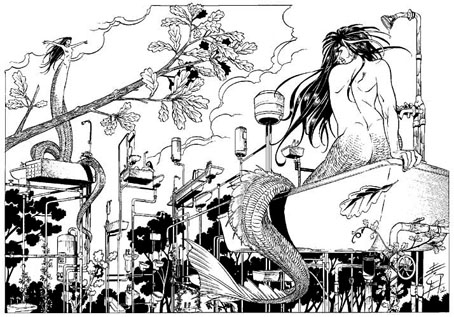
Thin Cities 3: Armilla by Luca Enoch.

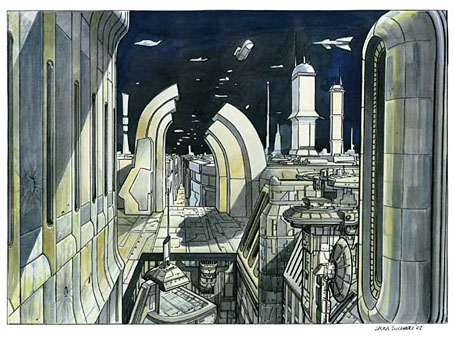
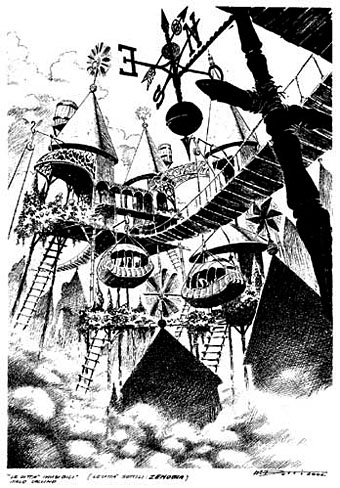
Sergio Bonelli Editore, an Italian comics publisher, staged an exhibition of art based on Italo Calvino’s Invisible Cities at the Triennale Milano in 2002. The drawings for Le Città In/visibili head in the opposite direction from Mikhail Viesel’s depictions, and in several pictures push the cities towards generic fantasy and science fiction. These images are from an extinct page on the publisher’s website although they may also be seen on the current site with a little searching. The publisher doesn’t offer much information, however, so while the artists are identified it’s less clear which cities are being depicted. I’ve noted the more obvious ones; Calvino obsessives can have fun guessing which the others might be.

sbe02.jpg

Laura Zuccheri.

sbe05.jpg

Thin Cities 2: Zenobia by Maurizio Dotti.

Continue reading “Le Città In/visibili”

Weekend links 265

rainbowhouse.jpg

The White House, Washington DC, on the evening of June 26, 2015.

I can remember that after the cops cleared us out of the bar we clustered in Christopher Street around the entrance to the Stonewall. The customers were not being arrested, but a paddy wagon had already hauled off several of the bartenders. Two or three policemen stayed behind, locked inside with the remaining members of staff, waiting for the return of the paddy wagon. During that interval someone in the defiant crowd outside called out “Gay Power”, which caused us all to laugh. The notion that gays might become militant after the manner of blacks seemed amusing for two reasons—first because we gay men were used to thinking of ourselves as too effeminate to protest anything, and second because most of us did not consider ourselves to be a legitimate minority.

At that time we perceived ourselves as separate individuals at odds with society because we were “sick” (the medical model), “sinful” (the religious model), “deviant” (the sociological model) or “criminal” (the legal model). Some of these words we might have said lightly, satirically, but no amount of wit could convince us that our grievances should be remedied or our status defended. We might ask for compassion but we could not demand justice. Many gays either were in therapy or felt they should be, and the words gay liberation would have seemed as preposterous to us as neurotic liberation (now, of course, Thomas S. Szasz in the United States, RD Laing in Britain and Felix Guattari on the Continent have, in their different ways, made even that phrase plausible enough).

What I want to stress is that before 1969 only a small (though courageous and articulate) number of gays had much pride in their homosexuality or a conviction that their predilections were legitimate. The rest of us defined our homosexuality in negative terms, and those terms isolated us from one another. We might claim Plato and Michelangelo as homosexuals and revere them for their supposed affinities with us, but we could just as readily dismiss, even despise, a living thinker or artist for being gay. Rich gays may have derived pleasure from their wealth, educated gays from their knowledge, talented gays from their gifts, but few felt anything but regret about their homosexuality as such. To be sure, particular sexual encounters, and especially particular love relationships, were gratifying then as now, but they were explained as happy accidents rather than as expected results.

Edmund White writing on The Political Vocabulary of Homosexuality (1980). Reprinted in The Burning Library: Writings on Art, Politics and Sexuality (1994).

• “…after seeing Don’t Look Now, The Wicker Man looked just so dull and flat. What Don’t Look Now has that The Wicker Man doesn’t is a complete mastery of cinema. Don’t Look Now is almost a silent movie, a brilliant, coherent, original and fantastic film that has an enormous emotional impact.” Bernard Rose emoting at length about Nicolas Roeg. Related: Wild Hearts Run Out Of Time, the Roy Orbison video that Rose mentions directing.

• “The male sex organ is depicted not so much as a body part, but more as a fetish object in its own right—a thing independent of the male body, worthy of intense, delirious veneration.” Jason Farago reviewing Tom of Finland: the Pleasure of Play. Related: Same-sex desire through the ages at the British Museum.

• “Sphinx is a typical love story only in the way that it’s the tale of two people who have fallen in love, and things don’t go smoothly. Beyond that…as reader, you have no idea of the gender of either half of this romantic equation.” Chris Clarke reviewing Sphinx, a novel by Anne Garréta.

• “To give space to the musical elements was really a thrill—how far can you get without using too much stuff?” Moritz von Oswald on “the sounds of emptiness”.

• “The problem is not always Helvetica but that Helvetica is all too often the default, the fall-back, the I-really-can’t-be-arsed choice,” says John Boardley.

• Mix of the week: Shaft’s Old Man: An Imaginary Soul Jazz Soundtrack by Aquarium Drunkard.

• “What is the Cut-Up Method?” Ken Hollings explains in a BBC magazine piece and radio feature.

• Nigel Kneale’s Quatermass, the final TV serial, will be released on Blu-ray next month.

• Relevant to the week’s reading: an archived Italo Calvino site.

Drÿad: a Tumblr.

Sphinx (1989) by Syd Straw | The Sodom And Gomorrah Show (2006) by Pet Shop Boys | Pattern 1 (2009) by Moritz Von Oswald Trio

The Cosmic Grill

hotmg1.jpg

Design and illustration by Barney Bubbles.

The past week’s music listening has alternated between the back catalogue of Seattle band, Earth (who I recommend highly), and the early recordings of my erstwhile employers, Hawkwind. The latter were reissued recently in a 10-CD box, This Is Your Captain Speaking…Your Captain Is Dead (The Albums And Singles 1970–1974) which I also recommend, it’s very good value, and packages the albums in those facsimile card sleeves that now seem de rigueur for album reissues. A swathe of my rare Hawkwind vinyl got sold off circa 1990, and I’ve never replaced any of the albums or singles so this was a good opportunity to catch up. If you like this period of the band there’s the added bonus of the complete Greasy Truckers concert from the Roundhouse in 1972, a ramshackle performance that nonetheless sounds pristine (my Greasy Truckers vinyl—which I do still own—was ruined by a previous owner with a spillage of tea on the Hawkwind side); there’s also the entirety of the 1999 Party concert from Chicago which I’d not heard before.

hotmg2.jpg

Listening again to Hall Of The Mountain Grill (1974) had me thinking about the origin of the album’s title. Hawkwind never took themselves as seriously as many of their contemporaries, but naming an album of ostensible space rock after a very mundane café in the Portobello Road was one of their more eccentric moments. The humour is compounded by Barney Bubbles’ cover design which for the title uses the kind of typeface (Palace Script) that you see on menus; on the inner sleeve there’s a photo of the fabled restaurant flanked by a pair of Barney’s futuristic towers. The verse beneath the photo (“from the Legend of Beenzon Toste”) refers to nearby Ladbroke Grove, and, of course, to Notting Hill Gate which in 1974 was still a haven for counterculture freaks, the very antithesis of that film. The verse was probably the work of Robert Calvert who explained the attraction of the restaurant in Pete Frame’s Hawkwind family tree:

The Mountain Grill was a working man’s café in Portobello Road—frequented by all the dross and dregs of humanity. Dave Brock always used to go and eat there—which is how I first met him…because I used to eat there too, when I worked on Frendz magazine. It was a kind of Left Bank café/meeting place for Notting Hill longhairs—a true artists’ hangout…but it never became chic, even though Marc Bolan, David Bowie and people like that often went there to eat lunch.

portobello.jpg

Photos on Flickr show how the place looked in 1977 when the sign from the album sleeve was still intact, and also in 2003 shortly before the restaurant closed down. The premises are a very different kind of eaterie today, remodelled and upmarket as befits a gentrified area.

Previously on { feuilleton }
Void City
Hawk things
The Sonic Assassins
New things for July
Barney Bubbles: artist and designer

The Big Fix!

fix1.jpg

One of the stories that was new to me in recent book purchase, Strange Ecstasies (1973), was The Big Fix by Richard Wilson, a science-fiction piece about a junkie in New York City looking for something newer and better than the heroin habit he’s trying to quit. The story first appeared in Infinity Science Fiction for August 1956 but the first half of the narrative seemed so unlike the usual SF fare of the time that I kept flicking back to the copyright page to check the date. The Big Fix of the title (or The Big Fix! as it was in the magazine) is a substance named uru given to the narrator by Jones, an alien in disguise; smoking the drug induces a telepathic conversation with Jones followed by a journey through space to his home planet. In the second half of the story we discover why Jones (or Joro as he’s known at home) is transporting low-lifes from New York and offering them a chance to live on his world. The explanation is as pedestrian in SF terms as an episode of Star Trek, a factor which makes the first half of the story seem all the more striking, replete as it is with junk-life details, contemporary slang and discussion of the (for the time) very obscure South American drug known as yage, aka ayahuasca. Was this written from Wilson’s personal experience or had the details been lifted from a contemporary authority?

fix2.jpg

A few minutes of searching turned up the solution in an illustrated spread from the magazine: the original printing opened with a paragraph from Junkie (1953) by William Burroughs (credited as William Lee) which not only explains the accuracy of the drug and slang details but also why Wilson was mentioning yage. Burroughs’ connections with (and influence upon) the SF world are well-documented but this is a surprising example—maybe the first—of his influencing a story before he was known as William Burroughs. I wonder now if he ever knew about this instance himself, or if the excising of the Junkie paragraph from subsequent reprints marooned the detail in the magazine. At the end of the story there’s more contemporary relevance when the narrator has managed to return to Earth and is helping some researchers with their mescaline experiments, a process whose higher status he attributes to “the Huxley effect”.

Elsewhere on { feuilleton }
The William Burroughs archive

Previously on { feuilleton }
More trip texts

Weekend links 260

burgher.jpg

Bachelor with “demons” (Sleezy) [sic] (2015) by Elijah Burgher. One of a new series of artworks by Burgher showing at Zieher Smith & Horton, NYC.

• The week in HR Giger: Belinda Sallin on her documentary, Dark Star: HR Giger’s World; Ron Kretsch on the unseen cinema of HR Giger; Matthew Cheney thinks the Gigeresque has become too familiar. I can see his point but originality is always in short supply; asking for something new means setting yourself up for a long wait.

Pwdre ser, or Star jelly, is “a pale, foul-smelling jelly traditionally associated with meteorite falls”. The Rot of the Stars at the ICA, London, is an audio-visual art collaboration between Jo Fisher and Mark Pilkington dealing with the mysterious substance.

• Mixes of the week: A Tri Angle Records birthday DJ set by Björk; OreCast 196 mix by Ilius; Secret Thirteen Mix 153 by M!R!M.

To assume that a given group of people would be similar because of birthdate, Ryder thought, was to risk committing a fallacy. “The burden of proof is on those who insist that the cohort acquires the organised characteristics of some kind of temporal community,” he wrote. “This may be a fruitful hypothesis in the study of small groups of coevals in artistic or political movements but it scarcely applies to more than a small minority of the cohort in a mass society.”

Generational thinking is a bogus way to understand the world says Rebecca Onion

The plan for an airport above the streets of Manhattan. Related: Charles Glover‘s similar plan for London.

Errol Morris on how typography shapes our perception of truth.

Michael Moorcock enjoyed The Vorrh, a novel by Brian Catling.

Clive Barker on almost dying, hustling, and killing Pinhead.

• A new Penguin Books website for Angela Carter.

• Callum James on artist Philip Core.

A Beginner’s Guide to King Tubby

King Tubby Meets Rockers Uptown (1976) by Augustus Pablo | Star Cannibal (1982) by Hawkwind | Sleazy (1983) by Jah Wobble, The Edge, Holger Czukay