The Kosmische Tarot

geitner-tarot-box.jpg

Revelation of the weekend has been the discovery that there are two sets of (for want of a better term) Krautrock Tarot cards. The first, Walter Wegmüller’s Zigeuner Tarot, is familiar for being included in the Tarot concept album released on the Kosmischen Kuriere label in 1973. The album was credited to Wegmüller but he only advised on the symbolism and acts as MC/narrator. Wegmüller’s cards are detailed and somewhat original, but their drawing is from the enthusiasm-over-technique school which goes against the grain of the rest of the album design and the accomplishment of the musicians.
mythos.jpg

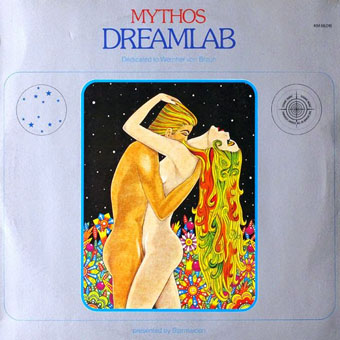
Dreamlab (1975) by Mythos. Design by Peter Geitner.

As noted a few days ago, the designer of the Tarot album was Peter Geitner working under the direction of a pair of very hands-on label bosses, Rolf-Ulrich Kaiser and Gille Lettmann. The story of Kaiser’s rise and fall has been recounted in some detail over the years (see here and here). Given the colourful saga, and the cast of notable musicians, writers and artists, I’m surprised to have seen no mention of the second Tarot set that Peter Geitner designed and illustrated in 1975 while the Kosmische Musik empire was imploding. One illustration (The Lovers) was even used as cover art for the Dreamlab album by Mythos.
geitner-tarot-back.jpg

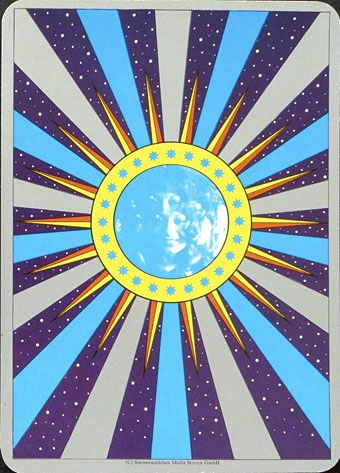
Card back for the Sternenmädchen’s Wahrsagespiel.

Sternenmädchen’s Wahrsagespiel (Star Girl’s Fortune Telling Game) is a specialised set of the Major Arcana presented as a spin-off from Gille Lettmann’s Sternenmädchen persona as featured on the Gilles Zeitschiff album; the back of the 22 cards features the photo of Gille from the album cover. I’ve said that Geitner illustrated the cards but some of the drawings may have originated as sketches by Gille Lettmann; information is scant but I’ve seen mention of her having been a textile or fashion designer. What’s most striking to me about these designs is how psychedelic they all are, more so than any of the Kosmische Musik album covers even though they maintain the cosmic themes of the record label. Many of those involved with the Kosmische empire were taking LSD at the time so this isn’t very surprising but psychedelia of this intensity was an outmoded thing by the mid-70s. Also of interest is the renaming of the cards which push the attributions away from medieval tradition and into the cosmos. I’ve not been able to find examples of all 22 designs but a list of the cards follows, together with examples of variable quality. The set was printed by AGM Müller but has never been reissued so it now commands high prices. (Many thanks to Jeff for drawing my attention to these!)
Continue reading “The Kosmische Tarot”

Weekend links 245

htbag.jpg

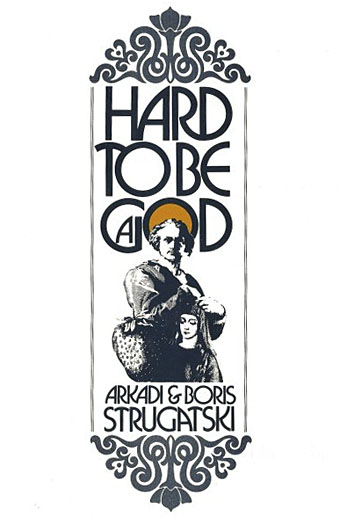
First English-language edition of Hard to Be a God, 1973. Cover design by Alan Peckolick.

A group of scientists is sent to the planet Arkanar to help the local civilization, which is in the Medieval phase of its own history, to find the right path to progress. Their task is a difficult one: they cannot interfere violently and in no case can they kill. The scientist Rumata tries to save the local intellectuals from their punishment and cannot avoid taking a position. As if the question were: what would you do in God’s place?

Hard to Be a God is a 170-minute Russian science-fiction film based on a novel by Arkady & Boris Strugatsky, the authors of Roadside Picnic. The film was the magnum opus of director Aleksey German (1938–2013) who died shortly before post-production was complete. German’s wife and son finished the film.

“…the wonder about this exhausting, astonishing film is not that it took so long to make, it’s that it got made at all,” says Gabriel Winslow-Yost; “one of the most consistently disgusting films ever made,” says Glenn Kenny, “…not only an unforgettable individual masterpiece but probably one of the capital-G Great Films.”; “There are no bones to be made about it, Hard to Be a God is a modern masterpiece,” says Matt Thrift.

This pushes all of my cinematic buttons, of course, so now I’m itching to see it. YouTube has trailers, and (if you must) you can also find the entire film without subtitles. I’d rather wait for a disc version. Meanwhile, Chicago Review Press have republished the novel with a new translation by Olena Blumberg and a foreword by Hari Kunzru.

• At the Guardian John Doran recommends new Middle Eastern and North African music; the playlist includes a song from the forthcoming album by Melechesh which features my cover art. At the Quietus this week Doran explored Manchester’s urban wastelands with local musician Julie Campbell aka Lonelady.

• “Research into psychedelics, shut down for decades, is now yielding exciting results,” says Michael Pollan. Related: Ryan Cooper on why the [US] government should be funding mass scientific studies of Ecstasy, magic mushrooms, and LSD, and “Early humans used magic mushrooms, opium“.

Dad combined porn with all manner of genre fiction. He wrote pirate porn, ghost porn, science-fiction porn, vampire porn, historical porn, time-travel porn, secret-agent porn, thriller porn, zombie porn and Atlantis porn. An unpublished Old West novel opens with sex in a barn, featuring a gunslinger called Quiet Smith, without doubt Dad’s greatest character name. By the end of the decade, Dad claimed to have single-handedly raised the quality of American pornography.

Chris Offutt on the prolific writing career of his father, Andrew Jefferson Offutt V

The Sound Repository 2 by Wizards Tell Lies, a free collection of “rare tracks, demos, early and alternative versions” at Bandcamp.

Jennifer Rothwell‘s new fashion collection uses prints based on Harry Clarke’s stained-glass windows.

• Mix of the week: My Body Full Of Stars, an Afrofuturism mix by Oyinboy.

Terry Gilliam’s title sequence for Cry of the Banshee (1970).

Endless Endless: Kraftwerk at Tumblr.

Sehr Kosmisch (1974) by Harmonia | Walky-Talky (1975) by Harmonia | Sometimes In Autumn (1976) by Harmonia 76

The edge of coherence: On the Silver Globe

otsg1.jpg

Science-fiction cinema has always suffered in comparison to its written counterparts; sets and special effects have to work hard to create believable worlds or futures, while the need to recoup enormous costs has often meant that film scenarios aren’t much better than those being written in the early days of the pulp magazines. Simplistic adventure stories yield bigger audiences and greater revenues. Computer technology has helped the effects problem but production expenses ensure that inventive or unusual SF films are scarce and invariably low-budget works. Anything too ambitious or challenging is unlikely to be funded.

otsg2.jpg

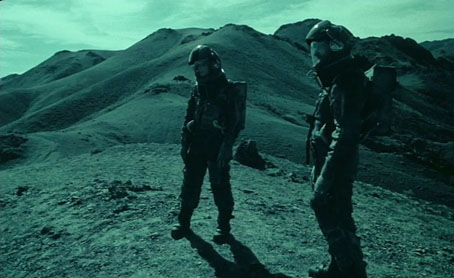
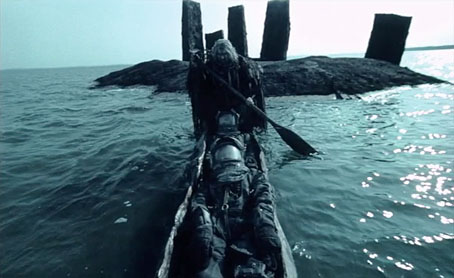
On the Silver Globe is an unfinished science-fiction film by Andrzej Żuławski that even in its incomplete state is that very rare thing: a film with a fantastic premise that doesn’t appear to have been staged for an audience at all. The film is long—over two-and-a-half hours—and much of it so disregards the conventions of commercial cinema that the immediate reaction is amazement that it exists in any form. Żuławski has a cult reputation outside his native Poland for Possession (1981), a unique horror film made when he was living in exile in Paris. On the Silver Globe was one of the reasons for his leaving the country; after two years of work in several countries, and with the film almost finished, the production was shut down in 1977 by a new vice-minister of cultural affairs who perceived a metaphoric subtext directed against the Polish authorities. The existing footage was supposed to have been destroyed but Żuławski and his production team hid the film and costumes hoping one day to shoot the missing scenes. After ten years of waiting it was decided to present the film as it was with the missing scenes filled by shots of Polish streets and countryside. A voiceover by the director describes the missing content.

otsg3.jpg

Continue reading “The edge of coherence: On the Silver Globe”

Weekend links 240

wiley.jpg

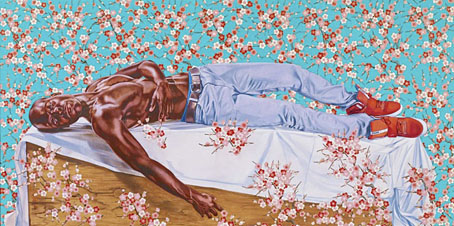
The Death of Chatterton (2014) by Kehinde Wiley.

• Mixes of the week (and the week before that): The Conjurer’s Hexmas: Second Rite by SeraphicManta; Secret Thirteen Mix 140 by Deaf Center; Best of 2014: A Highly Opinionated Mix by Robin The Fog.

• Never mind Music for Airports, how about Music for Neurosurgery? The Tegos Tapes Edits are extracts from “12 hours of unheard Vangelis music soundtracking films of various surgical operations”.

• “It was one of the first magazines that, with science-fiction and comics together, proposed comics for adults.” Aug Stone on 40 years of publisher Les Humanoïdes Associés and Métal Hurlant.

• Zinesters Do It on the Photocopier: Stephanie Schroeder on the Queer Zine Archive Project. Related: Holy Titclamps by Larry-bob Roberts.

A Year In The Country reached the end of its 365 posts. The archive is well worth a browse.

• “These people love to collect radioactive glass. Are they nuts?” asks Ben Marks.

• Think before you share: 86 viral images from 2014 that were totally fake.

• The Anti-Tolkien: Peter Bebergal on Michael Moorcock.

• Extracts from Alan Bennett‘s diary for 2014.

John Cage 4’33” Autotune

Alpha (1976) by Vangelis | Reve (1979) by Vangelis | L’Enfant (1979) by Vangelis

The Incredible Robert Baldick

baldick1.jpg

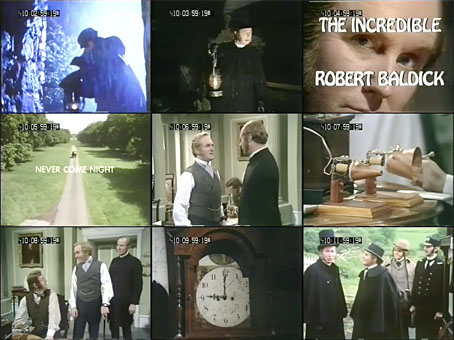
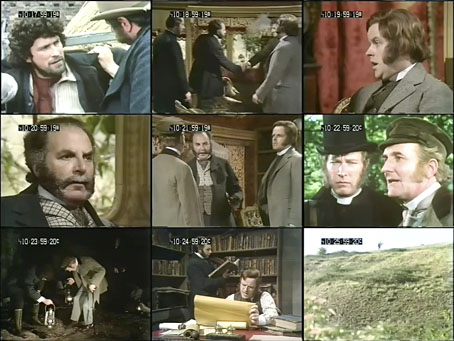
This is an odd one-off TV drama whose title I’ve known for years but which I hadn’t seen until this week. The Incredible Robert Baldick was broadcast in 1972 in a slot used by the BBC to test dramas that might later become series. The writer was Terry Nation, creator of Doctor Who and the dour post-apocalypse series, Survivors. Robert Hardy plays Robert Baldick, an aristocratic occult detective who we’re informed “cannot resist the inexplicable”. We’re also told he’s one of the finest scientific minds in 19th-century Britain. The exact period is vague but we first see Baldick and cohorts playing with an “electrical telepathy” communication device which would fix the time around the turn of the century. Baldick has a country estate, a bulletproof Russian train (“The Tsar”), a valet who is also an expert in Classics and ancient languages, a gamekeeper with preternatural senses, and a pet owl named Cosmo.

baldick2.jpg

The one-and-only 50-minute episode is entitled Never Come Night, and plays like something Nigel Kneale might have written, a combination of supernatural horror, suspicious yokels and archaeology, with an abrupt swerve into outright science fiction at the end. The cast features many familiar faces from film and television of the period: James Cossins as a fearful clergyman, Barry Andrews playing the same type of rustic he also played in Blood on Satan’s Claw, Julian Holloway as Thomas the valet, and John Rhys-Davies (Gimli in The Lord of the Rings) as Caleb the gamekeeper. All the ingredients are in place for what might have been a promising series along the lines of The Rivals of Sherlock Holmes, the first season of which had been running on another channel the year before, and which may have been an inspiration. A shame that the only women in the cast are a couple of barely visible servants and a corpse; even Holmes and Watson had Mrs Hudson. The timecoded copy on YouTube has evidently been hijacked from the BBC archives but it’s watchable enough.

Previously on { feuilleton }
The Horse of the Invisible
“The game is afoot!”