Weekend links 247

buratti.jpg

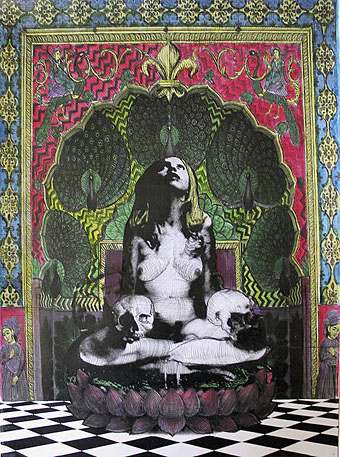
Encounter with the Priestess by Robert Buratti.

• “We were gothy, we loved the New York thing and people like Suicide, Dave loved Throbbing Gristle, we both loved the Sheffield bands…we loved the darkness to that kind of electro.” Marc Almond talking to Simon Price. Also at The Quietus, Cat’s Eyes choose their favourite soundtracks.

• “When he reveals that all he wants is to deliver a breakfast sandwich, the enigma of his desire is not so much dispelled as redoubled—why on earth would anyone want to do that?” Adam Kotsko on the unheimlich nature of old Burger King ads.

• “…commercial design is full of politics, to be a commercial designer is a political decision.” Jonathan Barnbrook talking to Katrina Schollenberger.

You need to know who Billy Wilder was. You need to know the names of people who are no longer alive. Because it’s very important—it’s what our history is made of. You need to see the movies the way they were—with the racism, the violence, and the censorship. All the things that let you see what the movie past had been so you understand where we are! But really nobody’s interested in that right now. Their interests are so bifurcated.

Joe Dante discussing film production past and present with Michael Sragow.

• From 1983: The Encyclopedia of Ecstasy, Vol. 1, a publication which creator Alistair Livingston describes as a “psychedelic goth punk fanzine”.

• Mixes of the week: No One’s There, a collection of post-punk electronica by Abigail Ward, and Secret Thirteen Mix 146 by Te/DIS.

• Frans Masereel’s My Book of Hours is “a crucial example of the power of stories without words,” says Stefany Anne Golberg.

Miles Davis and band in concert, 18th August, 1970. Pro-shot, 45 minutes.

• Lots of good reading and cultural connections at Celluloid Wicker Man.

A world map of micro-nations

Tokyo in dense fog

Tainted Love/Where Did Our Love Go? (1981) by Soft Cell | Tainted Love (1985) by Coil | Titan Arch (1991) by Coil with Marc Almond
Weekend links 246

ngai.jpg

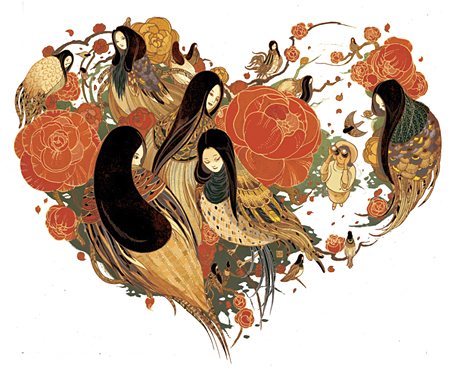
Love Hunter by Victo Ngai.

• “The strangeness of the lyric style, the misuse of words and awkward phraseology that have been criticized even by Poe’s fervent admirers, are here taken as virtues, heightening as they do, a given poem’s conscious and calculated formalism.” Marjorie Perloff reviews The Poet Edgar Allan Poe: Alien Angel by Jerome McGann.

• Mix of the week: Secret Thirteen Mix by Jeremy Kolosine. Starting with Michael Rother is apt when I’ve spent the past week in a Cluster/Harmonia/Kraftwerk/La Düsseldorf/Neu!/Rother loop.

• Court records “suggest that the supposedly prudish Victorians had a far more relaxed attitude to sex between men than their 1960s counterparts”. Historian Jeff Evans has the data.

• “Part of HP Lovecraft’s acknowledged debt to Machen also lies in hearing without seeing.” London Sound Survey on Arthur Machen’s “sounds from beyond the veil”.

• “…pity the designer who has to enact the stage direction that instructs rats to carry away a character’s feet.” Andrew Dickson on the extreme theatre of Sarah Kane.

• Psychedelic collage artist Wilfried Sätty receives a mention in Carey Dunne‘s piece about how LSD helped shape California’s ecstatic design legacy.

• More psychedelia: The Psychedelic Sex Book by Eric Gotland & Paul Krassner, edited by Dian Hanson.

• At Dangerous Minds: Robert Fripp demonstrates Frippertronics on The Midnight Special, 1979.

• Dreams from a Glass House: artist Josiah McElheny on the glass architecture of Paul Scheerbart.

• Director Peter Strickland on six films that fed into The Duke of Burgundy.

Vintage trade card designs

The Zero Of The Signified (1980) by Robert Fripp | Heptaparaparshinokh (1981) by Robert Fripp & The League of Gentlemen | 1984 (1981) by Robert Fripp

Listen to the Colour of Your Dreams: Part Six

usa.jpg

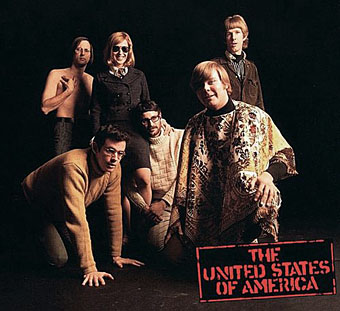
The United States of America, 1968. Back, left–right: Joseph Byrd, Dorothy Moskowitz, Gordon Marron; front, left–right: Ed Bogas, Craig Woodson, Rand Forbes.

Concluding the psychedelic mega-mix based on Jon Savage’s list of “100 mind-expanding masterpieces” (see this post). The last of the six mixes is the third visit to the USA, and features songs from the years 1968 to 1969 arranged in chronological order. As before, the selections from the Savage 100 are in bold, and I’ve added notes about my additions or amendments.

The most notable deviation from Savage’s list in this final collection is the substitution of Lothar and the Hand People for two other groups combining psychedelic music with electronic sounds, Fifty Foot Hose and The United States Of America. Lothar and the Hand People were so named because of their use of theremins; they’re often described as electronic pioneers but I’ve never liked their music very much or thought it was as inventive as people claim. Fifty Foot Hose and The United States Of America are better on all levels, the self-titled USA album is a masterpiece that proved an inspiration for Portishead (listen to Half Day Closing) and Broadcast.

Savage ended his UK list with Can’t Find My Way Home, a song that captured the come-down feeling after the psych fireworks were over. The US list lacked an equivalent resolution, hence the choice of Wooden Ships; where Blind Faith’s lament is a personal one, Jefferson Airplane offer something more global, a pessimistic vision of the future that you can tie to all the other crashing dreams of 1969. It’s also a great song, and a fitting way to bring everything to a close.

US Psychedelia, Part Three by Feuilleton on Mixcloud

Radio news — Grateful Dead drug bust
The Grateful Dead — That’s It For The Other One
Nazz — Open My Eyes (The first single by a band with Todd Rundgren on guitar, and another song from the original Nuggets collection.)
Iron Butterfly — In-A-Gadda-Da-Vida
Fifty Foot Hose — If Not This Time (One of several songs whose unusual chord progressions—some of them inspired by Schoenberg—set them apart from their contemporaries.)
Steppenwolf — Magic Carpet Ride
The Steve Miller Band — Song For Our Ancestors
The United States Of America — The Garden Of Earthly Delights (A paean to poisonous love with a title borrowed from Bosch.)
Tommy James And The Shondells — Crimson And Clover
White Lightning — William
Spirit — Dream Within A Dream
Skip Spence — War In Peace
The Youngbloods — Darkness, Darkness
Kak — Electric Sailor
Kaleidoscope (US) — Lie To Me (A last nod to the psychedelic sound from an album very aptly entitled Incredible!)
The Grateful Dead — Mountains Of The Moon
Jimi Hendrix — The Star Spangled Banner
Jefferson Airplane — Wooden Ships

Previously on { feuilleton }
Listen to the Colour of Your Dreams: Part Five
Listen to the Colour of Your Dreams: Part Four
Listen to the Colour of Your Dreams: Part Three
Listen to the Colour of Your Dreams: Part Two
Listen to the Colour of Your Dreams: Part One
What Is A Happening?
My White Bicycle
Ogdens’ Nut Gone Flake
Tomorrow Never Knows
The Dukes declare it’s 25 O’Clock!
A splendid time is guaranteed for all

Weekend links 245

htbag.jpg

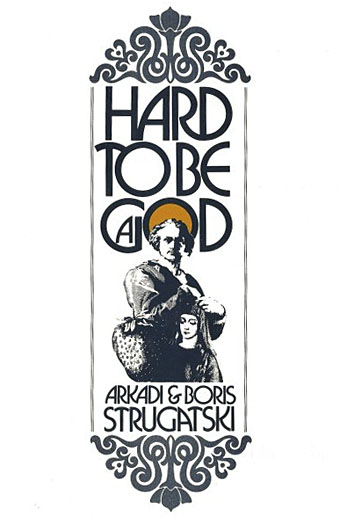
First English-language edition of Hard to Be a God, 1973. Cover design by Alan Peckolick.

A group of scientists is sent to the planet Arkanar to help the local civilization, which is in the Medieval phase of its own history, to find the right path to progress. Their task is a difficult one: they cannot interfere violently and in no case can they kill. The scientist Rumata tries to save the local intellectuals from their punishment and cannot avoid taking a position. As if the question were: what would you do in God’s place?

Hard to Be a God is a 170-minute Russian science-fiction film based on a novel by Arkady & Boris Strugatsky, the authors of Roadside Picnic. The film was the magnum opus of director Aleksey German (1938–2013) who died shortly before post-production was complete. German’s wife and son finished the film.

“…the wonder about this exhausting, astonishing film is not that it took so long to make, it’s that it got made at all,” says Gabriel Winslow-Yost; “one of the most consistently disgusting films ever made,” says Glenn Kenny, “…not only an unforgettable individual masterpiece but probably one of the capital-G Great Films.”; “There are no bones to be made about it, Hard to Be a God is a modern masterpiece,” says Matt Thrift.

This pushes all of my cinematic buttons, of course, so now I’m itching to see it. YouTube has trailers, and (if you must) you can also find the entire film without subtitles. I’d rather wait for a disc version. Meanwhile, Chicago Review Press have republished the novel with a new translation by Olena Blumberg and a foreword by Hari Kunzru.

• At the Guardian John Doran recommends new Middle Eastern and North African music; the playlist includes a song from the forthcoming album by Melechesh which features my cover art. At the Quietus this week Doran explored Manchester’s urban wastelands with local musician Julie Campbell aka Lonelady.

• “Research into psychedelics, shut down for decades, is now yielding exciting results,” says Michael Pollan. Related: Ryan Cooper on why the [US] government should be funding mass scientific studies of Ecstasy, magic mushrooms, and LSD, and “Early humans used magic mushrooms, opium“.

Dad combined porn with all manner of genre fiction. He wrote pirate porn, ghost porn, science-fiction porn, vampire porn, historical porn, time-travel porn, secret-agent porn, thriller porn, zombie porn and Atlantis porn. An unpublished Old West novel opens with sex in a barn, featuring a gunslinger called Quiet Smith, without doubt Dad’s greatest character name. By the end of the decade, Dad claimed to have single-handedly raised the quality of American pornography.

Chris Offutt on the prolific writing career of his father, Andrew Jefferson Offutt V

The Sound Repository 2 by Wizards Tell Lies, a free collection of “rare tracks, demos, early and alternative versions” at Bandcamp.

Jennifer Rothwell‘s new fashion collection uses prints based on Harry Clarke’s stained-glass windows.

• Mix of the week: My Body Full Of Stars, an Afrofuturism mix by Oyinboy.

Terry Gilliam’s title sequence for Cry of the Banshee (1970).

Endless Endless: Kraftwerk at Tumblr.

Sehr Kosmisch (1974) by Harmonia | Walky-Talky (1975) by Harmonia | Sometimes In Autumn (1976) by Harmonia 76

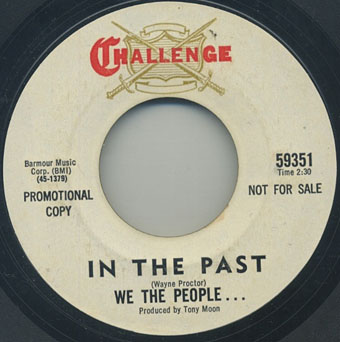
In The Past

inthepast1.jpg

In The Past (1966) by We The People.

Thanks to Modzilla in the comments for yesterday’s post I’ve been listening to different versions of In The Past all day. I always found the Chocolate Watchband rendition to be very catchy, the kind of song you’d expect to be covered by other bands even though the version in yesterday’s playlist is the work of session musicians under the direction of producer Ed Cobb. The original song is an uptempo number written by Wayne Proctor and recorded in 1966 by his garage outfit, We The People, a group I knew of already since two of their songs are featured on the Nuggets CD box. In The Past isn’t one of them, however, so I hadn’t heard it until today. More surprising is seeing the amount of times it’s been covered since. Lava lamps and false eyelashes at the ready, here’s a quick summary of a musical obsession.

inthepast2.jpg

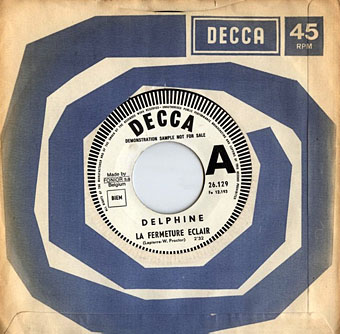
La Fermeture Eclair (1966) by Delphine.

The title translates as The Zipper Closure (?). Delphine was a Belgian singer who recorded a handful of singles. This seems to be her most popular song (see below), and a regular inclusion on compilations such as this. The YouTube video matches the music to shots from Vera Chytilová’s marvellous Daisies (1966).

inthepast3.jpg

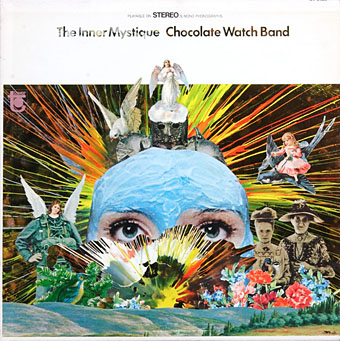
In The Past (1968) by The Chocolate Watchband.

Posted again so I get a chance to show the (uncredited) collage cover. Cobb and co. add sitar flourishes worthy of Bill Laswell.

Continue reading “In The Past”