Listen to the Colour of Your Dreams: Part Six

usa.jpg

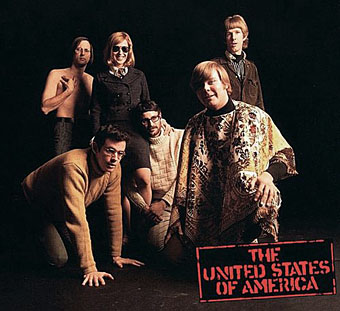
The United States of America, 1968. Back, left–right: Joseph Byrd, Dorothy Moskowitz, Gordon Marron; front, left–right: Ed Bogas, Craig Woodson, Rand Forbes.

Concluding the psychedelic mega-mix based on Jon Savage’s list of “100 mind-expanding masterpieces” (see this post). The last of the six mixes is the third visit to the USA, and features songs from the years 1968 to 1969 arranged in chronological order. As before, the selections from the Savage 100 are in bold, and I’ve added notes about my additions or amendments.

The most notable deviation from Savage’s list in this final collection is the substitution of Lothar and the Hand People for two other groups combining psychedelic music with electronic sounds, Fifty Foot Hose and The United States Of America. Lothar and the Hand People were so named because of their use of theremins; they’re often described as electronic pioneers but I’ve never liked their music very much or thought it was as inventive as people claim. Fifty Foot Hose and The United States Of America are better on all levels, the self-titled USA album is a masterpiece that proved an inspiration for Portishead (listen to Half Day Closing) and Broadcast.

Savage ended his UK list with Can’t Find My Way Home, a song that captured the come-down feeling after the psych fireworks were over. The US list lacked an equivalent resolution, hence the choice of Wooden Ships; where Blind Faith’s lament is a personal one, Jefferson Airplane offer something more global, a pessimistic vision of the future that you can tie to all the other crashing dreams of 1969. It’s also a great song, and a fitting way to bring everything to a close.

US Psychedelia, Part Three by Feuilleton on Mixcloud

Radio news — Grateful Dead drug bust
The Grateful Dead — That’s It For The Other One
Nazz — Open My Eyes (The first single by a band with Todd Rundgren on guitar, and another song from the original Nuggets collection.)
Iron Butterfly — In-A-Gadda-Da-Vida
Fifty Foot Hose — If Not This Time (One of several songs whose unusual chord progressions—some of them inspired by Schoenberg—set them apart from their contemporaries.)
Steppenwolf — Magic Carpet Ride
The Steve Miller Band — Song For Our Ancestors
The United States Of America — The Garden Of Earthly Delights (A paean to poisonous love with a title borrowed from Bosch.)
Tommy James And The Shondells — Crimson And Clover
White Lightning — William
Spirit — Dream Within A Dream
Skip Spence — War In Peace
The Youngbloods — Darkness, Darkness
Kak — Electric Sailor
Kaleidoscope (US) — Lie To Me (A last nod to the psychedelic sound from an album very aptly entitled Incredible!)
The Grateful Dead — Mountains Of The Moon
Jimi Hendrix — The Star Spangled Banner
Jefferson Airplane — Wooden Ships

Previously on { feuilleton }
Listen to the Colour of Your Dreams: Part Five
Listen to the Colour of Your Dreams: Part Four
Listen to the Colour of Your Dreams: Part Three
Listen to the Colour of Your Dreams: Part Two
Listen to the Colour of Your Dreams: Part One
What Is A Happening?
My White Bicycle
Ogdens’ Nut Gone Flake
Tomorrow Never Knows
The Dukes declare it’s 25 O’Clock!
A splendid time is guaranteed for all

Weekend links 245

htbag.jpg

First English-language edition of Hard to Be a God, 1973. Cover design by Alan Peckolick.

A group of scientists is sent to the planet Arkanar to help the local civilization, which is in the Medieval phase of its own history, to find the right path to progress. Their task is a difficult one: they cannot interfere violently and in no case can they kill. The scientist Rumata tries to save the local intellectuals from their punishment and cannot avoid taking a position. As if the question were: what would you do in God’s place?

Hard to Be a God is a 170-minute Russian science-fiction film based on a novel by Arkady & Boris Strugatsky, the authors of Roadside Picnic. The film was the magnum opus of director Aleksey German (1938–2013) who died shortly before post-production was complete. German’s wife and son finished the film.

“…the wonder about this exhausting, astonishing film is not that it took so long to make, it’s that it got made at all,” says Gabriel Winslow-Yost; “one of the most consistently disgusting films ever made,” says Glenn Kenny, “…not only an unforgettable individual masterpiece but probably one of the capital-G Great Films.”; “There are no bones to be made about it, Hard to Be a God is a modern masterpiece,” says Matt Thrift.

This pushes all of my cinematic buttons, of course, so now I’m itching to see it. YouTube has trailers, and (if you must) you can also find the entire film without subtitles. I’d rather wait for a disc version. Meanwhile, Chicago Review Press have republished the novel with a new translation by Olena Blumberg and a foreword by Hari Kunzru.

• At the Guardian John Doran recommends new Middle Eastern and North African music; the playlist includes a song from the forthcoming album by Melechesh which features my cover art. At the Quietus this week Doran explored Manchester’s urban wastelands with local musician Julie Campbell aka Lonelady.

• “Research into psychedelics, shut down for decades, is now yielding exciting results,” says Michael Pollan. Related: Ryan Cooper on why the [US] government should be funding mass scientific studies of Ecstasy, magic mushrooms, and LSD, and “Early humans used magic mushrooms, opium“.

Dad combined porn with all manner of genre fiction. He wrote pirate porn, ghost porn, science-fiction porn, vampire porn, historical porn, time-travel porn, secret-agent porn, thriller porn, zombie porn and Atlantis porn. An unpublished Old West novel opens with sex in a barn, featuring a gunslinger called Quiet Smith, without doubt Dad’s greatest character name. By the end of the decade, Dad claimed to have single-handedly raised the quality of American pornography.

Chris Offutt on the prolific writing career of his father, Andrew Jefferson Offutt V

The Sound Repository 2 by Wizards Tell Lies, a free collection of “rare tracks, demos, early and alternative versions” at Bandcamp.

Jennifer Rothwell‘s new fashion collection uses prints based on Harry Clarke’s stained-glass windows.

• Mix of the week: My Body Full Of Stars, an Afrofuturism mix by Oyinboy.

Terry Gilliam’s title sequence for Cry of the Banshee (1970).

Endless Endless: Kraftwerk at Tumblr.

Sehr Kosmisch (1974) by Harmonia | Walky-Talky (1975) by Harmonia | Sometimes In Autumn (1976) by Harmonia 76

In The Past

inthepast1.jpg

In The Past (1966) by We The People.

Thanks to Modzilla in the comments for yesterday’s post I’ve been listening to different versions of In The Past all day. I always found the Chocolate Watchband rendition to be very catchy, the kind of song you’d expect to be covered by other bands even though the version in yesterday’s playlist is the work of session musicians under the direction of producer Ed Cobb. The original song is an uptempo number written by Wayne Proctor and recorded in 1966 by his garage outfit, We The People, a group I knew of already since two of their songs are featured on the Nuggets CD box. In The Past isn’t one of them, however, so I hadn’t heard it until today. More surprising is seeing the amount of times it’s been covered since. Lava lamps and false eyelashes at the ready, here’s a quick summary of a musical obsession.

inthepast2.jpg

La Fermeture Eclair (1966) by Delphine.

The title translates as The Zipper Closure (?). Delphine was a Belgian singer who recorded a handful of singles. This seems to be her most popular song (see below), and a regular inclusion on compilations such as this. The YouTube video matches the music to shots from Vera Chytilová’s marvellous Daisies (1966).

inthepast3.jpg

In The Past (1968) by The Chocolate Watchband.

Posted again so I get a chance to show the (uncredited) collage cover. Cobb and co. add sitar flourishes worthy of Bill Laswell.

Continue reading “In The Past”

Listen to the Colour of Your Dreams: Part Five

hippies.jpg

Haight Street hippies, San Francisco, Oct. 26, 1967. From the Charles W. Cushman Photograph Collection.

Continuing the psychedelic mega-mix based on Jon Savage’s list of “100 mind-expanding masterpieces” (see this post). The fifth of the six mixes is the second visit to the USA, and features songs from the years 1967 to 1968 arranged in chronological order. As before, the selections from the Savage 100 are in bold, and I’ve added notes about my additions or amendments.

Savage’s selections for the USA can be more arguable than those in the UK list. As I noted earlier, UK singles are easily identifiable for being effects-heavy studio creations. The US scene evolved out of the dance halls of San Francisco, the same halls that also fuelled the demand for all the trend-setting psychedelic poster art. Some of the bands could be just as adventurous in the studio but the sound at this point is more a transcription of the live performance. In other songs the “psychedelic” quality is a result of context, as with Otis Redding who played at the Monterey Pop Festival, and is singing here about the San Francisco Bay, but isn’t really a psychedelic artist.

US Psychedelia, Part Two by Feuilleton on Mixcloud

Radio ad — The Trip
The Glass Family — House Of Glass (The first song on the group’s only album.)
Kaleidoscope (US) — Egyptian Candy (The multi-generic multi-instrumentalists recorded a number of Middle Eastern-style pieces. This is one of the more obscure ones.)
Park Avenue Playground — The Trip (The wildest trip song of them all.)
The Red Crayola — Hurricane Fighter Plane (One of the few actual songs in the psychedelic soup of the group’s first album. This version is from a compilation.)
Jefferson Airplane — White Rabbit
Tim Buckley — Hallucinations
The Chocolate Watchband — In The Past (The Savage 100 has Are You Gonna Be There (At The Love-In). This replacement is by the “fake” Watchband assembled by producer Ed Cobb to fill out a side of the group’s second album. Real or fake, I always liked the song.)
Big Brother and the Holding Company — Piece Of My Heart (The Savage 100 has Ball And Chain.)
The West Coast Pop Art Experimental Band — Smell of Incense (A great song by a group who never sound as experimental as their name implies.)
The Third Bardo — Five Years Ahead Of My Time
Painted Faces — Anxious Colour
The Beau Brummels — Magic Hollow
Buffalo Springfield — Broken Arrow
The Strawberry Alarm Clock — Incense And Peppermints
Love — The Red Telephone
The Byrds — Change Is Now
Otis Redding — (Sittin’ On) The Dock Of The Bay
The Balloon Farm — A Question Of Temperature
Sly & The Family Stone — Dance To The Music
Quicksilver Messenger Service — Pride Of Man
The Monkees — Porpoise Song (The Monkees at their most tripped-out. A song by Goffin & King that plays over shots of Micky Dolenz swimming with solarised mermaids during the opening of their feature film, Head.)

Previously on { feuilleton }
Listen to the Colour of Your Dreams: Part Four
Listen to the Colour of Your Dreams: Part Three
Listen to the Colour of Your Dreams: Part Two
Listen to the Colour of Your Dreams: Part One
What Is A Happening?
My White Bicycle
Ogdens’ Nut Gone Flake
Tomorrow Never Knows
The Dukes declare it’s 25 O’Clock!
A splendid time is guaranteed for all

Listen to the Colour of Your Dreams: Part Four

lsd05.jpg

LIFE, September 9th, 1966. Photo by Yale Joel.

Continuing the psychedelic mega-mix based on Jon Savage’s list of “100 mind-expanding masterpieces” (see this post). The fourth of the six mixes is the first visit to the USA, with songs from the years 1965 to 1967 arranged in mostly chronological order. As before, the selections from the Savage 100 are in bold, and I’ve added notes about my additions or amendments.

US psychedelia differs from the UK variety in its origins—there’s often a country or folk influence where British bands tended to be working from a background of R&B—and in the political reality that lurks underneath the spaced-out sentiments. UK psychedelia can be whimsical to a degree that tips into childishness, the stakes are often nothing more serious than the risk of being busted for illicit drug use; America was a nation at war overseas and at home, with riots and assassinations forming a backdrop to many of these songs. Kaleidoscope’s Keep Your Mind Open sounds like it might be a typical plea for freer thinking but the lyrics address the war in Vietnam, and the song fades out to the sounds of gunfire.

US Psychedelia, Part One by Feuilleton on Mixcloud

Radio ad — Psych Out
The Byrds — Eight Miles High (first version)
The Charlatans — Alabama Bound
Jefferson Airplane — Blues From An Airplane
Country Joe & The Fish — Section 43
Great SocietySomeone To Love
Captain Beefheart & His Magic Band — Electricity
Oxford Circle — Foolish Woman
The Vejtables — Feel The Music
The 13th Floor Elevators — Slip Inside This House (The Savage 100 has Roller Coaster but I got hooked on the momentum of this one—which is actually from 1968—via a compilation.)
The Count Five — Psychotic Reaction
The Magic Mushrooms — It’s-A-Happening (One of the outstanding numbers on the original Nuggets compilation.)
The Sons Of Adam — Feathered Fish
Love — 7 & 7 Is
The Beach Boys — Good Vibrations
Sopwith Camel — Frantic Desolation
The Doors — Crystal Ship
The Seeds — Mr. Farmer
Kaleidoscope (US) — Keep Your Mind Open
Radio ad — Vox Wah-Wah Pedal
The Electric Prunes — I Had Too Much To Dream Last Night (Savage has Get Me To The World On Time but this is one of my favourite psych songs of all.)
Mystery Trend — Johnny Was A Good Boy
The Moving Sidewalks — 99th Floor (The first single by a band featuring ZZ Top’s Billy Gibbons.)
Moby Grape — Omaha

Previously on { feuilleton }
Listen to the Colour of Your Dreams: Part Three
Listen to the Colour of Your Dreams: Part Two
Listen to the Colour of Your Dreams: Part One
What Is A Happening?
My White Bicycle
Ogdens’ Nut Gone Flake
Tomorrow Never Knows
The Dukes declare it’s 25 O’Clock!
A splendid time is guaranteed for all