Cassette culture

xetb.jpg

Three Spirits by Xenis Emputae Travelling Band.

Looks like I was premature in 2008 when I was eagerly contemplating the demise of the cassette tape as a music format. Earlier this year I bought a music cassette for the first time since the early 1980s, albeit inadvertently since this was the compilation that came with The Twilight Language of Nigel Kneale (more about that at a later date). This week Phil Legard of Xenis Emputae Travelling Band very generously sent a copy of his latest release, Three Spirits, which is another cassette edition. And to top things off, FACT magazine this week launched a review section for new cassette releases. So much for the format being moribund.

I have to admit my anti-cassette animus has largely dissipated now there’s no reason to rely on them for anything. And I did hang on to my cassette deck… Switching that on for the first time in years and pressing “play” was a considerable novelty, as was the inevitable tape hiss that’s absent from most contemporary releases unless your name is Pye Corner Audio. The resurgence of the format is both interesting and understandable: interesting for its being another example of the way the future never unfolds in a predictable manner; understandable because cassettes are relatively cheap to produce, and there’s still a very evident market for material, analogue artefacts. And the novelty is present, of course, for people young enough to miss out on the delight of friends’ cheap tape machines chewing their lovingly-crafted compilations.

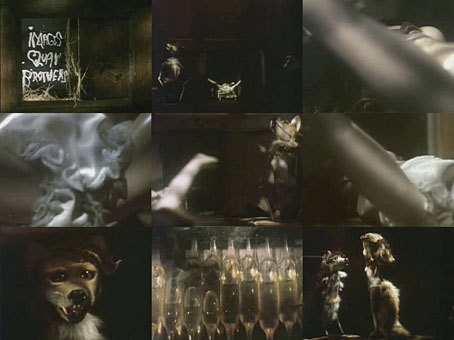
As to Three Spirits, it’s an excellent release, two sides of sublime atmospheres which at times sound like a local equivalent of Popol Vuh. I’ll be playing this one a lot. Phil writes about the music here, and there’s also a video for one of the tracks.

Previously on { feuilleton }
Xenis Emputae Travelling Band
Old music and old technology

Fatality by OCTiV

fatality.jpg

Catching up with more recent work, this was a quick collage for Fatality, a single by US musician OCTiV. This has been out for about a month. The main track—a kind of dubstep/metal hybrid—can be heard here. The request was for something on the cosmic horror spectrum which would also incorporate geometric elements, hence the swiping of a couple of polyhedra from Wenzel Jamnitzer’s wonderful Perspectiva Corporum Regularium (1568).

Among the other things which have yet to materialise there’s a book cover design for Tor, and the Ghosts in Gaslight, Monsters in Steam anthology which features some of my fiction as well as my cover design. I’m very pleased that the latter has achieved its Kickstarter funding. More about these projects later.

Weekend links 160

floyd.jpg

Collage by Jeneleen Floyd.

• “…slowly, block-by-block, pedestrians are starting to take back the streets.” Wayne Curtis on the hazards of being a pedestrian in a world of cars.

• Michael Hann looks back at LA’s Paisley Underground, and also talks to some of its key members.

Meighan O’Toole interviews JL Schnabel about her Blood Milk jewellery designs.

My central thesis is that camp was always a kind of signifying practice invented out of necessity (both for survival and for sheer creative pleasure) by “queer” (in the classic sense) outsiders – fags, drag queens, transsexuals, deviants, sexual renegades – and that it was always by its very nature deeply political and committed: Some people dedicated their entire lives to it! Sontag’s interpretation always seemed a bit dismissive to me somehow.

The seldom unprovocative Bruce LaBruce talking to Mark Allen about camp in the 21st century.

• Studiocanal launches an appeal to find the lost materials of The Wicker Man.

• At Flickr: Tales from a Parallel Universe and London’s Lost Music Venues.

Michael Wood tells us what we learn when we read Italo Calvino’s letters.

• Fragments of a Portrait: Francis Bacon and David Sylvester in 1966.

• An extract of a live session from Adrian Sherwood and Pinch.

• In Baba Yaga’s Hut: Amelia Glaser on Russian folk tales.

Buckminster Fuller Book Covers from the 1970s.

A Century of Proust.

The Real World (1982) by The Bangles | With A Cantaloupe Girlfriend (1982) by The Three O’Clock | Medicine Show (1984) by The Dream Syndicate | No Easy Way Down (live in Tokyo, 1984) by The Rain Parade

Ogdens’ Nut Gone Flake

ogdens1.jpg

More psychedelia (there’s always more psychedelia). Listening to this Small Faces album this week I couldn’t remember whether my vinyl reissue from the 1980s had survived the vinyl purge I instituted a few years ago. It turns out I do still have the vinyl copy, a facsimile of the original circular sleeve. Ogdens’ Nut Gone Flake was released in 1968. Despite the innovative sleeve design and the generally tripped-out atmosphere (especially on side two) it seldom gets included in retrospectives of psychedelic album art. This is surprising since for design and execution it’s far better than the sleeves for Their Satanic Majesties Request and Magical Mystery Tour, the latter a great album with a really awful cover. I suspect the Small Faces’ album gets overlooked because the most typically psychedelic aspect of the artwork—the drawing/collage below—is hidden inside, the rest of the cover being a careful imitation of an “Ogdens’ Nut-brown Flake” tobacco tin. XTC borrowed the circular sleeve idea for their 1984 album The Big Express.

ogdens2.jpg

Interior panel. Illustration by P. Brown.

The drawing is credited to one “P. Brown”; the sleeve design, we’re told, was the work of Mick Swan who did nothing else in this area. If I’m vague about the details it’s because my copies of the album (CD and vinyl) contain no information other than the label copy. I imagine recent reissues which have had booklet notes will are more enlightening. This page has some comments from the band as to how the tobacco tin idea came about.

ogdens3.jpg

The opened-out sleeve.

Original copies of this album used to command high prices (so to speak) since the fragile nature of the hinges holding together each part of the sleeve meant they rapidly wore out. Subsequent editions tended to be in regular square sleeves. My CD edition from 1989 was the first to make the most of the tobacco tin concept by packaging the whole thing in a tin. Inside you get a small reproduction of the fold-out sleeve and six somewhat redundant beer mats or coasters.

The band played two-thirds of the album on the BBC’s Colour Me Pop in 1968, complete with an appearance by Stan “The Man” Unwin who provides the “loony links” on the second side of Ogdens’ Nut Gone Flake. Most editions of Colour Me Pop are lost but that episode survived, and may be watched here.

ogdens4.jpg

The opened-out sleeve (obverse).

Elsewhere on { feuilleton }
The album covers archive

Tadanori Yokoo album covers

yokoo01.jpg

Kokoro No Uramado (1969) by Asaoka Ruriko.

A few examples of Tadanori Yokoo’s earlier cover designs which are the ones I prefer. Although he’s continued to produce collage art for music releases, the CD format does his work few favours. I lose interest musically in Santana after about 1970 so I’d not looked properly at their triple-live set Lotus before, an album which is one of those worth having for the cover alone. Worth having for the cover and the music is Miles Davis’s thundering jazz-rock monolith Agharta which for some reason was given a different cover by Elena Pavlov on its US and European release. For Yokoo’s more recent cover art see his Discogs page.

yokoo02.jpg

Lotus (1974) by Santana.

yokoo03.jpg

Lotus (1974) by Santana.

yokoo04.jpg

Lotus (1974) by Santana.

Continue reading “Tadanori Yokoo album covers”