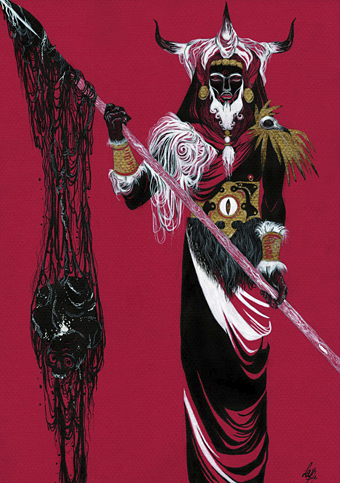
Santiago Caruso’s Maldoror

caruso1.jpg

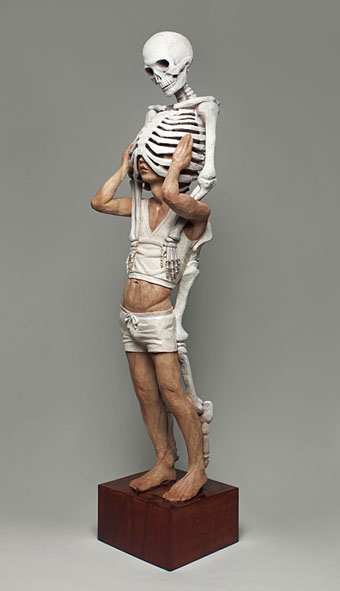
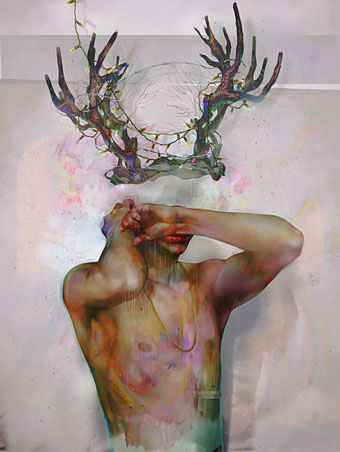
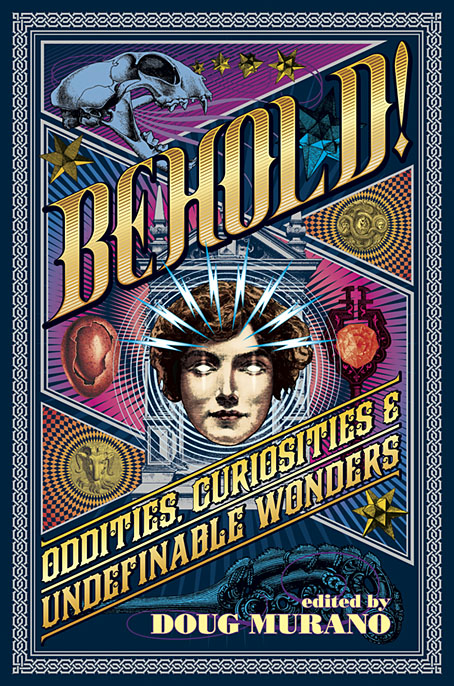
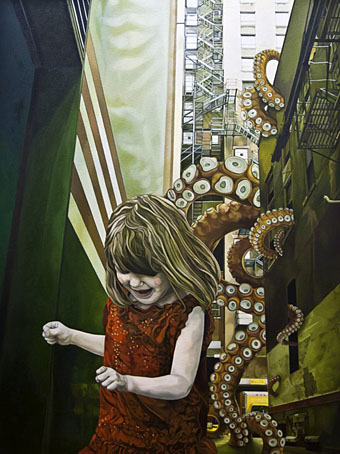
Continuing an occasional series in which illustrators of Lautréamont’s baleful masterwork are noted. Santiago Caruso’s paintings provide suitably grotesque embellishments to a Spanish edition of Maldoror which was published in 2016 by Valdemar. The book is part of their Gótica collection which includes many fine works of weird fiction including titles by contemporary writers such as Clive Barker and Thomas Ligotti. Caruso’s illustrations are among the best I’ve seen for Lautréamont’s novel, and make the book worthy of purchase even for those who can’t read Spanish. See the full set here.

caruso2.jpg

caruso3.jpg

Elsewhere on { feuilleton }
The illustrators archive

Previously on { feuilleton }
Jacques Houplain’s Maldoror
Hans Bellmer’s Maldoror
Les Chants de Maldoror by Shuji Terayama
Polypodes
Ulysses versus Maldoror
Maldoror
Books of blood
Magritte’s Maldoror
Frans De Geetere’s illustrated Maldoror
Maldoror illustrated

Typefaces of the occult revival

mmm.jpg

Man, Myth & Magic #1, January 1970; McCall’s, March 1970.

The announcement last week of the death of British character actor Geoffrey Bayldon prompted some discussion here about the typeface used for the titles of Bayldon’s TV series from the early 1970s, Catweazle. This was a humorous drama in which the actor portrayed a warlock transplanted by a time portal from the Norman era to the present day, a comic counterpart to another occult-themed series, Ace of Wands (1970–72). Being aimed at children, both Catweazle and Ace of Wands are at the lighter end of the great flourishing of occult-related media that runs in parallel with the rise and fall of psychedelic culture, a period roughly spanning the years 1965 to 1975. The two trends reflected and fed off each other; the hippie movement stimulated interest in the occult (Aleister Crowley is on the cover of Sgt Pepper) while giving to the commercial propagators of the supernatural a range of aesthetics lifted from the 19th century.

occult.jpg

Muller, 1972; TIME, June 1972.

Among the graphic signifiers is a small collection of typefaces from the Victorian or Edwardian eras, designs which vanished from sight after 1920 only to surface 50 years later in very different settings to their previous deployment. I’m always fascinated by the way context changes the perception of a typeface; the repurposing of Art Nouveau fonts—which hadn’t previously been associated with diabolism—to signify witchcraft or sorcery is a good example of this. In the case of the occult revival this was partly opportunism: the commercial application of post-psychedelic style made the previously untouchable trendy again, decoration and elaborate stylisation was no longer taboo. But it was also a solution to the problem of signifying the sorcerous with typography when there were no off-the-peg solutions as there were for, say, Westerns or stories about the Space Race. As well as carrying with them a flavour of old books, some of the more curious letterforms were reminiscent of the glyphs of magical alphabets which no doubt explains their popularity.

What follows is a chronological selection of the more striking examples (or my favourites…) which conveniently begins with Ringlet, the Catweazle font. With the trend being towards Art Nouveau you find popular Nouveau styles such as Arnold Bocklin also being used in the 1970s but I’ve avoided these in favour of the less common choices.


Ringlet (1882) by Hermann Ihlenburg

ringlet3.jpg

jullian08.jpg

Pall Mall, 1971.

Jullian’s landmark study of the Symbolist movement isn’t an occult text but it is a great favourite of mine whose original title—Esthètes et Magiciens—puts it in the right sphere. Inside, the author touches on the spiritual concerns of many of the artists which included Theosophy and fashionable Satanism.

ringlet1.jpg

ringlet2.jpg

Duckworth, 1973.

Aleister Crowley is represented here with the first reprinting of his erotic poetry, produced in a limited run by the venerable London house of Duckworth.

ringlet4.jpg

Rise Above Records, 2016.

Blood Ceremony are Canadians devoted to the occult rock of previous decades. Their presentation matches songs with titles like The Great God Pan and Morning Of The Magicians.


Rubens (1884) by John K. Rogers

rubens2.jpg

Rubens has long been a favourite of mine even though it gets used a great deal on horror novels and the like. Many Americans also regard it as “the Haunted Mansion font” owing to its use in Disney theme parks.

Peter Haining’s collection combined supernatural fiction with short non-fiction accounts of magical operations. The cover art is the full version of the drawing by Austin Osman Spare—The Elemental aka The Vampires are Coming—seen in detail on the cover of the first issue of Man, Myth & Magic.

rubens1.jpg

Coronet Books, 1972.


Eckmann (1900) by Otto Eckmann

eckmann2.jpg

eckmann1.jpg

Pan Books, 1969.

Many of the examples in this post tend towards the exploitational (see below…) but Cavendish’s overview of occult theory and history is a serious study, even if the cover does beckon to the Dennis Wheatley readership. My mother was among the latter which no doubt explains why she had a copy of this paperback; in due course it found its way into my hands. Richard Cavendish was enough of an authority to be hired by Purnell as editor-in-chief of Man, Myth & Magic.


Siegfried (c. 1900) by Wilhelm Woellmer

siegfried2.jpg

And speaking of which…Purnell offered their readership a sidereal start to 1971.

siegfried1.jpg

Man, Myth and Magic, 1970.

voodoo.jpg

Heinemann, 1977.


Pretorian (c. 1900) by PM Shanks & Sons

pretoria2.jpg

pretoria1.jpg

NEL, 1971.

This is where things shift from anthropology, history and children’s television to Satanic exploitation and hardcore porn. “Black magic” ceremonies in previous centuries were often a kind of orgiastic cosplay so it’s no surprise to find the same thing happening in the 20th century. New English Library dominated the British book world of the 1970s with a wide range of genre novels, as well as salaciously-packaged reprints of serious occult studies by Francis King and this volume by June Johns.

pretoria3.jpg

Undated.

Sexual Witchcraft and The Devil Made Me Do It are two works whose pornographic nature means their origin remains obscure; nobody seems to have any information about the latter title.

pretoria5.jpg

Undated.

pretoria6.jpg

Penguin, 1975.

pretoria4.jpg

Symbiosis by Demdike Stare. Modern Love, 2009.

Mancunian duo Demdike Stare hark back to the heyday of Ouija boards and witchcraft with sinister electronics and the monochrome art and design of Andy Votel. Pretorian is used on all their early releases.


De Vinne Ornamental (1900) by Nicholas J. Werner

devinne1.jpg

devinne2.jpg

Dell, 1978.

devinne3.jpg

Holt, Rinehart and Winston, 1984.


Marschall (1905) by Wilhelm Woellmer

marshall2.jpg

marshall3.jpg

Witchcraft magazine was a UK publication (dates unknown) whose revelatory stories ran alongside many photographs of naked ladies. There was a brief fad for this kind of thing, a diabolic counterpart to all those beefcake mags pretending to be devoted to body-building. Witchcraft did at least manage more than a single issue.

marshall1.jpg


Roberta (1962) by Robert Trogman

roberta1.jpg

Trogman’s type was based on a Belgian restaurant sign so this may be another Art Nouveau derivation. Not so the use to which it was put, however. Flaubert’s novel doesn’t feature any overt occultism (although there is a whole chapter of human sacrifice) but the cover is one of the first to establish Roberta as a signifier of the exotic/erotic .

roberta4.jpg

Berkley Medallion, 1966.

roberta2.jpg

The film equivalent of Witchcraft magazine from 1970. According to this review, Sex Rituals of the Occult also features some gay sex from the male performers, a rare thing in these boob-fests.

roberta3.jpg

Amicus Productions, 1971.


Davida (1965) by Louis Minott

davida1.jpg

Davida is one of those typefaces from the 60s that was very popular in the following decade so it’s no surprise to find one or two occult titles using it. I’ve included it here for the way its style refers back to Ringlet, and for Abragail and Valaria’s book of recipes.

davida3.jpg

Mattel, 1969.

davida2.jpg

Coronet Communications, 1971.

Previously on { feuilleton }
MMM in IT
The Book of the Lost
The Occult Explosion
Forbidden volumes
The Sapphire Museum of Magic and Occultism
Occultism for kids

Weekend links 357

brzezanska.jpg

Ruth St Denis (2010) by Agnieszka Brzezanska.

As Above, So Below: Portals, Visions, Spirits & Mystics is an exhibition of occult-oriented art at IMMA, Dublin. “An alternative history of art of the last century,” says Aidan Dunne.

THIS IS THE SALiVATION ARMY: a Tumblr archive of Scott Treleavan’s queer-pagan-punk zine, 1996–1999.

• Mixes of the week: Secret Thirteen Mix 219 by Paper Dollhouse, and a Mika Vainio Tribute Mix by broken20.

• Valdimar Ásmundsson’s Icelandic translation of Bram Stoker’s Dracula has been translated back to English.

• First evidence for higher state of consciousness found (thanks to psychedelic drugs).

• At Bibliothèque Gay: Narkiss (1908) by Jean Lorrain.

Boyd White on finding Arthur Machen’s bookplate.

Barry Adamson’s favourite albums.

John Waters: By the Book.

Dread: Lustmord in dub.

XXY Oscilloscope

Vampire (1976) by Devon Irons | Keep On Dubbing (1976) by Augustus Pablo | African Dub (1977) by The Silvertones

The Thing Group Art Show

creaturefeatures.jpg

People or, indeed, things in the Los Angeles area may be interested in the Thing Group Art Show which opens this Saturday at Creature Features in Burbank. The gallery will be displaying prints and original artwork from the forthcoming The Thing: Artbook including a print of my own contribution. Some of the prints are for sale, as mine will be, so Coulthart collectors (I know there’s one or two out there) should head to Magnolia Boulevard.

The publishers of The Thing: Artbook, Printed In Blood, have requested that the artists refrain from showing their contributions until the book is launched in July. I can show this Thing head, however, a manifestation that I couldn’t fit into my final composition. Even before I began work on my piece I suspected that many of the other artists would be doing their own versions of favourite moments from the film, an accurate prediction as it turns out. So my intention was to try and show some of the nastiness that might be occurring between the filmed scenes, to which end I produced a number of sketches of fanged heads. The one below would have worked better attached to a body (or at least some limbs) but I was running out of time so it was left aside. The Thing: Artbook may be pre-ordered here.

thing.jpg

Previously on { feuilleton }
Things

Weekend links 353

tuke.jpg

The Critics (1927) by Henry Scott Tuke.

• Geeta Dayal talks to ambient musician Midori Takada about Through The Looking-Glass (1983), an album being reissued this month by Palto Flats/We Release Whatever The Fuck We Want Records.

Jacob Brogan reviews The Abominable Mr. Seabrook by Joe Ollmann, a graphic biography of writer, occultist, explorer and determined cannibal, William Seabrook.

• More from the usual suspects (on these pages at least): Jonathan Meades on his new cookbook and a recent bout of heart surgery; and Iain Sinclair on The Last London.

The law only applied to men, but that didn’t mean same-sex relationships between women were immune to opprobrium. Dorothy Todd was hired as the editor of British Vogue in 1922. Under her visionary stewardship, the magazine became a bastion of high modernist style, swapping petticoats and corsets for Picasso, Cocteau, Man Ray and Woolf. Todd lived with her lover, the fashion editor Madge Garland. Sacked in 1926 because of declining circulation, she planned to sue the magazine, but was silenced when the publisher Condé Nast threatened to publicly expose her “morals”.

In such an inimical climate, it’s not surprising that art became a zone of enchantment as well as resistance. The plenitude of camp aesthetics, the lush excess, the cross-pollination of high and low forms might be conceived as a direct response to the paucity and hostility of the culture at large. From the mannered decadence of Aubrey Beardsley’s naughty woodcuts, to Cecil Beaton’s portraits of Stephen Tennant as a radiant boy prince, to the cabaret high jinks of Danny La Rue, to the wickedly doctored library book covers made by the playwright Joe Orton (a crime for which he received a jail sentence), camp offered a way of remaking the world, cutting it down to size and reassembling it in richly strange and strangely rich new forms.

Olivia Lang on the British artists working in defiance of iniquitous laws prior to the (partial) decriminalisation of homosexual acts in 1967.

• Due for publication later this year, You Should Come With Me Now, a new collection of short fiction by M. John Harrison.

Daniel Marner reviews Scarred For Life Volume One: The 70s, a book about the dark side of British pop culture.

Jay Babcock talks to Erik Davis about the end of Arthur magazine and his new life in the Californian desert.

• The nature photography of Nobuyuki Kobayashi and the ruin photography of Gina Soden.

Jon Forss of design team Non-Format on his time designing The Wire magazine.

Mac McClelland on how doctors treat mental illness with psychedelic drugs.

• Mix of the week: Secret Thirteen Mix 216 by WSR.

Hisham Matar on Jorge Luis Borges.

London Boys (1976) by T. Rex | Last Train To London (1979) by Electric Light Orchestra | London (2004) by Patrick Wolf