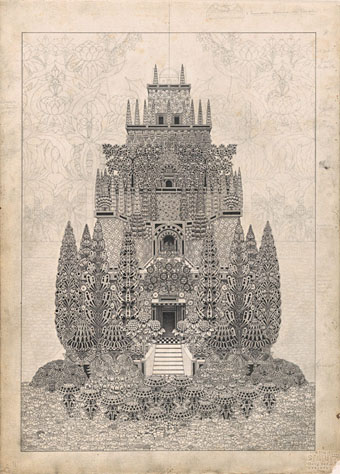
Illustrating Frankenstein

holst.jpg

Frontispiece by Theodore Von Holst of the 1831 edition of Frankenstein. The monster in this illustration, which Mary Shelley would no doubt have seen, is closer to the description in the text than the myriad shambling figures that came later.

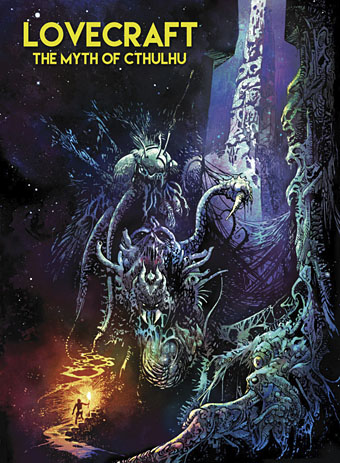
It’s a recurrent feature of commissioned work that you sometimes find yourself illustrating novels or stories you might otherwise have never attempted. Spanish publisher Editorial Alma have just added a new edition of Mary Shelley’s Frankenstein to their series of illustrated classics, convenient timing with this year being the bicentenary of the book’s first publication. Last year I produced 33 illustrations for Alma’s collection of Poe stories, as well as 3 new illustrations for a small Lovecraft collection. For their edition of Frankenstein I’ve created 24 full-page pictures, one for each chapter. (I produced 25 in total, 24 for the chapters and one for the letters at the front, but the Spanish translation is arranged slightly differently so one of the drawings has been omitted.) In the past I’ve given little consideration to illustrating classic books, preferring to look for subjects which were less familiar. Frankenstein is a book that isn’t illustrated as much as some but Lynd Ward in 1934, and Berni Wrightson in 1977/78 both produced sufficiently exceptional sets of drawings for me to regard the novel as almost unassailable. Until last year, that is.

ward1.jpg

Frankenstein by Lynd Ward (1934).

Despite such formidable predecessors, I felt that with this book at least I might be able to offer something new using the blend of collage and drawing that I’ve been evolving recently. There was additional promise in that the story as it’s written is less familiar than the Poe stories, and much less familiar than its fellow horror classic, Dracula. People think they know Frankenstein but what they often know is the manglings the novel has received in various film and TV adaptations. The Ward and Wrightson illustrations stay close to the text, the latter being replete with period detail, and rendered in a style reminiscent of 19th-century wood engravings. Wrightson even copied two of Gustave Dore’s pictures from The Rime of the Ancient Mariner for the opening scenes on the ship, one of which went unused. But Wrightson’s drawings are closer still to Franklin Booth‘s pen-and-ink style which was also derived from wood engraving yet which achieves its effects in a different manner to the engraving process.

frankenstein2.jpg

Frankenstein by Berni Wrightson (1977/78).

Even when artists follow the text of Frankenstein more closely than the screenplay adapters, personal tastes can’t help manifest themselves. So Ward’s drawings reflect the angular and stylised compositions of his “novels in woodcuts”, while Wrightson’s work still shows evidence of his earlier career as a comic artist. With my illustrations I wanted to reflect the artistic spirit that gave birth to the novel, namely Romanticism. Frankenstein is very much a Romantic tragedy with violent passions set against the overwhelming landscapes of the Swiss Alps, the Rhine valley and the Arctic seas. Three of the illustrations below allude to Caspar David Friedrich’s paintings, while many of the others have had their mundane cloudscapes exchanged for gloom and tumult.

I’ve said before that one of the things I enjoy about the collage technique is being able to use engravings and other graphics from the same period (give or take a few decades) as the story itself. The disadvantage of relying on pre-existing sources is that you’re always limited by the available material, so recently I’ve been pushing the technique further to achieve a hybrid style, something midway between the Ernst/Sätty engraving-collage technique and the very laborious, heavily-shaded pen-and-ink style I used when I was drawing comics. The approach isn’t so different to the one I used in my Lovecraft comics many of whose backgrounds and other details were copied from photographs. The difference is that where I used to spend several days working on a single panel (and two weeks working on a page) I can now create an entire picture in half the time. In these new illustrations I feel the hybrid style is working as I intended, allowing me greater freedom to create the picture I have in mind rather than a picture dictated by the source material. Without incorporating original figures and other drawn elements into the compositions it would have been difficult to illustrate a story with the same characters in so many scenes, a problem I encountered when I was illustrating Lewis Carroll’s Alice books and ran out of pictures of Victorian girls.

The full run of pictures follows below, including the one which was omitted from the print edition. All may be seen at a larger size here. Since the scenes aren’t always self-explanatory I’ve included fragments of text from each chapter.

frankenstein00.jpg

“In the morning, however, as soon as it was light, I went upon deck and found all the sailors busy on one side of the vessel, apparently talking to someone in the sea. It was, in fact, a sledge, like that we had seen before, which had drifted towards us in the night on a large fragment of ice.”

frankenstein01.jpg

“During one of their walks a poor cot in the foldings of a vale attracted their notice as being singularly disconsolate, while the number of half-clothed children gathered about it spoke of penury in its worst shape.”

This one was omitted from the Alma edition. No loss, really, since the scene doesn’t add much to the story.

frankenstein02.jpg

“When I returned home my first care was to procure the whole works of this author, and afterwards of Paracelsus and Albertus Magnus. I read and studied the wild fancies of these writers with delight; they appeared to me treasures known to few besides myself.”

The diagrams here are taken from some of the books the young Victor Frankenstein is reading. There’s an allusion to this in the magic square on the wall in the back of Theodore Von Holst’s frontispiece, the square being the kind of thing seen in books like this one by Cornelius Agrippa, one of the occult philosophers mentioned in the novel.

Continue reading “Illustrating Frankenstein”

Weekend links 400

bernard.jpg

Le Répit (La Mort allaitant une chauve-souris) (1895) by Valère Bernard.

Playhouse 90 presents Heart of Darkness by Joseph Conrad. An American TV production from 1957 starring Boris Karloff, Roddy McDowall, Eartha Kitt and others; introduced by Sterling Hayden. It’s bizarre. Acidemic goes into the detail.

• Erik Davis talks to occult writer and drug geek Julian Vayne about Baphomet, the (sur)reality of spirits, evolution, ritualizing entheogens, and his new book Getting Higher: The Manual of Psychedelic Ceremony.

• “Unsurprisingly, 1. Outside was the record that the #BowieBookClub readers most readily associated with Hawksmoor.” Anna Aslanyan revisits Peter Ackroyd’s architectural mystery.

The Flowers of Dorian Gray: part one of a series of posts examining one of Oscar Wilde’s favourite symbols.

• At Haute Macabre, an interview with Michael Locascio & Heather Jean Skawold of Dellamorte & Co.

One Minute Art History, an animated film by Cao Shu.

Film posters at the Harry Ransom Center, UT-Austin.

• Mix of the week: FACT mix 639 by Black Milk.

Susanna‘s favourite albums.

• Welcome to The Spoodoir.

• Flowers Of Evil (1983) by Cortex | Baphomet (1989) by Foetus Inc. | Heart Of Darkness (1989) by Syd Straw

The Demons of King Solomon

demon01.jpg

Abyzou.

Presenting my illustrations for The Demons of King Solomon, a horror anthology edited by Aaron French. This is a follow up to Aaron’s The Gods of HP Lovecraft which was published by JournalStone in 2015. I did 6 illustrations for the Lovecraft volume, covering half the stories whereas the new book has illustrations of mine for every story.

demon02.jpg

Agaras.

The brief for the authors this time was to write a story incorporating a Solomonic demon of their choosing. There are many of these, from the ones described in the Testament of Solomon to the 72 listed in the Ars Goetia (or Lesser Key of Solomon), the latter being familiar to many people via their often comical depictions in De Plancy’s Dictionnaire Infernal. My original intention for the illustrations was to do a series of pictures based on each story. Some of the stories were late in arriving, however, and I only had a month free for the work so I changed the plan to a series of depictions of the demons as they’re described in the grimoires. This makes more sense when many of the stories have the demons masquerading in human guise, so the illustrations not only show something new but also act as a connection back to their infernal history. Agaras (or Agares), for example, is described by the grimoires as an old man riding a crocodile with a hawk on his arm. Most of the seals on each picture are taken from the ones for the demons shown in the Ars Goetia. Not all the demons in the anthology are listed there so I had to invent a few seals to fill out the collection. I’ll let people guess which are genuine and which are inventions. The Demons of King Solomon is out now from JournalStone. Larger copies of the illustrations may be seen here.

demon03.jpg

Amdusias.

demon04.jpg

Asmodeus.

Continue reading “The Demons of King Solomon”

Weekend links 395

godwin.jpg

Love is a Martyrdom (1965) by Stephanie Godwin. See Joscelyn Godwin’s Flickr pages for more.

David Shire’s synthesizer score for Apocalypse Now was the first music recorded for the film but was abandoned when Shire was fired due to other commitments. 39 years later, his score has been released by La-La Land Records.

Moon Safari by “French band” Air was released in the UK on January 16th, 1998. Jeremy Allen looks back at an album that was more successful here than elsewhere.

• On the occasion of the US publication of Iain Sinclair’s The Last London, Geoff Nicholson presents an A to Z of the author and his works.

This is the story of how two artists fell in love with each other, with Kelmscott Manor, and with William Morris, the poet, craftsman, and socialist who had made it his home. As Kelmscott’s first tenants afer the Morris family, Edward and Stephani Scott-Snell rented the historic Oxfordshire house throughout the Second World War. There they created an aesthetic and erotic paradise based on a fantasy land called ‘Thessyros’, and produced a body of figurative painting unique for its time. Much of this was done under the influence of a legally-obtained drug they called ‘Starlight’, making many of their paintings  early examples of psychedelic art.

The Starlight Years is a book by Joscelyn Godwin about his artist-parents and their strange relationship

• Mixes of the week: FACT mix 634 by Minor Science, Secret Thirteen Mix 243 by Moa Pillar, and XLR8R Podcast 524 by Burnt Friedman.

• At The Smart Set: Marian Calabro pays a visit to the Brussels apartment where René and Georgette Magritte lived from 1930 to 1954.

Hormone Lemonade, a new album by Cavern Of Anti-Matter, will be released in March. The Quietus has a preview.

• At the Internet Archive: QZAP, the Queer Zine Archive Project; 551 downloadable publications from 1974 to 2015.

• At Dennis Cooper’s: Briefly recounting Tim Buckley‘s short, inconvenient stylistic trajectory.

• Musician and bookseller Richard Bishop recommends a handful of rare occult volumes.

• At Kickstarter: Arsgang, a short psychological horror film by Harry Edmundson-Cornell.

• “A Sloppy Machine, Like Me”: Michael Grasso on the history of video synthesizers.

• At Flashbak: 27 Snapshots of Manchester in the 1960s.

• At Strange Flowers: 18 books for 2018.

Love Is Strange (1956) by Mickey & Sylvia | Love Is Peace (1970) by Amon Düül | Love Is The Drug (1980) by Grace Jones

Weekend links 394

coin.jpg

Britain’s Royal Mint acknowledges this year’s bicentenary of the publication of Frankenstein with a commemorative £2 coin.

• A trailer for The Green Fog, a film by Guy Maddin, Evan Johnson and Galen Johnson, which uses clips from over 200 films set in and around San Francisco to create a collage companion to (and critique of) Alfred Hitchcock’s Vertigo. John DeFore reviewed the film for The Hollywood Reporter.

• Downloadable sound files and utilities for the Fairlight Computer Musical Instrument. Should you require it, the file containing the orchestra stab that was a feature of so much pop music in the 1980s is ORCH5. (Click on the “Library/Disk” listing then click “Extract” to download the samples.)

• Radio at the Internet Archive: the BBC adaptations of Mervyn Peake’s Titus Groan and Gormenghast (both adapted by Brian Sibley in 1984); and 554 Sherlock Holmes radio shows.

• Mixes of the week: XLR8R Podcast 523 by Scanner, RA Podcast 605 by Chris SSG, and Secret Thirteen Mix 241 by Jaroska.

• At Discogs: a list of “Experiments, gimmick and concept albums, bands and labels“.

Patrick Cowley The Ultimate Master Megamix

• At Dennis Cooper’s: Karen Black Day.

Events In Dense Fog (1978) by Brian Eno | Fog Animal (2005) by Deaf Center | In The Fog I (2011) by Tim Hecker