Weekend links 492

wilson

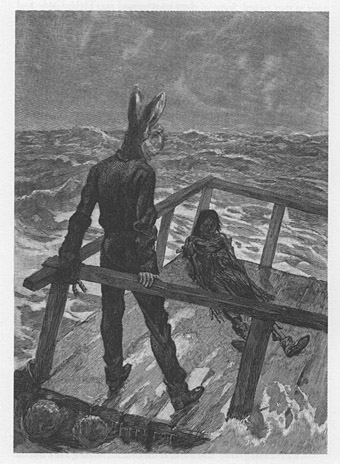
Cover art by Gahan Wilson for Monster (1980) by Herbie Hancock.

• RIP Gahan Wilson, a great cartoonist with a flair for horror, the macabre and grotesque. Many of his best cartoons are buried in back issues of The New Yorker, Playboy and National Lampoon but book collections of his work are worth seeking out. He also wrote regularly, and for several years was a film reviewer and columnist for The Twilight Zone Magazine, back issues of which may be found at the Internet Archive. Related: Gahan Wilson and the Comedy of the Weird, an interview with Wilson by Richard Gehr; The Beautifully Macabre Cartoons of Gahan Wilson by Michael Maslin.

• The Unanswered Question: Irmin Schmidt, the last surviving member of Can, interviewed by Duncan Seaman. The conversation is mostly about his solo work but he also mentions plans to release a collection of live Can recordings next year.

Valerie and Her Week of Wonders (1970), the Surrealist fable directed by Jaromil Jires, receives a welcome region-free blu-ray release by Second Run in January.

At its best, the true psychedelic experience is an analogue of psychotherapy: you are encouraged to lean in to something potentially rupturing or even disturbing, in an attempt to achieve deep personal resolution rather than simply mind-scrambling hedonism or entertainment (which, to be fair, the group can provide as well). […] Despite clear and longstanding links with the extreme worlds of black metal, power electronics, industrial, sludge metal and doom, Sunn O))) have created a space that now stands beyond any obvious scene signifiers. This zone of pure affect—and what they hope will be a healing experience—is welcome to all.

John Doran on the vibrational power of Sunn O)))

Neuland is an electronic collaboration by two ex-members of Tangerine Dream, Peter Baumann and Paul Haslinger.

• Flying teapots and electric Camembert: the story of Gong, prog’s trippiest band by Simon Reynolds.

• Conversations with Ursula: Clive Hicks-Jenkins answers some questions about his art.

• Mix of the week: Test Transmission Archive Reel 38 by Keith Seatman.

• Limitation of Life: Tim Pelan on John Frankenheimer’s Seconds.

Anthony Madrid on the most famous coin in Borges.

• At Dennis Cooper’s: Jacques Tati Day.

Dutch Graphic Roots

The Magic Yard (1970) by Lubos Fiser | Valerie (2003) by Broadcast | Introduction (2007) by The Valerie Project

Weekend links 491

beatty.jpg

The Weirdness is Coming, an illustration by Robert Beatty for an NYMag feature about the near future.

• I’m slightly late to this news, but better late than never: The Doll’s Breath is a 22-minute animated film by the Brothers Quay, shot on 35mm film and with a soundtrack by Michèle Bokanowski. It may take a while before it’s available to view outside the festival circuit but it’s good to know it’s in the world. Related: Filip Lech on the Polish inspirations of the Brothers Quay.

• More from Swan River Press: Joseph Sheridan Le Fanu’s disturbing horror tale, Green Tea, is published in a 150th anniversary edition, with an introduction by Matthew Holness, two essays and a CD containing a theatrical adaptation of the story by the Wireless Mystery Theatre.

• Luca Guadagnino, Olivia Laing and Sandy Powell, Tilda Swinton and John Waters choose favourite pieces of writing by Derek Jarman. Related: Protest!, a Jarman exhibition at the Irish Museum of Modern Art.

Fairport [Convention]’s revolutionary impact came in doing precisely the opposite of what the folklorists had intended when they began collecting the songs. By taking the old songs and setting them down on paper, they had largely believed they were preserving them in the form in which they must remain, ignoring the fact that songs passed through generations orally will always evolve. Fairport, though, played extremely fast and loose with the source material, matching tunes from one source with lyrics from another. As Rob Young put it in his book Electric Eden: “It threw into question the spurious ‘authenticity’ of the folk versions studiously set in stone by the Victorian and Edwardian collectors. Fairport’s electrifying act preserved and restored the guts and spontaneous vigour to the folk continuum.”

Michael Hann on the 50th anniversary of Fairport Convention’s Liege & Leaf

• More Patrick Cowley: PC’s megamix of Hills Of Kat Mandu by Tantra. And the mix of the week: a Patrick Cowley tribute from 1981 by DJ Jim Hopkins.

• The seventh edition of Wyrd Daze—”The multimedia zine of speculative fiction + extra-ordinary music, art & writing”—is out now.

5 Mishaps: A 32-page hardbound handmade book of short stories by Tamas Dobozy, with collage illustrations by Allan Kausch.

• At Dangerous Minds: Lovely Bones: The transfixing skeletons and dreamlike nudes of Belgian painter Paul Delvaux.

• From 1979: a very early TV appearance by Virgin Prunes (their first?) on Ireland’s The Late Late Show.

• Fists of fear: Anne Billson on 10 films featuring severed (and frequently vengeful) hands.

Adrian Curry at MUBI selects his favourite film posters of the 2010s.

Tea For Two (1956) by Duke Ellington | Tea For One (1976) by Led Zeppelin | Tea In The Sahara (2001) by Simon Shaheen & Qantara

Weekend links 490

stoer.jpg

An engraving from The Geometric Landscapes of Lorenz Stoer (1567).

• Curtis Harrington’s cult horror film, Night Tide (1961), receives a lavish blu-ray reissue from Powerhouse in January. The limited edition will include an extra disc of Harrington’s early short films which encompass Poe adaptations and also Wormwood Star, his portrait of occult artist (and actor in Night Tide) Marjorie Cameron.

• “He was the first American representative of an electronic sound that was largely coming from Europe, from bands like Kraftwerk, or producers like Giorgio Moroder and Pete Bellotte…” Jude Rogers on Patrick Cowley.

Clive Hicks-Jenkins examines Hans Poelzig’s and Marlene Moeschke’s work on Paul Wegener’s 1920 film of The Golem. Wegener’s film is released this month in a restored blu-ray edition by Eureka.

• “Conrad was uncompromising in his beliefs until the end, sticking to his ideals with tenacious fervor.” Geeta Dayal on Tony Conrad: Writings, edited by Constance DeJong and
Andrew Lampert.

• At Dennis Cooper’s: 47 dead films. One of the films, Hu-Man (1975), a French science-fiction drama starring Terence Stamp, isn’t as dead as was assumed.

• The Danske Filminstitut has made a collection of Danish silent films available to watch for free online.

• The Last Time I Saw John Giorno, an Extraordinary Performance Poet by Mark Dery.

• “Like looking through butterfly wings”: Ira Cohen’s Mylar chamber—in pictures.

Callum James reviews the Early Poetical Works of Aleister Crowley.

• Drawing the Gaze: Revisiting Don’t Look Now by Jesse Miksic.

• Mix of the week: FACT Mix 745 by Visible Cloaks.

Mind Warp (1982) by Patrick Cowley | Go-Go Golem (1986) by Golem Orchestra | Night Tide (1995) by Scorn

Weekend links 489

wyrding.jpg

Typhonic Neural Tantra by The Wyrding Module.

• November 2019, as many people have been noting, is the month in which Ridley Scott’s Blade Runner takes place. At Dangerous Minds Paul Gallagher writes about the unrelated William Burroughs script whose title was borrowed for Scott’s film.

• More Ridley Scott (sort of): disco was still a big thing when Alien was in the cinemas 40 years ago, so Kenny Denton reworked Jerry Goldsmith’s Alien score into a disco single which he released under the name Nostromo.

• “The Count of Monte Cristo is one of the most exciting novels ever written and on the other hand is one of the most badly written novels of all time and in any literature.” Umberto Eco on the cult of the imperfect.

• Jonathan Glazer has made a short film, The Fall, for the BBC but the corporation’s restrictions mean that (for the moment) it’s difficult to see if you live outside the UK.

• New albums at Bandcamp: Typhonic Neural Tantra by The Wyrding Module, and Emotional Freedom Techniques by Jon Brooks (aka The Advisory Circle).

• Hawkwind dancer Miss Stacia and the Barney Bubbles estate have made a line of T-shirts based on Barney Bubbles’ Space Ritual design.

Walter Murch and Midge Costin on the art of cinematic sound design.

Ivana Sekularac on the former Yugoslavia’s brutalist beauty.

• Congratulations to Strange Flowers on its 10th anniversary.

Geoff Manaugh on the witch houses of the Hudson Valley.

• At Dennis Cooper’s: 19 experimental horror films.

Fall (1968) by Miles Davis | The Fall (2011) by The Haxan Cloak | Fall (2014) by The Bug (feat. Copeland)

Peter Strickland’s Stone Tape

stonetape.jpg

My annual Halloween post breaks with its usual music mix/playlist format this year for a recording of The Stone Tape, Peter Strickland’s hour-long radio drama made for Halloween in 2015. This was an adaptation, co-written with Matthew Graham, of Nigel Kneale’s celebrated TV play of the same name, first broadcast in 1972 for the BBC’s Christmas ghost-story slot then unavailable for many years. The combination of Kneale’s name and the impossibility of easily seeing the play gave The Stone Tape a reputation somewhat greater than it might otherwise have warranted. The drama has a number of shortcomings by contemporary standards: the whole thing is shot on video, so it compares unfavourably to the ghost films the BBC were making throughout the 1970s, and the acting is also quite histrionic in places. On the plus side there’s a woman scientist as the central character (an excellent performance by Jane Asher), and another of Kneale’s examinations of a horror staple—the haunted house, in this case—which adeptly twists your expectations while combining science and the supernatural in equal measure.

Strickland’s adaptation uses the same scenario—struggling electronics company moves into a house with a haunted reputation—but with the events moved slightly forward to 1979. The director’s fondness for electronic music shifts the emphasis of the story to the capabilities of electronic sound, both its destructive potential and its use as a diagnostic tool. James Cargill, formerly of Broadcast, now in Children Of Alice, was the soundtrack composer on Strickland’s second feature film, Berberian Sound Studio, and here creates the music and electronic sounds. The radio play is closer to Berberian Sound Studio than anything else Strickland has done to date, and could even be regarded as a companion piece with its recording equipment and repeated screams. (Eugenia Caruso provides screams for both.) As with the film, two thirds into the drama the narrative becomes much more diffuse and fragmented; the recording medium itself is foregrounded for a lengthy sequence that works like an audio equivalent of found-footage horror films. The hazard of this is that the layered nature of Kneale’s horrors may not be so apparent if you’ve not seen the TV version (I can’t say) but the sound design is excellent throughout, and benefits from the use of headphones to appreciate its subtleties. There’s also some sly reference to Alvin Lucier if you’re familiar with his compositions. Jane Asher makes a cameo appearance as the mother of the character she portrayed in the TV version.

The Stone Tape may be listened to or downloaded here.

Previously on { feuilleton }
Nigel Kneale’s Woman in Black
Stone Tapes and Quatermasses
Nigel Kneale’s Nineteen Eighty-Four
The Stone Tape