The art of Paul Thévenaz, 1891–1921

thevenaz01.jpg

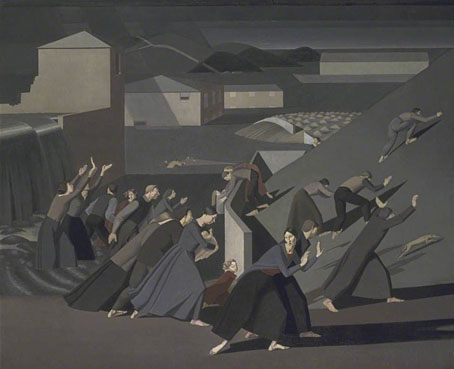
This portrait of Jean Cocteau by Swiss artist Paul Thévenaz isn’t included in the artist’s memorial book, Paul Thévenaz, A Record of His Life and Art (1922) which was published after Thévenaz died suddenly at the age of 30. Everything else in this post is, however, and there’s more in the book itself which shows Thévenaz ranging through society portraits (and self-portraits), designs for the theatre (I’ve included a Salomé below), murals and sketches.

Thévenaz is another candidate for the pantheon of lost gay artists although the work in the book isn’t especially homoerotic. There are fauns, however, which might be connected to his romantic association with poet Witter Brynner. The latter’s A Canticle of Pan was written in 1918, and is one of the many manifestations of the horned god in the literature of the period. As for Thévenaz, I like his drawing style a great deal; in places it resembles Wyndham Lewis in its sweeping curves and stylisations. (Thanks to Callum for the tip!)

thevenaz02.jpg

thevenaz03.jpg

thevenaz04.jpg

Continue reading “The art of Paul Thévenaz, 1891–1921”

Weekend links 310

monogenis.jpg

Parkland (2012) by Dean Monogenis.

• “The Story Behind the Planet’s Most Influential Road Map of ‘Weird Music’“. Gustavo Turner investigates the enduring influence of The Nurse With Wound List. Related: A Discogs list of links to all the NWWL discographies, and a recommended listening guide by Ultima Thule.

Tokyo Melody: Un film sur Ryuichi Sakamoto (1985) by Elizabeth Lennard features Sakamoto at work on Illustrated Musical Encyclopedia, together with Akiko Yano, Haruomi Hosono and Yukihiro Takahashi.

• “We wanted to fuse the aesthetics, histories and values of witchcraft, the traditional ideas with a contemporary edge,” says editor and creative director of Sabat magazine, Elisabeth Krohn.

There is a very seductive and very dangerous demon: the demon of generalities. He captivates man’s thought by marking every phenomenon with a little label, and punctiliously placing it together with another, similarly carefully wrapped and numbered phenomenon. Through him a field of human knowledge as changeable as history is turned into a neat little office, where this many wars and that many revolutions sleep in folders – and where we can pore over bygone ages in complete comfort. This demon is fond of words such as “idea”, “tendency”, “influence”, “period”, and “era”. In the historian’s study this demon reductively combines in hindsight the phenomena, influences and tendencies of past ages. With this demon comes appalling tedium – the knowledge (utterly mistaken, by the way) that, however humanity plays its hand or fights back, it follows an implacable course. This demon should be feared. He is a fraud. He is a salesman of centuries, pushing his historical price list.

Vladimir Nabokov in a previously unpublished lecture, On Generalities

• More Tom Phillips: 20 Sites n Years, a film by Jake Auerbach & David Thorp about the artist’s long-term urban photography project, is showing at Camberwell College of Arts next month.

• Mixes of the week: Sass In Pocket by Abigail Ward, Near Mint, 17th May 2016 by Robin the Fog & Hannah Brown, and Secret Thirteen Mix 184 by Andi Stecher.

• Grey Dog Tales talks to Brian J Showers of Swan River Press about horror and supernatural fiction.

• “Magic mushrooms lift severe depression in clinical trial.” But their use is still illegal in the UK.

• “Your brain does not process information, and it is not a computer,” says Robert Epstein.

Cliff Martinez’s theme for Nicolas Winding Refn’s forthcoming The Neon Demon.

Diamanda Galás, Still Wild and Primal, Returns to the New York Stage.

Janae Corrado on the photography of Joel-Peter Witkin.

Alastair Gee on gay home movies from the 1940s on.

People Laugh At Me (Coz I Like Weird Music) (1980) by The Instant Automatons | Weird Caravan (1980) by Klaus Schulze | Call It Weird (1983) by Xymox

Weekend links 309

witch.jpg

From What is a Witch, “an illuminated manifesto on witchcraft” by Pam Grossman and Tin Can Forest.

• “The other strand of influence for me from dance music was a production house called Savoy in Manchester, England. They were a super underground publishing house that printed cartoons and comic books, and they also released a series of underground dance records. And they were always being shut down by the police and all their stuff was being confiscated, because it was considered ‘anti-society’ in England.” Anohni giving a shout to my colleagues at Savoy Books in a new interview.

Belladonna of Sadness (1973), a feature-length animated film by Eiichi Yamamoto, has been restored, and is being given a premier release in the US. There’s a review here and a trailer here. No news as yet of a UK release but Finders Keepers has the soundtrack album.

Alejandro Jodorowsky talks to Daniel Kalder about his new novel, Albina and the Dog-Men, while Jodorowsky’s comic-book collaborator, Ladrönn, talks to Smoky Man about their new graphic novel, The Sons of El Topo.

Pretty little watercolours these are not. Made by bulldozers and dynamite instead of a paintbrush and easel, the works—often sited on baking sandscapes—fuse minimalism and modern industrial aesthetics to evoke the otherworldly structures of ancient civilisations, from Stonehenge to Mayan temples and the Egyptian pyramids.

Alex Needham on America’s land artists. A few years ago I tracked down some of the structures he describes using Google Maps.

• In every dream home a heartache: High Rise director Ben Wheatley on adapting Ballard, practical special effects and ’70s parenting.

Tom Phillips: From Prequel To Sequel, an exhibition of pages from A Humument at Shandy Hall Gallery.

• From fresh food to magic mushrooms: Michael Pollan probes the medicinal uses of psychedelic drugs.

• “Let’s not forget graphic design is an artistic discipline,” says Jonathan Barnbrook.

Supervert discusses censorship and related matters at SomethingDark.

• “I’ve sung gospel music when in great despair,” says Diamanda Galás.

• Mix of the week: FACT Mix 550 by James K.

Boy Club is a new gay magazine.

Gospel Trane (1968) by Alice Coltrane | The Gospel Comes To New Guinea (1981) by 23 Skidoo | Gospel Train (1990) by African Head Charge

Weekend links 308

trochut.jpg

Frank Herbert’s Dune receives a new cover design by Alex Trochut together with other notable works of science fiction and fantasy for a new series from Penguin.

• “…poet, scholar and biographer Sandeep Parmar…has raised the possibility that a long poem by Hope Mirrlees, titled Paris and published by the Hogarth Press in 1919, was a strong influence on The Waste Land.” Alfred Corn on new TS Eliot scholarship.

• “[Evolution‘s] strain of body horror brings to mind an ethereal HP Lovecraft mixed with David Cronenberg.” Rachel Bowles talks to the film’s director, Lucile Hadžihalilović.

• Library music “is a sonic world of ‘weird beats, odd instrumentations, albums full of dark jazzy interludes or bizarre garage rock.'” Adrian Shaughnessy on innovation in banality.

Italy, which EM Forster called “the beautiful country where they say ‘yes’”, became another resort, especially the island of Capri, where a French poet staged a ceremonial flogging of his teenage Italian lover before the boy departed to do his military service and became the subject of a novel by his compatriot Roger Peyrefitte. In the Egyptian city of Alexandria, Forster observed the Greek poet Constantine Cavafy “standing absolutely motionless at a slight angle to the universe”, and the Australian novelist Patrick White met a local man who became his lifelong companion. For decades, the novelists Paul and Jane Bowles presided in Tangier, which Jack Kerouac was to call a “sinister international hive of queens”. William Burroughs arrived in 1954 with a teenage Spaniard named Kiki who, Woods writes, “was, famously, the boy who would blow smoke into his pubic hair and say ‘Abracadabra’ as his hardening cock emerged from the cloud”. Tangier was to figure in Burroughs’s novel Naked Lunch as a phantasmagoric, rubbery walled sex market called the Interzone.

Caleb Crain reviewing Homintern by Gregory Woods

• Beardsley biographer Matthew Sturgis reviews Aubrey Beardsley: A Catalogue Raisonné, a two-volume collection edited by Linda Gertner Zatlin.

• “He was the Bresson of Birkenhead.” Andrew Collins reviews the forthcoming collection of BBC dramas directed by Alan Clarke.

• “The postwar Hollywood western was more content to let strangeness be strange,” says Michael Newton.

• “Bosch’s work has always caused trouble for interpreters and critics,” says Morgan Meis.

Misplaced New York: a project by Anton Repponen and Jon Earle.

Wyrd Daze, Lvl2 Issue 6, is out, and as before is a free download.

Lessons we can learn from Robert Altman’s 3 Women.

• Mix of the week: FACT Mix 548 by Peder Mannerfelt.

Paris 1971 (1971) by Suzanne Ciani | Paris II (1987) by Jon Hassell | Dreaming Of Paris (2013) by Van Dyke Parks

Weekend links 307

chew.jpg

Demon (2014) from the Witch Series by Camille Chew.

• Released next month, Machines Of Desire is the first album of new music by Peter Baumann since Strangers In The Night in 1983. Baumann’s first two solo albums, Romance 76 (1976) and Trans Harmonic Nights (1979), are exceptional works of analogue electronica that frequently outmatch his former colleagues in Tangerine Dream. Both albums have been unavailable for over 20 years so it’s good to know that Cherry Red are reissuing them at the end of May (see here and here).

• RIP Jenny Diski whose death from cancer wasn’t a surprise when she’d been writing about her condition for many months. Linked here in 2013 was this pre-diagnosis meditation on death that takes in Nabokov, Beckett and Francis Bacon (philosopher, not artist). “Jenny offered a living example of how, sometimes, compassion can be born of misanthropy,” says Justin EH Smith. The LRB’s archive of Diski writings is currently free to all.

Murder by Remote Control, a graphic novel by artist Paul Kirchner and writer Janwillem van de Wetering that “resembles a Raymond Chandler-esque noir ‘whodunnit,’ viewed through the psychotropic lens of filmmaker Alejandro Jodorowsky”.

Inspired by Gore Vidal’s 1968 satirical novel, Myra Breckinridge which was denounced as obscene by conservatives, [Boyd] McDonald embarked on a radically, offensive publication, one that avoided the sexless influence of middle class gay mores that sought to whitewash the homosexual experience in order to present a more palatable image of assimilated gays to the general society. This political strategy was successful in achieving gay marriage and more tolerance, but, in the opinion of McDonald, came at a cost. Straight to Hell was in fact the first queer zine. Utilizing erotic photos, interviews and news, McDonald saw it as a “newsletter for us,” the small group of deviates who were its earliest subscribers.

Walter Holland reviewing True Homosexual Experiences: Boyd McDonald and Straight to Hell by William E. Jones

• “HP Lovecraft’s…fascination with all things tentacular and aquatic is unmistakably imprinted on Evolution“, a new film by Lucile Hadžihalilović. Watch the trailer.

• At Dangerous Minds: Broken, the notorious Nine Inch Nails video collection with “snuff movie” interludes by Peter Christopherson, is available online (again).

BEAK> (Geoff Barrow & Billy Fuller) make “claustrophobic, hypnotic music, drawing…on krautrock, post-punk and Interstellar-Overdrive psychedelia”.

• Mixes of the week: Bacchus Beltane 3 : The Age of Abrasax by The Ephemeral Man, and Secret Thirteen Mix 183 by December.

Tease by Jan Rattia, photographs of male strippers on display at ClampArt, NYC.

Wu Zei (2010), a sea-monster sculpture by Huang Yong Ping.

• “I was born weird,” says Robert Crumb.

Sacred Revelation by Susanna

Broken Head (1978) by Eno, Moebius & Roedelius | Broken Horse (1984) by Rain Parade | Broken Harbours (Part 1) (2001) by Stars Of The Lid