Tales of the High Court

derr1.jpg

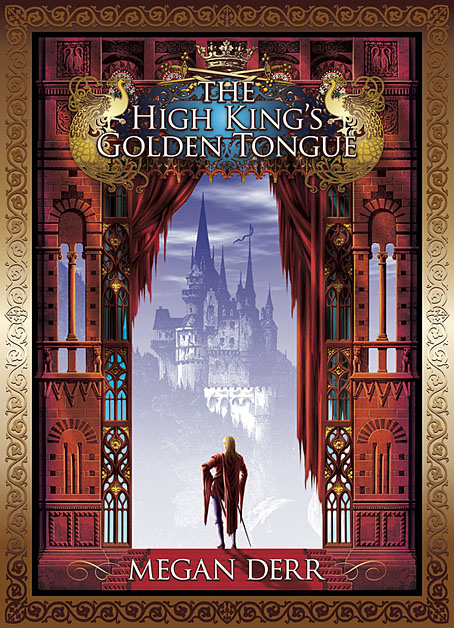
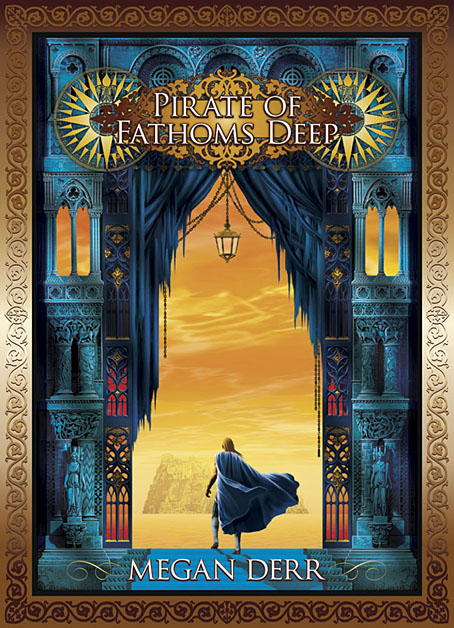
I thought I’d already written something about my cover for Megan Derr’s gay fantasy novel, The High King’s Golden Tongue, but it seems not. This appeared last year from Less Than Three Press, and the next volume in the Tales of the High Court series, Pirate of Fathoms Deep, has been published this week. My earlier omission allows me to show both covers together.

derr2.jpg

When working on the first volume I didn’t expect I’d also be working on a sequel so there was no need to consider whether the design could be carried over. The architectural frame is from a book about French architect Eugène Viollet-le-Duc, taken from one of Viollet-le-Duc’s illustrations for a study of the architecture of old France. I added the windows and curtains before colouring the stones and providing shadows and highlights. This became a problem for the second cover because my Viollet-le-Duc book only had one example of this kind of stonework. After some lengthy searches at Gallica I was able to find enough scans of other pages from the books that Viollet-le-Duc illustrated to piece together a new frame. The Gothic window frames on both covers are from another French volume, and I’ve now exhausted all those examples so a third volume in this series will no doubt present further challenges.

Weekend links 316

pca.jpg

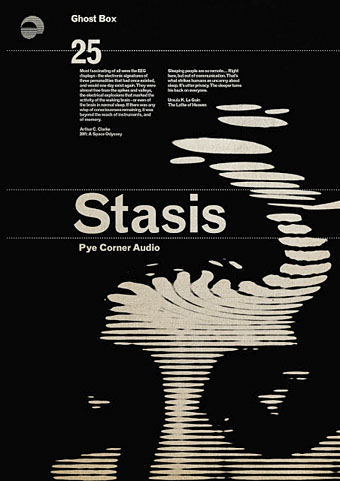
Stasis, the second album by Pye Corner Audio for the Ghost Box label, will be released at the end of August. Design, as always, is by Julian House.

• “In the modern internet world you have what I talk about as the ‘War of the Certain’: people insisting that their absolutist viewpoint, in 140 characters, is exactly the right way to think, and anyone who doesn’t agree with them is terrible. If you’ve grown up reading Robert Anton Wilson this is awful. Having all of these certain people with no nuance or doubt, and no understanding of multiple-model agnosticism, is not going to go anywhere good.” Writer John Higgs talking to Ben Graham about RAW, Discordianism and related matters. A related matter: Higgs talks to Alan Moore about virtual-reality mysticism, creating a new counterculture, reinventing magick, and the eternal nature of time.

• Nicolas Winding Refn’s The Neon Demon is out this month so features and interviews are proliferating. I’ve been avoiding them for the usual spoiler-shunning reasons, but this was worth noting: Refn’s mood-establishing playlist for the production. More Neon Demon: Cliff Martinez talks about working with Refn.

• ” ‘Paint me like one of your French girls” takes on a whole new meaning in Nicole G. Albert’s book Lesbian Decadence: Representations in Art and Literature in Fin-De-Siècle France,” says Rachel Wexelbaum.

The decaying low-baroque tableau of conjugal tenderness, features eaten away by the syphilis of time, played so well, on an anvil of whitewashed cement, alongside a municipal bowling green, that it became the provocation for a pedestrian expedition testing the Brexit boundaries of a timeless mead-hall England, before the fleet of plundering Papist Normans came sailing over the horizon. Just as tabloid gangs of Albanian drug-trafficking white slavers were now reputed to be sneaking ashore on Romney Marshes, at Deal and Camber Sands, on their Rigid Inflatable Boats, kayaks and leaking air mattresses. Could anyone bring themselves actually to cast a vote for Brexit, a commodity that sounds like a cereal bowl of Nordic cattlecake manufactured from wood shavings with an added ingredient to purge the bowels?

Iain Sinclair and company head south in turbulent times

• At Dangerous Minds: a video recording of Psychic TV live in Manchester, 1983 (I’m in the audience but up on the balcony so you won’t see me), and an interview with dub maestro Adrian Sherwood.

The Columbia Years, 1968–1969: fabled recording sessions by Betty Davis are to receive an official release by Light In The Attic.

We’re Here Because We’re Here – Jeremy Deller’s silent commemoration of the soldiers of the Somme.

• Inside Las Pozas, Edward James’ Surrealist Garden in the Mexican Jungle.

• The body as amusement park: A history of masturbation by Barry Reay.

Nicholas Olsberg on the mirage of an ideal metropolis.

The Strange World of…David Toop

Static Electrician (1994) by ELpH | Static (1998) by Redshift | Static (2001) by Monolake

Weekend links 315

knights.jpg

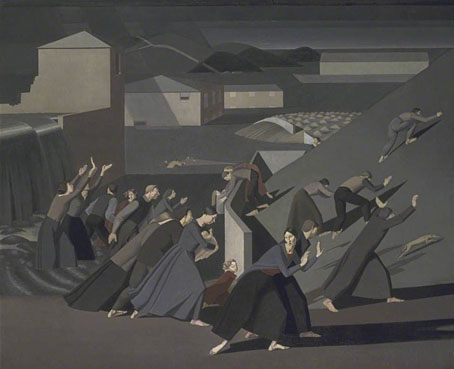
The Deluge (1920) by Winifred Knights.

Dennis Cooper‘s favourite fiction, poetry, nonfiction, film, music, art & internet of 2016 so far. (Thanks again for the nod to this blog!)

• At Literary Hub: Jonathan Russell Clark on Jorge Luis Borges, and Jon Sealy on why indie presses [in the US] are opening bookstores.

• “It’s not just about the music.” A conversation on the occult practices in the arts between poet Janaka Stucky and Peter Bebergal.

• Daisy Woodward talks to Andreas Horvath about Helmut Berger, Actor, a documentary about Visconti’s muse and lover.

• More Fritz Leiber: Brian J. Showers on his decision to republish Leiber’s horror novel, The Pale Brown Thing.

• Mixes of the week: Sextape 4 by Drixxxe, and Radio Oscillations #96 (Richard Pinhas/Heldon) by Iron Blu.

• The 5th Young One: Pay No Attention to the Girl Behind the Sofa; John Reppion on a television mystery.

• More reading suggestions: Cheerless beach reads for gloomsters and saddies by S. Elizabeth.

• Never the same film twice: Seances by Guy Maddin, Evan Johnson, Galen Johnson.

• How painter Winifred Knights became Britain’s “unknown genius”.

• The Journey & The Destination: An interview with Hawthonn.

Robert Latona goes in search of the grave of Constance Wilde.

• Invisible by Day: photos by Mikko Lagerstedt.

• A Queer Lit Q&A with Evan J. Peterson.

• RIP Michael Herr and Bernie Worrell.

Bridget Riley: The Curve Paintings.

• The typography of Blade Runner.

Japanese matchbox labels

SOS by Portishead

A Rainbow In Curved Air (1969) by Terry Riley | The Great Curve (1980) by Talking Heads | Dangerous Curves (2003) by King Crimson

The art of Paul Thévenaz, 1891–1921

thevenaz01.jpg

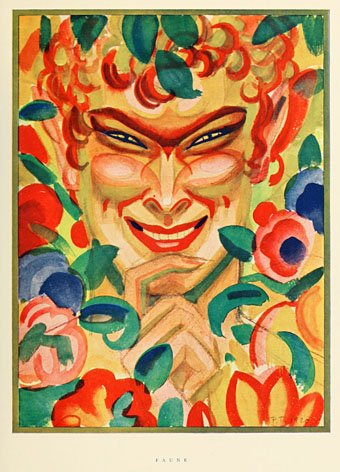
This portrait of Jean Cocteau by Swiss artist Paul Thévenaz isn’t included in the artist’s memorial book, Paul Thévenaz, A Record of His Life and Art (1922) which was published after Thévenaz died suddenly at the age of 30. Everything else in this post is, however, and there’s more in the book itself which shows Thévenaz ranging through society portraits (and self-portraits), designs for the theatre (I’ve included a Salomé below), murals and sketches.

Thévenaz is another candidate for the pantheon of lost gay artists although the work in the book isn’t especially homoerotic. There are fauns, however, which might be connected to his romantic association with poet Witter Brynner. The latter’s A Canticle of Pan was written in 1918, and is one of the many manifestations of the horned god in the literature of the period. As for Thévenaz, I like his drawing style a great deal; in places it resembles Wyndham Lewis in its sweeping curves and stylisations. (Thanks to Callum for the tip!)

thevenaz02.jpg

thevenaz03.jpg

thevenaz04.jpg

Continue reading “The art of Paul Thévenaz, 1891–1921”

Weekend links 310

monogenis.jpg

Parkland (2012) by Dean Monogenis.

• “The Story Behind the Planet’s Most Influential Road Map of ‘Weird Music’“. Gustavo Turner investigates the enduring influence of The Nurse With Wound List. Related: A Discogs list of links to all the NWWL discographies, and a recommended listening guide by Ultima Thule.

Tokyo Melody: Un film sur Ryuichi Sakamoto (1985) by Elizabeth Lennard features Sakamoto at work on Illustrated Musical Encyclopedia, together with Akiko Yano, Haruomi Hosono and Yukihiro Takahashi.

• “We wanted to fuse the aesthetics, histories and values of witchcraft, the traditional ideas with a contemporary edge,” says editor and creative director of Sabat magazine, Elisabeth Krohn.

There is a very seductive and very dangerous demon: the demon of generalities. He captivates man’s thought by marking every phenomenon with a little label, and punctiliously placing it together with another, similarly carefully wrapped and numbered phenomenon. Through him a field of human knowledge as changeable as history is turned into a neat little office, where this many wars and that many revolutions sleep in folders – and where we can pore over bygone ages in complete comfort. This demon is fond of words such as “idea”, “tendency”, “influence”, “period”, and “era”. In the historian’s study this demon reductively combines in hindsight the phenomena, influences and tendencies of past ages. With this demon comes appalling tedium – the knowledge (utterly mistaken, by the way) that, however humanity plays its hand or fights back, it follows an implacable course. This demon should be feared. He is a fraud. He is a salesman of centuries, pushing his historical price list.

Vladimir Nabokov in a previously unpublished lecture, On Generalities

• More Tom Phillips: 20 Sites n Years, a film by Jake Auerbach & David Thorp about the artist’s long-term urban photography project, is showing at Camberwell College of Arts next month.

• Mixes of the week: Sass In Pocket by Abigail Ward, Near Mint, 17th May 2016 by Robin the Fog & Hannah Brown, and Secret Thirteen Mix 184 by Andi Stecher.

• Grey Dog Tales talks to Brian J Showers of Swan River Press about horror and supernatural fiction.

• “Magic mushrooms lift severe depression in clinical trial.” But their use is still illegal in the UK.

• “Your brain does not process information, and it is not a computer,” says Robert Epstein.

Cliff Martinez’s theme for Nicolas Winding Refn’s forthcoming The Neon Demon.

Diamanda Galás, Still Wild and Primal, Returns to the New York Stage.

Janae Corrado on the photography of Joel-Peter Witkin.

Alastair Gee on gay home movies from the 1940s on.

People Laugh At Me (Coz I Like Weird Music) (1980) by The Instant Automatons | Weird Caravan (1980) by Klaus Schulze | Call It Weird (1983) by Xymox