Weekend links 470

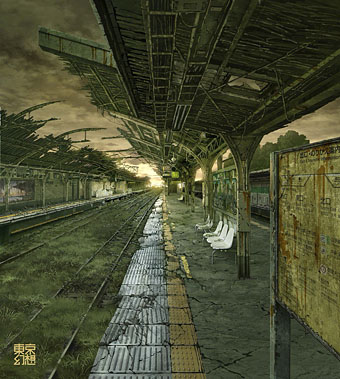
genso.jpg

A rail station in ruins by Tokyo Genso. From a series of views of Tokyo showing a ruined and abandoned city.

• Old music technology of the week: The EKO ComputeRhythm, a programmable drum machine from 1972 used by Chris Franke (who didn’t like the sounds so he used it to trigger other instruments), Manuel Göttsching (the rhythms on New Age Of Earth), and Jean-Michel Jarre (on Equinoxe); and Yuri Suzuki‘s digital reconstruction of Raymond Scott’s Electronium.

• At Dennis Cooper’s: Spotlight on…Ishmael Reed Mumbo Jumbo (1972), and DC’s favourite fiction, poetry, non-fiction, film, art, and internet of the year so far. Thanks again for the link here!

• “Pauline told her to shove her shyckle up her khyber.” Philip Hensher on the origins and revival of Polari, the secret gay argot. Related: a Polari word list, plus other links.

In Star, Mishima fuses his major theme of the mask, the public role all humans are destined to play out, with the theme of suicide, an act which Mishima considered a work of art. All of his work is punctuated by suicide, and it is peopled with masks, with people knowing they are nothing but masks, who are aware that the center doesn’t hold because there is no center, that character is a flowing fixture, a paradoxical constancy and a definite variable, always.

Jan Wilm on Star, a novella by Yukio Mishima receiving its first publication in English

• “How have these places managed to transform from monuments to atrocity and resistance into concrete clickbait?” Owen Hatherley on the popularity of spomeniks.

• The late George Craig on translating the scrawl of Samuel Beckett’s letters (written in French) into coherent English.

• Outsider Literature, Part 1: a Wormwoodiana guide by RB Russell.

• Mix of the week: Secret Thirteen Mix 291 by Arturas Bumsteinas.

Symbiose, a split album by Prana Crafter and Tarotplane.

Robby Müller’s Polaroids

Apollo 11 in Real-time

Tokyo Shyness Boy (1976) by Haruomi Hosono | Tokyo (1979) by Jean-Claude Eloy | Tokyosaka Train (2002) by Funki Porcini

Weekend links 467

td.jpg

Artwork by Kuldar Leement (maybe…I’ve yet to see a credit for this). No, it’s the work of Rupert Lloyd.

In Search Of Hades: The Virgin Recordings 1973–1979, is a retrospective box set comprising 16 CDs and 2 blu-ray discs devoted to the first phase of Tangerine Dream’s output on the Virgin label. For enthusiasts of the group’s Virgin recordings (myself among them) this is very welcome, especially for the albums being given the Steven Wilson remix treatment, and the wealth of rare and unreleased material. In addition to several live concerts the box will include the complete Oedipus Tyrannus theatre soundtrack, the overture of which appeared on a compilation in 1975 but has since been unavailable outside bootlegs. Baroque 2 is a taster of the unheard soundtrack. The box itself will be released on 14th June. Related: Edgar Froese interviewed on a US radio station in 1974. Among the topics of discussion are German music of the time, Tangerine Dream’s dissatisfaction with Ohr Records, and their happiness at moving to Virgin.

• “As the witch-burning begins, the image gradually dissolves into a stroboscopic onslaught of neon colours accompanied by rapid, high-pitched ringing and a thundering drone.” Don’t come to Gaspar Noé for social realism. Lux Aeterna is his new thing.

• An ode to the ultimate camp film: Nathalie Atkinson on Boom!, Joseph Losey’s adaptation of a Tennessee Williams play, and (unsurprisingly) one of John Waters’ favourites.

“Adhesive,” a term borrowed from phrenology, was Whitman’s synonym for homosexuality. According to gay studies pioneer William A. Percy, “the term became part of the special vocabulary of the emerging homosexual subculture of the nineteenth century,” which Whitman and his coterie would have understood. Despite Whitman’s private vows to resist temptation, and to be more aloof, he continued to court young men until he died. One of the final photos of Whitman, taken at the Camden docks in 1890, shows the poet with his handsome male nurse Warren Fritzinger. “I like to look at him—he is health to look at: young, strong, lithe,” Whitman told Traubel.

Jeremy Lybarger on Walt Whitman’s boys

Psychedelic Promos & Radio Spots: 8 volumes, over 500 tracks, all free downloads. Hear many of the most popular groups of the late 60s shilling for commercial radio stations.

Hildur Guðnadóttir used only sounds from a nuclear plant in her score for Chernobyl.

• US museums of the week: Poster House, NYC, and The Moogseum, Asheville, NC.

• “Yes, witches are real,” says Pam Grossman, “I know because I am one.”

• Photos by Chas Gerretsen from the set of Apocalypse Now.

• Geeta Dayal on the brainwave music of David Rosenboom.

• Mix of the week: Self-Titled NE285 Mix by Kevin Martin.

• RIP Roky Erickson

Boom Boom (1961) by John Lee Hooker | Boom Stix (1962) by Curley & The Jades | Boom! (1992) by The Grid

Weekend links 465

palladini.jpg

The Star (1970) from The Aquarian Tarot by David Palladini.

• Artist David Palladini died in March but I only heard the news this week. His poster for Werner Herzog’s Nosferatu has been a favourite of mine ever since the film’s release, while some of his other works have featured here in the past. Still popular among Tarot users is the Aquarian Tarot (1970), a deck published a few years after Palladini had helped with the production of the Linweave Tarot. From the same period as the Aquarian deck is a set of Zodiac posters, all of which exhibit Palladini’s distinctive blend of Art Nouveau and Deco stylings. In addition to posters, Palladini produced book covers and illustrations, and even a few record covers. A book collecting all of this work would be very welcome.

Erotikus: A History of the Gay Movies (1974? 75? 78?): Fred Halsted presents a 90-minute history of American gay porn, from the earliest beefcake films to the hardcore of the 1970s, some of which Halsted also helped create. Related: Centurians of Rome [sic]: Ashley West and April Hall on the bank robber who made the most expensive gay porno of all time.

Peter Bradshaw reviews Too Old to Die Young, a Nicolas Winding Refn TV series described as “a supernatural noir”. Sign me up.

Naomi Wolf’s Outrages establishes the context for [John Addington] Symonds’s desperate efforts to justify his own sexual feelings. Since he was born in 1840, he was 15 when the first edition of Walt Whitman’s Leaves of Grass appeared, the same year that legislation in Britain streamlined the laws against sodomy and ensured that men found guilty of it served long prison sentences. With intelligence and flair, Wolf uses the various responses to Whitman to show the levels of intense need in the decades after the publication of Leaves of Grass for images and books that would rescue homosexuality from increasing public disapproval.

Colm Tóibín reviews Outrages: Sex, Censorship and the Criminalisation of Love by Naomi Wolf

• Record label Dark Entries has discovered 40 more reels (!) of music by Patrick Cowley dating from 1974 to 1979.

• “Is Stockhausen’s Licht the most bonkers operatic spectacle ever?” asks Robert Barry.

• Sex, Spunk, Shoes and Sweet Satisfaction: A Q&A with artist Cary Kwok.

• Tripping his brains out: Eric Bulson on Michel Foucault and LSD.

• Paul O’Callaghan chooses 10 best Dennis Hopper performances.

• “More obscene than De Sade.” Luc Sante on the fotonovela.

• Karl Blossfeldt’s Urformen der Kunst (1928).

• The Strange World of…Gong

Neonlicht (1978) by Kraftwerk | Brüder Des Schattens, Söhne Des Lichtes (1978) by Popol Vuh | Lichtfest (2017) by ToiToiToi

Weekend links 464

picaud.jpg

13 Circles by Julien Picaud.

• The 50th anniversary of the Apollo Moon landing is only two months away so it’s no surprise that Brian Eno’s Apollo: Atmospheres And Soundtracks is being reissued. The latest release will include an additional disc of new music by Eno with his collaborators from the original sessions, Daniel Lanois and Roger Eno. Related: the Apollo 11 Command Module as an explorable (and printable) 3D model.

• From the real Moon to the presence of the satellite in myth and history, the next book from Strange Attractor will be Selene: The Moon Goddess & The Cave Oracle, a volume which is also the final work by the late Steve Moore. With a foreword by Bob Rickard, and an afterword by Alan Moore.

• Guitar-noise maestro Caspar Brötzmann released a handful of thrilling albums in the 1990s then disappeared from view. Spyros Stasis talked to Brötzmann about his hiatus and his recent resurfacing on the Southern Lord label.

• A year late, but I didn’t know Paul Schrader had written an updated introduction to his 1972 study of Ozu, Bresson and Dreyer, Transcendental Style in Film. I love the idea of “The Tarkovsky Ring” as a directorial event horizon.

• “Nothing written is utterly without value, as I proved to myself by reading two random works.” Theodore Dalrymple on the lasting worth of “worthless” books.

Cinemagician: Conversations with Kenneth Anger, a documentary by Carl Abrahamsson about the director/writer/magus.

• Mirror, Mirror: When Movie Characters Look Back at Themselves by Sheila O’Malley.

• From Susan Sontag to the Met Gala: Jon Savage on the evolution of camp.

• Mix of the week: Secret Thirteen Mix 289 by Mondkopf.

• Portrait of the Artist as a Consumer: Anne Billson.

• A video by IMPATV for Religion by Teleplasmiste.

Obscure Sound ~ Cosmic: a list.

Mira Calix‘s favourite records.

Transcendental Overdrive (1980) by Harald Grosskopf | Transcendental Moonshine (1991) by Steroid Maximus | The Transcendent (1999) by Jah Wobble

Under the Hill by Aubrey Beardsley

ab1.jpg

Aubrey Beardsley’s drawings are reprinted endlessly but his writings receive less attention even though he lavished as much care on his literary efforts as he did on his illustrations. The major work is his unfinished novel, Under the Hill, a book whose descriptive filigree is as detailed as the drawings which accompany the text, and whose erotic passages ensured that the story was never published in full during his lifetime. Extracts appeared with illustrations in The Savoy, the magazine for which Beardsley was art editor; after Beardsley’s death a longer expurgated version was published by John Lane in 1903, together with Beardsley’s other writings including two pieces of verse, The Three Musicians and Ballad of a Barber.

ab2.jpg

The Lane volume is a recent arrival at the Internet Archive, and while most of the material is familiar to me it does feature a few pages of Beardsley’s table talk which I’d never seen before. The expurgated Under the Hill is worth reading as an introduction to Aubrey’s florid writing style (and his obsession with clothing) but so much is missing that it can’t be considered representative of the author’s intentions. Under the Hill was published in full in 1907 in a private edition by Leonard Smithers, but the book had to wait until 1959 to receive a more public presentation when Olympia Press added it to their famous Traveller’s Companion series. The Olympia edition has the additional benefit of being completed by John Glassco, a bisexual Canadian poet, and accomplished pasticheur of erotic literature. Glassco not only matches Beardsley’s style while completing the story, he also provides a detailed history of the text, and a defence of its value as literature. If you’re a Beardsley enthusiast who already has most of the artwork then the Olympia book is worth seeking out.

glassco.jpg

New English Library reprint, 1966.

ab3.jpg

ab4.jpg

ab5.jpg

ab6.jpg

Elsewhere on { feuilleton }
The Aubrey Beardsley archive