Weekend links 504

maclean.jpg

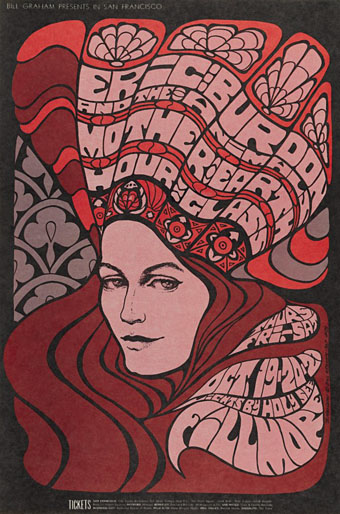
Eric Burdon and the Animals, Mother Earth, Hour Glass; Fillmore Auditorium, October 19-21, 1967 by Bonnie MacLean.

• RIP Bonnie MacLean, another of the original San Francisco poster artists, and the only woman of note in the US psychedelic poster scene. (Not the only woman, however; in Europe we had Marijke Koger.) Related: Bonnie MacLean’s posters at Wolfgang’s. And RIP to illustrator Tom Adams, an artist whose exceptional covers for novels by Agatha Christie are only one part of a long and varied career.

The Litanies Of Satan (1982), the short but uncompromising debut album by Diamanda Galás, is reissued on Galás’s own label later this month. Further albums from her remarkable back catalogue will follow. Related: video of Galás performing The Litanies Of Satan in 1985.

• “Scorsese is amazed that United Artists didn’t touch one frame of Raging Bull, since it’s the first time in his life as a feature director that this has apparently occurred.” In 1981 Derek Malcolm talked to Martin Scorsese about his reasons for making a boxing picture.

“…in a post-AIDS world, its scenes of mass male-on-male decadence evoke a sense of the spiritual: Not to put so blunt a phrase on it, but the majority of the men we see in Cruising‘s bars would likely die within the next decade, victims of a very heterosexual genocide of neglect. These are blurred, melancholic memories locked forever within Cruising‘s celluloid; a phantasmagoria of men whose liberation was not legislatively delivered, but recovered in the privacy of leather bars and cruising joints. The film’s overt sexuality makes it hard to escape a sense of catastrophic loss.”

Jack King on William Friedkin’s Cruising

• The Pet Shop Boys’ eccentric feature film, It Couldn’t Happen Here (1988), is released on blu-ray and DVD in June. The video for You Were Always On My Mind gives an idea of the contents.

• “Orion being one of the brightest constellations makes it a lot of people’s favourites, and he was my favourite as a kid.” Ben Chasny on his history of stargazing.

• “You think the Holy Grail is lost? No. I have it on my piano.” John Boorman talks to Xan Brooks.

• Laura Cumming on the dark and haunting paintings of Belgian Symbolist Léon Spilliaert.

• Mix of the week: XLR8R Podcast 631 by Ondness.

Alistair Ryder chooses 10 great killer plant films.

Howl by John Foxx And The Maths.

• At Dennis Cooper’s: Gleam.

The Litanies Of Satan (1969) by Ruth White | Grail (1971) by Grail | Plants’ Music (1981) by Ippu-Do
Weekend links 503

kausch.jpg

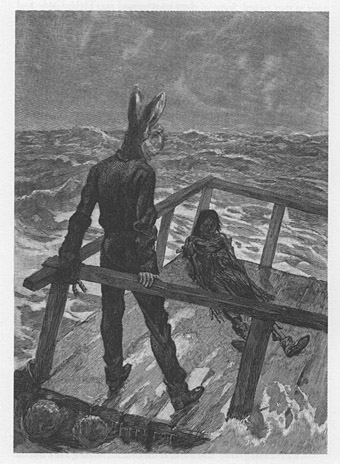
Rabbit Man with Skull Lady (1998) by Allan Kausch.

• “They were the first generation that said, ‘Fuck it, we’re not going to be intimidated.’ They weren’t going to make specifically pro-gay statements, but they were the first generation to really live that out. If you look at the Alternative Miss World, it’s a kind of gender-fuck, it’s almost like the English version of the Cockettes.” Jon Savage speaking in a piece by Alex Petridis about “Them” (Kevin Whitney, Luciana Martinez de la Rosa, Duggie Fields, Derek Jarman, Zandra Rhodes, Andrew Logan et al). Related: Andrew Logan in Andrew’s Adventures in Loganland.

• Sex, Satanism, Manson, Murder, and LSD: Kenneth Anger tells his tale. “Anger rarely if ever veers from the script as he is a man who has carefully controlled his myth and reputation for decades,” says Paul Gallagher.

• “Don’t even think about operating heavy machinery while listening to this mix.” The latest Dave Maier collection of recent ambient drift, drone-works and beatless atmospherics.

It is by no means easy to track or trace relationships between women, past or present. Women’s relationships with other women are often disguised: by well-documented marriages to men, by a cultural refusal to see what is in full view or even to believe such relationships exist. In a world built by and for men and their pursuits, a woman who loves women does not register—and is not registered, i.e., written down. Reasons for this layer one upon the other: A lesbian purposely hides her identity and remains closeted. A lesbian refuses to call herself a lesbian, disidentifying from the term and its associations for reasons personal or political. A woman does not know she is a lesbian—because she does not ever have a relationship with another woman, or because she is not aware that the relationships she engages in could be called lesbian. I didn’t call myself one for several years. Or, as in Carson’s case, her own self-understanding and identification are difficult to determine because of the efforts of those who outlived her and pushed her into the closet.

Jenn Shapland on the closeting of Carson McCullers

• At The Paris Review: The Collages of Max Ernst. Related: Kolaj: A directory of collage books.

Adam Scovell on the deathly hinterlands of Georges Franju’s Eyes without a Face.

• When Dorothy Parker got fired from Vanity Fair, by Jonathan Goldman.

• At Dennis Cooper’s: The Proto-Psychedelic Art of CG Jung’s Red Book.

• The abstract, single-stroke paintings of Daigoro Yonekura.

Adam Gopnik on the seriousness of George Steiner.

Caligula MMXX

The Ballad Of Dorothy Parker (1987) by Prince | Lotus Collage (1979) by Laraaji | Death Collage (1992) by Snakefinger & The Residents

Weekend links 500

provensal.jpg

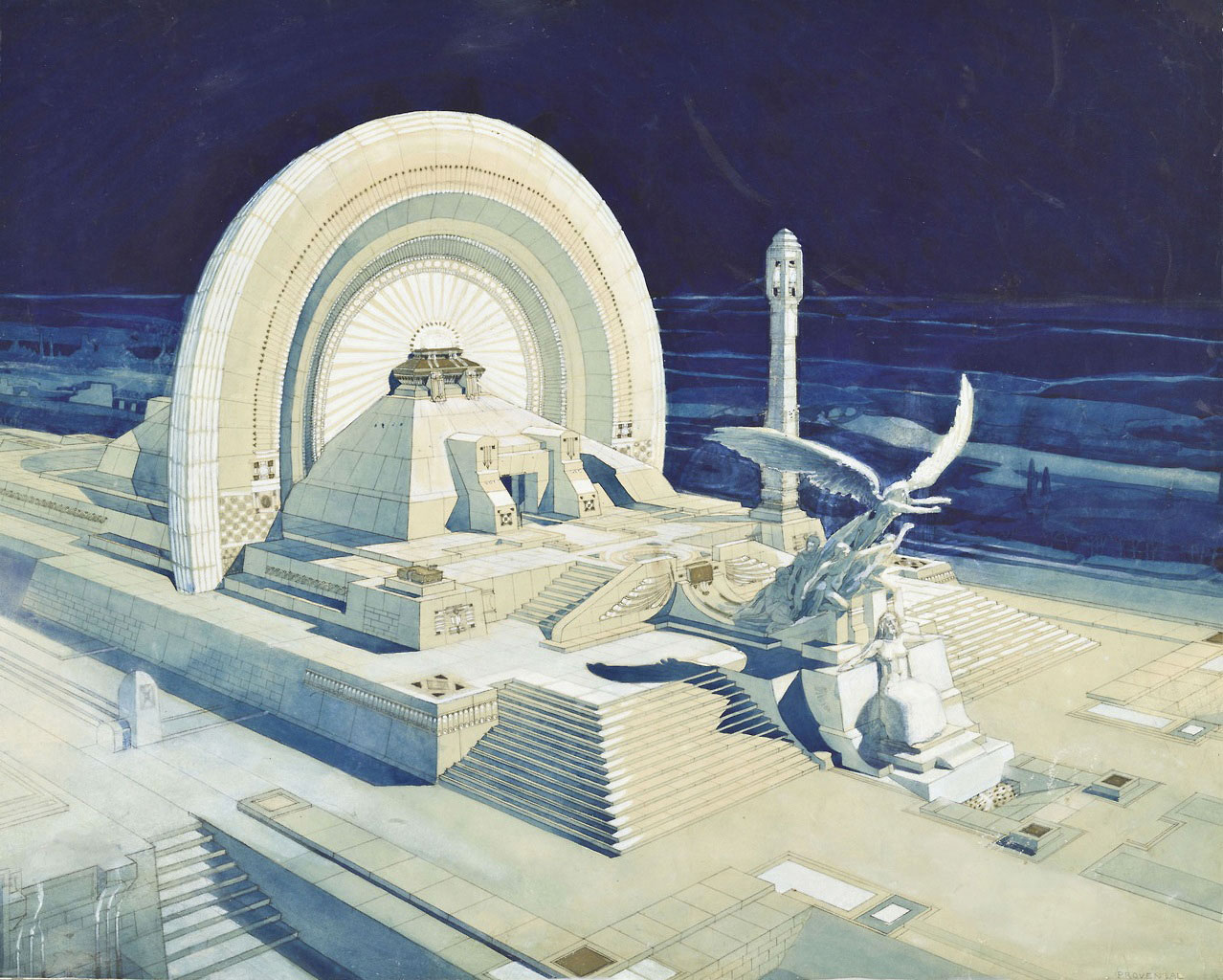
Projet onirique (tombeau pour un poète) (1901) by Henry Provensal.

• “20 years later, Sexy Beast remains something of an oddity…It offers a deconstruction of the genre, which is then reconstructed to marry the unhinged, convulsive beauty of surrealism with sturdy, universal storytelling.” Thomas H. Sheriff looks back at Jonathan Glazer’s debut feature.

Blau Gers, a new piece by The Alvaret Ensemble: Greg Haines (piano), Jan Kleefstra (voice, poems), Romke Kleefstra (guitar, bass and effects) and Sytze Pruiksma (percussion).

Wendy Carlos: A Biography by Amanda Sewell, the first study of the life and work of the electronic composer, is out in March.

The prejudice against writing sex in Anglo-American literature is something that utterly baffles me. What a bizarre thing it is to claim that this central, profound territory of human life is off-limits to literary or artistic representation. Sex seems to me one of the densest and most intense human phenomena, one of the things I find it hardest to think about—and so something I want to think about in art. The biggest surprise to me about the reception of my first book—other than the fact of there being any reception at all—was how much discussion there was about the sex in it. There isn’t very much sex in it! It said something about the culture of mainstream publishing in America in 2016 that a novel with maybe three or four pages of explicit sex between men could seem surprising.

Garth Greenwell talking to Ilya Kaminsky about literature and life

• Some (but not all) of the museums of Paris have made thousands of artworks available for free online.

• The Work of Fate: AS Hamrah introduces a screening of Jean Cocteau’s Orphée.

La Labyrinthèque: Histoire de l’art jouissive & enchantements littéraires.

Clive Hicks-Jenkins on the art of the (book) cover.

Tom Huddleston on 10 great stressful films.

• At Dennis Cooper’s: Malcolm Le Grice Day.

François de Nomé’s Imaginary Ruins.

Sexy Sadie (1968) by The Beatles | Sexy Photograph (1995) by Ui | Sexy Boy (1998) by Air

Weekend links 499

konoike.jpg

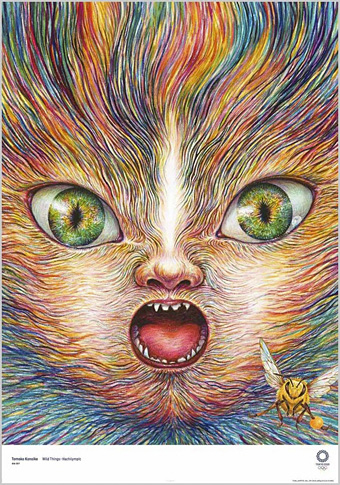
Wild Things – Hachilympic, a poster by Tomoko Konoike for the Tokyo 2020 Olympics.

• Hidden Jewels in ‘The Garden of Orchids’: Steve Toase on Der Orchideengarten (1919–1921), the German magazine of fantastic art and literature. Since the article doesn’t mention it, I’ll note again that the first Anglophone appraisal of the magazine (and also the place where it was drawn to the attention of myself and 50 Watts) was in Franz Rottensteiner’s The Fantasy Book (Thames & Hudson/Collier, 1978).

• “In its furtive, sotto-voce way, Gorey’s work is in conversation with gay history, gay literary influences, and, now and then, the gay-straight tensions of his time.” Mark Dery on the attempts by Edward Gorey’s readers and critics to ignore the obvious signs of a personal sexuality in his work.

• The Apotheosis of the Grotesque: illustrator Sidney Sime interviewed by Arthur H. Lawrence in The Idler, January 1898.

Goff would experiment with form, material, structure and ornament to almost absurd degrees. Materials he used in his buildings included aviation parts, goose feathers, oil rig equipment, orange artificial turf (on the roof), lumps of coal, and any kind of glass he could get his hands on. His 1948 Ledbetter House, also in Oklahoma, features a recurring motif of vertical lines of diamond-shaped glass studs set into doors and columns. In fact they are dime-store glass ashtrays.

Steve Rose on the restoration of “outsider architect” Bruce Goff

• At the BFI: Adam Scovell on where to begin with Delphine Seyrig; Kat Ellinger on giving Fellini’s later films their due; and Matthew Thrift on 10 great Acid Westerns.

• RIP Ivan Passer and Neil Peart. A reminder that John Patterson described Passer’s Cutter’s Way as a cinematic masterpiece. So it is.

Geeta Dayal on musician/composer Arthur Russell and yet another posthumous release.

Haunted And Known, a new recording by Six Organs Of Admittance.

• At Dennis Cooper’s: Hidden.

2112 (1976) by Rush | Xanadu (1977) by Rush | La Villa Strangiato (1978) by Rush

Weekend links 497

roma.jpg

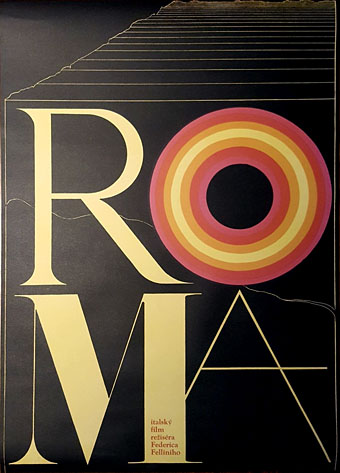
Poster by Zdeněk Ziegler for Roma (1972), a film by Federico Fellini.

• At Dennis Cooper’s: a short history of Straight to Hell, a long-running fanzine launched by Boyd McDonald in 1971 dedicated to true stories of men having sex with other men. The post gives an idea of the contents but for a deep dive I’d suggest Meat (1994) at the Internet Archive, a collection of the best of the early editions of STH. Related: “Straight to Hell was an immensely popular underground publication. John Waters, William S. Burroughs, and Robert Mapplethorpe were fans; Gore Vidal called it ‘one of the best radical papers in the country.'” Erin Sheehy on Boyd McDonald’s determination to kick against the pricks.

• RIP psychedelic voyager and spiritual guide Richard Alpert/(Baba) Ram Dass. The Alpert/Ram Dass bibliography includes The Psychedelic Experience: A Manual Based on the Tibetan Book of the Dead (1964), an acid-trip manual written in collaboration with Timothy Leary and Ralph Metzner from which John Lennon borrowed lines for the lyrics of Tomorrow Never Knows. But the most celebrated Ram Dass volume is Be Here Now (1971), a fixture of countless hippy bookshelves whose first editions were all handmade.

• “An Einstein among Neanderthals”: the tragic prince of LA counterculture. Gabriel Szatan talks to David Lynch, Devo and others about the eccentric songwriter, performer and voice of Lynch’s Lady in the Radiator, Peter Ivers.

• For the forthcoming centenary of Federico Fellini’s birth Stephen Puddicombe offers suggestions for where to begin with the director’s “exuberant extravaganzas”. Related: Samuel Wigley on 8½ films inspired by .

• “I met resident Tony Notarberardino for the first time in 2015 and entering his apartment was like crossing into another dimension.” Collin Miller explores the Chelsea Hotel.

• “More green tea, professor?” The haunted academic, a reading list by Peter Meinertzhagen. Related: Our Haunted Year: 2019 by Swan River Press.

• “30 July, Yorkshire. Thunder, which is somehow old-fashioned.” Alan Bennett’s 2019 diary.

• More acid trips: Joan Harvey on the resurgence of interest in psychedelic drugs.

• At Lithub: Werner Herzog’s prose script for Nosferatu the Vampyre.

Tief gesunken, a new recording by Bohren & Der Club Of Gore.

In Heaven (1979) by Tuxedomoon | Die Nacht Der Himmel (1979) by Popol Vuh | Roma (1981) by Steve Lacy