Going beyond the zero

gr1.jpg

“But it is a curve each of them feels, unmistakably. It is the parabola. They must have guessed, once or twice—guessed and refused to believe—that everything, always, collectively, had been moving toward that purified shape latent in the sky, that shape of no surprise, no second chances, no return. Yet they do move forever under it, reserved for its own black-and-white bad news certainly as if it were the Rainbow, and they its children….”

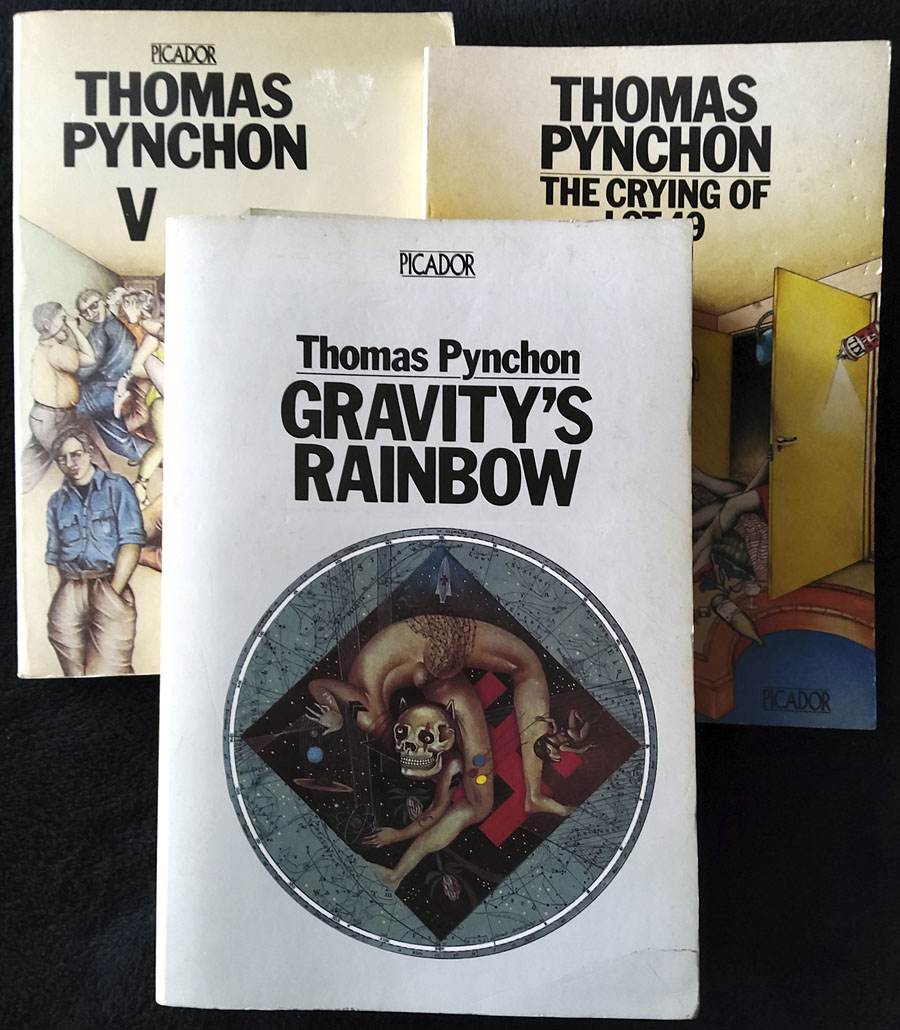
Reader, I read it. It isn’t an admission of great achievement to announce that you’ve reached the last page of a novel after a handful of stalled attempts, but when it’s taken me 36 years to reach this point it feels worthy of note; and besides which, Gravity’s Rainbow isn’t an ordinary novel. Umberto Eco is partly responsible for my return to Pynchon. I’d just finished The Name of the Rose, a book I’d avoided for years even while reading (and enjoying) a couple of Eco’s other novels, and was wondering what to read next. Maybe it was time to try the Rocket book again? The thick white spine of the Picador edition—760 pages in 10pt type—would accuse me every time I spotted it on the shelf: “Still haven’t made it to page 100, have you?” For many people this happens with novels because a book is “difficult” (which I didn’t think it was), or boring (which it isn’t at all), or simply too long (page count doesn’t put me off). Back in 1985 I was looking for more heavyweight fare after reading Ulysses, something I’ve now done several times, so I wasn’t going to be intimidated by a novel which is misleadingly compared to Ulysses on its back cover. If anything the comparison was an enticing one. Pynchon at the time exerted a gravitational pull (so to speak) for being very mysterious, although this was a decade when most living authors, especially foreign ones, were mysterious to a greater degree than they are today, when so many have their own websites and social media profiles. Pynchon’s works were also referred to in interesting places, unlike his less mysterious contemporaries. I may be misremembering but I seem to recall a mention of the W.A.S.T.E. enigma from The Crying of Lot 49 in Robert Shea & Robert Anton Wilson’s Illuminatus!; if it is there then it’s no surprise that a writer so preoccupied with conspiracy and paranoia would find favour with the authors of the ultimate conspiracy novel. (And that’s not all. I’m surprised now by the amount of coincidental correspondence between Illuminatus! and Gravity’s Rainbow. Both novels were being written at the same time, the late 1960s, yet both refer to the Illuminati, the eye in the pyramid on the dollar bill, Nazi occultism, and the death of John Dillinger. Both novels also acknowledge the precedent of Ishmael Reed’s Mumbo Jumbo, another remarkable conflation of conspiracy, secret history, and wild invention.)

gr2.jpg

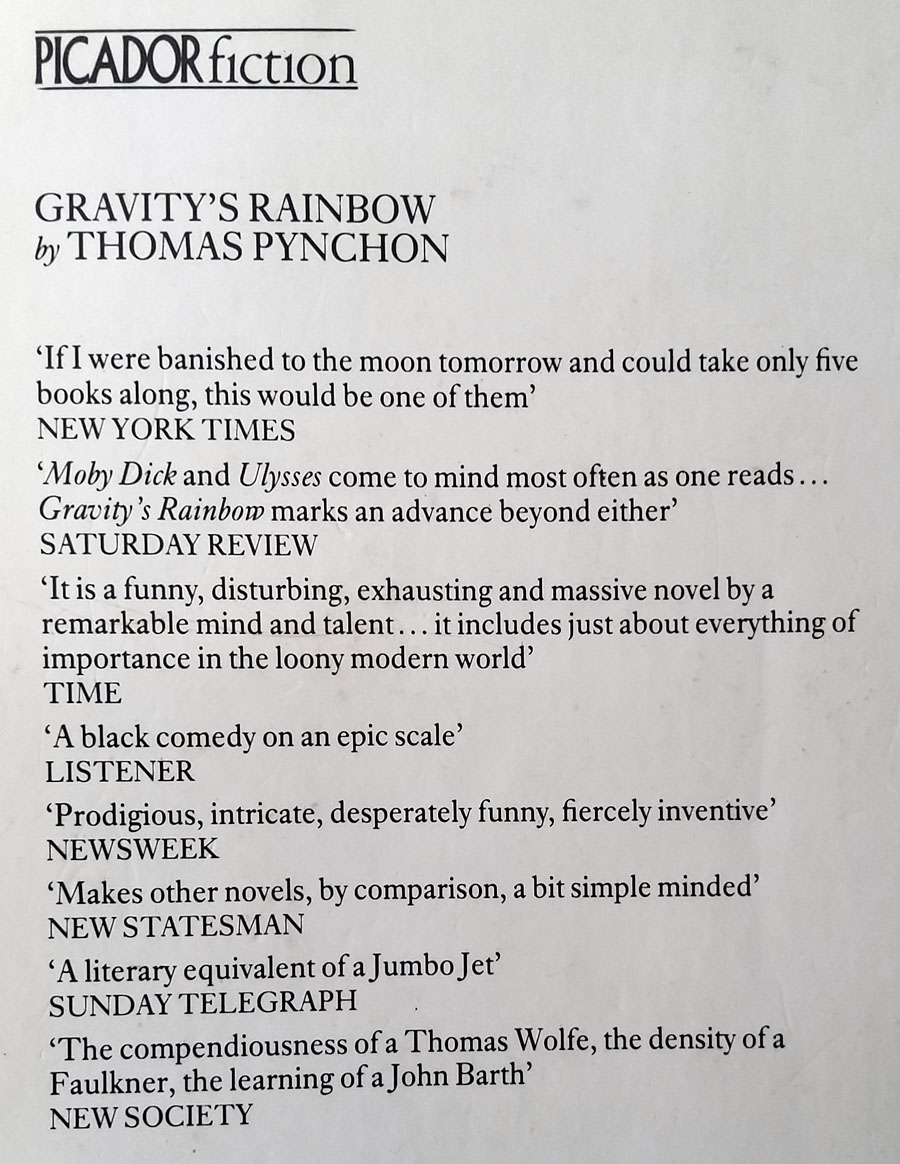
Pynchon had other connections to the kind of fiction I was already interested in. One of his early short stories, Entropy, had been published in New Worlds magazine in 1969, although editor Michael Moorcock later claimed to have avoided reading any of the novels until much later. And, Pynchon, like Shea & Wilson (and Moorcock…), made pop-culture waves. I think it was Laurie Anderson who put Gravity’s Rainbow in the centre of my radar when she released Mister Heartbreak, an album whose third song, Gravity’s Angel, refers to the novel and is dedicated to its author. As for the novel itself, in the mid-1980s this was still Pynchon’s major work, the one that fully established his reputation. Nothing new had appeared since its publication in 1973; Vineland, and the subsequent acceleration of the authorial production line, was six years away. The final lure was the refusal of the Picador edition to communicate very much of its contents: what was this thick volume actually about? The back cover is filled with praise but doesn’t tell you anything about the novel at all, while the cover illustration by Anita Kunz suggests a scenario connected with the Second World War but little else. (“This was one of the most complicated books I ever read,” says the artist, “and really hard to get the germ of the idea. Pynchon kept going off in tangents. I mixed up the art the same way the writer did and made an image that can be read in all directions.”) It’s only when you start reading the book that you find the connection between the novel’s dominant concerns—the development of the V-2 rockets used by the Nazis to bomb London, and the erotic compulsions of Tyrone Slothrop, an American lieutenant at large in war-ravaged Europe—subtly reflected in the illustration, much more subtly than the cover art on the edition that preceded this one.

Continue reading “Going beyond the zero”

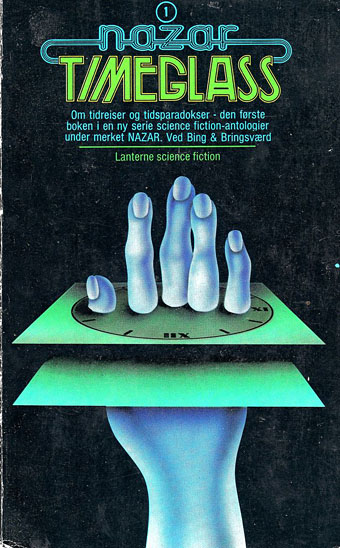
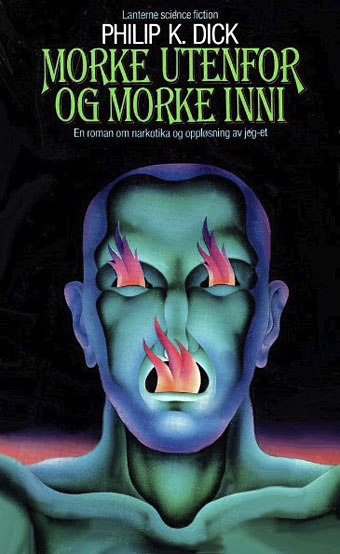
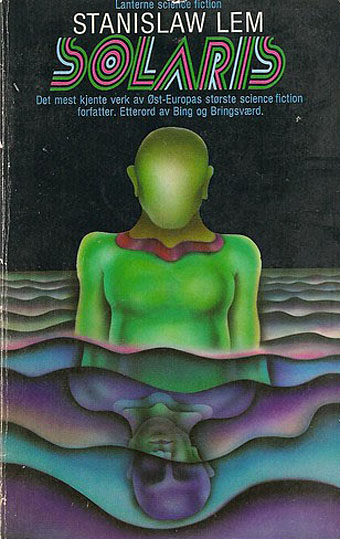
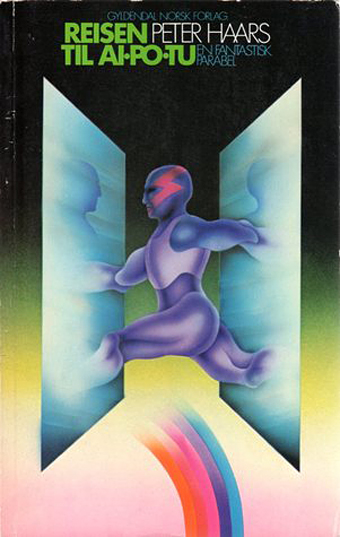
Peter Haars book covers

haars20.jpg

Peter Haars (1940–2005) was born in Germany but moved to Norway in the 1960s where he worked as a graphic designer, art director and illustrator. He also wrote fiction and created Prokon (1971), a one-off publication that looks like a designer’s take on underground comics. Most of the covers that turn up when you search for his work are science fiction, and all painted in that bold airbrush style that was common in the 1970s. Documentation is scarce, unfortunately, ISFDB only lists two titles, so I’ve no idea about the dates, but the Lanterne SF imprint was active throughout the decade.

haars01.jpg

haars21.jpg

haars15.jpg

haars08.jpg

Continue reading “Peter Haars book covers”

Weekend links 571

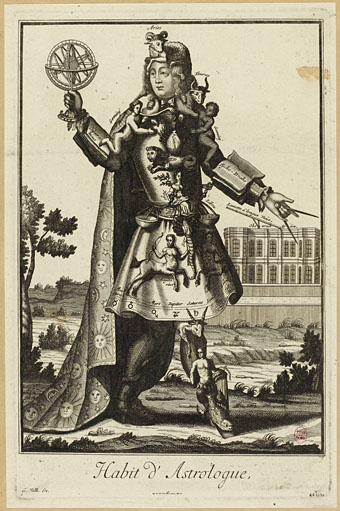
valck.jpg

Habit d’Astrologue (c. 1700) by Gerard Valck.

• “The Appointed Cloud begins with the high-pitched, keening sound of many bagpipes noisily playing at once—and then the music slowly coalesces, approaching a peaceful, tranquil hum. This gives way to fast-paced repetitive pulses, reminiscent of the minimalist works of composers such as Terry Riley and Philip Glass. Then the bagpipes join in once more, in a ferocious swarm of energy.” Geeta Dayal on the music of Yoshi Wada.

• “How can we conceive of the time of climate change, the time of planetary death? The House on the Borderland tried to conceive of exactly this a century ago. Yes, the narrator’s acts are fruitless. He gets haplessly carted about the universe to witness the end of time, which never really ends, is always at the edge, nearing an asymptote, on the borderland.” Namwali Serpell journeys through space and time with William Hope Hodgson.

• The Bureau of Lost Culture: DJ Food hosts a podcast discussion with Tony Bennett, founder and publisher of Knockabout Comics.

• Mixes of the week: Isolated Mix 111 (plus interview) by Ian Boddy, and a Wire mix (plus interview) by Teresa Winter.

• Fantastic visions and unknown worlds: Edwin Pouncey on Van Der Graaf Generator’s sleeve art.

• At Spoon & Tamago: Sculptor Kenichi Nakaya reconfigures ubiquitous Japanese rural crafts.

• My Bloody Valentine’s Kevin Shields: “We wanted to sound like a band killing their songs.”

• At Wormwoodiana: More earth mysteries are explored in Northern Earth magazine.

• New music: Black Horses Of The Sun by Dave Bessell.

The Exotica Project: One Hundred Dreamland 45s

• At Dennis Cooper’s: Hans Richter Day.

Mdou Moctar‘s favourite music.

Earth Floor (1985) by Michael Brook | Earth Tribe (1993) by Transglobal Underground | Earth Lights (2012) by Belbury Poly

Weekend links 570

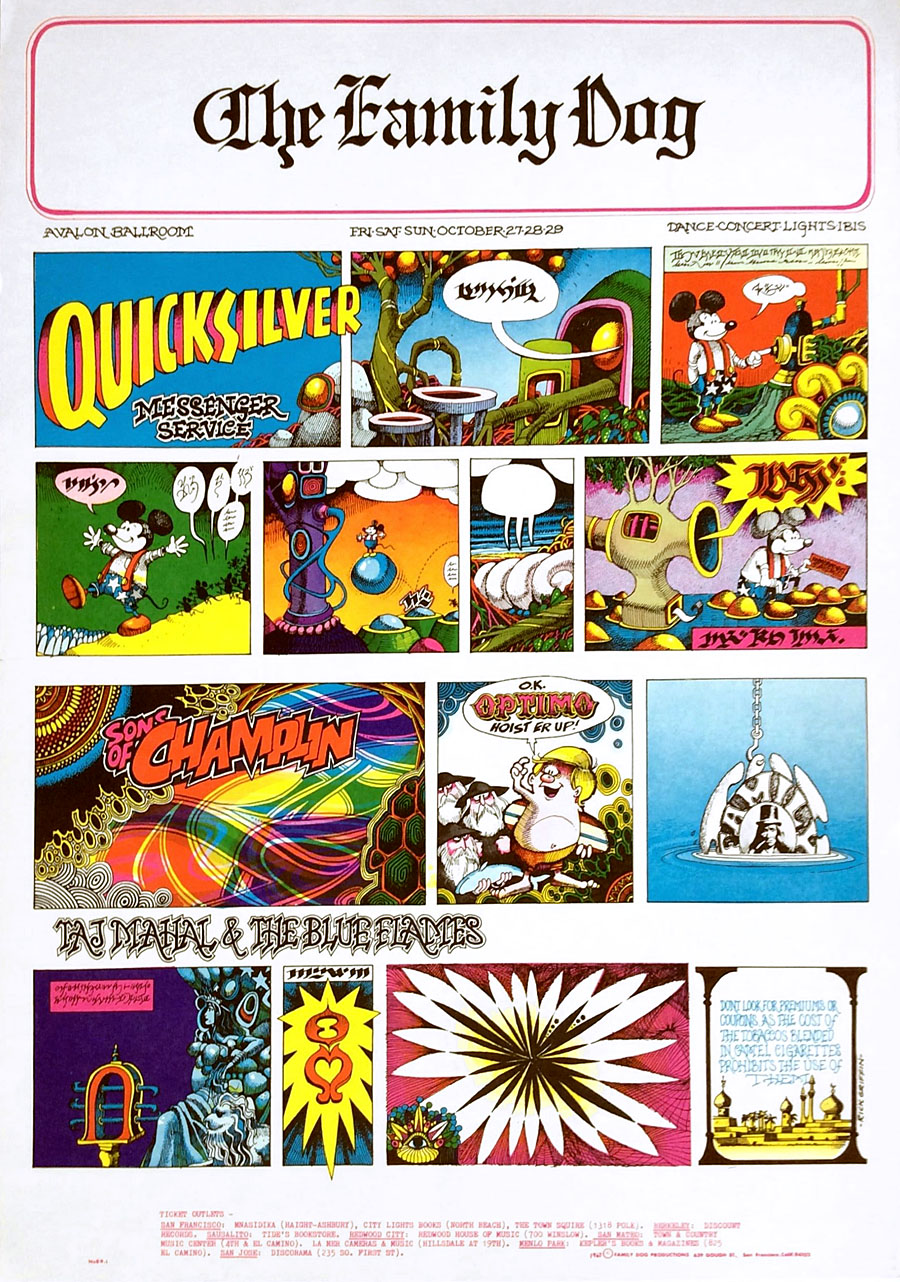
griffin.jpg

Rick Griffin’s comic-style poster for The Quicksilver Messenger Service at the Avalon Ballroom, October 1967.

• “Like ‘perversion,’ the word ‘script’ has a special meaning for Escoffier, who devotes most of the book’s attention to films featuring sex between men, and treats pornography as a vast screen on which all of our fantasies are projected.” Steve Susoyev reviews Sex, Society, and the Making of Pornography by Jeffrey Escoffier.

• “The themes reflect Griffin’s core obsessions: sex, death, Christ, flesh, liquids, goofy japes, and lysergic gnosis. Man from Utopia is an opus, one that Griffin felt strongly enough about to eschew the usual pulp, printing the cover on good full-color card stock.” Erik Davis on Rick Griffin and a comic book like no other.

Strange Things Among Us, a summer exhibition at The College of Psychic Studies, London, will include among its exhibits a room of art by Austin Osman Spare.

She delighted in the fact that after The Sadeian Woman, she ended up on the mailing lists of both pro- and antiporn groups, though no one (alas) ever sent her any actual porn. She aligns more naturally in retrospect with Madonna—potent, fiercely individualistic, disruptive, and self-invented. Carter’s evolved philosophical position on gender was a variation on Stoicism. Gender roles were “behavioural modes,” a construct (“Baby is hermaphrodite!”), and there was weakness in allowing oneself to be beholden to (let alone enslaved by) a construct. Above all, women should have total sexual agency and also their own money. “I became a feminist,” she wrote in a postcard to Susannah Clapp, “when I realised I could have been having all this instead of being married.”

Minna Zallman Proctor on the life and work of raucous fabulist Angela Carter

• New music: Chapter 4 by the Moritz Von Oswald Trio with Heinrich Köbberling & Laurel Halo, and Synth Vehicles For Guitar by Michael C. Sharp.

• DJ Food searched the back issues of International Times to find a handful of adverts for London’s legendary UFO Club.

• At Wormwoodiana: Mark Valentine explores Hy Brasil, a novel by Margaret Elphinstone.

• Remembering Tom of Finland through stories of those who knew him.

• What I’m Aiming For: Peggy Seeger’s favourite music.

• At Dennis Cooper’s: The Light Show (1965–1971).

• Mix of the week: Haze by The Ephemeral Man.

• A Strange Light From The East (1967) by Tuesday’s Children | Strange Things Are Happening (1968) by Rings & Things | Strange Walking Man (1969) by Mandrake Paddle Steamer

32 Short Lucubrations Concerning Alan Moore

am.jpg

One of my few comic strips that isn’t either a Lovecraft adaptation or part of the Lord Horror mythos is a five-page piece I produced in 2003 for Alan Moore: Portrait of an Extraordinary Gentleman. This was a book compiled by Smoky Man to honour Alan’s 50th birthday, for which my strip was one of many other comics, one-off portraits and contributions by different artists and writers. The book is out of print so Smoky has been posting extracts (with permission) on his blog. My strip may now be seen in full here.

I got the idea for this one from Thirty Two Short Films About Glenn Gould (1994), a feature-length portrait of the celebrated pianist which evaded the clichés of the biopic by addressing its subject through self-contained sequences in a variety of modes: dramatic reconstruction, interviews with Gould’s friends, documentary material, a spectrographic display from the playback of one of his Bach recordings, even a short piece of animation. My strip is less ambitious but it combines factual trivia about Alan Moore with personal reminiscences plus significant historical details connected with his birth date, 18th November, 1953. It was fun to put together, and a reminder that comic strips can be used for more than just telling stories.

Previously on { feuilleton }
Voice of the Fire by Alan Moore
The Blake Video
The Cardinal and the Corpse
Mapping the Boroughs
Art is magic. Magic is art.
Alan Moore: Storyteller
Alan Moore: Tisser l’invisible
Dodgem Logic #4