Weekend links 563

tonto.jpg

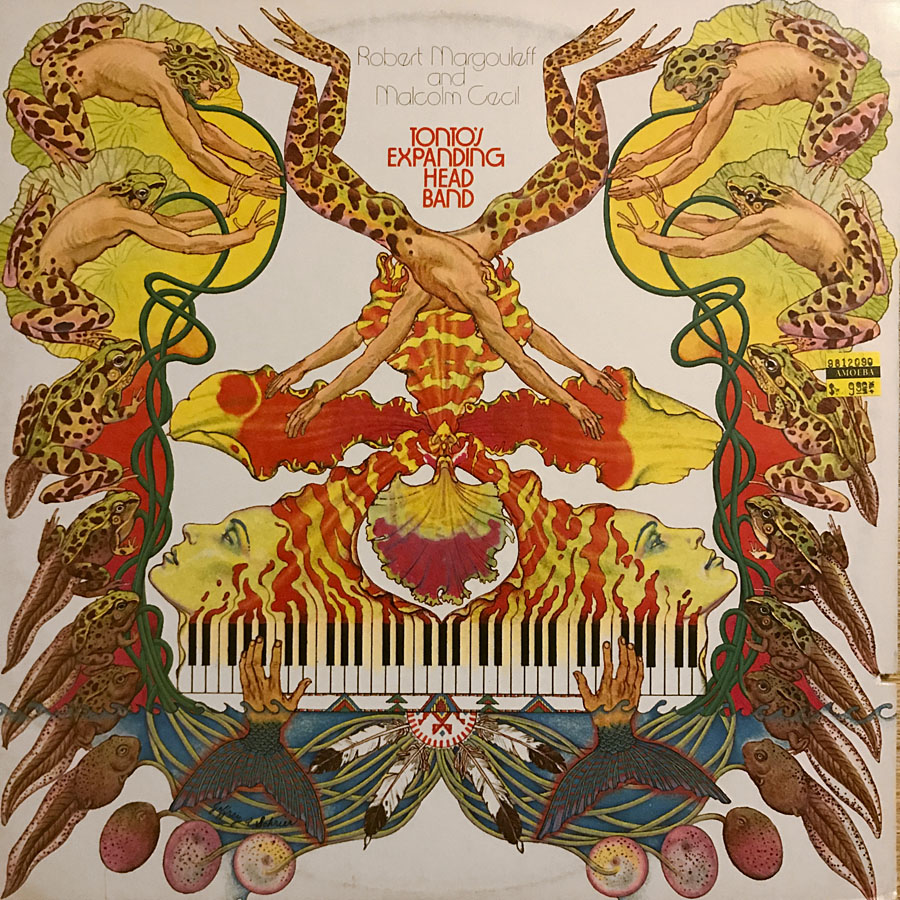
Cover art by Jeffrey Schrier for the 1975 reissue of Zero Time by Tonto’s Expanding Head Band.

• RIP Malcolm Cecil, electronic musician, and producer of Stevie Wonder, among many others. The term pioneer is over-used when discussing electronic artists, but it’s an accurate one when applied to Cecil and his partner in Tonto’s Expanding Head Band, Robert Margouleff. The first Tonto album, Zero Time (1971), was a collection of fully-realised all-electronic compositions recorded in the days when “electronic music” in the rock sphere usually meant rock-band-plus-synth-burbles. As I said in a post about Tonto’s debut album a few years ago, “Jetsex sounds like an outtake from Kraftwerk’s Autobahn (albeit three years early) while Timewhys wouldn’t have been out of place on The Human League’s Travelogue album almost a decade later”. Cecil may be seen in this short film showing off the bespoke synth gear that comprised The Original New Timbral Orchestra (aka TONTO), while he talks at length about his career in issue 4 of Synapse magazine here. Cecil and Margouleff parted company in the mid-70s shortly after releasing a second album, It’s About Time (1974), a collection of jazzy instrumentals that’s overdue a proper reissue.

• “Every film production company they showed it to said it was ‘too weird’ to ever be made. ” Next month Strange Attractor publishes The Otherwise, a script by Mark E. Smith and Graham Duff for an unmade horror film.

• More horror: Predator’s Ball by Uni; music video as horror scenario in which you can play spot-the-reference: Alice in Wonderland, Rocky Horror, Leigh Bowery (?), Pasolini’s Salò (?)…

• At Bibliothèque Gay: Narkiss by Jean Lorrain, another homoerotic classic newly translated into Spanish, and with new illustrations.

• The week in Gary Panter: Nicole Rudick on Gary Panter’s Punk Everyman, and the man himself writing about his life and art.

• At Wormwoodiana: Mark Valentine investigates the connections between Charles Williams and Sax Rohmer.

• At Dangerous Minds: New Age Steppers, “the only ever post-punk supergroup”.

• Mix of the week: XLR8R Podcast 689, a feast of funk compiled by Steve Arrington.

• At Public Domain Review: Agostino Ramelli’s Theatre of Machines (1588).

• At Dennis Cooper’s: Pier Paolo Pasolini Day.

Valentina Magaletti’s favourite music.

Louvre site des collections

Narcissus Queen (1958) by Martin Denny | Narciso (1974) by Pierrot Lunaire | Narkissos (2006) by Sadistic Mikaela Band

Weekend links 560

martin.jpg

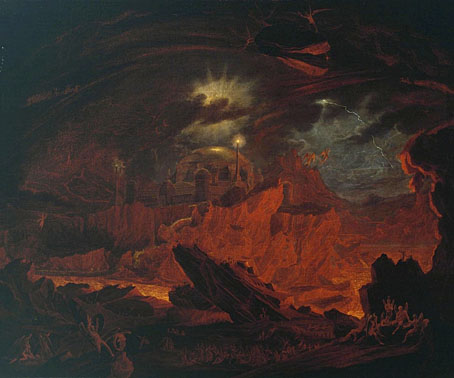
The Fallen Angels Entering Pandemonium, from ‘Paradise Lost’, Book 1 (c.1841) by John Martin.

• “Hergé’s heirs sue artist over his Tintin/Edward Hopper mashups.” The complaint is that the paintings of Xavier Marabout besmirch Tintin’s character by making him seem…human? Silly. I’d sooner complain that Hergé’s ligne claire drawing style is an awkward match for Hopper’s realism. And besides which, isn’t Tintin gay? There’s a lot of wish-fulfilling slash art showing Tintin and Captain Haddock in a closer relationship than Hergé ever would have wanted. This Canadian magazine cover by Normand Bastien dates from 1987.

• “Everyone wanted to make products that looked fast and angry and maybe wanted to lay eggs in your brain.” Alexis Berger tells S. Elizabeth how she avoided years stuck in a design office by becoming a jeweller instead.

• New music: Chiaroscuro by Alessandro Cortini, and Frequencies For Leaving Earth Vol. 4 (One-Hour Loop) by Kevin Richard Martin & Pedro Maia.

The Willows is less a flight of fancy and more an attempt to articulate the ways in which what we dubiously still call “nature” is at once an object of human systems of knowledge and yet also something that undermines those same systems. Thus if The Willows is indeed a classic of “supernatural horror” (as HP Lovecraft would famously note), we might also be justified in calling it “natural horror” as well. In Blackwood’s wonderfully slow, patiently constructed scenes of atmospheric suspense, there is the sense of an impersonal sublime, a lyricism of the unhuman that shores up the limitations of anthropocentric thinking, as well as evoking the attendant smallness of human beings against the backdrop of this deep time perspective.

Eugene Thacker on how Algernon Blackwood turned nature into sublime horror

• Women of Letters: John Boardley talks to Lynne Yun, Deb Pang Davis, Coleen Baik and Duong Nguyen about their typographic designs.

• At Google Arts & Culture: Music, Makers & Machines: A brief history of electronic music.

• At The Public Domain Review: The Universe as Pictured in Milton’s Paradise Lost (1915).

• Beyond the Perseverance drone: Chloe Lula on the sounds of space.

• At Wormwoodiana: Colour magazine (1914–1932).

Wyrd Daze Lvl.4 FOUR STAR is here.

• At Dennis Cooper’s: Hell.

O Willow Waly (1961) by Isla Cameron And The Raymonde Singers | Cool Iron (1972) by The Willows | The Willows (2005) by Belbury Poly

The groovy look

groovy14.jpg

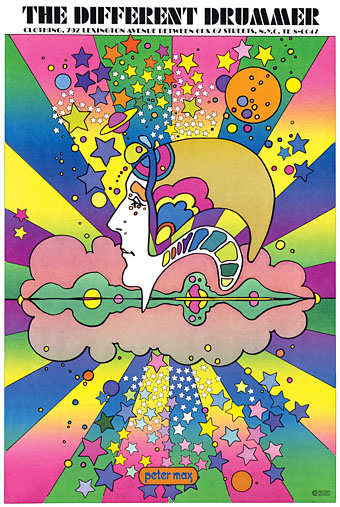
Peter Max, 1968.

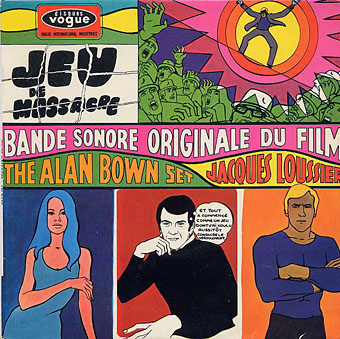
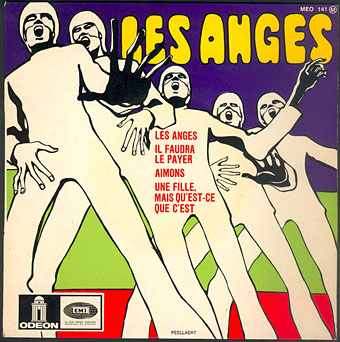
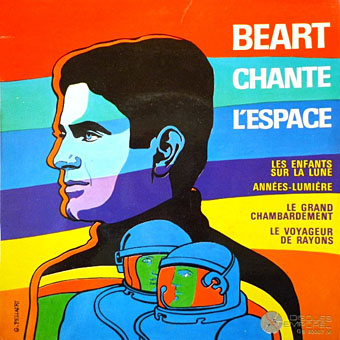
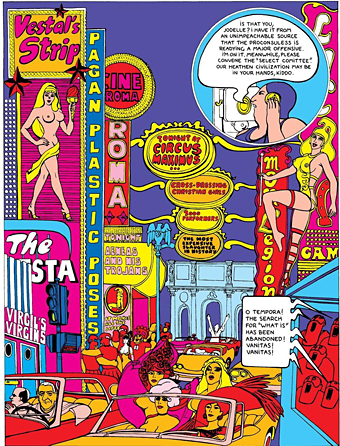
Artists complain justifiably about the constraining effect of labels but sometimes you really do need a label in order to identify a particular idiom. The artwork here is what most people would regard as psychedelic even though the subject matter isn’t always psychedelic at all. I doubt that Citroën intended their new Dyane car to be associated with LSD when they asked Michel Quarez to create a comic book to promote the vehicle, while Quarez’s Mod Love comic is just as hallucinogenically chaste. I tend to think of this style as “groovy”, an unsatisfying term with other associations but “post-psychedelic”, while accurate, feels too cumbersome for such playful graphics. The groovy look is where the purely psychedelic style enters the mundane world, and where the intended audience may be youthful but isn’t always a crowd of experienced lysergic voyagers; a watering down of psych delirium mixed with a dash of Pop Art, all bold shapes, heavy outlines and very bright colours, comic art (or actual comics) with the edges and detail smoothed away and the gain pushed to the maximum. I keep wishing someone would put together a collection of this stuff. There’s a lot more to be found.

Update 1: I knew I’d forgotten somebody. I replaced the book cover by Gray Morrow—an artist who was never really groovy in the manner of these other works—with a contraception poster by Nicole Claveloux, who was very much in the Groove Zone in the 1970s.

Update 2: Added designs by Miguel Calatayud, Mike Hinge, György Kemény, and Tito Topin. Thanks to Vadim for the tips!

• Further browsing: The Peculiar Manicule.

groovy01.jpg

Guy Peellaert, 1967.

groovy02.jpg

Guy Peellaert, 1968.

groovy03.jpg

Guy Peellaert, 1968.

groovy04.jpg

The Adventures of Jodelle by Pierre Barbier and Guy Peellaert, 1966.

Continue reading “The groovy look”

Switched On again

stereolab.jpg

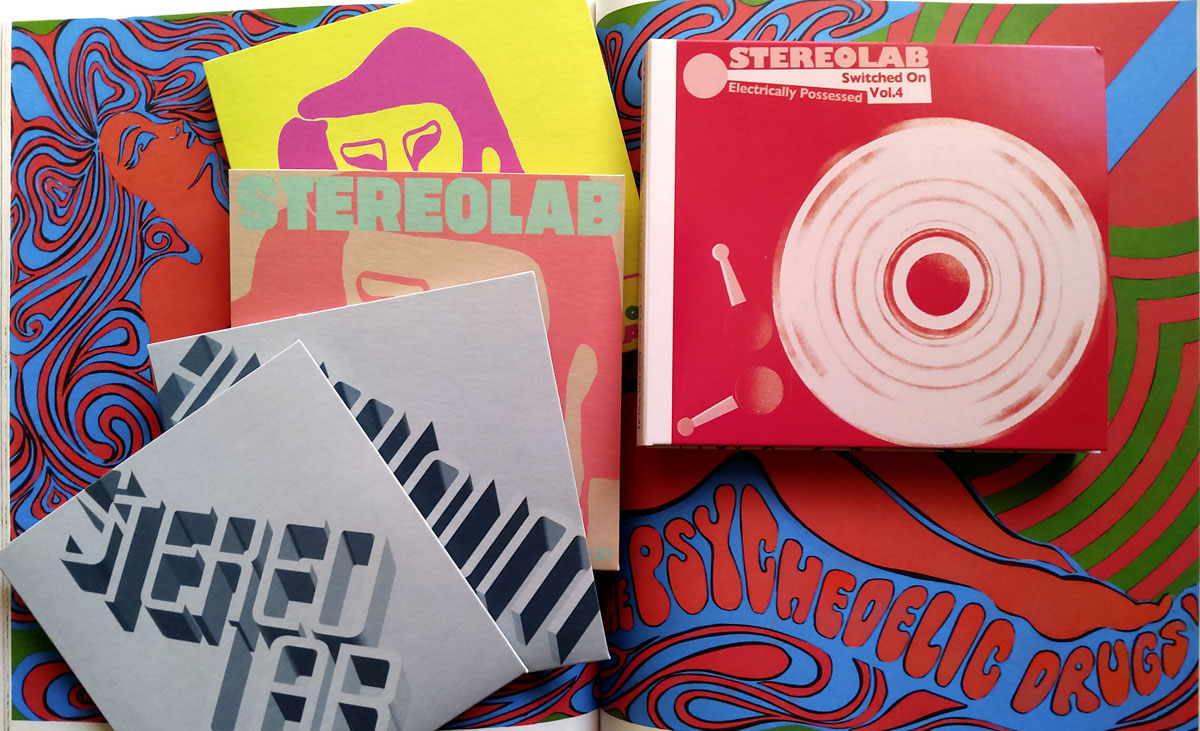
This week I’m electrically possessed by Stereolab, thanks to the arrival of the fourth volume in the Groop’s Switched On series of compilation albums. As with the earlier releases, the new album collects deleted EPs, singles and other scarcities. I already had a third of this one on the First Of The Microbe Hunters EP but it’s good to finally have on disc B.U.A. (aka Burnt Umber Assembly), a previously unreleased piece from the Amorphous Body Study Centre recordings, together with more of the tour singles such as The Underground Is Coming and Free Witch And No-Bra Queen. The latter may well allude in its title and cover art to Pravda, La Survireuse, Guy Peellaert’s freedom-loving biker-hippie whose persona was modelled on Françoise Hardy. (Stereolab’s borrowings are often overt but I’ll give them the benefit of the doubt on this one.) Pravda or not, the animation that Peellaert produced with Gallien Guibert would have made a great video for the song if it was a little longer. Guibert has an updated version of the film here.

Weekend links 556

wilson.jpg

Captain Edward St. Miquel Tilden Bradshaw and his Crew Come to Grips with Bloodthirsty Foe Pirates by S. Clay Wilson, Zap Comix no. 3, 1968.

• RIP S. Clay Wilson, the wild man of American comics. The scene of mayhem above is typical in being barely coherent at a small size; click for a larger view. Patrick Rosenkranz at The Comics Journal describes Wilson as “the most influential artist of his generation…creating an extensive body of work that will defy authority and offend propriety until the end of days”. When Moebius was writing in the 1980s about the founding of Métal Hurlant he had this to say about the American undergrounds: “They were the first in the world to use comics as a means of communication, to express real emotions. Before, comics were used only to do stories, entertainment. They had some great moments but they were all very conventional. The American Underground showed us in Europe how to express true feelings, how to tell something to the reader through the comics. They blew the minds of the few professionals in Europe who saw them.” Also at TCJ, the S. Clay Wilson Interview. Wilson sent me a postcard once. I wish I knew what the hell I’d done with it.

• Michael Hoenig, synthesist for Agitation Free and (briefly) Tangerine Dream, plays one of the pieces from his debut album of electronic music, Departure From The Northern Wasteland, on a radio show in 1977. Hoenig’s album is long overdue a remastering and re-release.

• “My job, which the BBC has tasked me to do, is to provoke people and ask them, ‘Have you thought about looking at the world this way?'” Adam Curtis talks to Michael J. Brooks about his new TV series, Can’t Get You Out Of My Head.

m_chat.jpg

{ feuilleton } celebrates its 15th birthday today. Monsieur Chat, the mascot of this place, is happy about that but then Monsieur Chat is happy about most things.

• At Greydogtales: Opening The Book of Carnacki. A call for contributions to a collection of new stories about William Hope Hodgson’s occult detective. I’d be tempted if I didn’t already have more than enough to keep me occupied.

• “I’m being asked to talk about it a great deal at the moment, with the pandemic.” Roger Corman and Jane Asher on filming The Masque of the Red Death.

• New music: Cygnus Sutra by Mike Shannon, “a soundtrack to a fantasy/sci-fi epic not yet written”.

• A trailer for The Witch of King’s Cross, a documentary about occult artist Rosaleen Norton.

• At Dennis Cooper’s: Spotlight on…Hans Bellmer & Paul Eluard The Games of the Doll (1949).

• RIP also this week to Rowena Morrill, fantasy artist, and to Chick Corea.

• “Computers will never write good novels,” says Angus Fletcher.

• DJ Food on Zodiac posters by Funky Features, 1967.

• Mix of the week: Fact Mix 794 by Lutto Lento.

Annie Nightingale’s favourite music.

Zodiac (1984) by Boogie Boys | From The Zodiacal Light (2014) by Earth | Zodiac Black (2017) by Goldfrapp