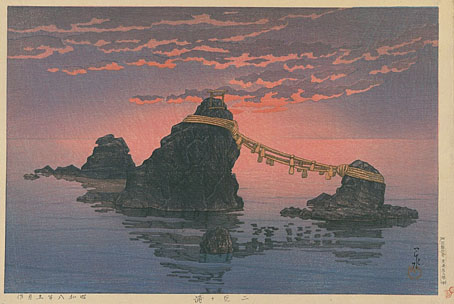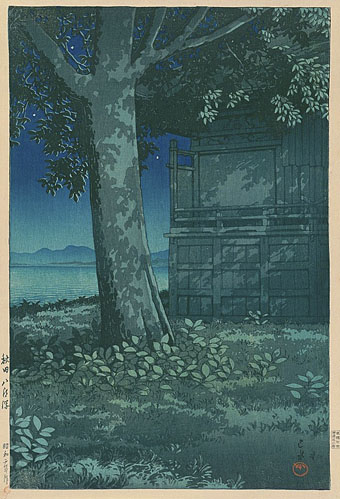
The art of Hasui Kawase, 1883–1957

kawase18.jpg

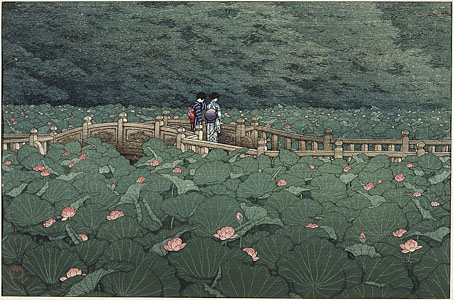
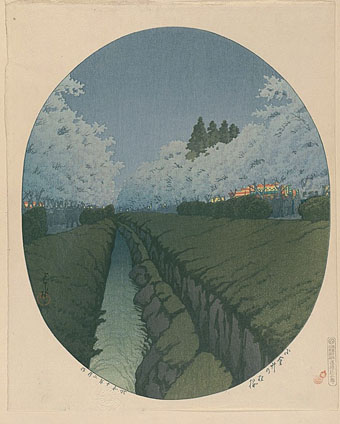
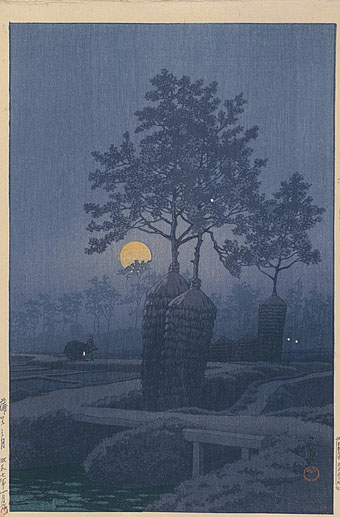
For the past few months I’ve been nurturing a desire to create one or more pieces of art in the ukiyo-e style, not bona fide woodblock prints—I don’t have the materials or the experience—but something that imitates the general look of such things. Other commitments have so far prevented my attempting anything but I keep browsing the work of the print-makers with an eye on the future. Hasui Kawase is very useful in this respect since he was one of the first Japanese artists to combine traditional subjects and print-making techniques with a graphic style influenced by Western art. The views and compositions are often familiar ones but there’s a greater sense of pictorial realism, especially in the treatment of light and shade which is exceptionally skilful. I especially like his nocturnes. Kawase was a very prolific artist so there’s a lot to see, Ukiyo-e.org has over 3,000 of his prints on file. Many of these will be duplicates but that’s still a lot of work.

kawase14.jpg

This is a necessarily limited selection from the collection of Kawase prints at Wikimedia Commons. The quality of his work is so good you could easily make several posts like this one. For those who’d like to see more, two high-resolution print collections, here and here, are a good place to start.

kawase13.jpg

kawase17.jpg

kawase02.jpg

Continue reading “The art of Hasui Kawase, 1883–1957”

Weekend links 663

wt.jpg

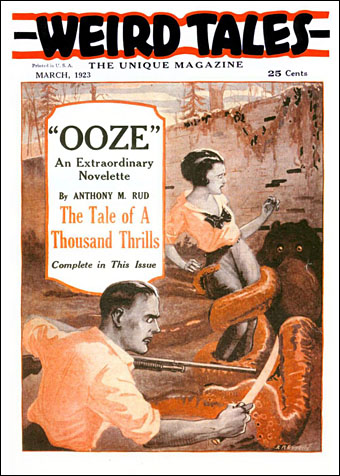
Weird Tales celebrates its centenary this month (although the first issue was on the shelves in February, 1923). Thirty years later, one of the last issues from the initial run had Slime by Joseph Payne Brennan as the story featured on its cover. The magazine maintained a viscous consistency if nothing else. Tentacular art by RR Epperly.

• A big surprise in yesterday’s Bandcamp Friday was the announcement of Singularity, a new album by synth ensemble Node. Or new-ish since the previously unreleased recording is almost 30 years old:

Singularity is the legendary “lost” Node album. Recorded at the same time as their original sessions in 1994 this has DiN stalwart Dave Bessell join Buller & Flood alongside original member Gary Stout who was later replaced by Mel Wesson for the two DiN releases. Presented here for the first time, mastered to modern standards but otherwise untouched and in its original form and recorded to two track with no overdubs.

Node have never been very prolific—two decades separate their first album from their second—so this was very welcome. The new release includes a bonus addition of the 16-minute version of Terminus, one of their best pieces which has only been available previously on a scarce CD-single.

• Steven Watson at Print Mag on skeuomorphic magazine design that turns print into play. Now I want to design a book that fits inside a cassette box.

• RIP jazz giant Wayne Shorter, and David Lindley, co-founder of one of my favourite psychedelic groups, the incredible Kaleidoscope.

• S. Elizabeth at Unquiet Things on The Sensitive Plant, a poem by Percy Shelley illustrated by Charles Robinson.

• Christopher Parker at Smithsonian Magazine asks “Did Salvador Dalí paint this enigmatic artwork?” Yes, he did.

Tangerine Dream in 1973 playing Atem live (with pre-recorded drums) on Spotlight, an Austrian TV show.

• New music: Mohanam by Shakti, and Area Code 601 by William Tyler & The Impossible Truth.

• At Spoon & Tamago: Bento boxes inspired by notable Japanese architecture.

• At Tentaclii: Ian Miller cover art for metal albums.

Northern lights seen across the UK.

New Blue Ooze (1970) by Kaleidoscope | Ooze Out And Away, Onehow (1986) by Harold Budd/Simon Raymonde/Robin Guthrie/Elizabeth Fraser | Ooze (1986) by 23 Skidoo

Now it’s here

rucker1.jpg

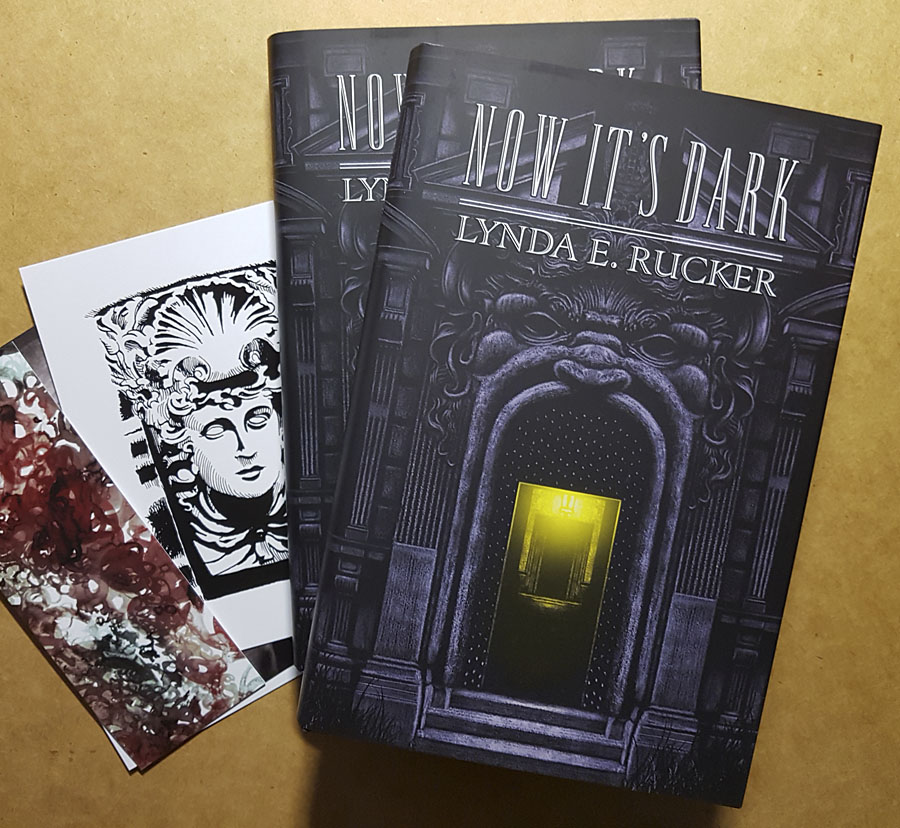
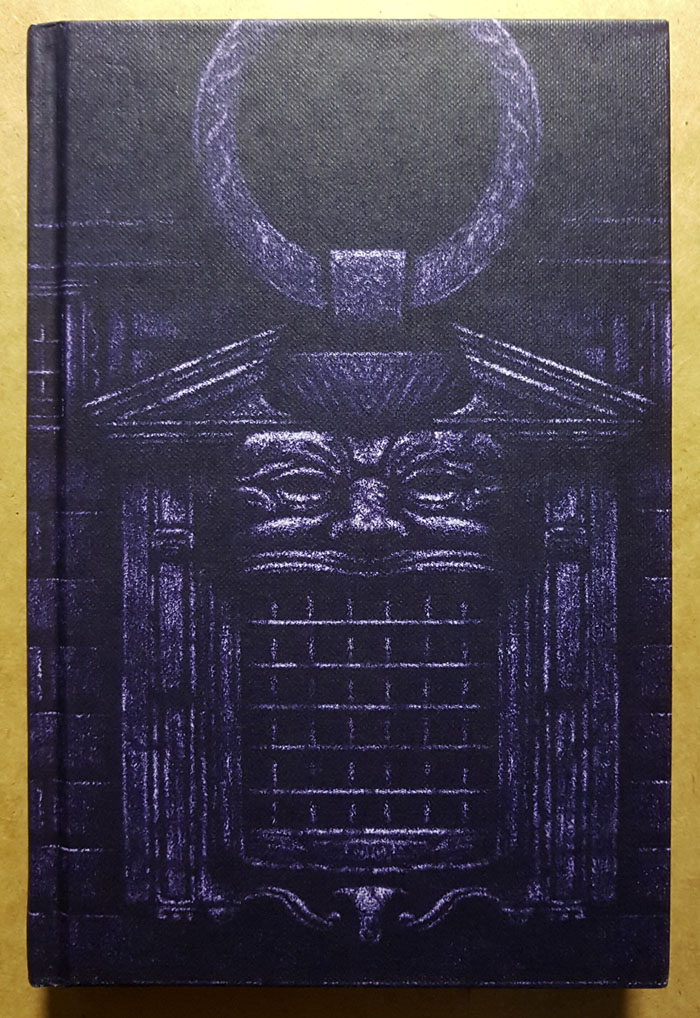
Arriving in the post this week, the Lynda E. Rucker story collection with my art on the dustjacket and the printed boards. This is a typically high-quality production from Swan River Press which comes with the usual complement of postcards and bookmark. I’ve already written something about the art but now the book is in print you can see the texture of the stock that covers the boards. I like the way this works with the texture of the drawing.

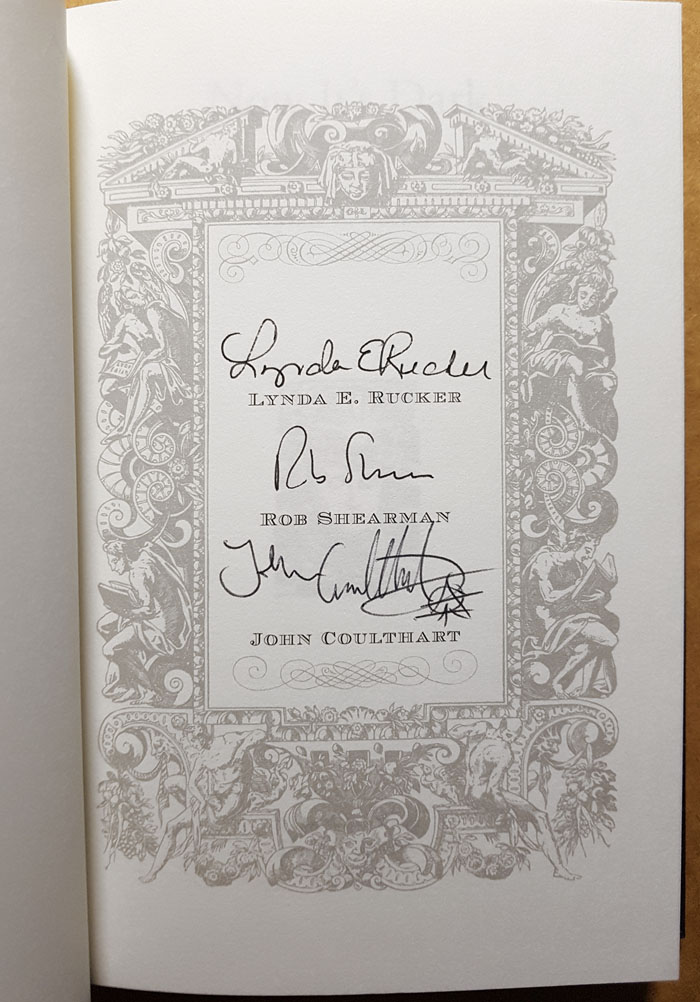
The book is available now. All copies are signed by the author, by Rob Shearman (who wrote the introduction), and by myself.

rucker2.jpg

rucker3.jpg

Parapsychology by Moebius

moebius04.jpg

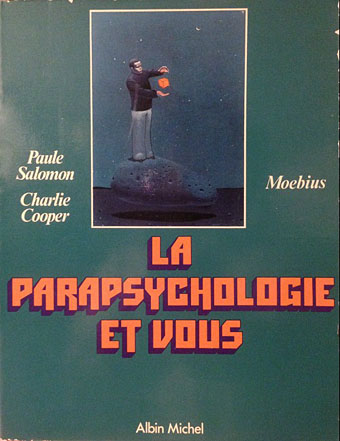
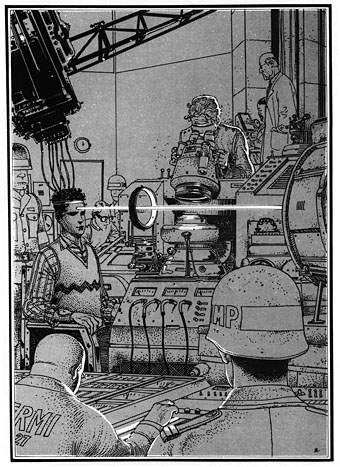
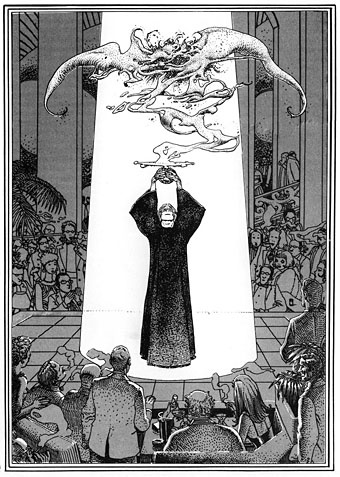
I always enjoy seeing illustrations by Moebius but they haven’t always been easy to find, even today when his international popularity has grown but his comics still overshadow his work in other areas. La Parapsychologie et Vous, a book by Paule Salomon and Charlie Cooper, was published in 1980 and illustrated throughout by Moebius. According to a note by Jean-Marc Lofficier, Moebius had been introduced to Salomon by Jean-Paul Appel-Guéry, a French New-Age figure who I think may be the “guru” whose influence over Moebius in the 1980s is referred to rather scathingly by Jodorowsky in the Moebius Redux documentary.

moebius01.jpg

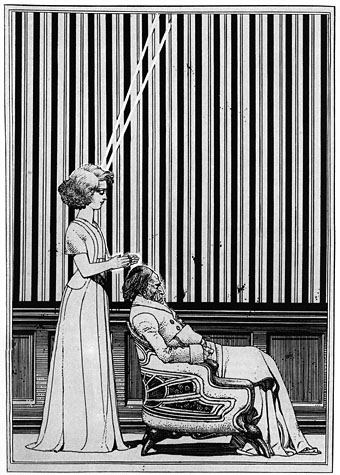
Whatever the circumstances that led to the commission, I love these illustrations which manage to honour the theme of the book while being typical products of their creator’s imagination. It’s also good to see further examples of Moebius adding screentone (aka Letratone or Zip-A-Tone) to his drawings. Moebius and Jodorowsky’s The Eyes of the Cat (1978) was created using the same technique, but elsewhere his black-and-white art is usually shaded by hand, if it’s shaded at all.

moebius09.jpg

All these illustrations are taken from Chaos (1991), a collection of Moebius illustrations and other one-off pieces which may be seen in full here. I’ve not seen a copy of La Parapsychologie et Vous so I can’t say whether this is a complete set of drawings; there’s at least one other picture, showing someone floating in a chair, that seems to be from the same series. In addition to book reprints, the drawings were also reprinted a few years ago as a portfolio set for collectors.

moebius07.jpg

Continue reading “Parapsychology by Moebius”

Weekend links 662

mika.jpg

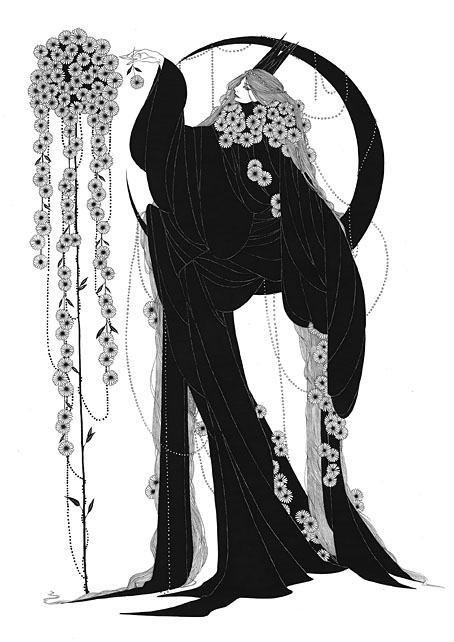
Pierrot le Fleur by Marina Mika.

• I’ve been saying for years that Andrzej Żuławski’s On the Silver Globe should be given a proper blu-ray release, and that’s what Region B viewers will receive soon courtesy of Eureka. Andrzej Żuławski: Three Films will be released in May, a set that comprises the director’s unfinished SF film, his debut feature, The Third Part of the Night (1971)—which I still haven’t seen—and also The Devil (1972), which I have seen but only as a poor copy that’s been circulating via illicit channels for many years.

• “The album’s 18-minute, multi-section standout Jenny Ondioline acquired a crucial role. It became the first track I’d play whenever I boarded a train, slipped on my headphones, and settled in beside an anonymous rail rider.” Hayden Merrick on travelling across the USA to the sounds of Transient Random-Noise Bursts With Announcements by Stereolab.

• At Aquarium Drunkard: E. Hehr explores musical exotica via Technicolor Paradise: Rhum Rhapsodies & Other Exotic Delights, “…a compilation that touches upon the noir side of exotica, far more gritty and raw compared to the lavish production on the esteemed exotica albums from Capitol and Liberty.” I own this collection. It’s a good one.

“My own experience,” Leda muses “tells me that more love goes into the thought of homosexuality than the practice.” Other gays are neither radical heroes nor the pathetic, self-hating fairies of, say, Mart Crowley’s Boys in the Band. This frankness makes Love, Leda a singular work; a contemporary portrait of working-class gay London in the years running up to decriminalisation that neither flatters nor sensationalises. In doing so, Hyatt transforms gay sex and love from an abject taboo to a deeply human intimacy.

Huw Lemmey on Love, Leda by Mark Hyatt, a candid tale of gay life in the Britain of the 1960s

• “It became something like a ritual, an exhumation of long-unheard music reanimated as glacial drones and ghostly symphonic movements—the sound of the cathedral transmuted into an enveloping shadow of pulsation, echo and glitch.” Orgelwerk by Ted Reichman.

Max Richter answers 50 questions. Sleep, Richter’s 8-hour ambient epic, is still my favourite among his compositions that I’ve heard to date: 8 CDs and a blu-ray disc from Deutsche Grammophon.

• RIP Alastair Brotchie, publisher of books at Atlas Press, and biographer of Alfred Jarry. Also a commenter here on one occasion when he corrected an erroneous photograph caption.

• A trailer for Suzume, a new feature film by Makoto Shinkai. Related: A Gathering of Cats.

• The story behind Jack Pierson’s homoerotic new photo book.

• The Strange World of…Phew.

Why Do I Still Sleep (1983) by Popol Vuh | Sleep I (1995) by Paul Schütze | The Dreamer Is Still Asleep (1999) by Coil