Rammellzee RIP

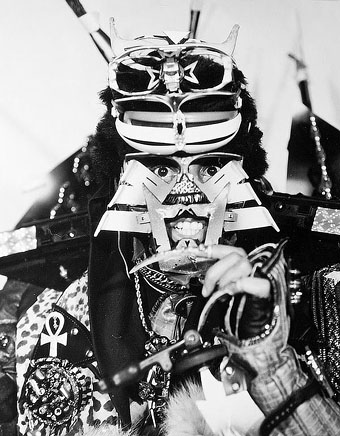
rammellzee.jpg

Rammellzee.

I consider that immortality is the only goal worth striving for: immortality in space. Man is an artefact created for space travel.
William Burroughs, 1982

We have to leave this tasteless mould of a planet.
Rammellzee, 2004

It’s fitting that a post about the late Rammellzee should follow one about Brion Gysin even if the circumstances aren’t those one would wish. Before he was involved in music Rammellzee was a graffiti artist and the convoluted mythologising which he later wove around the art of the graffiti tag—and his obsession with words and their meaning—bears comparison with Gysin and Burroughs’ similar mythologising, their theories about the viral origins of language. Look at Gysin’s calligraphic paintings (which he based on Arabic script) and you’ll see an exact analogue with the stylisations of graffiti taggers.

Given all of that, it’s even more fitting that Rammellzee was one of the voices chosen by Bill Laswell to set beside William Burroughs on Material’s finest forty minutes, Seven Souls, in 1989. I knew that voice from the great 1983 single he made with K-Rob, Beat Bop, one of many highlights on the best of the Street Sounds compilations, Electro 2, so it was a pleasant surprise finding it on the album which remains the best musical work that Burroughs was involved with. Rammellzee’s subsequent recordings with Laswell and others evolved an elaborate strain of what’s now known as Afrofuturism which he extended into paintings, collages and sculptural work. When you look at his detailed, science fiction philosophies, or at the underwater mythologies of Drexciya, it’s evident that there’s a rich seam of the African-American imagination which exactly parallels Burroughs’ visionary work. Visionaries right now are in short supply; we can’t afford to lose another.

Rammellzee: The Remanipulator versus Syntactical Virus by Peter Shapiro (1997)
No Guts No Galaxy—Rammellzee & phonosycographDISK (1999)
Rammellzee: The Ikonoklast Samurai by Greg Tate (2004)

Previously on { feuilleton }
Street Sounds Electro
The art of Shinro Ohtake

Brion Gysin let the mice in

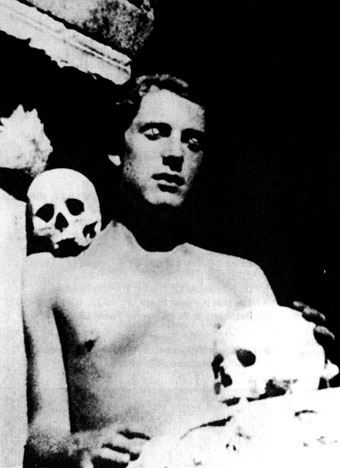
gysin.jpg

Brion Gysin—autoportrait (1935).

“A shaman to me is always a pansexual being,” says the gay Canadian filmmaker. “These guys all came out of that period where queer was really hardcore, it was part of their radical art — and of course it was illegal.” (more)

The filmmaker in question is Nik Sheehan discussing FLicKeR, his 2007 documentary about artist and writer Brion Gysin. Sheehan’s film is available for viewing at Ubuweb although I haven’t got round to watching it yet so I can’t say much about it. (Reality Studio has a review.) Gysin’s life and work is certainly worthy of study, however, his art and writing—which encompassed novels and experimental poetry—often having been overshadowed by his close association with William Burroughs. He gets a raw deal in Ted Morgan’s curiously bad-tempered biography of Burroughs, for example, despite having given his co-conspirator the cut-up technique, collaborated with him on The Third Mind, and so on. FLicKeR‘s title refers to Gysin’s Dreamachine, the first sculpture which needs to be experienced with the eyes closed, being a homemade hallucination engine which works by flickering light and shadow at a rapid rate on the closed eyelids. I made some Dreamachines of my own in the mid-1980s by carefully studying photos in RE/Search #4/5, and they certainly do work. It’s a shame that 78rpm record players are more difficult to find than they used to be since the original template devised by Gysin and Ian Sommerville needs a high speed in order to create the optimum flicker rate. As you might expect, various psychonauts have since created their own variations such as this one for a 45rpm player.

I mentioned a few weeks ago that the New Museum in NYC is staging the first US retrospective of Gysin’s work, an exhibition which they happen to call Dream Machine, and which opens on July 7th. The New York Times ran a piece about Gysin in advance of that. Ubuweb has further Gysin materials, such as this Burroughs piece about Gysin’s invention of the cut-up method, and some recordings of the permutated poems. Finally, if you’re wondering about the title of the post, it’s a reference to this.

Previously on { feuilleton }
Burroughs: The Movie
William S Burroughs: A Man Within
Emil Cadoo
The Great God Pan
The Final Academy
William Burroughs book covers
Towers Open Fire

Weekend links 19

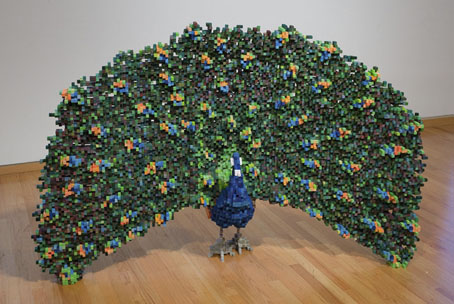
smith.jpg

Peafile (2006) by Shawn Smith; plywood, ink, acrylic paint.

Surreal Friends, an exhibition of work by Leonora Carrington, Remedios Varo and Kati Horna at the Pallant House Gallery, Chichester, UK. Related: The surrealist muses who roared, Leonora Carrington and other women Surrealists profiled.

Landscapes From a Dream: How the Art of David Pelham Captured the Essence of JG Ballard’s Early Fiction. A graphic design essay at Ballardian.

• “(T)he significant thing is not the behaviour of the players but the attitude of the spectators: and, behind the spectators, of the nations who work themselves into furies over these absurd contests, and seriously believe — at any rate for short periods — that running, jumping and kicking a ball are tests of national virtue. (…) It is the most violently combative sports, football and boxing, that have spread the widest. There cannot be much doubt that the whole thing is bound up with the rise of nationalism — that is, with the lunatic modern habit of identifying oneself with large power units and seeing everything in terms of competitive prestige.” The Sporting Spirit by George Orwell, December 1945.

• One of my cult pop albums from the 1980s, A Secret Wish by Propaganda, is reissued in a 25th anniversary edition next month. I no doubt have most of the bonus tracks already but the prospect is still irresistible.

Tangier Cut-Up, an uncollected piece by William Burroughs from Esquire, September 1964.

Ghostwriter —  The Continuing Adventures Of The Strange Sound Association.

Faust And Last And Always: Germany’s Most Radical Rock Group Talk.

Hollingsville at Resonance FM. Related: Graphic Design on the Radio.

iPad Publishing No Savior for Small Press, LGBT Comics Creators.

The Largest Oil Spills in History, 1901 to Present.

1948 Buick Streamliner by Norman E Timbs.

Neville Brody’s work on display in Tokyo.

Dr Mabuse (1984) by Propaganda; Vladek Sheybal, cowled monks, Fritz Lang references and Anton Corbijn directing.

Weekend links 16

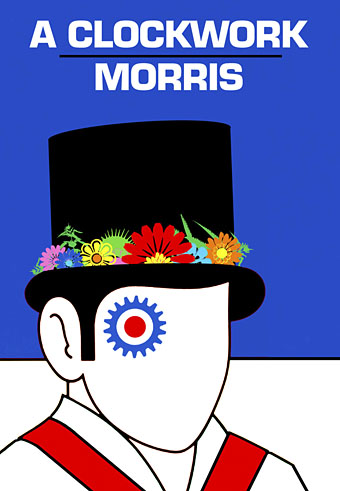
clockwork.jpg

Sumer Is Icumen In but you wouldn’t have known it today, it being cold and wet, O my brothers. The picture above is the work of David Owen whose Ink Corporation does a splendid job of updating the iconography of the folk music world. Via Electric Eden.

• Biting the hand that feeds: designer Jonathan Barnbrook’s contribution to the Biennale of Sydney takes a dig at the whole enterprise. The art market is impervious to criticism (or shame) but the gesture is an amusing one.

Emanuel Schongut’s book covers of the 1960s and 1970s on the artist’s own Flickr pages. Via A Journey Round My Skull.

• Owen Freeman on illustrating William Burroughs. Related: Reality Studio interviews Victor Bockris.

• RIP Jack Birkett, Derek Jarman’s Caliban and the Pope in Caravaggio. And RIP Dennis Hopper, actor, director and photographer.

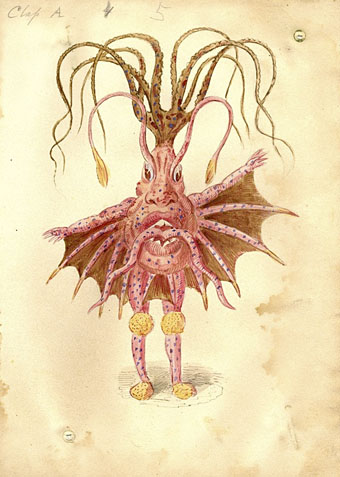
seanettle.jpg

“Sea Nettle” (1873), a costume design by the Mistick Krewe of Comus. From this BibliOdyssey posting of New Orleans Mardi Gras designs.

• Chris Summerfield’s surfer boys at Lulu.

• Homotography also has a Tumblr page.

The Ghost Box Study Series Singles.

• More 3D projection on buildings.

John Foxx interviewed at FACT.

Song of the week: Ineffect (1989) by Material.

Weekend links 10

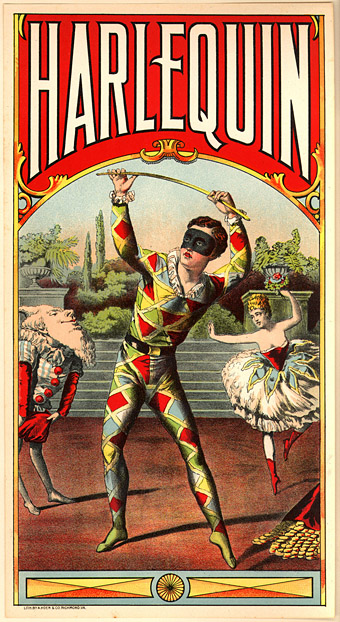
harlequin.jpg

One of a number of vintage ads and ephemeral items at this Flickr set.

• From 1971: The Anthony Balch/William Burroughs/Jan Herman video experiment.

• The NYT reports on World on a Wire, a neglected science fiction drama by Rainer Werner Fassbinder.

• “While some of the technology industry’s brightest minds were inventing the first PCs and developing groundbreaking software, they were also feeding their heads with LSD.”

• The archive of author and illustrator Mervyn Peake has been acquired by the British Library for £410,000.

• Thames & Hudson are publishing I Wonder, a book by the wonderful Marian Bantjes, later in the year. Her site has a preview. I want.

• The gays: It’s election season in the UK so My Gay Vote looks at how the three main parties have supported LGB issues. (No data for the graphs, however.) Is theatre finally glad to be gay? Yet more Tumblrs: I heart skinny boys & Cute boys with cats.

• Trend-spotter, “svengali”, Situationist and the man who named the Sex Pistols: RIP Malcolm McLaren. The Guardian ran a number of memorial pages. Related: Anarchy in Gardenstown.

• Dublin’s One City, One Book choice for April 2010 is The Picture of Dorian Gray.

The Catastrophist: Christopher Hitchens on JG Ballard.

Steampunk Taxidermy by Lisa Black.

• LIFE looks back at Aleister Crowley.

• Groovy songs of the week: Julie Driscoll (with Brian Auger & The Trinity), a pair of songs by Bob Dylan—This Wheel’s On Fire—and Donovan—Season Of The Witch—and sets which look like a collaboration between Verner Panton and Marcel Duchamp. Amazing.