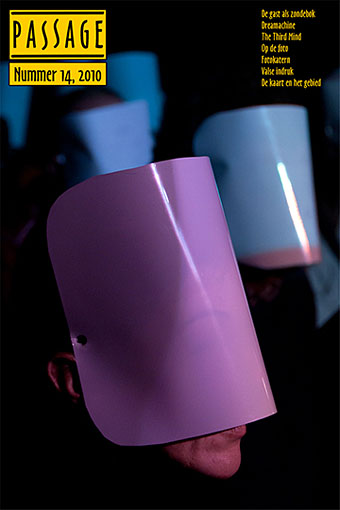
Passage 14

passage14.jpg

It’s that time of year again when my good friend Ed Jansen unveils the latest edition of Passage, his Dutch-language webzine:

The 14th issue of Passage contains articles about language, the dreamachine of Brion Gysin, the collaboration of Gysin with William Burroughs and Ian Sommerville (The Third Mind), a recently discovered photograph of Arthur Rimbaud’s presence in Aden, lots of photos of exhibitions and performances of artists in and around The Hague, about the experiences of Louis-Ferdinand Céline in the First World War and the latest novel of Michel Houellebecq. The purpose behind everything we write and make is to give the reader a sense of direction towards the unknown, towards the North-West Passage that leads to a new world.

The cover picture is a photo of the audience at a Dreamachine-inspired presentation by Matthijs Munnik about which we’re told:

In my performance I also make use of the flicker effect, but I have more control over it. In my performance, the audience wears white plastic masks, this way they look into a ganzfeld, a totally white field during the performance. In my set up, I use beamers, projecting light on the audience’s masks, completely immersing them in the light and colors of the projection.

I play an 8 minute live composition, based on the varying effects of different frequencies of flicker, colour, binaural beats and sound. During the performance every spectator will see something different, varying patterns and colours, created within their own brains.

And speaking of the Dreamachine, Nick Hydra left a comment in an earlier post with the news that visitors to the Wellcome Collection’s High Society exhibition in London have the opportunity to trip out with one of Brion Gysin’s flicker machines until the end of February.

Previously on { feuilleton }
Brion Gysin let the mice in
Passage 13
Passage 12
Passage 11
Passage 10

Saint Genet

genet1.jpg

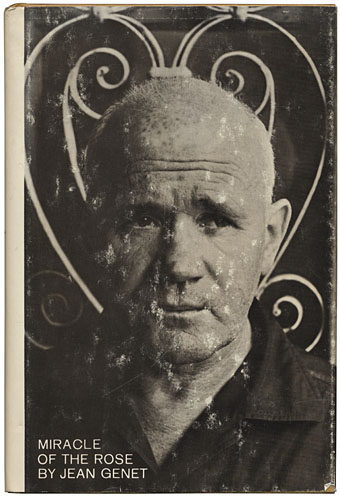
Miracle of the Rose (1965). Photo by Jerry Bauer, design by Kuhlman Associates.

[William Burroughs is] without a doubt…the greatest American writer since WWII. There are very, very few writers in his class; I think Genet is about the only one whom I’d put in the same category. All the British and American writers so heavily touted—the Styrons and the Mailers and their English equivalents—it’s just not necessary to read anybody except William Burroughs and Genet.

JG Ballard, RE/Search interview, 1984.

Jean Genet (the “Saint” was a gift from Jean-Paul Sartre) was born on December 19th, 1910 so consider this a late centenary post. Some of Ballard’s debt to William Burroughs can be found in writings such as The Atrocity Exhibition (1970) and his early text experiments. Genet’s influence, if we have to look for such a thing, I usually see in the use of metaphor to transform an uncompromising reality. Like the moment at the beginning of Crash (1973) when the crushed bodies of package tourists are compared to “a haemorrhage of the sun”. Genet’s writings effected similar transformations from squalid prison environments, turning the sexual assignations and passions of the inmates into ceremonial acts which assume the lineaments of a new religion. He used to claim in later life to have forgotten all his works but we haven’t forgotten him. A small selection of Genet links follows.

esquire.jpg

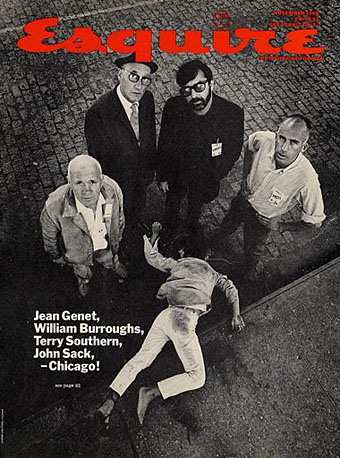
Esquire, November 1968.

RealityStudio:

Burroughs’ most famous and most widely read piece for Esquire remains his coverage of the 1968 Democratic National Convention, “The Coming of the Purple Better One,” which was included in Exterminator! Burroughs was hired to cover the convention along with Terry Southern, who was a pioneer in New Journalism with his “Twirling at Ole Miss” (which appeared in Esquire in February 1963), John Sack, who wrote on the experiences of Company M in Vietnam for Esquire (with the legendary cover “Oh my God — We hit a little girl”), and Jean Genet, an authority on oppression who turned increasingly politically active after the events in Europe in May 1968. (Continues here.)

Ubuweb:
Un Chant d’Amour (1950): Genet’s short homoerotic drama which he later disowned. The film’s masturbating prisoners and naked male flesh made it notorious and, for later generations of filmmakers, a pioneering and influential work.
Le condamné à mort (1952): A reading of Genet’s poem (in French) with electroacoustic accompaniment.
Ecce Homo (1989): A short film by Jerry Tartaglia which cuts scenes from Un Chant d’Amour with gay porn.

caillaux.jpg


Bibliothèque Gay:
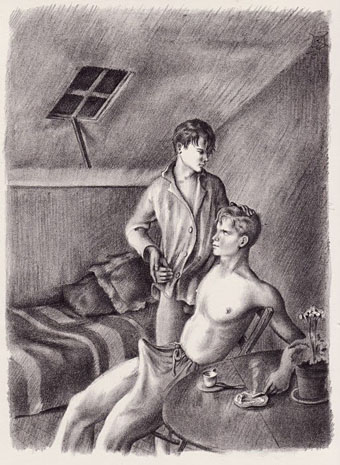
Vingt lithographies pour un livre que j’ai lu, Jean Genet, Roland Caillaux, 1945. A sequence of twenty pornographic drawings.

YouTube:
The Maids (1975): Glenda Jackson and Susannah York in a film by Christopher Miles based on Genet’s play. There’s also Fassbinder’s Querelle (1982) but YouTube’s limitations don’t do it any favours.
Jean Genet (1985): an extract from the BBC interview where the writer makes a fool of interviewer Nigel Williams. This captured Genet a few months before his death and he remains the stubborn outsider to the last, questioning the conventions of the television interview which he compares to a police interrogation. A transcript of the whole fascinating event can be found here.

Previously on { feuilleton }
Emil Cadoo
Penguin Labyrinths and the Thief’s Journal
Un Chant d’Amour by Jean Genet

Weekend links 31

bock.jpg

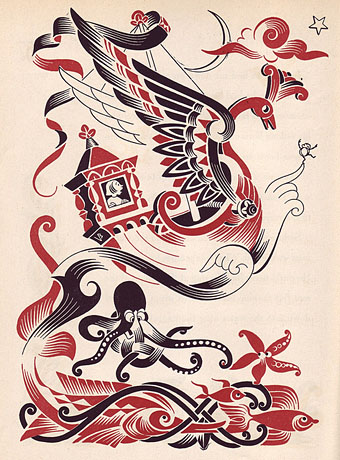
One of a series of illustrations by Vera Bock for A Ring and a Riddle (1944) by M.Ilin and E. Segal. Via A Journey Round My Skull.

The Creator of Devotion: Photos from a Vogue Hommes Japan feature by Matthew Stone. And also here.

Dressing For Pleasure: Jonny Trunk gets out the rubber gear. Related: King of Kinky.

Salvator Rosa (1615–1673) is having a show at the Dulwich Picture Gallery, London.

Hackney Dissenting Academy #1: Throbbing Gristle, Iain Sinclair & Alan Moore.

Out Of The Flesh (1984) by Chakk. A great single never reissued on CD.

• Photographer Charles Gatewood remembers William Burroughs.

mural.jpg

The Endless Mural. Follow links here to have a play around.

Vinyl record sales are at the top of a four-year sales trend.

Can explosions move faster than the speed of light?

• Buckminster Fuller’s Dymaxion Car is reborn.

• Maximus Clarke talks with William Gibson.

Why Stephen Fry loves Wagner.

Kafka’s Last Trial.

• Alice Coltrane in concert, Warsaw, 1987: Harp solo | Impressions | Lonnie’s Lament | A Love Supreme.

Weekend links 30

woody.jpg

Did someone say “woody”? Plenty more toy antics at TheOneCam.

• And yet more Haeckelisms: Praying in Haeckel’s Garden, recent works by artist Mary O’Malley.

Seasons of the Peacock, the perennial showoff as depicted by a handful of Art Nouveau artists. A couple of examples there I hadn’t seen before.

• Dorian Cope presents On This Deity, “Commemorating culture heroes and excavating world events.”

• At long last, Fantagraphics will be publishing Ah Pook is Here, the comic strip collaboration between William Burroughs and artist Malcolm McNeill. Something to look forward to for next year. Related: Malcolm McNeill’s website.

David Lynch Dark Splendor: “Der große Filmemacher David Lynch als Fotograf, Maler, Zeichner und Grafiker.”

More on the forthcoming album from Brian Eno, Leo Abrahams and Jon Hopkins. With this degree of hype the end result is going to be a disappointment.

Book design by Richard Hollis, including John Berger’s essential Ways of Seeing.

A fistful of Vignellis: the work of Lella and Massimo Vignelli celebrated.

• Berni Wrightson’s Frankenstein at Golden Age Comic Book Stories.

Jimi Hendrix, Philip José Farmer reader.

Imagerie du Chemin de Fer.

El UFO Cayó (2005) by Ry Cooder.

Weekend links 21

nagai.jpg

A poster by Kazumasa Nagai.

• Franco Maria Ricci creates the world’s largest maze. “The former publisher said he first confided his ambition to Jorge Luis Borges, who characteristically told him the world’s largest maze already existed and was called a desert.” Related: Mirror, Mask, Labyrinth, a review of two new collections of Borges’ poetry.

FACT mix 164 is a dubstep collection by Pinch and a promotion for the Dark Matter compilation which I designed earlier this year.

• One of the monuments of 20th century music, Bitches Brew by Miles Davis, is released in another new (and expensive) edition next month by Sony. Nice packaging, and there’s a vinyl edition included, but these things always come across as a cyncial attempt to milk the hardcore fans one more time. And have you noticed how all vinyl releases are now described as “audiophile”? If the big record companies had shown this much dedication to quality in the 1980s when they were jobbing out sub-standard vinyl pressings their reputation might be slightly higher today.

• More Gysin: Brion Gysin, William Burroughs, and the secret life of a building on the Bowery. And Ubuweb’s page of Gysin sound works and recordings.

Michael Moorcock: “I think I preferred my own imagination”. A two-part interview about the cover designs for Moorcock books.

The Pansy Project: “Artist Paul Harfleet plants pansies at the site of homophobic abuse, he finds the nearest source of soil to where the incident occurred and generally without civic permission plants one unmarked pansy. The flower is then photographed in its location and posted on his website, the image is entitled after the abuse … The Pansy Project also marks locations where people have been killed as a result of homophobic attack”

This Gaming Life: Travels in Three Cities. Jim Rossignol’s book is available as a free download.

Lost London. Also, the Victorian Catacombs of South London.

Dedalus Books had its Arts Council grant reinstated.

’Zine Lutefisk: fashion/art/escape.

Time Will Show The Wiser (1968) by Fairport Convention | She Moves Through The Fair (1969) by Fairport Convention | She Moved Through The Fair (1994) by Jam Nation.