Weekend links 321

miyabi.jpg

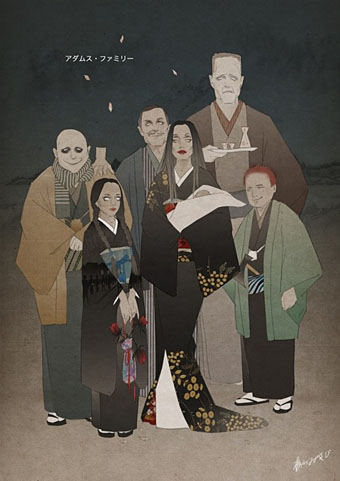
The Addams Family In Kimonos by Matsuyama Miyabi. Via S. Elizabeth.

• “They’re not the men you’ll walk down the street and lock eyes with, or that you’ll spot at a bar casually. They’re a fantasy.” Michael Valinsky reviewing Tom House: Tom Of Finland In Los Angeles edited by Michael Reynolds. Related (and almost a polar opposite): Nick Campbell on The Life to Come and Other Stories by EM Forster.

Randall Dunn, musician (Master Musicians of Bukkake), producer (Sunn O))), Earth, etc), engineer, discusses making and recording music.

John Waters brings back Multiple Maniacs: “Of course I went a little too far.” he says. Waters also talked about the film at Gawker.

Q: Most cherished book on your shelves? Why?

A: Depends on the day. Today it’s Blood Meridian by Cormac McCarthy. Blood Meridian is an indictment of Manifest Destiny, the Westward Expansion, of Hollywood and its portrayal of the west; it’s confrontational and bellicose. The sheer brutality of it affected me like I’d swallowed poison or taken a shot to the liver that I didn’t remember. Blood Meridian is a reminder that literature isn’t always tame. It can bite you.

Laird Barron talking to Smash Dragons about favourite writers and his own fiction

• In East Tower Dreaming Howlround, aka Robin the Fog, processes the sounds of a former BBC office building.

• At The Headless Hashasheen: Magic Mirrors and Specters: Paschal Beverly Randolph, Hashish, & Scrying.

• At Dangerous Minds: The astonishingly beautiful three-colour photography of Bernard Eilers.

Samm Deighan on Gothic Film in the ’40s: Doomed Romance and Murderous Melodrama.

• On a scale from 1–100, Milton Glaser rates every single Olympic logo design in history.

• The overwhelming A/V experience of Paul Jebanasam and Tarik Barri.

Patrick Feaster describes how to “play back” a picture of a sound wave.

• Mix of the week: Secret Thirteen Mix 192 by Shadows.

COLLAGE—The London Picture Archive

Madrigal Meridian (1978) by Tangerine Dream | Meridian Moorland (1979) by Peter Baumann | Meridian (2009) by Espers
Tomita album covers

tomita01.jpg

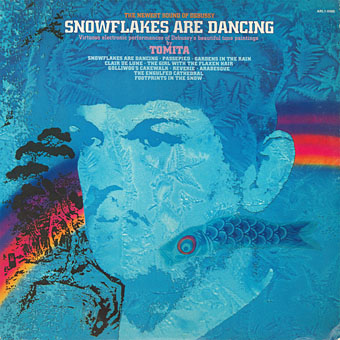
Snowflakes Are Dancing (1974); art direction; Joseph J. Stelmach; artwork: David B. Hecht.

The Japanese composer Isao Tomita died last week so I’ve been listening to some of his early recordings, and thinking—as usual—about their cover designs. Tomita was by far the best of the many electronic musicians in the 1970s who took advantage of the huge success of Wendy Carlos’s Switched-On Bach (1968) to create their own versions of classical music with Moog and other synthesisers. If this makes Tomita sound like an opportunist (and his 1972 collection of electronic pop covers was titled Switched On Hit & Rock), he quickly developed his own approach to electronic composition which ranged from quirky humour to his own brand of cosmic pictorialism. The latter was very different from the equally cosmic meanderings of Tangerine Dream which seldom strayed too far from the rock world. Tomita had a genius for taking very familiar pieces of classical music which he fashioned into synthesizer soundtracks for imaginary science-fiction films. (He also produced actual scores for a number of Japanese films but few, if any, of these were released outside Japan.) This approach is shown to great effect on The Bermuda Triangle (1979), an album that was subtitled “A Musical Fantasy Of Science Fiction”, and which filters Prokofiev and Sibelius through a library of crank paperbacks, with references to UFOs, undersea pyramids, Agharta, the Hollow Earth, Close Encounters of the Third Kind, and the Tunguska Event.

tomita02.jpg

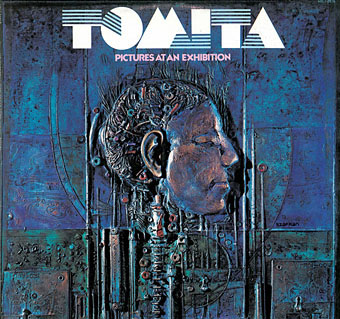
Pictures At An Exhibition (1975); artwork: bas-relief by Gene Szafran. The first appearance of the logo that became a fixture of Tomita’s albums. No designer is credited but I’d guess it was the work of Joseph J. Stelmach. The logo typeface is Sinaloa.

As for the covers, Tomita’s recordings may have been classical music but RCA targeted the albums at a rock audience so there’s no sign of the venerable composers heads that appear continually on the sleeves of orchestral recordings. The examples here are almost all the Western releases which, surprisingly, tended to have better covers than the Japanese originals. This is also a partial selection, favouring Tomita’s own releases (no soundtracks), and mostly the early albums. The later albums aren’t as impressive, and many of them were only released in Japan.

tomita03.jpg

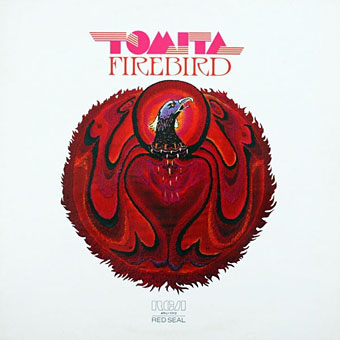
Firebird (1975). No design or art credit. I’d not noticed before that the logo evolves by degrees, here gaining some extensions.

Lastly, I’ll dedicate this post to my old friend Nik Green who died in March. Nik was a session musician of some note, and the first person I knew who owned a synthesizer (an ARP Odyssey). He was also a great Tomita enthusiast who shared Tomita’s sense of humour and relished the quirkier moments on many of these albums. I can’t listen to the opening of the Mars section of Tomita’s The Planets without remembering Nik shouting “That’s a Moog!” when a synthetic fanfare interrupts the sounds of a spacecraft lift-off.

Continue reading “Tomita album covers”

Weekend links 307

chew.jpg

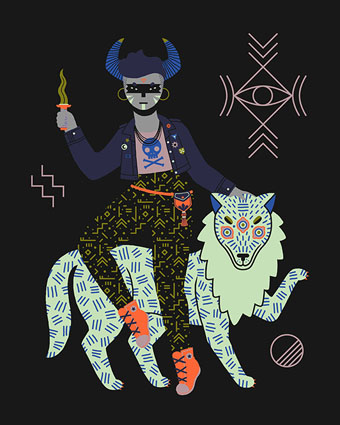
Demon (2014) from the Witch Series by Camille Chew.

• Released next month, Machines Of Desire is the first album of new music by Peter Baumann since Strangers In The Night in 1983. Baumann’s first two solo albums, Romance 76 (1976) and Trans Harmonic Nights (1979), are exceptional works of analogue electronica that frequently outmatch his former colleagues in Tangerine Dream. Both albums have been unavailable for over 20 years so it’s good to know that Cherry Red are reissuing them at the end of May (see here and here).

• RIP Jenny Diski whose death from cancer wasn’t a surprise when she’d been writing about her condition for many months. Linked here in 2013 was this pre-diagnosis meditation on death that takes in Nabokov, Beckett and Francis Bacon (philosopher, not artist). “Jenny offered a living example of how, sometimes, compassion can be born of misanthropy,” says Justin EH Smith. The LRB’s archive of Diski writings is currently free to all.

Murder by Remote Control, a graphic novel by artist Paul Kirchner and writer Janwillem van de Wetering that “resembles a Raymond Chandler-esque noir ‘whodunnit,’ viewed through the psychotropic lens of filmmaker Alejandro Jodorowsky”.

Inspired by Gore Vidal’s 1968 satirical novel, Myra Breckinridge which was denounced as obscene by conservatives, [Boyd] McDonald embarked on a radically, offensive publication, one that avoided the sexless influence of middle class gay mores that sought to whitewash the homosexual experience in order to present a more palatable image of assimilated gays to the general society. This political strategy was successful in achieving gay marriage and more tolerance, but, in the opinion of McDonald, came at a cost. Straight to Hell was in fact the first queer zine. Utilizing erotic photos, interviews and news, McDonald saw it as a “newsletter for us,” the small group of deviates who were its earliest subscribers.

Walter Holland reviewing True Homosexual Experiences: Boyd McDonald and Straight to Hell by William E. Jones

• “HP Lovecraft’s…fascination with all things tentacular and aquatic is unmistakably imprinted on Evolution“, a new film by Lucile Hadžihalilović. Watch the trailer.

• At Dangerous Minds: Broken, the notorious Nine Inch Nails video collection with “snuff movie” interludes by Peter Christopherson, is available online (again).

BEAK> (Geoff Barrow & Billy Fuller) make “claustrophobic, hypnotic music, drawing…on krautrock, post-punk and Interstellar-Overdrive psychedelia”.

• Mixes of the week: Bacchus Beltane 3 : The Age of Abrasax by The Ephemeral Man, and Secret Thirteen Mix 183 by December.

Tease by Jan Rattia, photographs of male strippers on display at ClampArt, NYC.

Wu Zei (2010), a sea-monster sculpture by Huang Yong Ping.

• “I was born weird,” says Robert Crumb.

Sacred Revelation by Susanna

Broken Head (1978) by Eno, Moebius & Roedelius | Broken Horse (1984) by Rain Parade | Broken Harbours (Part 1) (2001) by Stars Of The Lid

The art of Neil Dallas Brown, 1938–2003

brown3.jpg

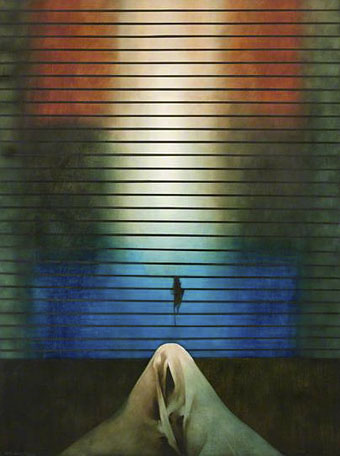
Apocalypse (Homage to Tangerine Dream) (1981).

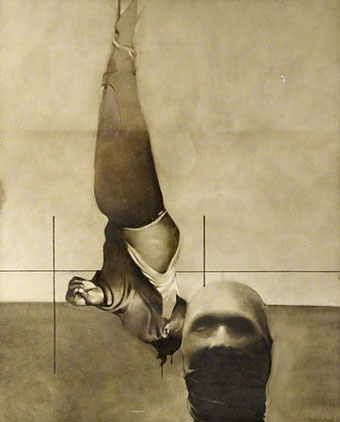
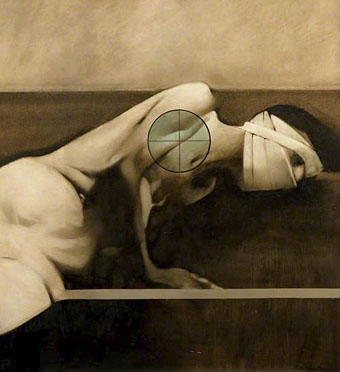
It’s not every day you find a painting dedicated to the doyens of German electronica. This and other works by Scottish artist Neil Douglas Brown are in public galleries in Britain which means they’re also online at the BBC’s Your Paintings site. The pictures that combine nebulous figures, blank backgrounds and lines/arrows show an obvious Francis Bacon influence but that’s no bad thing, and Brown isn’t the only artist to explore this territory. There’s more of his work at the official website.

brown1.jpg

The Indictment (1976–77).

brown2.jpg

Fallen Man (1977).

The kosmische design of Peter Geitner

geitner07.jpg

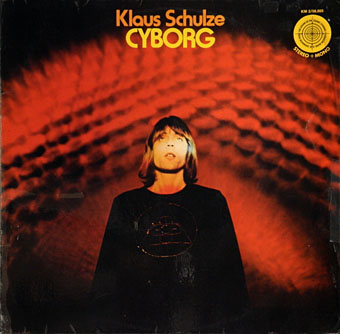
Cyborg (1973) by Klaus Schulze.

More German music design. Once you start delving into the music produced in Germany between 1969 and 1975 you eventually notice that a) the good albums generally have decent cover designs, and b) there are many justly forgotten albums with astonishingly tasteless artwork. Most of the well-known names were smart enough to craft a visual identity: Kraftwerk’s efforts have been explored here recently but there was also the Gothic Surrealism of Falk-U Rogner’s photo montages for Amon Düül II (worthy of a post in themselves); Neu! followed the lead of Kraftwerk with strikingly minimal presentation; Faust’s debut album was released on transparent vinyl in a clear sleeve while their second album was an all-black sleeve with a series of strange pictures inside, one for each song. Can are a notable exception in having no clear identity.

geitner23.jpg

Peter Geitner is unique in this scene in being the only graphic designer you can find who was creating any kind of consistent identity for a label and a group of artists. Almost all the work here is for Rolf-Ulrich Kaiser’s short-lived Kosmische Musik which replaced the earlier Die Kosmischen Kuriere. Both labels were offshoots of Ohr Records (Tangerine Dream’s original home), and catered mostly to the musicians based in Berlin, with a later detour to Switzerland. All the releases feature Geitner’s recurrent motifs of radiating stars and sunburst graphics. I think one of the reasons I like Geitner’s design is because I have a tendency to use similar spiky sunbursts in my own work. Whatever Geitner did after the collapse of Kosmische Musik I’ve yet to discover.

geitner22.jpg

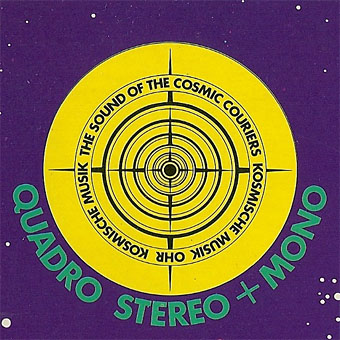
The standard design for the vinyl labels. Many of the albums were released as quadrophonic mixes so the star logo also signifies multi-directional sound. Klaus Schulze’s album is nothing if not cosmic, four sides of treated strings and swirling synth noise.

geitner03.jpg

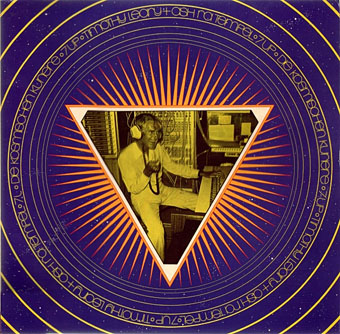
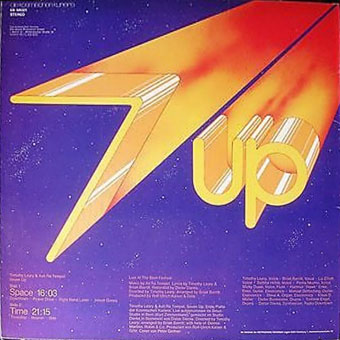
Seven Up (1973) by Timothy Leary & Ash Ra Tempel.

This is a reissue design that replaces the more common sleeve with its Walter Wegmüller doodles and poor layout. I didn’t used to like the music very much either, two sides of bluesy jams with Tim Leary and cohorts bellowing over the top. But it’s a historical oddity, a rare connection between the US psychedelic scene and the German music which took psychedelia in new directions.

geitner04.jpg

Continue reading “The kosmische design of Peter Geitner”