Ave Arthur!

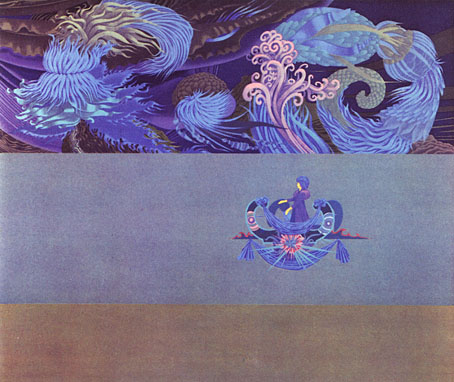
avalon.jpg

The Last Sleep of Arthur in Avalon (detail, 1881–1898) by Edward Burne-Jones.

Arthur magazine announced its demise this week: “He died as he lived—free, high and a-dreaming of love, ’neath vultures’ terrible gaze.” The magazine lapsed for a while in 2007 then returned but this time it seems things are more permanent. Running a magazine of any kind is never easy, and they don’t always last long—the UK run of the legendary Oz only managed 48 issues to Arthur‘s 32—but it’s a dismal fact that certain tastes are rarely catered for or encouraged in this world. Supermarkets stock multiple titles devoted to women’s hair or tin boxes with wheels but you’ll have to hunt elsewhere for copies of Sight & Sound or The Wire. This isn’t a sign of any kind of new barbarism, if you look to history you’ll find The Savoy magazine publishing Aubrey Beardsley’s art and literature alongside contributions from future Nobel Prize winners yet it only managed eight issues; New Worlds magazine struggled during its run in the 1960s and 1970s, and while it may never have officially died (not while Michael Moorcock lives and breathes) it’s safe to say that it would struggle anew if re-launched today. If this is the end then let’s celebrate what’s been done, and hope it may inspire something new.

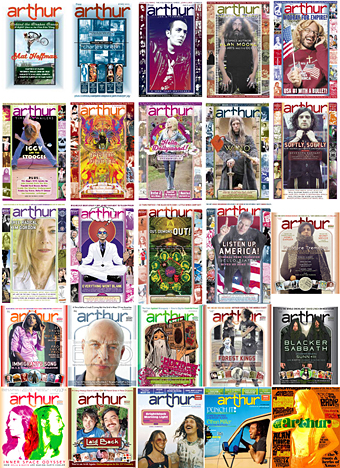
all_the_arthurs.jpg

Issues #1–25.

The Arthur archives will be available online in the future. In the meantime, the favourites among my own contributions were MBV Arkestra (cover illustration), The Aeon of Horus, Out, Demons, Out (cover illustration), Brian Eno, and Sir Richard Bishop.

Previously on { feuilleton }
The Savoy magazine
Dodgem Logic
The Realist
A wake for Arthur
Oz magazine, 1967-73

Weekend links 50

selski1.jpg

Invisible Light by Margo Selski.

The Glass Garage Fine Art Gallery has an online collection of paintings by Margo Selski, many of which feature her cross-dressing son, Theo. Coilhouse profiled artist and model earlier in the week. Some of these paintings mix oil with beeswax which is something I’ve not come across before.

• The Periwinkle Journal‘s first issue will be available online, free, from March 22nd until mid-June, featuring work by filmmaker and artist Hans Scheirl (Dandy Dust), artwork and collages by Genesis Breyer P-Orridge, a 7-page colour comic by Mavado Charon, artwork by Timothy Cummings, artwork and installations by Cody Chritcheloe/SSION, photos by Megan Mantia, Science-Heroes by Peter Max Lawrence, an illustration portfolio by Diego Gómez, selections from the queer photography pool on Flickr, reviews and other stuff. More later.

• The Quietus wanted to remind us that this year is the 25th anniversary of the NME‘s C86 compilation tape, a collection that sought to capture a moment of ferment but which inadvertently inspired too much dreary sub-Velvet Underground pop. I’d rather celebrate the 30th anniversary of the NME‘s C81 compilation, a far more diverse collection and musically superior. If you want to judge for yourself, both tapes can be downloaded here.

selski2.jpg

Machine in the Garden — Our Island Shall Know Abundance Without End by Margo Selski.

• Rick Poynor continues his exploration of Ballardian graphics with a piece about the paintings of Peter Klasen. Related: Where Will It End? JG Ballard interviewed by V. Vale & introduced by Michael Moorcock (Arthur No. 15/March 2005).

In his autobiography, Miracles of Life, JG Ballard suggested that illustrated versions of The Arabian Nights helped prepare him for surrealism.

Robert Irwin, author of The Arabian Nightmare, on the illustrators of The Arabian Nights.

• Another Coulthart cult movie surfaces, Jerzy Skolimowski’s Deep End (1970), out of circulation for many years but newly restored by the BFI. A re-release is scheduled for May so I’m hoping now that a DVD release will follow soon after.

Thom Ayres’ photostream at Flickr, and more long-exposure photos.

Fuck You, A Magazine of the Arts, number 5, volume 8.

Nicolas Roeg: “I don’t want to be ahead of my time.”

• MetaFilter looks at the films of René Laloux.

• The Eerie covers of Frank Frazetta.

Indie Squid Kid.

Requiem (for String Orchestra) by Toru Takemitsu.

Weekend links 46

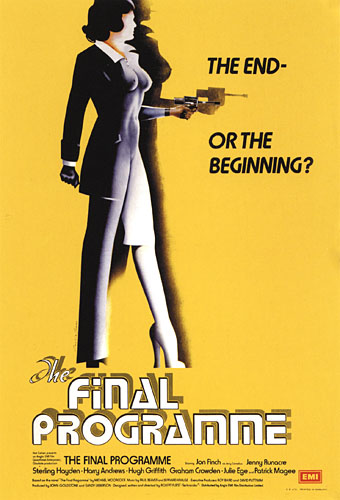
finalprogramme.jpg

The Final Programme (1973). Philip Castle’s poster art implied the androgynous finale of Moorcock’s novel which the film itself evaded.

They were musty-smelling 10p messages from the futuristic past, complete with cover designs (and content) that were unlike anything I’d seen before. I’m fairly certain that this was how I first came across Michael Moorcock, in an early-70s Mayflower paperback, with a psychedelic cover by Bob Haberfield.

(…)

Moorcock steered New Worlds towards a set of concerns that chimed with the times; this was the period ruled by Marshal McLuhan and RD Laing, and the exploration of “inner space” seemed just as interesting as the “outer space” of satellites and moonshots. This turn was controversial, not just with die-hard pulp fans, but, surprisingly, with people such as the pop artist Richard Hamilton, another denizen of the London scene. “He thought we were turning science fiction into something namby-pamby, losing its roots,” Moorcock says. “He wanted explosions and spaceships and robots.”

When Hari Kunzru met Michael Moorcock, a major feature on a great writer and cultural catalyst. Kunzru posted the full transcript of their conversation here. Jovike’s Moorcock Flickr set has many of the lurid Mayflower covers.

• Moorcock is among the contributors to the forthcoming Thackery T. Lambshead Cabinet of Curiositities. io9 posted a list of contents (and one of my pics) while co-editor Jeff VanderMeer added some detail.

• So long to The White Stripes whose dissolution was announced earlier in the week. We know they’ll be back one day. Jay Babcock gave them their first major interview for the LA Weekly in 2000 which he’s reposted here.

Mister Blues (1962) by Lasry-Baschet aka Structures Sonores, a rare 7″ single showcasing the unique glass-and-metal sounds of the Cristal Baschet. Young Teddy Lasry on clarinet was playing in prog-jazz outfit Magma a few years later. Related: John Payne on Magma and The Mars Volta.

Here’s one thing that changed me: a close reading of Flannery O’Connor’s Mysteries and Manners. In it, she says that, “it is the business of fiction to embody mystery through manners,” manners being those concrete details — depictions of the real — in story. “Mystery through manners…” I had never heard a modern author seeking deep metaphysical mystery through realism before. Well, sure, Robert Musil, Bruno Schulz, Robert Walser, and a handful of other personal faves. By deep mystery I mean, mystery about our relationship with the planet, not anthropocentric mystery. I get sick of thinking about humans quickly, as we only constitute about 1% of what’s happening in our universe, if that much, and it was refreshing to me to hear O’Connor critiquing Henry James’ idea that modern people should aspire to know nothing of mystery, to be completely rooted in humanity. That notion makes me feel like hurling myself off a cliff. In her opinion, great literature seeks to embrace and express mystery through its mimicry of actual mannerisms. Mystery — fantasy — through the real. And with that, the borders between fantasy and realism were completely transgressed in my brain. Suddenly, I saw them as two good means to the same end. This made me excited to write real human situations again.

Trinie Dalton is interviewed here.

• And speaking of mystery through the real, there’s London Intrusion, a sequence of metropolitan adumbrations by China Miéville. Am I the only person to spot an intrusion of a different kind in the presence there of one of Eugène Atget’s Parisian views? There’s a doorway to Viriconium in that curious wedge of buildings but nobody can tell you where.

Rupert Murdoch—A Portrait of Satan. Adam Curtis on top form looking at the Dirty Digger’s career and a reminder of why some of us have always called one of his rags The Scum. A key point for me: Murdoch’s insecure railing against “elites”, a favourite term of aspersion on his Fox News network.

• Rick Poynor asks What Does JG Ballard Look Like? Related: “…only two people in Bucharest are going to read this.” Eduardo Paolozzi in conversation with JG Ballard and Frank Whitford, 1971.

How many days does Bill Murray’s character really spend reliving Groundhog Day?

• Silent Porn Star explores The Translucent Beauty of Androgyny.

Ballets Russes brought back to life on film, and also here.

Dewanatron Electronic Music Instruments.

RIP Tura Satana. Remember her this way.

Warm Leatherette (1978) by The Normal | Warm Leatherette (1982) by Grace Jones | Warm Leatherette (1998) by Chicks On Speed.

Weekend links: New Year edition

olofsdotter1.jpg

Flower Me Gently (2010) by Linn Olofsdotter.

• “Many of Moorcock’s editorials are published here, and they still make exhilarating reading. Then, as now, Moorcock set his face against a besetting English sin: a snobbish parochial weariness, an ironic superiority to the frightful oiks who have started filling up the streets. You can almost hear, behind the languorous flutter of the pages, Sir Whatsits sniggering to Lady Doo-Dah. It still goes on, and it’s usually the same flummery in different clothes. Moorcock not only would not go to the party: he threw the literary equivalent of explosive devices into the Hampstead living rooms.” Michael Moorcock’s Into the Media Web reviewed. And also here.

• “Beefheart channeled a secret history of America, the underbelly of a continent and a culture that has now all but vanished along with one of its greatest poets.” Jon Savage on the life and work of the late Captain.

Miniatures Blog, in which musician Morgan Fisher works his way through each of the fifty one-minute tracks on his extraordinary Miniatures compilation album, with details and anecdotes about the artists and the recording of each piece.

Look at Life: IN gear (1967). A Rank Organisation newsreel about Swinging London. Sardonic commentary and some great colour photography showing how the often shabby reality differs from the caricature. Many of the shots are familiar from documentaries about the era but this is the first time I’ve seen them all in one place.

olofsdotter2.jpg

Predator (Self-portrait) by Linn Olofsdotter.

Lewis Carroll’s new story: The Guardian‘s review of Through the Looking-Glass from December, 1871. Related: My Through the Psychedelic Looking-Glass 2011 calendar is now reduced in price.

The United Kingdom and Ireland as seen from the International Space Station, December, 2010. Related: Spacelog, the stories of early space exploration from the original NASA transcripts.

The “Big Basket” Fraud, 1958: “…there seems to be a limited segment with a one-track mind interested in seeing an exaggerated masculine appendage.”

• “Ancient arena of discord”: a billboard for King’s Cross by Jonathan Barnbrook. Related: Vale Royal by Aidan Andrew Dun.

• The inevitable Ghost Box link, Jim Jupp is interviewed at Cardboard Cutout Sundown.

• Amazon is still playing the random moral guardian at the Kindle store.

Antwerpian Expressionists at A Journey Round My Skull.

Salami CD and vacuum packaging by Mother Eleganza.

Paris 1900: L’Architecture Art Nouveau à Paris.

Bill Sienkiewicz speaks about Big Numbers #3.

Philippe Druillet illustrates Dracula, 1968.

Aesthetic Peacocks at the V&A.

Well Did You Evah! (1990), Deborah Harry & Iggy Pop directed by Alex Cox.

Philippe Jullian, connoisseur of the exotic

jullian01

Monsieur Jullian as seen on the back cover of Dreamers of Decadence (1971).

Here at last is the long-promised (and long!) piece about the life and work of Philippe Jullian (1919–1977), a French writer and illustrator who’s become something of a cult figure of mine in recent years. Why the fascination? First and foremost because at the end of the 1960s he wrote Esthètes et Magiciens, or Dreamers of Decadence as it’s known to English readers, a book which effectively launched the Symbolist art revival and which remains the best introduction to Symbolist art and the aesthetic hothouse that was the 1890s. If I had to choose five favourite books Dreamers of Decadence would always be on the list. This point of obsession, and Philip Core’s account of the writer, made me curious about the rest of Jullian’s career.

jullian13

An illustration from Wilson & Jullian’s For Whom the Cloche Tolls (1953). “Tata has called these his Krafft-Ebbing (sic) pictures of his friend Kuno, whatever that means.”

Philip Core was friends with Philippe Jullian, and Core’s essential Camp: The Lie that Tells the Truth (1984) has Jullian as one of its dedicatees. It’s to Core’s appraisal that we have to turn for details of the man’s life. There is an autobiography, La Brocante (1975), but, like a number of other Jullian works, this doesn’t seem to have been translated and my French is dismally pauvre. Core’s piece begins:

Philippe Jullian, born to the intellectual family of Bordeaux Protestants which produced the well-known French historian, Camille Jullian, was a last and lasting example of pre-war camp. His career began as an artist in Paris with a reputation for drag-acts parodying English spinsters. Snobbery, a talent for sensitive daydreaming, and a consuming passion for antiques, obscure art and social history, made a very different figure out of the thin and dreamy young man. Jullian suffered terribly during the Second World War; he managed to survive by visiting some disapproving cousins dressed as a maiden aunt, whom they were happy to feed. However, he made a mark in the world of Violet Trefusis, Natalie Barney and Vita Sackville-West by illustrating their books with his wiry and delicate doodles; this led to a social connection in England, where he produced many book jackets and covers for Vogue throughout the 1950s.

Having only seen Jullian in his besuited and bespectacled guise it’s difficult to imagine him dragged up, but the cross-dressing interest is apparent in his humorous collaboration with Angus Wilson and in a later novel, Flight into Egypt. As for the wiry and delicate doodles, they’re very much of their time, in style often resembling a less-assured Ronald Searle. One early commission in 1945 was for the first of what would become a celebrated series of artist labels for Château Mouton Rothschild. Later cover illustrations included a run for Penguin Books some of which can be found at Flickr.

Philip Core continues the story:

Elegant in the austerely tweedy way the French imagine to be English, Jullian exploited his very considerable talents as a writer, producing a series of camp novels throughout the 1950s (Scraps, Milord) which deal frankly but amusingly with the vicissitudes of handsome young men and face-lifted ladies, grey-haired antique dealers and criminals. One of the first to reconsider Symbolist painting, Jullian reached an enormous public in the 1960s with his gorgeous book, Dreamers of Decadence – where an encyclopaedic knowledge of the genre and its accompanying literature helped to create the boom in fin de siècle revivalism among dealers and museums.

An acerbic wit accompanied this vast worldly success; always docile to duchesses, Jullian could easily remark to a hostess who offered him a chocolate and cream pudding called Nègre en chemise, “I prefer them without.” Less kindly, to a gay friend who objected to Jullian’s poodles accompanying them into a country food shop by saying “Think where their noses have been”, he could also retort “Yes, that’s what I think whenever I see you kiss your mother.”

Continue reading “Philippe Jullian, connoisseur of the exotic”