Mister Jarman, Mister Moore and Doctor Dee

tempest.jpg

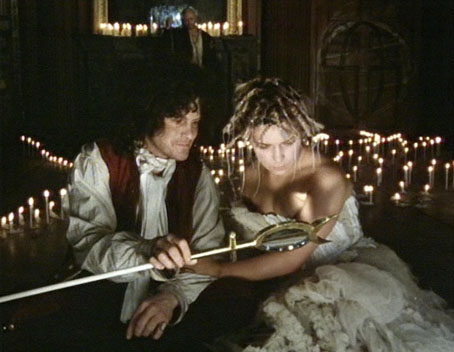
Prospero (Heathcote Williams) and Miranda (Toyah Willcox), The Tempest (1979).

The Shakespeare who spun The Tempest must have known John Dee; and perhaps through Philip Sidney he met Giordano Bruno in the year when he was writing the Cena di Ceneri—the Ash Wednesday supper in the French Ambassador’s house in the Strand. Prospero’s character and predicament certainly reflect these figures, each of whom in his own way fell victim to reaction. John Dee, with the greatest library in England, skrying for the angels Madimi and Uriel (so nearly Ariel)—all of which is recorded in the Angelic Conversations—ended up, in his old age, penniless in Manchester. Bruno was burnt for heresy.

Ten years of reading in these forgotten writers, together with a study of Jung and his disciples proved vital in my approach to both Jubilee and The Tempest. As for the black magic which David Bowie thought I dabbled in like Kenneth Anger, I’ve never been interested in it. I find Crowley’s work dull and rather tedious. Alchemy, the approach of Marcel Duchamp, interests me much more.

Derek Jarman, Dancing Ledge (1991).

Damon Albarn’s opera Doctor Dee has been all over the news this week following its premier as part of the Manchester International Festival. Last weekend one of the press ads was announcing this as an “untold story”, as though no one had given much thought to the Elizabethan magus prior to Mr Albarn’s arrival. Neither the ads nor anyone associated with the production will be in a hurry to tell you that the idea for the opera came from Alan Moore who’s had a fascination with John Dee’s life and work for many years. Albarn and fellow Gorillaz cohort Jamie Hewlett approached Alan about a collaboration a couple of years ago; Alan agreed to write something on the condition that Gorillaz provide a contribution to Alan’s magazine, Dodgem Logic. They agreed, Alan set to work, having suggested John Dee as a good subject then the whole thing fell apart: Gorillaz said they were too busy to accommodate themselves to the magazine’s generous deadlines so Alan told the pair that he was now too busy to have anything further to do with their opera. This is all old news (and being a Dodgem Logic contributor I have a partisan interest in the story) but it’s worth noting since the opera will be playing elsewhere once it’s finished its Manchester run so we’ll continue to hear about it. The point is that the subject matter was Alan Moore’s choice, not Damon Albarn’s; if Alan had decided to write something about Madame Blavatsky (say) we’d now be reading reviews of Blavatsky: The Opera. Albarn can at least be commended for staying with the subject. Despite John Dee’s exile in Manchester being part of the city’s history (among other things he helped organise the first survey of the streets) you can bet the apes from Oasis have never heard of him.
jubilee.jpg

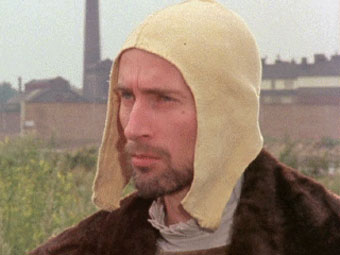
Richard O’Brien as John Dee in Jubilee (1978).

All of which had me thinking how John Dee, a maverick intelligence of the Elizabethan era, has a tendency to attract equally maverick intelligences in later eras. Derek Jarman’s work returns to John Dee often enough to make the magus a recurrent theme in his films, from the scenes in Jubilee (1978) (part of an earlier script) where he’s portrayed by Richard O’Brien showing Elizabeth I the future of her kingdom, to The Tempest (1979) where Prospero’s wand is modelled on Dee’s Monas Hieroglyphica, to The Angelic Conversation (1987) which borrows its title from Dee’s scrying experiments and finds via the sonnets another connection between John Dee and Shakespeare (Ariel being the contrary spirit whose magic allows a vision of the future in Jubilee). By one of those coincidences which make you think there must have been something in the air during the mid-70s, Michael Moorcock’s novel Gloriana, or The Unfulfill’d Queen was published the year Jubilee premiered, a fantasy in which the Elizabethan court is blended with its fictional counterpart from Spenser’s The Faerie Queen, and which features a Doctor John Dee as the queen’s Councillor of Philosophy. (If you want to stretch the connections further, Jenny Runacre who plays Elizabeth in Jubilee had earlier portrayed Miss Brunner in the film of Moorcock’s The Final Programme.)
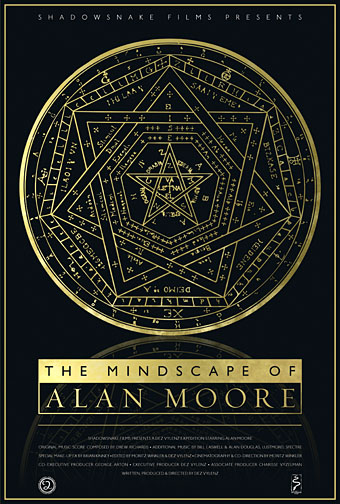
mindscape_dee.jpg

My 2009 poster design for The Mindscape of Alan Moore, a documentary by Dez Vylenz. John Dee’s Sigillum Dei Aemeth appears in the film so I used this as the principal motif for the packaging design and DVD interface.

Reading the reviews it’s impossible to tell how Alan’s libretto might have fared on stage compared to the work which is now showing, the content of which draws on Benjamin Woolley’s excellent biography, The Queen’s Conjuror. Alan and Benjamin Woolley can both be found among the interviewees in a Channel 4 documentary about John Dee broadcast in the Masters of Darkness (sic) series in 2001. For those keen to delve beyond the stage show, Derek Jarman’s films are all on DVD, of course, while fragments of Alan’s libretto can be found in the fourth edition of Strange Attractor along with his notes for the rest of the opera. Charlotte Fell Smith’s life of Dee from 1909, for many years the standard study of the man, can be found online here.

Previously on { feuilleton }
The Tempest illustrated
Robert Anning Bell’s Tempest
In the Shadow of the Sun by Derek Jarman
Designs on Doctor Dee
Derek Jarman at the Serpentine
The Angelic Conversation
The life and work of Derek Jarman
Weekend links 10

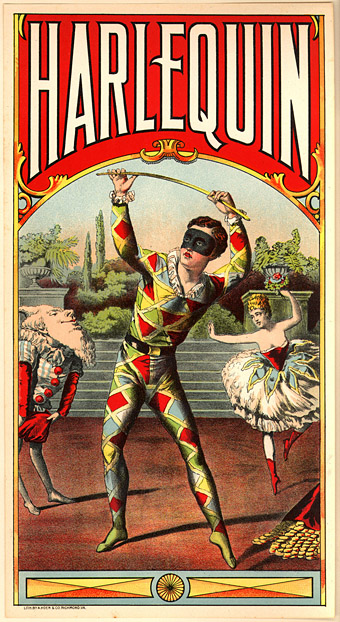
harlequin.jpg

One of a number of vintage ads and ephemeral items at this Flickr set.

• From 1971: The Anthony Balch/William Burroughs/Jan Herman video experiment.

• The NYT reports on World on a Wire, a neglected science fiction drama by Rainer Werner Fassbinder.

• “While some of the technology industry’s brightest minds were inventing the first PCs and developing groundbreaking software, they were also feeding their heads with LSD.”

• The archive of author and illustrator Mervyn Peake has been acquired by the British Library for £410,000.

• Thames & Hudson are publishing I Wonder, a book by the wonderful Marian Bantjes, later in the year. Her site has a preview. I want.

• The gays: It’s election season in the UK so My Gay Vote looks at how the three main parties have supported LGB issues. (No data for the graphs, however.) Is theatre finally glad to be gay? Yet more Tumblrs: I heart skinny boys & Cute boys with cats.

• Trend-spotter, “svengali”, Situationist and the man who named the Sex Pistols: RIP Malcolm McLaren. The Guardian ran a number of memorial pages. Related: Anarchy in Gardenstown.

• Dublin’s One City, One Book choice for April 2010 is The Picture of Dorian Gray.

The Catastrophist: Christopher Hitchens on JG Ballard.

Steampunk Taxidermy by Lisa Black.

• LIFE looks back at Aleister Crowley.

• Groovy songs of the week: Julie Driscoll (with Brian Auger & The Trinity), a pair of songs by Bob Dylan—This Wheel’s On Fire—and Donovan—Season Of The Witch—and sets which look like a collaboration between Verner Panton and Marcel Duchamp. Amazing.

Mark Beard’s artistic circle

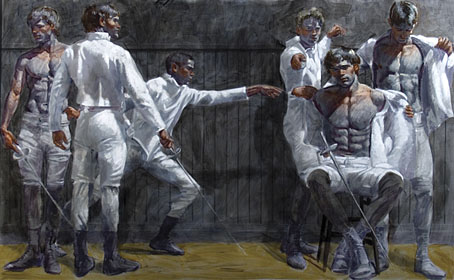
beard1.jpg

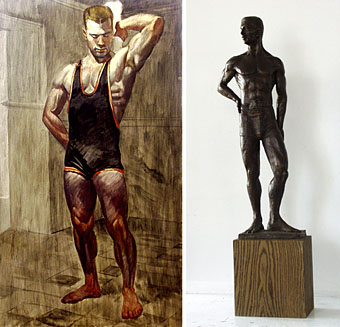
The Fencing Team by Bruce Sargeant.

Artists in the 20th century used to be multifarious in their activities, often taking their work through different stages or periods of evolution; Picasso and Max Ernst are two good examples of this. In today’s inflated art market this is no longer a wise move. As Brian Eno has noted in the case of the polymathic Tom Phillips, the pressure is there to establish yourself as a person who does one thing only, to turn yourself into a brand.

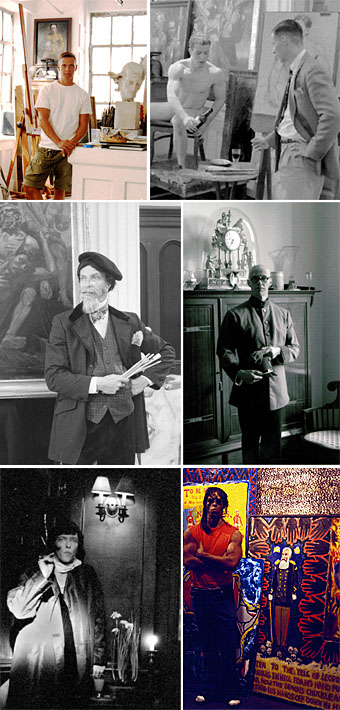
American artist Mark Beard isn’t happy with that situation. In order to satisfy a desire to create in whatever styles he chooses, he’s developed a number of distinct artist personalities, each with their own detailed biographies and even photographs (below). This isn’t entirely unprecedented, Marcel Duchamp famously had a female alter-ego named Rrose Sélavy, and was photographed by Man Ray in feminine attire, but offhand I can’t think of another artist going as far as creating six distinct personas. The painting above is one of a homoerotic sports-themed series by artist Bruce Sargeant who died, we’re told, in 1938 as a result of a wrestling accident. Examples of Beard’s other influences follow. For the complete artist biographies, see the Mark Beard pages at the Carrie Haddad gallery.

The artists

beard2.jpg

top left: Mark Beard (b. 1956); right: Bruce Sargeant and model (1898-1938)
middle left: Hippolyte-Alexandre Michallon (1849-1930); right: Brechtolt Steeruwitz (1890-1973)
bottom left: Edith Thayer Cromwell (1993-1962); right: Peter Coulter (b. 1948)

Their works

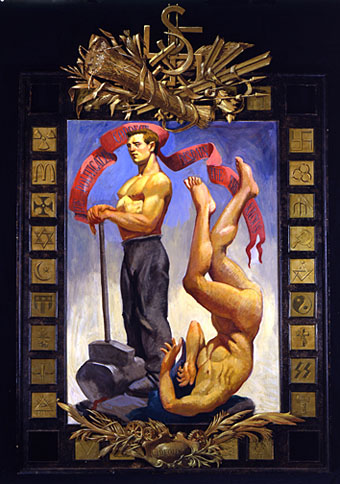
beard3.jpg

Ideology: The Politically Correct Disdain the Frivolous by Mark Beard (1989).

beard4.jpg

Avant la Fuite by Hippolyte-Alexandre Michallon (1894).

beard5.jpg

Swimmer Drying Himself, Berlin Olympics (1936), Young Athlete by Bruce Sargeant.

beard6.jpg

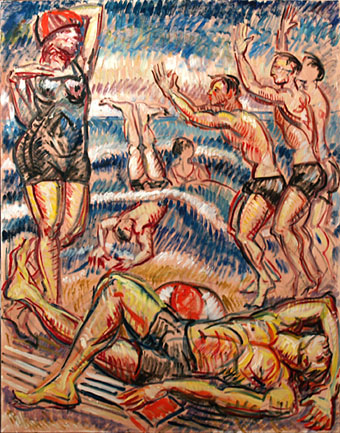
On the Strand by Edith Thayer Cromwell.

beard7.jpg

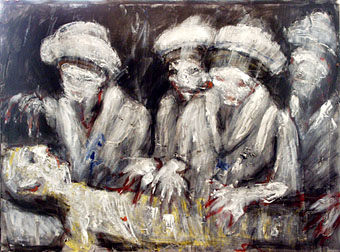
Das Krakenhaus by Brechtolt Steeruwitz (At the Hospital) (1923).

beard8.jpg

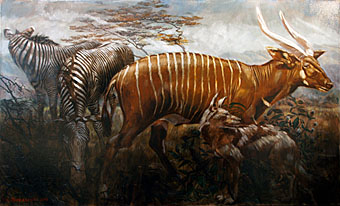
Cabinet by Peter Coulter.

Elsewhere on { feuilleton }
The gay artists archive

Entr’acte by René Clair

entracte.jpg

One of the best—and most entertaining—films to come out of the Dada/Surrealist period, Entr’acte (1924) is also worth watching for the appearance of notable figures such as Francis Picabia (who initiated the project), Marcel Duchamp, Man Ray and Erik Satie.

This extraordinary early film from director René Clair was originally made to fill an interval between two acts of Francis Picabia’s new ballet, Relâche, at the Théâtre des Champs-Elysées in Paris in 1924. Picabia famously wrote a synopsis for the film on one sheet of note paper, headed Maxim’s (the famous Parisian restaurant), which he sent to René Clair. This formed the basis for what ultimately appeared on screen, with some additional improvisations. Music for the film was composed by the famous avant-garde composer Erik Satie, who appears in the film, along side its originator, Francis Picabia. The surrealist photographer Man Ray also puts in an appearance, in a film which curiously resembles his own experimental films of this era.

entracte2.jpg

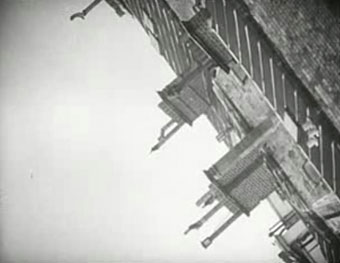
Entr’acte is a surrealistic concoction of unrelated images, reflecting Clair’s interest in Dada, a fashionable radical approach to visual art which relied on experimentation and surreal expressionism. Clair’s imagery is both captivating and disturbing, giving life to inanimate objects (most notably the rifle range dummies), whilst attacking conventions, even the sobriety of a funeral march.

Entr’acte can be watched and downloaded at Ubuweb. Tate Modern is running a major exhibition of the works of three of the participants, Duchamp, Man Ray, Picabia, until 26 May, 2008.

Previously on { feuilleton }
Alexander Hammid
Impressions de la Haute Mongolie revisited
Short films by Walerian Borowczyk
The South Bank Show: Francis Bacon
Rose Hobart by Joseph Cornell
Some YoYo Stuff
Beckett directs Beckett
Meshes of the Afternoon by Maya Deren
Not I by Samuel Beckett
La Villa Santo Sospir by Jean Cocteau
Un Chant D’Amour by Jean Genet
Borges documentary
Film by Samuel Beckett
Towers Open Fire

Jasper Johns

johns.jpg

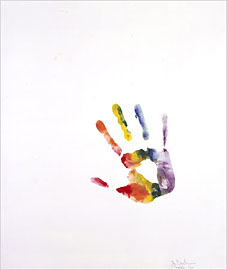
Left: Handprint (1964).

Bull’s-Eyes and Body Parts:
It’s Theater, From Jasper Johns

By HOLLAND COTTER
New York Times, February 2, 2007

WASHINGTON — Art and crass are all but inseparable. So it’s no surprise to find an exhibition that brings together a record number of Jasper Johns’s famous target paintings being bankrolled by Target. You pass the corporate bull’s-eye logo, small but vivid, on a wall on your way into “Jasper Johns: An Allegory of Painting, 1955-1965” here at the National Gallery of Art.

Mr. Johns’s targets, endlessly reproduced in the half century since he painted the earliest of them, have themselves become a form of advertising, a logo for American postwar art. Through sheer omnipresence they’ve become nearly invisible. What could change that now?

The answer: Seeing them live. The 15 “Target” paintings installed in the show’s first gallery look every bit as radical and mysterious as they surely did in New York in the 1950s, when, simply by existing, they closed the door on one kind of art, Abstract Expressionism, and opened a door on many, many others.

The National Gallery show, organized by the museum’s curator of modern and contemporary art, Jeffrey Weiss, has mysteries of its own. It isn’t a survey of the decade 1955-65, but a selection of 90 Johns works from that time organized by visual theme: targets, “devices,” words and the human body. Other motifs at least as important to that phase of his career, like flags, numbers and maps, are nowhere in evidence. Nor can the connective “allegory” proposed by the exhibition title be readily discerned. No matter.

Walk in the door, and you’re hooked. Try to move through the show in a hurry, and you can’t. The work is too strong, too unusual. It keeps stopping you, here, then here, then here. Mr. Johns, you suddenly remember, doesn’t just create visual objects, he creates situations, events. Each painting is a mini-theater, with farce and tragedy silently acted out and the audience invited to participate.

Initially Mr. Johns wanted the participation to be physical. “Target With Plaster Casts” (1955) is a painting surmounted by a row of wooden niches holding casts of body parts: a hand, a foot, a penis, a breast. And each niche has a little flip-up door, designed to be opened and closed by viewers, to give them a different, more intimate art experience than usual. Of course, if you reach for them now, in a museum, you risk arrest. So the real message, which Mr. Johns must have anticipated, is: Touch, but don’t touch.

His art is built on such ambiguities. Most of his very early paintings, done in a thick encaustic medium that makes them look molded instead of brushed, feel like sculptures. Many of those done a bit later in oils have three-dimensional objects attached to their surfaces so that, like furniture, they carve out sculptural space.

Dada, cerebral and vacant, was a big influence on Mr. Johns. His group of paintings made up of the stenciled names of colors — red, yellow, blue — was inspired in part by Marcel Duchamp’s use of language as art. Duchampian too are the so-called “devices” paintings, which have rotatable wooden discs, with squeegeelike arms for smoothing arcs of paint, affixed to their surfaces.

One assumes that Mr. Johns was declaring his complete dissociation from gestural abstraction, with its fetishized brushstroke, its existentialist soul, its emotional acting out. But then you arrive at a word-painting like “False Start” (1959), which explodes with hysterical brushwork. Or “Device Circle” (1959), on which the attached wheel looks gloomily derelict, like a one-handed clock. Or “Painting Bitten by a Man” (1961), which has a mouthful of wax encaustic gnawed out of its center, leaving a mark like a frozen scream or guffaw.

What’s the story? Is he mocking expressive painting or declaring it compatible with Dada’s cerebral conceits? Is he exposing a reserve of hidden passion beneath Duchamp’s dandyish, bone-dry wit?

In 1962 Mr. Johns made a group of prints by pressing his face and hands, covered with baby oil, onto large sheets of paper. The resulting images suggest a person swimming up from beneath an opaque surface that he is unable to push through. Over the next two years he finished two paintings and a drawing that referred to Hart Crane, the American poet who jumped off a ship in midsea and drowned.

The larger of the paintings, “Diver,” is very large and holds a compendium of motifs from earlier work: stenciled words, turbulent brushwork and a rainbow-colored target. At the center, two long wooden arms, ending in palms-open hands, reach upward.

If the painting theatrically approximates the psychic splintering that drove Crane to suicide, the related charcoal drawing, also called “Diver,” suggests the aftermath of his leap. Here the arms have hands at both ends. They point both downward and upward, with the descending hands meeting to form the shape of a skull in a subaqueous twilight.

It is in these theme-gathering works that a narrative, or “allegory,” comes together, though how to interpret it is hard to say. Countless glosses have been applied to Mr. Johns’s art, which is always assumed to be thick with coded meanings. Critics and scholars have scrutinized the art he has looked at, the writers he has read, the thinkers he has thought about.

Others have parsed his life. The artist Robert Morris, in a powerful catalog essay, links the themes of targets, flags and maps to Mr. Johns’s stint in the Army from 1951 to 1953. The art historians Kenneth E. Silver and Jonathan Katz have noted the dark, personal turn in his art after he and his lover, Robert Rauschenberg, split up in 1961. Their relationship seems to have shaped the careers of both men. It lives on in an art-world game that pits them against each other in a who’s-greater competition, though they are very different kinds of artists.

And what kind of artist is Mr. Johns? Various labels have been advanced: post-Dada, proto-Pop. I would call him a metaphysical artist, in the way that the 17th-century English poet John Donne is a metaphysical poet. Like Donne’s poetry, Mr. Johns’s art is equally about body and mind, sensuality and reflection. It is unmystical, unromantic, unnostalgic but obsessed with transcendence and the reality of loss.

Despite the difference in medium, the languages of Donne and Mr. Johns share many features: deliberate awkwardness, ungraceful beauty, a virtuosity so extreme that it turns weird. Their work can be startlingly, even embarrassingly candid, but is more often self-protectively opaque. Metaphor, rather than statement or confession, is their method. Some people find Donne manipulatively difficult and withholding. They might feel the same about Mr. Johns.

Finally, both metaphysicians appeared when a culture was on the cusp of change. And they were prepared to engage with that change, boldly, anxiously, in long careers that were electrifying early but are of profound interest all the way through. Mr. Johns’s career is of course still very much in progress, and I look forward to each future phase. I know of no major postwar American male artist whose work more completely approaches the condition of poetry, that reads as richly as it looks. To me it always feels new.

“Jasper Johns: An Allegory of Painting, 1955-1965” continues through April 29 at the National Gallery of Art, East Building, Constitution Avenue between Third and Ninth Streets, Washington; (202) 737-4215, nga.gov.

Previously on { feuilleton }
Michael Petry’s flag
Dada at MOMA