Philippe Jullian, connoisseur of the exotic

jullian01

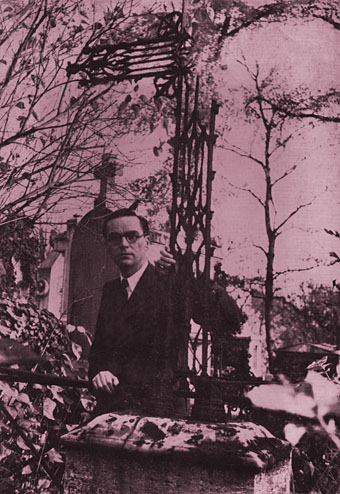
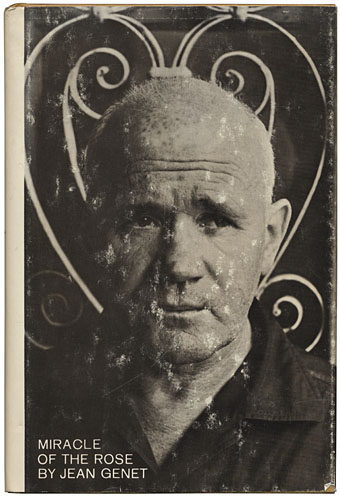
Monsieur Jullian as seen on the back cover of Dreamers of Decadence (1971).

Here at last is the long-promised (and long!) piece about the life and work of Philippe Jullian (1919–1977), a French writer and illustrator who’s become something of a cult figure of mine in recent years. Why the fascination? First and foremost because at the end of the 1960s he wrote Esthètes et Magiciens, or Dreamers of Decadence as it’s known to English readers, a book which effectively launched the Symbolist art revival and which remains the best introduction to Symbolist art and the aesthetic hothouse that was the 1890s. If I had to choose five favourite books Dreamers of Decadence would always be on the list. This point of obsession, and Philip Core’s account of the writer, made me curious about the rest of Jullian’s career.

jullian13

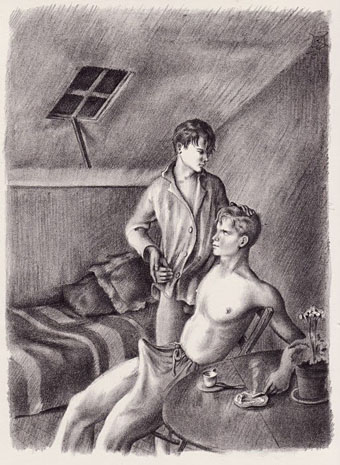
An illustration from Wilson & Jullian’s For Whom the Cloche Tolls (1953). “Tata has called these his Krafft-Ebbing (sic) pictures of his friend Kuno, whatever that means.”

Philip Core was friends with Philippe Jullian, and Core’s essential Camp: The Lie that Tells the Truth (1984) has Jullian as one of its dedicatees. It’s to Core’s appraisal that we have to turn for details of the man’s life. There is an autobiography, La Brocante (1975), but, like a number of other Jullian works, this doesn’t seem to have been translated and my French is dismally pauvre. Core’s piece begins:

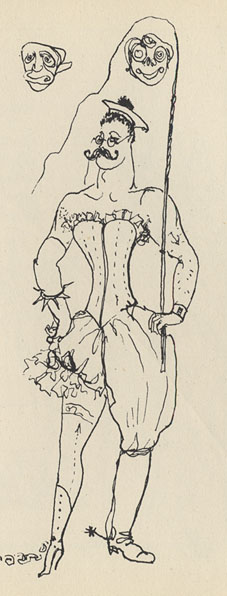
Philippe Jullian, born to the intellectual family of Bordeaux Protestants which produced the well-known French historian, Camille Jullian, was a last and lasting example of pre-war camp. His career began as an artist in Paris with a reputation for drag-acts parodying English spinsters. Snobbery, a talent for sensitive daydreaming, and a consuming passion for antiques, obscure art and social history, made a very different figure out of the thin and dreamy young man. Jullian suffered terribly during the Second World War; he managed to survive by visiting some disapproving cousins dressed as a maiden aunt, whom they were happy to feed. However, he made a mark in the world of Violet Trefusis, Natalie Barney and Vita Sackville-West by illustrating their books with his wiry and delicate doodles; this led to a social connection in England, where he produced many book jackets and covers for Vogue throughout the 1950s.

Having only seen Jullian in his besuited and bespectacled guise it’s difficult to imagine him dragged up, but the cross-dressing interest is apparent in his humorous collaboration with Angus Wilson and in a later novel, Flight into Egypt. As for the wiry and delicate doodles, they’re very much of their time, in style often resembling a less-assured Ronald Searle. One early commission in 1945 was for the first of what would become a celebrated series of artist labels for Château Mouton Rothschild. Later cover illustrations included a run for Penguin Books some of which can be found at Flickr.

Philip Core continues the story:

Elegant in the austerely tweedy way the French imagine to be English, Jullian exploited his very considerable talents as a writer, producing a series of camp novels throughout the 1950s (Scraps, Milord) which deal frankly but amusingly with the vicissitudes of handsome young men and face-lifted ladies, grey-haired antique dealers and criminals. One of the first to reconsider Symbolist painting, Jullian reached an enormous public in the 1960s with his gorgeous book, Dreamers of Decadence – where an encyclopaedic knowledge of the genre and its accompanying literature helped to create the boom in fin de siècle revivalism among dealers and museums.

An acerbic wit accompanied this vast worldly success; always docile to duchesses, Jullian could easily remark to a hostess who offered him a chocolate and cream pudding called Nègre en chemise, “I prefer them without.” Less kindly, to a gay friend who objected to Jullian’s poodles accompanying them into a country food shop by saying “Think where their noses have been”, he could also retort “Yes, that’s what I think whenever I see you kiss your mother.”

Continue reading “Philippe Jullian, connoisseur of the exotic”

Compass Road by Iain Sinclair

sinclair.jpg

I was hoping to get my delayed 2011 calendar launched today but other work needed completing so here’s an interim post.

Think of your journey through mortality as a sequence of valid movies and the pain is ameliorated. Forget the tedious 60-minute division of the lecture hall or dead television (quartered by adverts): arrange just enough markers for the 90-minute slots of Golden Age cinema. And then it’s only a question of nominating the eight guides, culture-figures who will dominate your thoughts (and reveries) for as long as you stay upright. The road is endless, you aren’t. Iain Sinclair

There may be a recession on but people still keep putting out the luxury goods; maybe the bankers are buying all this stuff with their unwarranted bonuses. Compass Road is a limited edition wristwatch from Mr Jones Watches, London, and sports a design commissioned from writer Iain Sinclair, a somewhat surprising choice given that these things are more usually farmed out to those individuals we have to call celebrities. Sinclair is too intelligent and interesting to be a mere celebrity and consequently designs a watch I’d probably buy if I had an excessive income. The watch middle and the hands are based on the British road signs designed by Margaret Calvert and Jock Kinneir while the typeface used for the compass points is Calvert and Kinneir’s Transport (below) which is also used across Britain’s road signs. For the destinations Sinclair has chosen eight writers with London associations: John Clare, Gerald Kersh, Bram Stoker, Joseph Conrad, William Blake, HG Wells, JG Ballard and Louis-Ferdinand Céline. The last seems an odd choice but he did work in London for a while.

transport.jpg

Sinclair’s design is a flexible enough to be applied to other literary cities which raises the question of which names you’d choose for Paris, say, or New York. And which signage systems? Subways or the local roads? Compass Road meanwhile can be yours for £145.

Design as virus 13: Tsunehisa Kimura

kimura.jpg

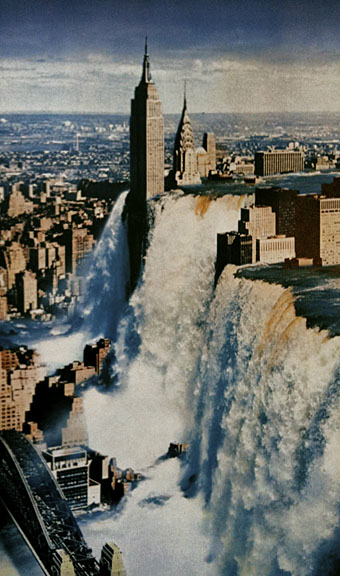
Waterfall by Tsunehisa Kimura.

Continuing an occasional series. Japanese artist Tsunehisa Kimura (1928–2008) was initially inspired by the polemical graphics of John Heartfield to create his own photomontages, a painstaking collage technique now rendered obsolete by Photoshop. Kimura’s work exchanges Heartfield’s satire for an overt and frequently apocalyptic Surrealism, as in his most visible piece, Waterfall. The copy above is one of a number of pictures reproduced by Geoff Manaugh at BLDGBLOG from a 1979 Kimura collection, Visual Scandals by Photomontage.

schutze1.jpg

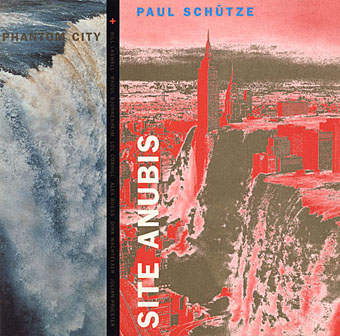
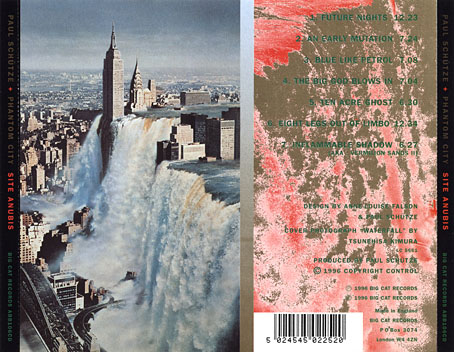
Design by Anne-Louise Falson & Paul Schütze.

I was first startled by Waterfall in 1996 when Paul Schütze released his Site Anubis album, the product of a “virtual group” comprised of musicians recording in different studios around the world:

The musicians comprising Phantom City—the name, incidentally, originating from the book title Topology of a Phantom City by French novelist Alain Robbe-Grillet—never met for the recording of Site Anubis, as each one recorded in a different studio in a different country: guitarist Raoul Björkenheim in Helsinki, bass- and contra-bass clarinetist Alex Buess in a Basel studio, soprano saxophonist Lol Coxhill in London, bassist Bill Laswell at Green Point Studio in Brooklyn, New York, trombonist Julian Priester in Seattle, drummer Dirk Wachtelaer in Brussels, and Schütze himself in London and Basel. Incredibly, Laswell had only Schütze’s electronic backing track to respond to. Wachtelaer had Laswell and Schütze to play against, Björkenheim had drums and bass,—in short, certain players had more information than others.

schutze2.jpg

Kimura’s picture is an ideal accompaniment to this excellent album, especially when you note a Ballard reference in the titles (not the first in Schütze’s oevre), and read the scene-setting piece of fiction on the CD insert, an explanation of the album title:

That morning a report came in from an unmarked helicopter somewhere over the city. The waters were subsiding and the smoke from a thousand fires had begun to drift inland revealing an impossible new structure. Towering some eight hundred feet over the gleaming devastation of the streets, its base occupying an entire city block, was a colossal black basalt figure. The body was male and human, – the head, which stared expectantly toward the boiling western horizon, was the head of a jackal. From the air it was clear that the pattern of destruction on the ground was radial and that the massive figure was sited precisely at its centre.

Continue reading “Design as virus 13: Tsunehisa Kimura”

Marsi Paribatra: the Royal Surrealist

marsi1.jpg

La Menace (1994).

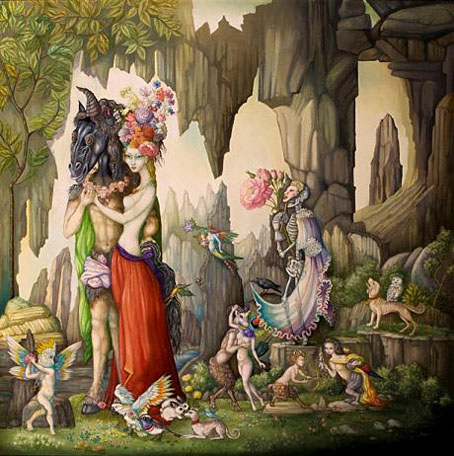
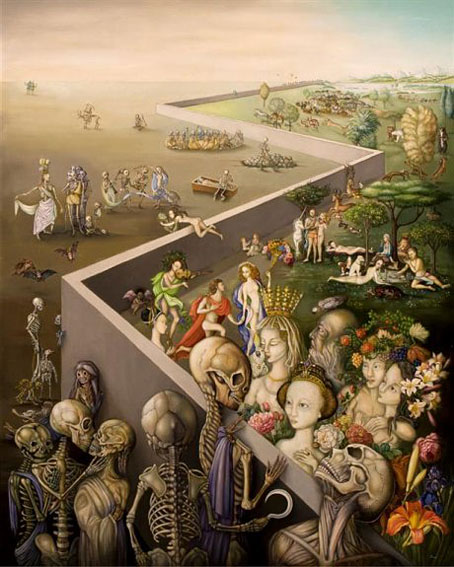
Two paintings by Princess Marsi Paribatra, a member of the royal family of Thailand who lists Dalí, Arcimboldo and Titian among her artistic influences. If it seems surprising that a princess should not only be an accomplished painter but also be possessed of a distinctly vivid imagination we might ask why this is the case. There’s no reason why a member of a royal family shouldn’t be as good a painter as anyone else although it’s the case that here in Britain our views of royalty are inevitably tainted by the uninspiring members of the current House of Windsor. Prince Charles in particular is a singularly dreary and frequently philistine figure, and also a painter whose daubs would never have received any attention at all were it not for his being born into the right family.

This hasn’t always been the case. It used to be that being an aristocrat gave you the free time and the wealth to indulge no end of manias and eccentricities. The British Isles are littered with architectural follies of various kinds built to appease the whims of rich landowners; William Beckford (1760–1844) is renowned for having written the Gothic melodrama Vathek and also for having built the lavish (and unfortunately short-lived) pile of Fonthill Abbey. In the 20th century we had Edward James (1907–1984), a lifelong champion of Surrealism who spent much of his later life building Las Pozas in the Mexican jungle at Xilitla, a concrete fantasia which looks like something dreamed up by Antonio Gaudí and JG Ballard. James collected the work of Leonora Carrington and Dorothea Tanning and I’d imagine him being equally entranced by some of Marsi Paribatra’s paintings. The recurrence of skeletal figures in her work invokes the Mexican Day of the Dead traditions which always excited the Surrealists.

marsi2.jpg

No title or date available.

Dali House has more about Marsi Paribatra’s life and art while further examples of her paintings can be found here and here. Thanks again to Monsieur Thombeau for pointing the way!

Elsewhere on { feuilleton }
The fantastic art archive

Previously on { feuilleton }
Angels of Anarchy: Women Artists and Surrealism
Return to Las Pozas
The art of Leonor Fini, 1907–1996
Surrealist women
Las Pozas and Edward James

Weekend links 19

smith.jpg

Peafile (2006) by Shawn Smith; plywood, ink, acrylic paint.

Surreal Friends, an exhibition of work by Leonora Carrington, Remedios Varo and Kati Horna at the Pallant House Gallery, Chichester, UK. Related: The surrealist muses who roared, Leonora Carrington and other women Surrealists profiled.

Landscapes From a Dream: How the Art of David Pelham Captured the Essence of JG Ballard’s Early Fiction. A graphic design essay at Ballardian.

• “(T)he significant thing is not the behaviour of the players but the attitude of the spectators: and, behind the spectators, of the nations who work themselves into furies over these absurd contests, and seriously believe — at any rate for short periods — that running, jumping and kicking a ball are tests of national virtue. (…) It is the most violently combative sports, football and boxing, that have spread the widest. There cannot be much doubt that the whole thing is bound up with the rise of nationalism — that is, with the lunatic modern habit of identifying oneself with large power units and seeing everything in terms of competitive prestige.” The Sporting Spirit by George Orwell, December 1945.

• One of my cult pop albums from the 1980s, A Secret Wish by Propaganda, is reissued in a 25th anniversary edition next month. I no doubt have most of the bonus tracks already but the prospect is still irresistible.

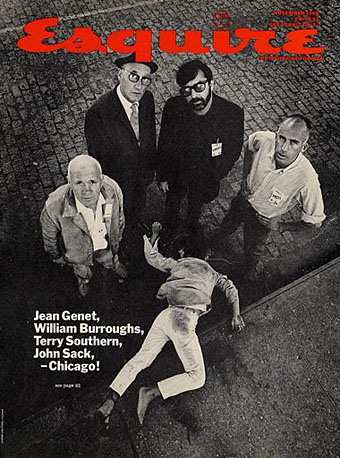
Tangier Cut-Up, an uncollected piece by William Burroughs from Esquire, September 1964.

Ghostwriter —  The Continuing Adventures Of The Strange Sound Association.

Faust And Last And Always: Germany’s Most Radical Rock Group Talk.

Hollingsville at Resonance FM. Related: Graphic Design on the Radio.

iPad Publishing No Savior for Small Press, LGBT Comics Creators.

The Largest Oil Spills in History, 1901 to Present.

1948 Buick Streamliner by Norman E Timbs.

Neville Brody’s work on display in Tokyo.

Dr Mabuse (1984) by Propaganda; Vladek Sheybal, cowled monks, Fritz Lang references and Anton Corbijn directing.