Chute Libre science fiction

chutelibre01.jpg

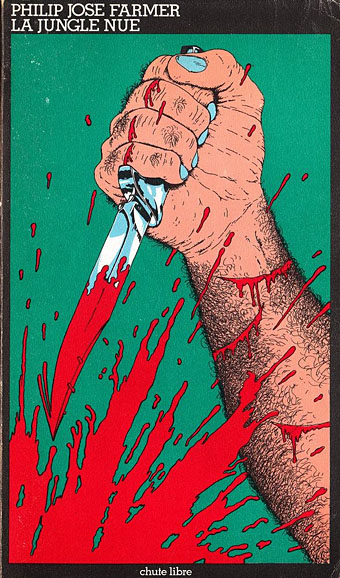
La Jungle Nue (A Feast Unknown, 1974). Illustration de Alain Le Saux.

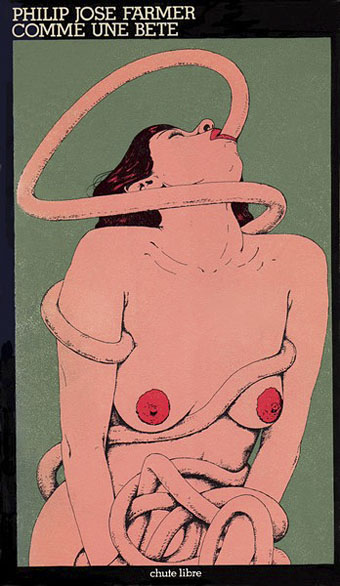
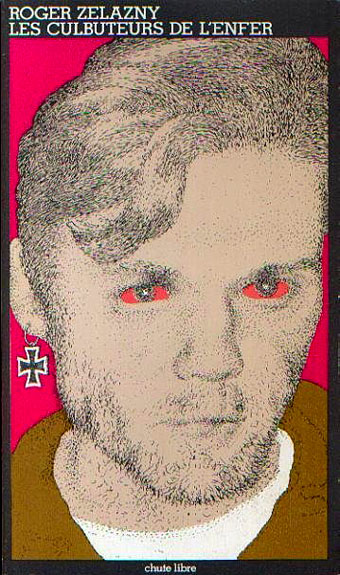
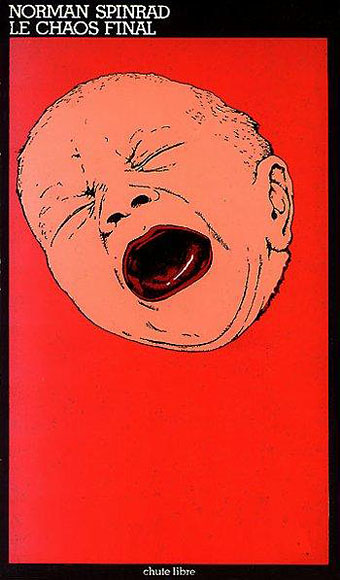
Chute libre means “free fall” in French, and here refers to an imprint of French publisher Champ Libre that from 1974 to 1978 reprinted a series of science fiction titles under that name. The imprint is notable for a number of reasons, not least the striking covers which impress with their uniform design and bold imagery. The combination of black cover with vivid artwork is very similar to the covers Penguin were producing for their SF titles a few years earlier but since there’s little written anywhere about the French books I can’t say whether this was an influence or merely coincidence. I’ve not been able to find a complete list of all the illustrators either. At least two of the covers are the work of Moebius, rare examples of him being commissioned outside the comics medium.

The other notable aspect of the imprint is the books themselves which are an odd mix of the outrageous and sexually provocative end of SF spectrum, together with more usual fare. Some of the covers play to the provocation more than is necessary: Michael Moorcock has always been pleased by the attention his work receives in France but I’ll bet he hates that cover. Several of these titles appeared as SF in the 1970s because of other work by their authors despite there being nothing overtly science fictional about The Atrocity Exhibition or Breakfast in the Ruins. Farmer’s A Feast Unknown and The Image of the Beast/Blown are violent and sexually excessive, and feature little genre material, but managed to slide onto the SF shelves for the same reason. Every so often I wonder whether any of these books (or books like them) would be offered to, or accepted by, genre publishers today.

As usual, if anyone can supply information about the missing illustrators then please leave a comment.

chutelibre02.jpg

Comme une Bête (Image of the Beast, 1974). Illustration by Moebius.

chutelibre03.jpg

Les Culbuteurs de l’Enfer (Damnation Alley, 1974). Illustration by Jean-Claude Castelli.

chutelibre04.jpg

Le Chaos Final (The Men in the Jungle, 1974).

Continue reading “Chute Libre science fiction”

Chris Marker, 1921–2012

chrismarker.jpg

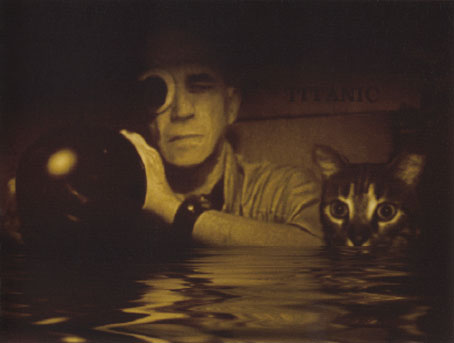
“A recurrent rumour says that Chris Marker and the cat Guillaume-en-Egypt sank with the Titanic.” Photo credited to Wim Wenders.

In our moments of megalomaniacal reverie, we tend to see our memory as a kind of history book: we have won and lost battles, discovered empires and abandoned them. At the very least we are the characters of an epic novel (“Quel roman que ma vie!” said Napoleon). A more modest and perhaps more fruitful approach might be to consider the fragments of memory in terms of geography. In every life we would find continents, islands, deserts, swamps, overpopulated territories and terrae incognitae. We could draw the map of such a memory and extract images from it with greater ease (and truthfulness) than from tales and legends. That the subject of this memory should be a photographer and a filmmaker does not mean that his memory is essentially more interesting than that of the next man (or the next woman), but only that he has left traces with which one can work, contours to draw up his maps.

Chris Marker, introductory notes to Immemory (2002)

Memory is the key word: it’s at the heart of Chris Marker’s most well-known films, his science fiction short La Jetée (1962), and the feature-length film-essay Sans Soleil. Both those films reference Hitchcock’s Vertigo, a film concerned with layered memories, both real and invented. Memory also comprises the subject of Marker’s most ambitious work from his later years, the CD-ROM Immemory, a unique creation which few will have experienced since it appeared after the great wave of ROM-mania in the 1990s, and was also Mac-only at a time (2002) when Macs were even more of a minority concern than they are today. My own copy is now unusable since it only runs on the outmoded OS 9 system (later copies were upgraded to OS X), leaving me with nothing but memories of Immemory and a box which sports a still from Vertigo among its cover images. The loss is regrettable but somehow fitting, and there’s a lesson here about impermanence for all you boys and girls planning bright new iPad apps. La Jetée is the film that receives the most attention, made on a budget that even when adjusted forward wouldn’t have covered the catering costs on Inception, it was one of JG Ballard’s favourites, and the source (of course) for Terry Gilliam’s Twelve Monkeys. But it’s to Sans Soleil that I always return, a place where the complex interleaving of documentary footage and fictional—or is it?—narration proves endlessly rewarding.

marker.jpg

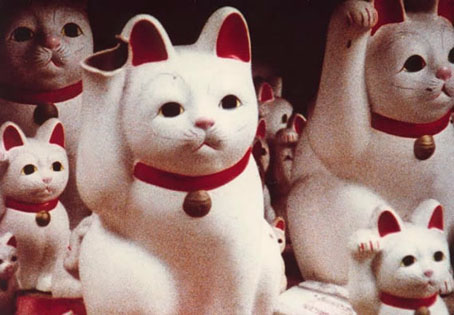
The Beckoning Cats from Sans Soleil (1983).

Chrismarker.org: an essential resource
Chris Marker’s YouTube channel
Chris Marker interviewed by Samuel Douhaire and Annick Rivoire in 2003
The New Yorker: In Memoriam: Chris Marker by Richard Brody
Guardian obituary by Ronald Bergan
Telegraph obituary
Things That Quicken The Heart: Chris Marker’s Sans Soleil by David Moats
The Humanists: Chris Marker’s Sans Soleil by Colin Marshall
Brian Dillon on La Jetée

Previously on { feuilleton }
Junkopia
Penguin Labyrinths and the Thief’s Journal
Monsieur Chat
Sans Soleil

m_chat.jpg

Weekend links 117

lux1.jpg

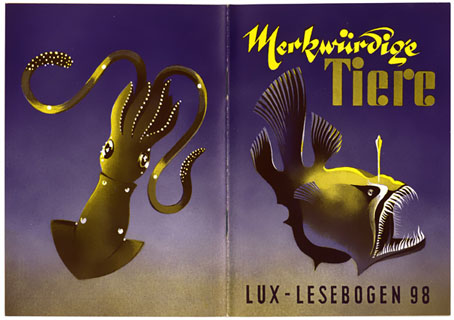
Illustration and design by Karlheinz Dobsky.

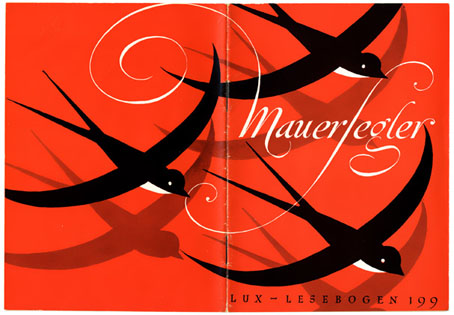
Above and below: samples from Die Lux-Lesebogen-Sammlung, an exhibition of booklets for young people published by Sebastian Lux from 1946–1964. All were designed and illustrated by Karlheinz Dobsky.

• At The American Scholar: “Vladimir Nabokov’s understanding of human nature anticipated the advances in psychology since his day,” says Nabokov biographer Brian Boyd, and An Unquenchable Gaiety of Mind: “On visits to Cambridge University late in life, Jorge Luis Borges offered revealing last thoughts about his reading and writing,” says George Watson.

• The British Library releases The Spoken Word: “A rare collection of recordings featuring the American writer William S Burroughs and the British-born artist Brion Gysin.” Related: Interzone – A William Burroughs Mix by Timewriter.

• Charting the Outlaws: Christopher Bram (again) talking to Frank Pizzoli about his recent study Eminent Outlaws: The Gay Writers Who Changed America.

• The BBC asks “Where are you on the global fat scale?” I’ve always been thin but was still surprised to find my BMI at the very bottom of the scale.

The “otherness” of Ballard, his mesmeric glazedness, is always attributed to the two years he spent in a Japanese internment camp in Shanghai (1943–45). That experience, I think, should be seen in combination, or in synergy, with the two years he spent dissecting cadavers as a medical student in Cambridge (1949–51). Again the dichotomy: as a man he was ebulliently social (and humorous), but as an artist he is fiercely solitary (and humourless). The outcome, in any event, is a genius for the perverse and the obsessional, realised in a prose style of hypnotically varied vowel sounds (its diction enriched by a wide range of technical vocabularies). In the end, the tensile strength of The Drowned World derives not from its action but from its poetry.

Martin Amis on The Drowned World by JG Ballard.

The Chickens and the Bulls: “The rise and incredible fall of a vicious extortion ring that preyed on prominent gay men in the 1960s.”

• It’s that Zone again: Jacob Mikanowski on Andrei Tarkovsky’s Stalker and Geoff Dyer’s Zona.

• Scans of the rare film programme for London screenings of Fritz Lang’s Metropolis.

lux2.jpg

Illustration and design by Karlheinz Dobsky.

• “The web is a Library of Babel that could go the way of the Library of Alexandria.

Fila Arcana: alchemy- and occult-themed embroidery by Mina Sewell Mancuso.

A Very Edgy Alice In A Very Weird Wonderland: illustrations by Pat Andrea.

Malka Spigel reveals a new track from her third solo album.

John Martin and the Theatre of Subversion.

Olafur Eliasson: Little Sun at Tate Modern.

• Meanwhile, back in 1972: Mahavishnu Orchestra live at the BBC (30 mins), and the complete performance of the MC5 on Beat Club (29 mins).

Weekend links 111

thefox.jpg

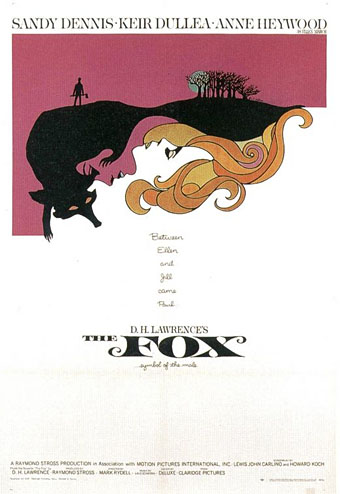
The Fox (1968). Design by Bill Gold, art by Leo & Diane Dillon.

Mark Rydell’s The Fox may be regarded unfavourably now for its retrograde idea of a lesbian relationship but that’s still a great poster by the Dillons. Equally retrograde (well it was 1957) is Anders als du und ich, a film about wayward German youth directed by ex-Nazi propagandist Veit Harlan:

Klaus is a young man in post-war Berlin. He is drawn to his friend Manfred and, under the encouragement of their acquaintance, Dr. Winkler, explores the underground world of gay clubs and electronic music. His family begins to learn of his other life and do everything they can to set him straight.

A saving grace is the conspicuous deployment of Oskar Sala’s Trautonium. They’re deviants—of course they like weird electronic music! Sala’s instrument was his own invention which means it has a unique pre-Moog sound, famously used by Alfred Hitchcock in the score for The Birds. YouTube has a collection of the electronica moments from Anders als du und ich. Wait for the wrestling scene…

Netherwood: Last Resort of Aleister Crowley by A Gentleman of Hastings. Related: Jimmy Page’s Lucifer Rising sessions part 1 and part 2.

• “This coming 16 June, [BBC] Radio 4 will be a wall-to-wall Joycefest, kicking off at 9am and running until midnight.”

A World Where Architecture is the Driving Force Behind Society, Core77 on the Cités Obscures of François Schuiten.

• At The Hooded Utilitarian an examination of the thorny problem of adapting Lovecraft for the comics medium.

• Plates from La Plante et ses Applications Ornementales (1897–1900) by Eugene Grasset.

• Coilhouse found a rough copy of Todd Haynes’ Superstar: The Karen Carpenter Story.

Three Quick Ways to Introduce Yourself to the Work of Harlan Ellison.

Daniel Buren’s Monumenta 2012 at the Grand Palais, Paris.

Our Sorrows, a new video from Julia Holter.

I, Cyclops: Monocularity in a 3-D World.

JG Ballard: The Concordance.

• RIP Pete Cosey.

• Pete Cosey with Miles Davis et al, November 1973: Ife | Turnaroundphrase

Weekend links 101

cabat.jpg

Kraken from Ernie Cabat’s Magical World Of Monsters (1992) at Monster Brains.

“I think for a lot of people who don’t read pulp growing up, there’s a real surprise that the particular kind of Pulp Modernism of a certain kind of lush purple prose isn’t necessarily a failure or a mistake, but is part of the fabric of the story and what makes it weird. There’s a big default notion that ‘spare,’ or ‘precise’ prose is somehow better. I keep insisting to them that while such prose is completely legitimate, it’s in no way intrinsically more accurate, more relevant, or better than lush prose.” China Miéville at Weird Fiction Review expressing an opinion that few in the literary world ever articulate, never mind agree with. Far more common is (to pick a recent example) Ursula K Le Guin dismissing Cormac McCarthy for “pretentious prose”.

• “Militant feminist scientists brainwash a research subject to assassinate the Welsh Minister of Prostitution. Meanwhile World War III is being fought and the USA has been invaded.” The IMDB précis for Taking Tiger Mountain (1983), a feature film directed by Tom Huckabee from a script by William Burroughs, and featuring a 19-year-old pre-Aliens/Near Dark Bill Paxton. The director discusses the film’s production at Screen Slate and attends a rare screening at Spectacle, Brooklyn, NYC, today (March 25th). YouTube has a three-minute clip. Surprising this has remained buried for so long. When can the rest of us get to see it?

• Prestel have published the catalogue for In Wonderland: The Surrealist Adventures of Women Artists in Mexico and the United States. AnOther previewed some of the contents. The exhibition runs at the LACMA, Los Angeles, until 6th May.

…gays only make up about 3% of the population so we spend our whole lives “translating” straight movies, books, ballets into gay terms and studying the heterosexuals around us—we know much more about them than they know about us, just as blacks know a lot about whites but whites know virtually nothing about blacks.

Edmund White (again) interviewed by Frank Pizzoli at Lambda Literary Review.

• New on Caroline True Records: Jon Savage’s “Fame”, Secret History of Post-Punk 1978–81. “Some of it doesn’t sound like anything that has happened since,” says Savage. Indeed. FACT has the track list which I was pleased to see includes Chrome among the usual suspects. Hear a 12-minute promo mix at Soundcloud.

guerin.jpg

The Colossi of Memnon by Jules Guerin. From Egypt and its Monuments (1908) by Robert Hichens at Golden Age Comic Book Stories.

Gay Life Stories, “a colourful compendium of same-sex love through the ages” by Robert Aldrich. Reviewed here. Related: Alice Dreger asks “Are straight people born that way?”

• Clive Hicks-Jenkins created a series of designs for a Washington DC performance of Stravinsky’s The Soldier’s Tale. Follow their evolution in reverse order at his blog.

• Hocus Pocus: Margaret Eby on the brief epistolary relationship between Harry Houdini and Arthur Conan Doyle.

Rick Poynor on more cover designs for JG Ballard’s Crash.

London, city of dreams and rivers, caught on Polaroid.

• Photo prints by Thom Ayres for sale at Society6.

B*tches in Bookshops

• Meet You In The Subway (1979) by Chrome | New Age (Version III) (1980) by Chrome | Danger Zone (1981) by Chrome | Firebomb (1982) by Chrome.