Weekend links 150

feanne.jpg

One of A Pair of Peacocks (2012) by Feanne.

Jonathan Barnbrook reveals his package design for the new David Bowie CD. The Barnbrook studio has also designed the catalogue for the forthcoming V&A Bowie exhibition. And there’s more (don’t worry, it’ll be over soon): Jon Savage on When Bowie met Burroughs.

• “Witches have a fashion moment,” says the NYT. Nice clothes but the writing trots out too many of the usual lazy clichés. Related: A Tale of Witches, Woodland and Half-remembered Melodies…, a new mix by Melmoth the Wanderer.

Calidostópia! is a free album (FLAC & mp3) from Marcus Popp aka Oval: “an enticing 16-track collaboration…with seven wonderful singers/musicians from all over South America”.

Before meeting Moorcock in person, [Hari] Kunzru went on to say, ‘I didn’t realise the role he’d played in connecting so many different scenes and undergrounds together – the psychedelic music scene, the science fiction scene, the hip experimental literature scene around people like William Burroughs, pop art’.

Brave New Worlds: A Michael Moorcock Retrospective by Carol Huston. Moorcock’s Elric novels will be published by Glénat in new bande dessinée adaptations later this year.

• More art by Michael W. Kaluta at The Golden Age. And more fantastic comics/illustration by Philippe Caza at 50 Watts. There’s more Caza here.

• Mine and David Britton’s new book, Lord Horror: Reverbstorm, was reviewed at The Spectator.

Google Street Scene: “Moments of cinema captured by Google Street View cameras”.

Cosmic Sentinels and Spiral Jetties: JG Ballard, Robert Smithson & Tacita Dean

• Strange Flowers showcases the heads of Pavel Tchelitchew, 1949–1952.

Setting in the East: Diamanda Galás on Women and Real Horror

Little Joe: “A magazine about queers and cinema, mostly.”

Nanoparticles loaded with bee venom kill HIV.

Treatises on Dust: Antic Found Texts

The Wizard Blew His Horn (1975) by Hawkwind (with Michael Moorcock) | Brothel In Rosenstrasse (1982) by Michael Moorcock’s Deep Fix | Running Through The Back Brain (1983) by Hawkwind (with Michael Moorcock)

Paul Delvaux: The Sleepwalker of Saint-Idesbald

delvaux.jpg

Saint-Idesbald is a small, unremarkable seaside town on the Belgian coast situated between Ostend and the border with France. I spent a week there on a school camping holiday in the 1970s unaware that it was the home of the great Surrealist painter Paul Delvaux (1897–1994). I suppose you could make the argument that the location of Dalí’s home in Cadaqués was equally unremarkable, but Dalí’s house was well-known, and that area of the Spanish coast is familiar from many of his paintings. The surprise in later discovering that Delvaux lived in Saint-Idesbald, rather than Brussels or Bruges, or even Ostend, is that the town is quite unlike the tram-haunted, cobblestoned, moonlit vistas of his paintings. It’s appropriate that JG Ballard thought highly enough of Delvaux to mention his paintings in some of his stories, and also commission reproductions of two lost canvases; Ballard’s Shepperton was an equally unlikely home for such a vivid imagination.

Paul Delvaux: The Sleepwalker of Saint-Idesbald is a film from the Naxos record label that lasts all of three minutes, but which happens to feature the first footage I’ve seen of Paul Delvaux as a working artist. Despite Ballard’s attention, Delvaux has often been passed over as a subject of Surrealist documentaries in favour of the usual trinity of Dalí, Magritte and Max Ernst. There are older documentaries in existence, however, so I’ll continue to hope they may turn up eventually. For anyone who happens to journey near Saint-Idesbald, many of Delvaux’s paintings can be seen in the museum there.

Previously on { feuilleton }
The Public Voice by Lejf Marcussen
Ballard and the painters
Taxandria, or Raoul Servais meets Paul Delvaux

Sine Fiction

sine6.jpg

Sine Fiction VI: Nova Express (2003) by Eucci.

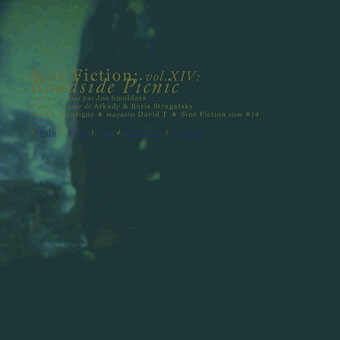
More Burroughsian music, and a selection that includes another interpretation of The Ticket That Exploded. Sine Fiction is a music project curated by Aimé Dontigny that commissions electronic artists to provide soundtracks to science fiction novels. The project has been running since 2000, and has so far managed twenty releases, the most recent of which—Dontigny’s own music for Ballard’s The Drowned World—appeared in 2011. In addition to three Burroughs titles there’s another work with considerable cult status, the Strugatsky Brothers’ Roadside Picnic, which Jos Smolders accompanies in a very minimal fashion. I’d still go for the gloriously doomy atmospheres of Stalker (1995) by Robert Rich & B. Lustmord but there’s room in the world for multiple interpretations.

All the Sine Fiction releases are available as free downloads at the No Type site or (if you prefer) at the Internet Archive.

sine7.jpg

Sine Fiction VII: Soft Machine (2003) by Kevin M Krebs.

sine9.jpg

Sine Fiction IX: The Ticket That Exploded (2003) by A_Dontigny.

sine14.jpg

Sine Fiction XIV: Roadside Picnic (2004) by Jos Smolders.

Elsewhere on { feuilleton }
The William Burroughs archive

Previously on { feuilleton }
A playlist for Halloween: Drones and atmospheres

Weekend links 143

empire.jpg

Ai No Corrida poster design by Egil Haraldsen (2001).

• “Back then, publishing an interview with Félix Guattari alongside little chats with rough trade and street walkers was unheard of — it still is for the most part.” BUTT on Kraximo, a gay Greek magazine of the 1980s.

13 books for 2013: A selection of forthcoming titles at Strange Flowers which so closely aligns with my preoccupations that I worry he’s reading my mind.

• “The Macaulay Library is the world’s largest and oldest scientific archive of biodiversity audio and video recordings.”

• A free BitTorrent Robert Anton Wilson audio and video pack. See also the RAW files at the Internet Archive.

beijing.jpg

The Pangu Building, Beijing, January 12th, 2013. Blade Runner arrives six years early.

Wired celebrates 100 years of Edward Johnston’s typeface for the London Underground.

Borges’ translation of Ulysses. Or of the last page of Ulysses as a translation of Ulysses.

0181, a new album by Four Tet, can be heard in full at SoundCloud.

• The Edge question for 2013: “What should we be worried about?

JG Ballard documentaries at Ubuweb.

Unlocking Dockstader.

• RIP Nagisa Oshima.

Ai No Corrida (1980) by Quincy Jones | Empire Of The Senses (1982) by Bill Nelson | Forbidden Colours (1983) by David Sylvian & Riuichi Sakamoto

Chronopolis by Piotr Kamler

chronopolis3.jpg

Another gem at Ubuweb, and nothing to do with JG Ballard’s SF story of the same name, Piotr Kamler’s Chronopolis (1983) is a 50-minute animated science fiction film, albeit science fiction of a much more abstract variety than one usually finds in cinema. I’m generally exasperated by the way film and TV SF does little more than play Cowboys & Indians in space so it’s refreshing to see something that’s unashamedly strange and doesn’t feel the need to explain itself. There is apparently a version of this with some English narration for those benighted American audiences everyone feels a need to pander to but the Ubuweb version is wordless, and if you can’t read French then you won’t understand the few lines of text prologue at the opening.

chronopolis1.jpg

Accompanying Kamler’s beautifully crafted and quite inexplicable scenes there’s an electronic score by composer Luc Ferrari, mostly analogue timbres whose origin is as mysterious as the events taking place on-screen. Kamler’s statuesque figures remind me of the gods and aliens that Moebius and co. were drawing in Métal Hurlant during the 1970s. Chronopolis was a French production begun in 1977 so it’s possible that French comics were an influence. Moebius himself worked on another animated SF film during this period, René Laloux’s Time Masters (1982). Chronopolis is closer in tone to the weirdness of Laloux’s earlier Fantastic Planet (1973), and all the better for it.

chronopolis2.jpg

Previously on { feuilleton }
Les Jeux des Anges by Walerian Borowczyk
Les Temps Morts by René Laloux