H.P. Lovecraft: The Complete Fiction

lovecraft1.jpg

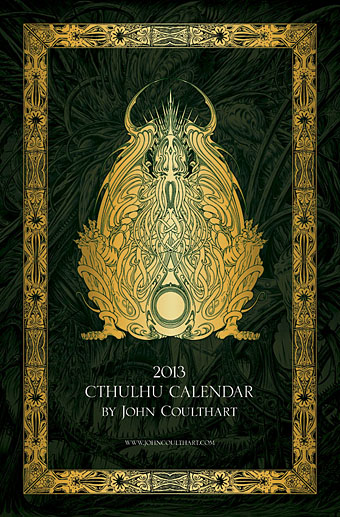
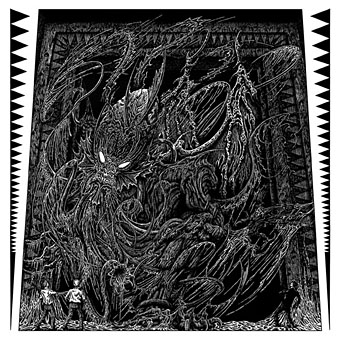
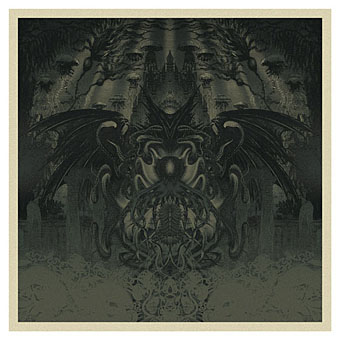
Illustration by Sven Geier, design by Jo Obarowski and Rebecca Lysen.

HP Lovecraft would have been as surprised as anyone if he could have witnessed the tremendous posthumous triumph he and his work have achieved.

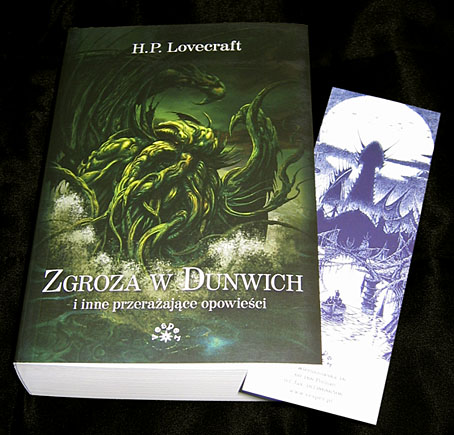
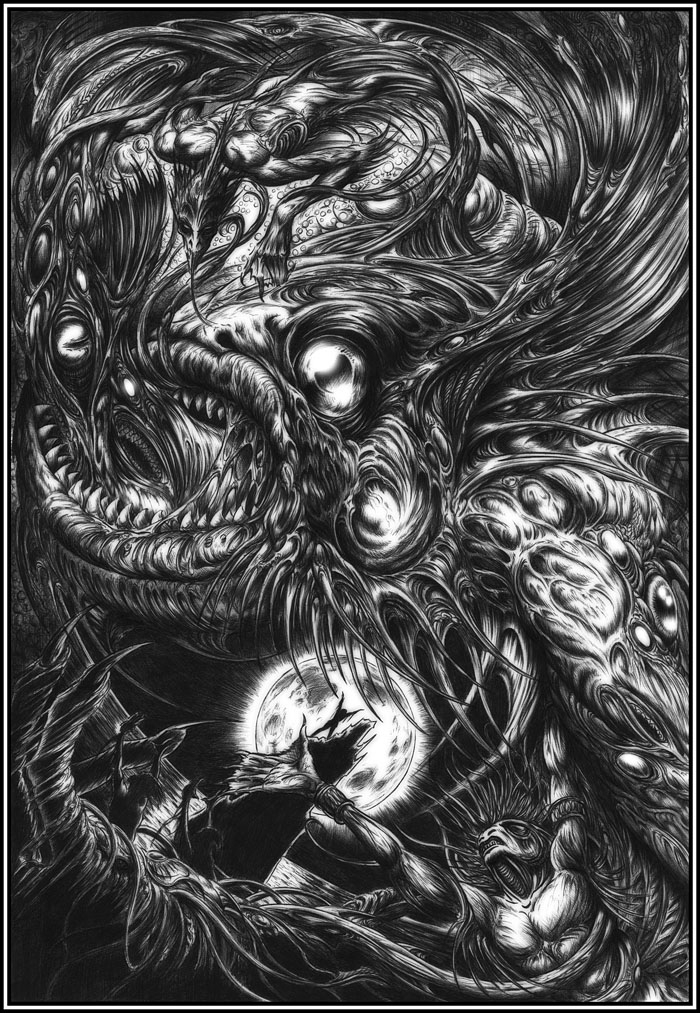
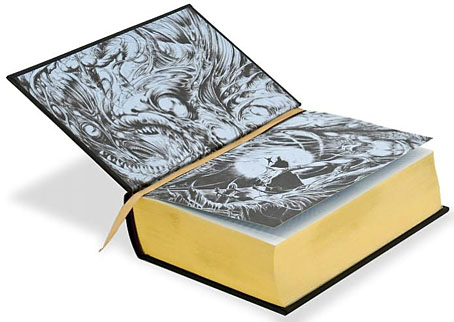
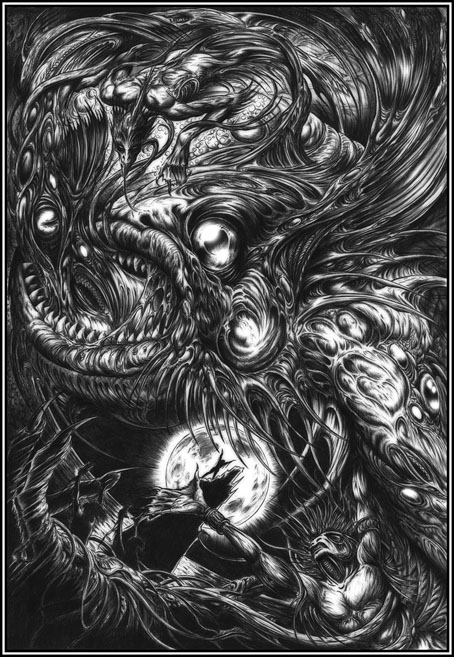
Thus leading Lovecraft biographer and scholar ST Joshi in the introduction to this suitably monstrous book. H.P. Lovecraft: The Complete Fiction was published in a new edition last year after first appearing in 2008 as part of Barnes & Noble’s Leatherbound Classics Series. My drawing of Dagon from 1999 adorns the silvered endpapers, and the reason for this belated mention is because I was only sent copies this week after moaning about not having seen a copy in a Tor.com post about the series. In truth the oversight was partly my own fault: one hazard of this line of work is that artwork is requested months (or even years) in advance of publication, so if the work in question is a reprint it’s easy to forget all about it as you get involved with other things.
lovecraft2.jpg

So anyway, this is a handsome volume of over a thousand pages, not quite leather, it’s more of a leatherette with the design blocked into it. Sven Geier’s cosmic illustration has been given an iridescent finish, and the copies I was sent have metallic silver on the edges as well as a purple ribbon which makes a better match with the colour scheme. The contents comprise all of Lovecraft’s solo fiction (no collaborations, in other words) from the juvenilia through to the non-fiction of his Supernatural Horror in Literature essay. In addition to the introduction there’s a short note from ST Joshi for each story. Needless to say, I’m very pleased to be associated with Lovecraft’s work in this way.

Anyone considered buying a copy should note that the book is currently cheaper at B&N than at Amazon. Also, complaints about typos would appear to apply to the earlier edition although I’ve not had a chance to read any of the stories.

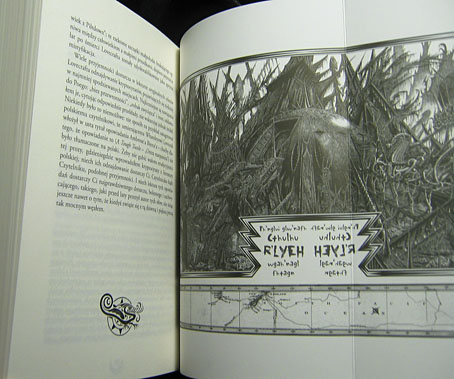
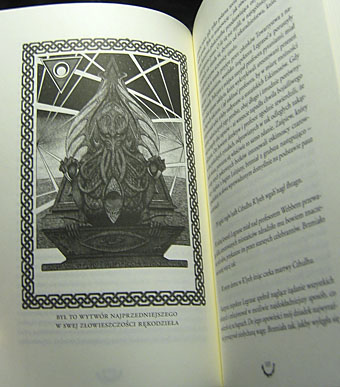
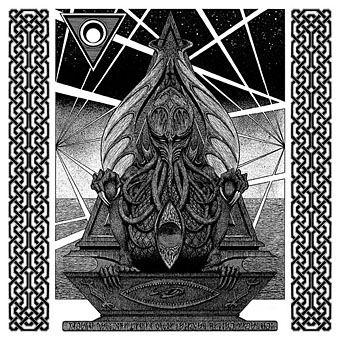
My Dagon picture below appears here larger than it has done before. The drawing was done with a Biro pen, something I’ve always liked using, then tweaked slightly in Photoshop to blur the lines a little and bring out the highlights. I’m not sure now the tweaking was necessary so I may dig out the original at some point to see how it compares.
dagon.jpg

Dagon (1999) by John Coulthart.

Elsewhere on { feuilleton }
The Lovecraft archive

Hodgson versus Houdini

whhhh.jpg

William Hope Hodgson and Harry Houdini.

Work this week has had me scouring the Internet Archive’s scanned books more than usual for source material. You’ll see the fruits of this in due course, but the search turned up a small book from 1922, The Adventurous Life of a Versatile Artist: Houdini, an anonymous account of the escapologist’s career padded out with many newspaper reports of his exploits in various cities. One of these is the notorious meeting between Houdini and writer William Hope Hodgson on the stage of the Palace Theatre, Blackburn, Lancashire, in 1902. Hodgson was still running his School of Physical Culture in the town at this time, and was otherwise unknown. He only began writing the weird fantasy for which he’s celebrated when the school failed and he needed to earn a living some other way.

The following account has been reprinted often enough in collections of Hodgson ephemera but this is the first time I’ve seen it in a Houdini book. Houdini was a hero of mine when I was 12 or 13, not so much for his escapology but for his magic tricks. I had an obsession with stage magic for a while, and had read and re-read JC Cannell’s The Secrets of Houdini (1932), a book which exposed for the first time the workings of Houdini’s tricks and many of his escape acts. It was a surprise after discovering Hodgson’s work to read about the Houdini encounter. Strangest of all is that Hodgson’s books were later championed by HP Lovecraft who ghost-wrote Under the Pyramids (aka Entombed with the Pharaohs or Imprisoned with the Pharaohs) for Houdini, a story published in Weird Tales in 1924. I’ve wondered for years whether Houdini or Lovecraft were aware of this connection. Probably not. Hodgson in 1902 was unknown, and Houdini’s career and fame were such he would have been far too busy to dwell on the matter or care what happened to the diminutive bodybuilder who treated him so badly that evening.

*

AN EPISODE IN HOUDINI’S LIFE.

Star, Blackburn, England, Saturday, Oct. 25, 1902.

MANACLED BY A STRONG MAN.
TRUSSED TILL MIDNIGHT.
Unparalleled Scenes at the Palace Theatre.

Never in the history of Blackburn or music hall life has there been witnessed so remarkable a scene as occurred last night. Houdini, the Handcuff King, and Mr. Hodgson, principal of the School of Physical Culture, provided a big sensation for the patrons of the Palace Theatre, Blackburn.

Houdini, who has been appearing at the Palace during the week, claims to be able to release himself from any of the regulation shackles or irons used by the police of Europe or America, and offered nightly to forfeit £25 if he failed to prove his claim. Mr. Hodgson, of the Physical Culture School, Blackburn,took up the challenge, stipulating that he was to use his own irons and fix them himself. Houdini consented, and deposit the £25 with the editor of the Daily Star.

The trial of skill and strength was fixed to take place last night, and the crowd which came together to witness it crammed the theatre literally from floor to ceiling — even standing room being ultimately unobtainable.

Shortly after ten o’clock the parties to the challenge faced each other, and excitement at once became intense.

Mr. Hodgson produced 6 pairs of heavy irons, furnished with clanking chains and swinging padlocks. These were carefully examined by Houdini, who raised some disappointment and much sympathetic cheering by stating that his claim was that he could escape from “regulation” irons. The “cuffs ” brought by Mr. Hodgson, he said, had been tampered with — the iron being wrapped round with string, the locks altered, and various other expedients adopted to render escape more difficult.

Mr. Hodgson’s answer, given dramatically from the stage,was that he stipulated that he should bring his own irons.

Houdini again protested that Mr. Hodgson was going beyond the challenge, but added that he was quite willing to go on, if only the audience would give him a little time in which to deal with the extra difficulties.

This announcement was greeted with great cheering, and the work of pinioning proceeded.

First, Mr. Hodgson, with the aid of a companion, fixed a pair of irons over Houdini’s upper arm, passing the chain behind his back and pulling it tight, and fixing the elbows close to the sides.

To make assurance doubly sure, he fixed another pair in the same way, and padlocked both behind.

Then, starting with the wrists, he fixed a pair of chained “cuffs” so that the arms, already pulled stiffly behind, were now pulled forward. The pulling and tugging at this stage was so severe — the strong man exercising his strength to some purpose — that Houdini protested that it was no part of the challenge that his arms should be broken.

He also reminded Mr. Hodgson that he was to fix the irons himself.

This led to Mr. Hodgson’s assistant retiring.

Proceeding, Mr. Hodgson fixed a second pair of “cuffs” on the wrists and padlocked both securely, Houdini’s arms being then trussed to his side so securely that escape seemed absolutely impossible.

Still Mr. Hodgson was not finished with him.

Getting Houdini to kneel down, he passed the chain of a pair of heavy leg irons through the chains which bound the arms together at the back. These were fixed to the ankles,and after a second pair had been added, both were locked,and Houdini now seemed absolutely helpless.

A canopy being placed over Houdini in the middle of the stage, the waiting began, and excitement grew visibly every minute.

Meanwhile Mr. Hodgson and others kept strict watch on the movements of Houdini’s wife and brother (Hardeen), who were both on the stage.

At the end of about 15 minutes the canopy was lifted and Houdini was revealed lying on his side, still securely bound.It was at first thought he had fainted, but he soon made it known that all he wished was to be lifted up. This Mr. Hodgson refused to do, at which the now madly excited audience hissed and ” booed ” him for his unfair treatment, and Hardeen lifted his brother to his knees. The curtain of the cabinet was again closed.

Another 20 minutes passed, and again the curtain was lifted. This time Houdini said his arms were bloodless and numb owing to the pressure of the irons, and asked to have them unlocked for a minute so that the circulation could be restored.

Mr. Hodgson’s reply, given amidst howls, was: “This is a contest, not a love match. If you are beaten, give in.”

Great shouting and excited calling followed, which was renewed when Dr. Bradley, after examining Houdini, said his arms were blue, and it was cruelty to keep him chained up as he was any longer.

Still Mr. Hodgson was obdurate, and the struggle proceeded, Houdini again appealing for time.

Fifteen minutes more: Houdini appeared and announced that one hand was free.

This was the signal for terrific cheering, which was continued after the canopy was dropped.

At intervals Houdini now appeared, and announced further progress in his escape; and when, shortly after midnight, he came out with torn clothing and bleeding arms, and threw the last of the shackles on the stage, the vast audience stood up and cheered and cheered, and yelled themselves hoarse to give vent to their overwrought feelings. Men and women hugged each other in mad excitement. Hats, coats, and umbrellas were thrown up into the air, and pandemonium reigned supreme for 15 minutes.

Houdini, when quietness had been restored, said he had been doing the handcuff trick now for 14 years, but never had he been subjected to such brutality as that to which his bleeding arms and wrists gave witness.

When Houdini again obtained a hearing, it was to state that, not only had the irons been altered, but the locks had been plugged.

It was well after midnight when the huge audience left the theatre, and broke up into excited, gesticulating groups.


Previously on { feuilleton }
Weekend links: Hodgson edition
Druillet meets Hodgson

Weekend links 111

thefox.jpg

The Fox (1968). Design by Bill Gold, art by Leo & Diane Dillon.

Mark Rydell’s The Fox may be regarded unfavourably now for its retrograde idea of a lesbian relationship but that’s still a great poster by the Dillons. Equally retrograde (well it was 1957) is Anders als du und ich, a film about wayward German youth directed by ex-Nazi propagandist Veit Harlan:

Klaus is a young man in post-war Berlin. He is drawn to his friend Manfred and, under the encouragement of their acquaintance, Dr. Winkler, explores the underground world of gay clubs and electronic music. His family begins to learn of his other life and do everything they can to set him straight.

A saving grace is the conspicuous deployment of Oskar Sala’s Trautonium. They’re deviants—of course they like weird electronic music! Sala’s instrument was his own invention which means it has a unique pre-Moog sound, famously used by Alfred Hitchcock in the score for The Birds. YouTube has a collection of the electronica moments from Anders als du und ich. Wait for the wrestling scene…

Netherwood: Last Resort of Aleister Crowley by A Gentleman of Hastings. Related: Jimmy Page’s Lucifer Rising sessions part 1 and part 2.

• “This coming 16 June, [BBC] Radio 4 will be a wall-to-wall Joycefest, kicking off at 9am and running until midnight.”

A World Where Architecture is the Driving Force Behind Society, Core77 on the Cités Obscures of François Schuiten.

• At The Hooded Utilitarian an examination of the thorny problem of adapting Lovecraft for the comics medium.

• Plates from La Plante et ses Applications Ornementales (1897–1900) by Eugene Grasset.

• Coilhouse found a rough copy of Todd Haynes’ Superstar: The Karen Carpenter Story.

Three Quick Ways to Introduce Yourself to the Work of Harlan Ellison.

Daniel Buren’s Monumenta 2012 at the Grand Palais, Paris.

Our Sorrows, a new video from Julia Holter.

I, Cyclops: Monocularity in a 3-D World.

JG Ballard: The Concordance.

• RIP Pete Cosey.

• Pete Cosey with Miles Davis et al, November 1973: Ife | Turnaroundphrase

Rex Ingram’s The Magician

magician1.jpg

The Magician (1926), Rex Ingram’s curious occult horror film, receives a rare screening with live music accompaniment at the Brighton Fringe Festival on Tuesday, 22nd May. The film is notable for being based on the 1908 Somerset Maugham novel of the same name whose modern-day magus character, Oliver Haddo, was modelled on Aleister Crowley. The screening will feature an introduction by Gary Lachman, and a live soundtrack by the fabulous Ragged Ragtime Band, featuring members of Blondie, Indigo Octagon, Raagnagrok and Time. Booking details and other information here.

magician2.jpg

Maugham’s book has always been easier to find than Ingram’s film, more’s the pity when the film—despite some flaws—is the superior article. Read today, the novel comes across as a template for the standard Dennis Wheatley tale of middle-class innocents imperilled by grandiloquent villainy. A young couple, Arthur Burdon and his fiancée, Margaret, are pitted against Haddo’s extravagant diabolisms; for assistance they have a friend, Dr Porhoët, a Van Helsing type, older than the couple and with a convenient (but purely intellectual) interest in the occult. Haddo kidnaps Margaret and forces her with hypnosis into an unconsummated marriage. Haddo’s goal is to create artificial life—homunculi—and for that he requires a virgin’s blood. Maugham later described his novel as “lush and turgid”, an honest and accurate appraisal. Aleister Crowley was amused at being portrayed as a “Brother of the Shadows” but pretended to be scandalised by Maugham’s alleged plagiarism which he condemned in a Vanity Fair review that he signed “Oliver Haddo”. The best parts of the novel certainly owe something to other authors, usually the scenes concerning the sinister magus and his occult activities; the rest of the characters are lifeless by comparison. Some of the better passages read like HP Lovecraft writing Dorian Gray, and Maugham not only quotes from Walter Pater but also (uncredited) from Wilde’s Salomé.

magician4.jpg

Paul Wegener as Oliver Haddo.

Continue reading “Rex Ingram’s The Magician”

Virgil Finlay’s Tarzan

finlay.jpg

Thanks are due to Ty Reutel for alerting my attention to this one. I’d no idea that the great Virgil Finlay had illustrated Tarzan but here’s the proof, one half of an interior drawing for The Quest of Tarzan in Argosy Weekly for 1941. That’s the first surprise, the second, of course, was that Finlay had copied Frederic Leighton’s Athlete Wrestling with a Python (1877) ( below), a sculpture which has been a subject of discussion here recently. I’ve mentioned before my including Leighton’s work in one of my Lovecraft adaptations; I referred to many other artworks in those stories but never made any direct reference to Virgil Finlay even though he was the original illustrator of Lovecraft’s The Haunter of the Dark when it was first published in Weird Tales in 1936. Finlay’s illustrations for that story later appeared with some of my own in the enormous Centipede Press collection of Lovecraft art so it’s strange to find that we were also led to the same Leighton sculpture.

Tarzan illustration has been in my thoughts for the past few weeks while I’ve been at work (again!) on the collected Reverbstorm, many pages of which played variations on Burne Hogarth’s comic adaptations of the Tarzan stories. Reverbstorm is at long last very close to being finally, absolutely finished, and ready for printing in a single definitive volume. No production schedule just yet but any news will be announced here.

leighton4.jpg

Previously on { feuilleton }
Frederic Leighton’s sculptures
Virgil Finlay’s Salomé
Die Farbe and The Colour Out of Space
Lovecraft’s favourite artists revisited
Angelo Colarossi and son
The monstrous tome
Men with snakes