
Weekend links 422

kolosimo.jpg

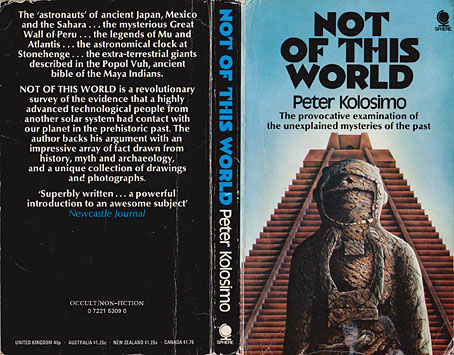
Wu Ming, a communist writing collective known for its historical fiction, sees Kolosimo as using pseudohistory as a tool to shake people from their belief that capitalist society is natural and transhistorical, opening minds to other possibilities for how humans can live. They regret that popular proponents of his theories today, like Graham Hancock and Erich von Däniken, are unable to recognize the political motivations behind his project: “Nothing of his radicality survives in today’s copycats… Every corner has been blunted, the heresy has become telegenic, but we know that the revolution will not be televised.”

The secret history of Marxist alien hunters by AM Gittlitz

I received the Sphere edition of Peter Kolosimo’s book as a Christmas present in 1974, and being 12 years old at the time took its theories fairly seriously. As a work of pseudohistory it’s as poor as the books of Erich von Däniken but I always liked the title, and it happens to be the place I first encountered the mysterious words “Popol Vuh”, a name that would acquire a very different significance a few years later. Kolosimo also joins Kenneth Grant in taking HP Lovecraft’s work as a thin fictionalisation of supposed fact. For a serious dismantling of Not of This World see this review (the first of three parts) by “skeptical xenoarchaelogist” Jason Colavito.

• The Archons are back: Erik Davis talks with Gnostic scholar Matthew Dillon about religious mourning, the Nag Hammadi library, sex-magick Jesus, the Gnostic Eden, David Icke’s lizards, and the power of the Archons as an allegory of contemporary technological and political power.

Crystal Voyager (1973) is a surfing film by David Elfick that ends with a 23-minute sequence of slow-motion waves set to Echoes by Pink Floyd. Some of the same footage later appeared in the final scenes of Peter Weir’s The Last Wave (1977).

• Sweet artifice: “Dandies in the age of decadence favoured synthetics over nature, nowhere more so than in perfumery’s fabulous counterfeits,” says Catherine Maxwell.

• Now for a lampshade solo: Pascal Wyse on how the Radiophonic Workshop built the future of sound.

• Wilde about Paris: Alex Dean on the sex, drink and liberation of Oscar Wilde’s “lost” years.

Bee in the City: the vanguard of an invading army from Planet Bee.

• Five books that most inspired Alexander McQueen.

Colin Newman‘s favourite albums.

Echoes (1969) by Leon Thomas | Echo Waves (1974) by Ash Ra Tempel | Not Of This World (1988) by Danzig

Weekend links 420

nighttide.jpg

• I’ve wondered for years why there was such a difference in quality between Plight & Premonition (1988) and Flux + Mutability (1989), a pair of instrumental albums by David Sylvian and Holger Czukay. The former warrants repeated listening while the latter…doesn’t. David Sylvian‘s reminiscences about the recording sessions are enlightening.

• “There’s something evil and dangerous that is too old to comprehend.” Justin Benson and Aaron Moorhead, directors of The Endless, talk to Virginie Sélavy about the creepiness of recorded media, the science of the supernatural and their belated readings of HP Lovecraft.

• “I hope my site will inspire people to see the world a different way,” says Nicolas Winding Refn, writing about the forthcoming launch of byNWR.com, a home for his collection of restored cult films. Good to see Night Tide (1961) by Curtis Harrington among the titles.

Dennis Cooper‘s favourite fiction, poetry, non-fiction, film, art, and internet of 2018 so far. Thanks again for the link here! Also: Laura Dern Day.

• Mixes of the week: FACT Mix 660 by 7FO, and Light Entertainment Programme: PRExotica 1914–1952 by Jesús Bacalão.

David Bennun on thirty years of the animated masterpiece that is Katsuhiro Otomo’s Akira.

Diane Mehta on the rare women in the rare book trade. Related: Pyewacket Books.

• At Greydogtales: One hundred years of Philip José Farmer.

• In Paris, an omnivorous Asian phantasmagoria.

• The Strange World of…Jon Hassell.

Night Tide (1994) by Scorn | Dark Noontide (2002) by Six Organs Of Admittance | Flowery Noontide (2004) by Espers

Weekend links 419

ellison.jpg

Cover art by Leo & Diane Dillon, 1975.

Art is not supposed to be easier! There are a lot of things in life that are supposed to be easier. Ridding the world of heart attacks, making the roads smoother, making old people more comfortable in the winter, but not Art. Art should always be tough. Art should demand something of you. Art should involve foot-pounds of energy being expended. It’s not supposed to be easier, and those who want it easier should not be artists. They should be out selling public relations copy.

Typical of the late Harlan Ellison to describe his vocation in terms of difficulty and struggle even when his prolific output made writing seem effortless. When my colleagues at Savoy Books published a Savoy issue of New Worlds magazine in 1979 one of the features they ran was an introduction by Michael Moorcock to an Ellison story collection. (They also published two books of Ellison’s around this time.) A copy of the magazine was duly sent to the subject of the essay since Ellison always liked to keep track of his print appearances. The back page of that particular issue is blank but for a few words in bold type from singer PJ Proby: “I am an artist; and should be exempt from shit.” Ellison cut this slogan from the magazine then glued it to his typewriter, no doubt transferring it to later models since it was still visible in the 2008 Ellison documentary, Dreams With Sharp Teeth.

My first encounter with Ellison’s work was also my first encounter with what became labelled the new wave of science fiction, via a reprint of I Have No Mouth, and I Must Scream in a book in the school library. I was only about 12 or 13 at the time, and found Ellison’s story so shocking and disturbing that it overpowered everything else in the collection. The only other story that made an equivalent impression at the time was The Colour Out of Space by HP Lovecraft, so it’s perhaps fitting that Ellison gave my work a favourable mention in his introduction to the huge Centipede Press collection of Lovecraft artwork, A Lovecraft Retrospective: Artists Inspired by HP Lovecraft. I still haven’t got over that one. After the initial encounter, the Ellison-edited Dangerous Visions and Again, Dangerous Visions were just as important for me as the paperback reprints of stories from the Moorcock-edited New Worlds: a handful of books that showed science fiction to be a literary form of limitless possibilities, as opposed to the stereotype of space adventure and future technology. The Ellison and Moorcock anthologies led me to William Burroughs, James Joyce and all points beyond; they also soured for me the preoccupation with space adventure and future technology which persists today.

My final connection with Ellison replayed his compliment in a small way, when editor Jill Roberts and I took extra care with the typesetting of Jeffty is Five for The Very Best of Fantasy & Science Fiction, Volume 2. Ellison was the only author I’ve encountered in the digital age whose corrections were still handwritten comments on printed sheets; these had to be faxed to San Francisco then scanned and emailed to me (to this day I still don’t know why the oft-reprinted story required so many adjustments). It was awkward but amusingly so, a benign taste of a legendary bloody-mindedness and insistence on precision.

• “Laughing about an acid trip with members of Can and opening up about some of the ‘scars’ left from his association with Brian Eno and David Byrne’s My Life In the Bush of Ghosts, [Jon] Hassell is candid in a way that comes naturally to those who’ve lived life on their own terms.”

• Drone Metal Mysticism: Erik Davis talks with music scholar and ethnographer Owen Coggins about amplifier worship, sonic pilgrimage, “as if” listening, metal humour, and his new book Mysticism, Ritual and Religion in Drone Metal.

Psychedelic Prophets: The Letters of Aldous Huxley and Humphry Osmond; “Letters between the men who coined the term ‘psychedelic’ and opened doors to a different way of thinking about human consciousness.”

Artaud 1937 Apocalypse: Letters from Ireland by Antonin Artaud; translated and edited by Stephen Barber.

• “I thought female sexuality was an OK thing?” says writer and porn performer, Stoya.

• “How did a major label manage to lose a John Coltrane record?” asks Ted Gioia.

• Welcome to the dollhouse: Alex Denney on a century of cinematic cutaways.

• The trailer for Mandy, a new (and much-awaited) film by Panos Cosmatos.

• Rest in Anger, Harlan Ellison (1934–2018) by Nick Mamatas.

• Mix of the week: FACT Mix 659 by BD1982.

Emily Gosling on library music design.

Record Label Logos

The Deathbird Song (1997) by The Forbidden Dimension | Eidolons (2017) by Deathbird Stories | Deathbird (2017) by Tempos De Morte

Weekend links 412

maroto.jpg

Lovecraft: The Myth of Cthulhu, an English-language edition of three comic-strip adaptations by Esteban Maroto, is now available from IDW.

The Coffin House, a short story by Robert Aickman that’s a taster for the new Aickman collection, Compulsory Games. Anwen Crawford wrote an introduction to Aickman’s world of “strange stories” for The New Yorker. Related: Victoria Nelson, editor of the new collection, chooses ten favourite horror stories.

• German music this week at The Quietus: Sean Kitching talks to Irmin Schmidt about his years with Can; and there’s an extract from Force Majeure, an autobiography by the late Edgar Froese, writing about the early days of Tangerine Dream.

• More German music at Carhartt WIP: a lengthy and revealing interview with guitarist Michael Rother about his time as one half of Neu!. There’s also a bonus Neu!-themed mix (and one of the mixes of the week) by Daniel Miller.

• From October last year, a Stereoklang interview with master synthesist Hideki Matsutake (Logic System, Yellow Magic Orchestra, et al).

• “When did you first get interested in esoteric studies?” Gary Lachman interviewed at The Astral Institute.

• At Sweet Jane: early illustrations by Wojtek Siudmak for Plexus magazine, 1969.

• 87 prints and drawings by MC Escher in zoomable high-resolution.

• Meet the Small Press: James Conway of Rixdorf Editions.

• Mix of the week: Goodbyes & Beginnings by Zach Cowie.

Derek Jarman on the trouble with shopping for clothes.

Person To Person (1981) by Logic System | Plan (1981) by Logic System | Prophet (1981) by Logic System

Weekend links 403

pennington.jpg

Cover art by Bruce Pennington, 1974. Via Clark Ashton Smith vs Bruce Pennington.

Garçons de Joie. Prostitution masculine à Paris 1860-1960 is an exhibition running at Galerie Au Bonheur du Jour, Paris, until May. The catalogue is expensive (and seems to be in French throughout) but features a substantial amount of rare homoerotic art.

• In the latest Expanding Mind podcast Erik Davis talks to Burt Shonberg biographer Spencer Kansa about LA bohemia, psychedelic art, Marjorie Cameron, gumshoe biography, and his new book Out There: The Transcendent Life and Art of Burt Schonberg.

Gregg Anderson on 20 years of Southern Lord’s dark and heavy art. Related: Earth’s Dylan Carlson announced a new solo album, Conquistador, and single, Scorpions In Their Mouths.

Without any formal training, Smith began to paint and draw his strange visions of sentient plants, grotesque creatures from other dimensions, and throbbing alien landscapes. Eventually commissioned to provide illustrations for Weird Tales, he became one of Lovecraft’s most voluminous correspondents (though never as voluminous as Lovecraft himself). Over the next 10 years, they filled one another’s mailboxes with effusive admiration for each other’s stories and poems. With Lovecraft’s adulatory wind at his back, Smith never strayed far from the Long Valley, and sat home to produce more than a hundred bizarre, linguistically challenging, often unforgettable stories and novelettes for the pulp magazines between 1925 and 1936. Unsurprisingly, Smith’s spurt of fictional creativity didn’t survive the death of Lovecraft in 1937, and while that rich burst of stories may not have earned Smith much money or fame, it caused an almost episteme-shifting earthquake in the brains of the young, aspiring writers lucky enough to read him.

Scott Bradfield on Clark Ashton Smith

Psychomagic, An Art That Heals will be Alejandro Jodorowsky’s next feature film if the crowdfunding is successful. Many rewards are available, large and small.

• At The Quietus this week: Val Wilmer on Sun Ra, and The Strange World of…Cocteau Twins.

• Spectacular images from Chicago’s turn-of-the-century design bible (The Inland Printer).

The shop that buys your dead uncle’s porn collection.

• Mix of the week: FACT mix 642 by Mokira.

Cafe Bohemian (1959) by The Enchanters | Genius Of Love (1981) by Tom Tom Club | A Scandal In Bohemia (1986) by United States Of Existence