HR Giger’s Passagen

giger1.jpg

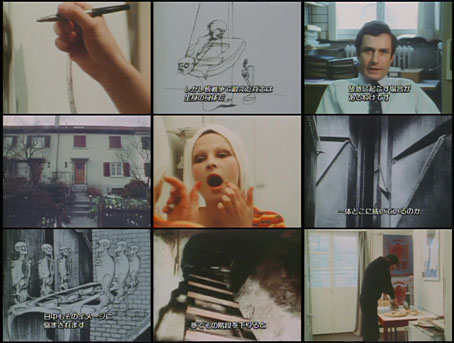
HR Giger’s art books were always very thorough in detailing all the media manifestations of the artist’s work, including film and television appearances. For years this presented tantalising questions, especially regarding the lengthy pre-Alien documentaries that were listed there: what were these films, and when would we get to see them? Giger’s Necronomicon (1976) did finally appear on YouTube a few years ago, and now here’s the second of the pair thanks to an upload of what appears to be a Japanese laserdisc.

giger2.jpg

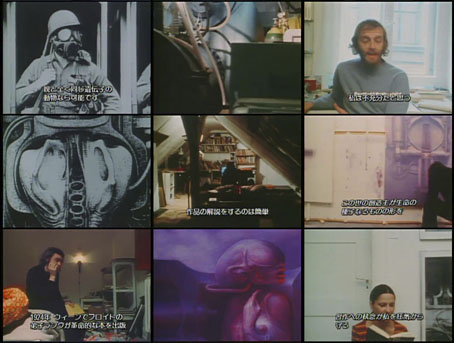
Passagen was made in 1972 by Giger’s friend Fredi M. Murer, their third film collaboration after Heimkiller and High (1967) and Swiss Made 2069 (1968). The latter (which Giger co-directed) is still frustratingly absent from the web, and similarly tantalising for being a 45-minute piece of underground science fiction which features Giger’s first production designs for cinema. Passagen was less ambitious, a 50-minute documentary about Giger’s work made for the German TV station, WDR. As a documentary it functions as a companion to Giger’s Necronomicon, while both films complement the subsequent art books, especially Giger’s Necronomicon (the book) which features many of the paintings seen in the films, together with anecdotes about their origins and inspiration. One of these anecdotes, about the nightmares induced in the young Hans Rudi by a stairway in the hotel next door to the Giger family home, is recounted in Passagen alongside the vertiginous drawings the nightmares inspired. It’s impossible to consider this piece of child psychology, and to watch the artist walking up and down stairs and stepladders, without recalling that Giger died after falling down a flight of stairs in 2014.

giger3.jpg

Giger’s Necronomicon is the more interesting of the two documentaries, especially now that the life and work is so well known; the art is taken more for granted, and we also get to see Giger at work on one of his big airbrush paintings. Passagen spends much of its time attempting to contextualise Giger’s drawings and paintings for an unwitting television audience, so a great deal of the running time is given over to newsreel footage of wars, riots, terrorism, atomic explosions and so on. A geneticist discusses the effects of atomic mutation while Giger’s earliest series of pictures, Atomkinder, is shown; psychoanalysts examine his paintings from a psychosexual angle.

Of more interest for Giger aficionados is the presence of his partner at the time, Li Tobler, the subject of several memorable portraits from this period. Among the working shots, the best shows Giger improvising a drawing with the same speed as Philippe Druillet in the Ô Sidarta film. Giger only started using an airbrush in 1972 so most of the works seen here are either early drawings or the paintings in the Passagen and Alptraum series, the style and colouring of which is much closer to the art world of 1972 than anything which would follow. For me the greatest revelation comes early on when Giger picks out a record to play while he’s working. The disc he chooses is just identifiable as Universal Consciousness by Alice Coltrane, an album which had been released the year before. (This isn’t the music heard on the soundtrack, however.) Alice Coltrane’s brand of ecstatic, pan-religious jazz would seem remote from Giger’s own universe but the choice isn’t so surprising if you know that he’d been a jazz enthusiast since the 1950s; in The Book of Alien (1979) his list of influences includes HP Lovecraft, John Coltrane and Miles Davis.

As is evident from the screen grabs, the film is hard-coded throughout with Japanese subtitles. Unlike Giger’s Necronomicon there’s no English overdub either, the soundtrack is in German throughout. I can’t complain when I’ve been waiting so long to be able to see this at all. For those who watched the later film divided into four YouTube clips there’s now a complete version (also Japanese but with English overdub) here.

Previously on { feuilleton }
Heimkiller and High
The Man Who Paints Monsters In The Night
Hans by Sibylle
HR Giger album covers
Giger’s Necronomicon
Dan O’Bannon, 1946–2009
Alejandro Jodorowsky’s Dune
The monstrous tome

Weekend links 402

hodgson.jpg

Cover art for the 1921 edition by W. Otway Cannell.

• “An exiled recluse, an ancient abode in the remote west of Ireland, nightly attacks by malevolent swine-things from a nearby pit, and cosmic vistas beyond time and space. The House on the Borderland has been praised by China Miéville, Terry Pratchett, and Clark Ashton Smith, while HP Lovecraft wrote, ‘Few can equal [Hodgson] in adumbrating the nearness of nameless forces and monstrous besieging entities through casual hints and significant details, or in conveying feelings of the spectral and abnormal.’

“‘Almost from the moment that you hear the title,’ observes Alan Moore, ‘you are infected by the novel’s weird charisma. Knock and enter at your own liability.’ The House on the Borderland remains one of Hodgson’s most celebrated works. This new edition features an introduction by Alan Moore, an afterword by Iain Sinclair, and illustrations by John Coulthart.” The long-gestating illustrated edition of William Hope Hodgson’s The House on the Borderland is now available for pre-order from Swan River Press. This is limited to 350 copies so I’d advise anyone interested to order as soon as they can; there’s been a lot of interest in the edition, and with the print run being a small one it’s liable to sell out quickly.

• “Art et Liberté was a movement that came into being in 1938 in Cairo. It was affiliated to Surrealism through contact with André Breton in Paris, and shared Surrealism’s spirit of rebellion and provocation, its desire for dream knowledge and penchant for manifestos.” Marina Warner on the neglected history of Egyptian Surrealism.

• Titan Comics follow their recent collection of Philippe Druillet’s first six Lone Sloane stories with Gail, a book which I don’t think has received an English translation until now.

• Mixes of the week: FACT mix 641 by Alva Noto, a mix by Chris Carter for Bleep/NTS, and Through A Landscape Of Mirrors Vol. I: Sweden by David Colohan.

• 200 years after the first publication of Frankenstein, the city of Bath is to unveil a plaque commemorating Mary Shelley‘s time spent there while writing the book.

• Southern Lord co-founder Gregg Anderson talks to Red Bull Radio about running a record label devoted to avant-garde metal.

• Twelve illustrated dust jackets from Martin Salisbury’s The Illustrated Dust Jacket: 1920–1970.

• At MetaFilter: Links to Hokusai’s drawing guides and similar books.

Canada Modern

Grief (1999) by Tactile | In The Cellar (2005) by Nostalgia | The House On The Borderland (2008) by Electric Wizard

The Demons of King Solomon

demon01.jpg

Abyzou.

Presenting my illustrations for The Demons of King Solomon, a horror anthology edited by Aaron French. This is a follow up to Aaron’s The Gods of HP Lovecraft which was published by JournalStone in 2015. I did 6 illustrations for the Lovecraft volume, covering half the stories whereas the new book has illustrations of mine for every story.

demon02.jpg

Agaras.

The brief for the authors this time was to write a story incorporating a Solomonic demon of their choosing. There are many of these, from the ones described in the Testament of Solomon to the 72 listed in the Ars Goetia (or Lesser Key of Solomon), the latter being familiar to many people via their often comical depictions in De Plancy’s Dictionnaire Infernal. My original intention for the illustrations was to do a series of pictures based on each story. Some of the stories were late in arriving, however, and I only had a month free for the work so I changed the plan to a series of depictions of the demons as they’re described in the grimoires. This makes more sense when many of the stories have the demons masquerading in human guise, so the illustrations not only show something new but also act as a connection back to their infernal history. Agaras (or Agares), for example, is described by the grimoires as an old man riding a crocodile with a hawk on his arm. Most of the seals on each picture are taken from the ones for the demons shown in the Ars Goetia. Not all the demons in the anthology are listed there so I had to invent a few seals to fill out the collection. I’ll let people guess which are genuine and which are inventions. The Demons of King Solomon is out now from JournalStone. Larger copies of the illustrations may be seen here.

demon03.jpg

Amdusias.

demon04.jpg

Asmodeus.

Continue reading “The Demons of King Solomon”

The Thing on the Doorstep

thing1.jpg

Workwise, this year has been a major one for interior illustration. So far I’ve completed about 80 illustrations for different titles, and I’m still not finished. The majority of the work has been for a Spanish publisher, Editorial Alma, based in Barcelona. Earlier this year they launched a line of reprints of classic works of fiction, each of which is illustrated. To date I’ve worked on three of the titles, the first of which, Narraciones extraordinarias by Edgar Allan Poe, will feature in a later post.

The second title, La llamada de Cthulhu by HP Lovecraft, is a small collection comprising the rather odd pairing of The Call of Cthulhu with The Thing on the Doorstep, two very different stories that you wouldn’t usually expect to see together. I provided six illustrations, three for Cthulhu which are slightly reworked pages from my comic-strip adaptation of the story, and three new ones for The Thing on the Doorstep. This is a story I’d never considered illustrating before when so much of its horror is psychological. It does, however, feature two characters who (by Lovecraft’s standards) are well-defined: the ineffectual Edward Pickman Derby and his sinister future wife, Asenath Waite. So that’s what you see here: portraits of the two main characters plus a view of the climactic scene that gives the story its title. Ideally, I would have liked to have done a fourth picture showing Derby’s surprise awakening at a nightmarish ritual but the deadlines on these books have been tight and there simply wasn’t time.

thing2.jpg

For those interested in this title, the only purchase link I have is an Amazon one. All the books are hardbacks (without dustjackets) complete with decorated endpapers—I provided a tentacle pattern for this one—and a bookmark ribbon. Deadlines aside, it’s been a very pleasant experience working for Alma. The next two books are the big ones so watch this space.

thing3.jpg

Elsewhere on { feuilleton }
The Lovecraft archive

Weekend links 385

picasso.jpg

• It won’t be out until late January—and then in the UK only—but the blu-ray premiere of The Mystery of Picasso (1956) by Henri-Georges Clouzot was announced this week. The initial run of the discs (there’s also a DVD) will include a booklet containing my essay about the film, something I was very pleased and honoured to be asked to write. Clouzot’s remarkable study of Picasso drawing and painting for the camera was made immediately after his masterwork, The Wages of Fear (also newly available on UK blu-ray), and this new edition will include two short extras, one of which, A Visit to Picasso (1949) by Paul Haesaerts, is an excellent precursor/companion to the main feature. More on this subject later.

• At the Internet Archive: an almost complete run of The Twilight Zone Magazine (1981–1989). While masquerading as a TV-series spin-off, TZ under the editorship of TED Klein was an excellent periodical devoted to horror and dark fantasy. In addition to running original fiction by major authors (Stephen King was a regular), the magazine contained features about older writers such as Lovecraft and Machen along with book reviews by Thomas Disch, film reviews by Gahan Wilson, interviews and more.

• “Bram Stoker was gay,” says Tom Cardamone in a review of Something in the Blood: The Untold Story of Bram Stoker, the Man Who Wrote Dracula by David J. Skal. I’ve not read Skal’s book so can’t comment on its claims but his earlier Hollywood Gothic (about Dracula on page and screen) includes some discussion of “sexual ambiguity” in Stoker’s work.

• Mixes of the week: FACT mix 625 by Elena Colombi, Secret Thirteen Mix 235 by Rhys Fulber, and XLR8R Podcast 514 by Tommaso Cappellato.

Help, Help, The Globolinks! is a previously unreleased electronic soundtrack by Suzanne Ciani, out next week.

La Région Centrale (1971), Michael Snow’s epic of landscape gyrations in two parts, here and here.

Alexander Calder and the Optimism of Modernism: Jed Perl in Conversation with Morgan Meis.

• Illustrations by Lynd Ward for The Haunted Omnibus (1935) edited by Alexander Laing.

Daniel Dylan Wray on the gay-porn music of disco pioneer Patrick Cowley.

• It’s that man again (and his drawings): Ernst Haeckel: the art of evolution.

• At Dennis Cooper’s: Steve Erickson presents A Black Psychedelia Primer.

Bootsy Collins‘ favourite albums.

Picasso (1948) by Coleman Hawkins | Pablo Picasso (1976) by The Modern Lovers | Picasso Suite pt. 1 (1993) by David Murray Octet