Weekend links 419

ellison.jpg

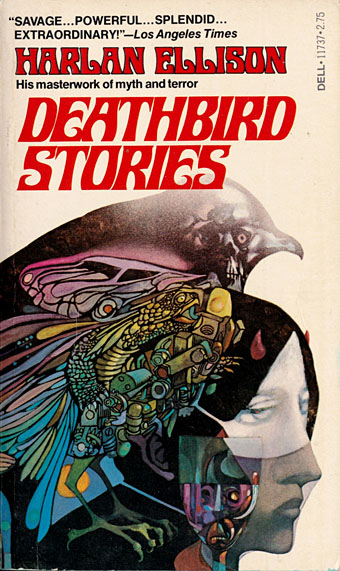
Cover art by Leo & Diane Dillon, 1975.

Art is not supposed to be easier! There are a lot of things in life that are supposed to be easier. Ridding the world of heart attacks, making the roads smoother, making old people more comfortable in the winter, but not Art. Art should always be tough. Art should demand something of you. Art should involve foot-pounds of energy being expended. It’s not supposed to be easier, and those who want it easier should not be artists. They should be out selling public relations copy.

Typical of the late Harlan Ellison to describe his vocation in terms of difficulty and struggle even when his prolific output made writing seem effortless. When my colleagues at Savoy Books published a Savoy issue of New Worlds magazine in 1979 one of the features they ran was an introduction by Michael Moorcock to an Ellison story collection. (They also published two books of Ellison’s around this time.) A copy of the magazine was duly sent to the subject of the essay since Ellison always liked to keep track of his print appearances. The back page of that particular issue is blank but for a few words in bold type from singer PJ Proby: “I am an artist; and should be exempt from shit.” Ellison cut this slogan from the magazine then glued it to his typewriter, no doubt transferring it to later models since it was still visible in the 2008 Ellison documentary, Dreams With Sharp Teeth.

My first encounter with Ellison’s work was also my first encounter with what became labelled the new wave of science fiction, via a reprint of I Have No Mouth, and I Must Scream in a book in the school library. I was only about 12 or 13 at the time, and found Ellison’s story so shocking and disturbing that it overpowered everything else in the collection. The only other story that made an equivalent impression at the time was The Colour Out of Space by HP Lovecraft, so it’s perhaps fitting that Ellison gave my work a favourable mention in his introduction to the huge Centipede Press collection of Lovecraft artwork, A Lovecraft Retrospective: Artists Inspired by HP Lovecraft. I still haven’t got over that one. After the initial encounter, the Ellison-edited Dangerous Visions and Again, Dangerous Visions were just as important for me as the paperback reprints of stories from the Moorcock-edited New Worlds: a handful of books that showed science fiction to be a literary form of limitless possibilities, as opposed to the stereotype of space adventure and future technology. The Ellison and Moorcock anthologies led me to William Burroughs, James Joyce and all points beyond; they also soured for me the preoccupation with space adventure and future technology which persists today.

My final connection with Ellison replayed his compliment in a small way, when editor Jill Roberts and I took extra care with the typesetting of Jeffty is Five for The Very Best of Fantasy & Science Fiction, Volume 2. Ellison was the only author I’ve encountered in the digital age whose corrections were still handwritten comments on printed sheets; these had to be faxed to San Francisco then scanned and emailed to me (to this day I still don’t know why the oft-reprinted story required so many adjustments). It was awkward but amusingly so, a benign taste of a legendary bloody-mindedness and insistence on precision.

• “Laughing about an acid trip with members of Can and opening up about some of the ‘scars’ left from his association with Brian Eno and David Byrne’s My Life In the Bush of Ghosts, [Jon] Hassell is candid in a way that comes naturally to those who’ve lived life on their own terms.”

• Drone Metal Mysticism: Erik Davis talks with music scholar and ethnographer Owen Coggins about amplifier worship, sonic pilgrimage, “as if” listening, metal humour, and his new book Mysticism, Ritual and Religion in Drone Metal.

Psychedelic Prophets: The Letters of Aldous Huxley and Humphry Osmond; “Letters between the men who coined the term ‘psychedelic’ and opened doors to a different way of thinking about human consciousness.”

Artaud 1937 Apocalypse: Letters from Ireland by Antonin Artaud; translated and edited by Stephen Barber.

• “I thought female sexuality was an OK thing?” says writer and porn performer, Stoya.

• “How did a major label manage to lose a John Coltrane record?” asks Ted Gioia.

• Welcome to the dollhouse: Alex Denney on a century of cinematic cutaways.

• The trailer for Mandy, a new (and much-awaited) film by Panos Cosmatos.

• Rest in Anger, Harlan Ellison (1934–2018) by Nick Mamatas.

• Mix of the week: FACT Mix 659 by BD1982.

Emily Gosling on library music design.

Record Label Logos

The Deathbird Song (1997) by The Forbidden Dimension | Eidolons (2017) by Deathbird Stories | Deathbird (2017) by Tempos De Morte
Weekend links 412

maroto.jpg

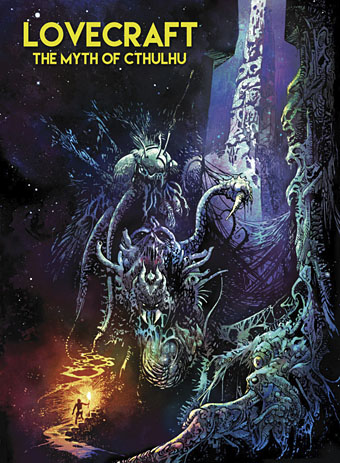
Lovecraft: The Myth of Cthulhu, an English-language edition of three comic-strip adaptations by Esteban Maroto, is now available from IDW.

The Coffin House, a short story by Robert Aickman that’s a taster for the new Aickman collection, Compulsory Games. Anwen Crawford wrote an introduction to Aickman’s world of “strange stories” for The New Yorker. Related: Victoria Nelson, editor of the new collection, chooses ten favourite horror stories.

• German music this week at The Quietus: Sean Kitching talks to Irmin Schmidt about his years with Can; and there’s an extract from Force Majeure, an autobiography by the late Edgar Froese, writing about the early days of Tangerine Dream.

• More German music at Carhartt WIP: a lengthy and revealing interview with guitarist Michael Rother about his time as one half of Neu!. There’s also a bonus Neu!-themed mix (and one of the mixes of the week) by Daniel Miller.

• From October last year, a Stereoklang interview with master synthesist Hideki Matsutake (Logic System, Yellow Magic Orchestra, et al).

• “When did you first get interested in esoteric studies?” Gary Lachman interviewed at The Astral Institute.

• At Sweet Jane: early illustrations by Wojtek Siudmak for Plexus magazine, 1969.

• 87 prints and drawings by MC Escher in zoomable high-resolution.

• Meet the Small Press: James Conway of Rixdorf Editions.

• Mix of the week: Goodbyes & Beginnings by Zach Cowie.

Derek Jarman on the trouble with shopping for clothes.

Person To Person (1981) by Logic System | Plan (1981) by Logic System | Prophet (1981) by Logic System

Weekend links 403

pennington.jpg

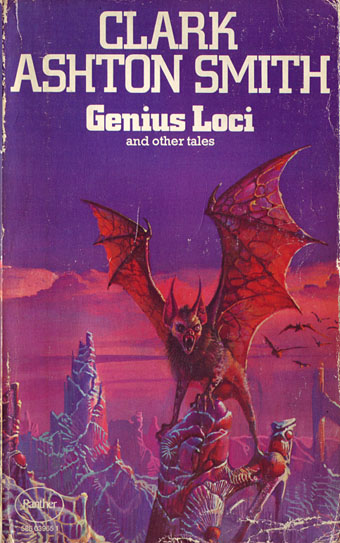
Cover art by Bruce Pennington, 1974. Via Clark Ashton Smith vs Bruce Pennington.

Garçons de Joie. Prostitution masculine à Paris 1860-1960 is an exhibition running at Galerie Au Bonheur du Jour, Paris, until May. The catalogue is expensive (and seems to be in French throughout) but features a substantial amount of rare homoerotic art.

• In the latest Expanding Mind podcast Erik Davis talks to Burt Shonberg biographer Spencer Kansa about LA bohemia, psychedelic art, Marjorie Cameron, gumshoe biography, and his new book Out There: The Transcendent Life and Art of Burt Schonberg.

Gregg Anderson on 20 years of Southern Lord’s dark and heavy art. Related: Earth’s Dylan Carlson announced a new solo album, Conquistador, and single, Scorpions In Their Mouths.

Without any formal training, Smith began to paint and draw his strange visions of sentient plants, grotesque creatures from other dimensions, and throbbing alien landscapes. Eventually commissioned to provide illustrations for Weird Tales, he became one of Lovecraft’s most voluminous correspondents (though never as voluminous as Lovecraft himself). Over the next 10 years, they filled one another’s mailboxes with effusive admiration for each other’s stories and poems. With Lovecraft’s adulatory wind at his back, Smith never strayed far from the Long Valley, and sat home to produce more than a hundred bizarre, linguistically challenging, often unforgettable stories and novelettes for the pulp magazines between 1925 and 1936. Unsurprisingly, Smith’s spurt of fictional creativity didn’t survive the death of Lovecraft in 1937, and while that rich burst of stories may not have earned Smith much money or fame, it caused an almost episteme-shifting earthquake in the brains of the young, aspiring writers lucky enough to read him.

Scott Bradfield on Clark Ashton Smith

Psychomagic, An Art That Heals will be Alejandro Jodorowsky’s next feature film if the crowdfunding is successful. Many rewards are available, large and small.

• At The Quietus this week: Val Wilmer on Sun Ra, and The Strange World of…Cocteau Twins.

• Spectacular images from Chicago’s turn-of-the-century design bible (The Inland Printer).

The shop that buys your dead uncle’s porn collection.

• Mix of the week: FACT mix 642 by Mokira.

Cafe Bohemian (1959) by The Enchanters | Genius Of Love (1981) by Tom Tom Club | A Scandal In Bohemia (1986) by United States Of Existence

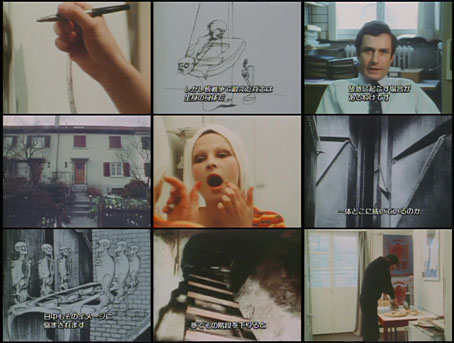
HR Giger’s Passagen

giger1.jpg

HR Giger’s art books were always very thorough in detailing all the media manifestations of the artist’s work, including film and television appearances. For years this presented tantalising questions, especially regarding the lengthy pre-Alien documentaries that were listed there: what were these films, and when would we get to see them? Giger’s Necronomicon (1976) did finally appear on YouTube a few years ago, and now here’s the second of the pair thanks to an upload of what appears to be a Japanese laserdisc.

giger2.jpg

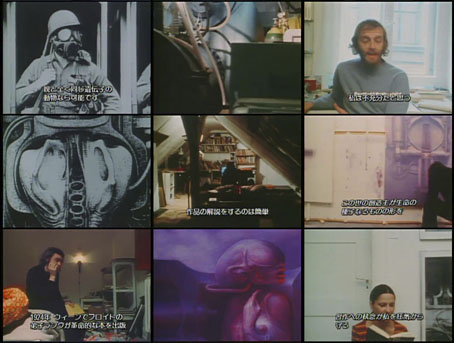
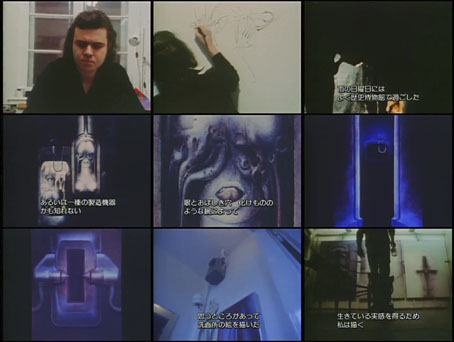
Passagen was made in 1972 by Giger’s friend Fredi M. Murer, their third film collaboration after Heimkiller and High (1967) and Swiss Made 2069 (1968). The latter (which Giger co-directed) is still frustratingly absent from the web, and similarly tantalising for being a 45-minute piece of underground science fiction which features Giger’s first production designs for cinema. Passagen was less ambitious, a 50-minute documentary about Giger’s work made for the German TV station, WDR. As a documentary it functions as a companion to Giger’s Necronomicon, while both films complement the subsequent art books, especially Giger’s Necronomicon (the book) which features many of the paintings seen in the films, together with anecdotes about their origins and inspiration. One of these anecdotes, about the nightmares induced in the young Hans Rudi by a stairway in the hotel next door to the Giger family home, is recounted in Passagen alongside the vertiginous drawings the nightmares inspired. It’s impossible to consider this piece of child psychology, and to watch the artist walking up and down stairs and stepladders, without recalling that Giger died after falling down a flight of stairs in 2014.

giger3.jpg

Giger’s Necronomicon is the more interesting of the two documentaries, especially now that the life and work is so well known; the art is taken more for granted, and we also get to see Giger at work on one of his big airbrush paintings. Passagen spends much of its time attempting to contextualise Giger’s drawings and paintings for an unwitting television audience, so a great deal of the running time is given over to newsreel footage of wars, riots, terrorism, atomic explosions and so on. A geneticist discusses the effects of atomic mutation while Giger’s earliest series of pictures, Atomkinder, is shown; psychoanalysts examine his paintings from a psychosexual angle.

Of more interest for Giger aficionados is the presence of his partner at the time, Li Tobler, the subject of several memorable portraits from this period. Among the working shots, the best shows Giger improvising a drawing with the same speed as Philippe Druillet in the Ô Sidarta film. Giger only started using an airbrush in 1972 so most of the works seen here are either early drawings or the paintings in the Passagen and Alptraum series, the style and colouring of which is much closer to the art world of 1972 than anything which would follow. For me the greatest revelation comes early on when Giger picks out a record to play while he’s working. The disc he chooses is just identifiable as Universal Consciousness by Alice Coltrane, an album which had been released the year before. (This isn’t the music heard on the soundtrack, however.) Alice Coltrane’s brand of ecstatic, pan-religious jazz would seem remote from Giger’s own universe but the choice isn’t so surprising if you know that he’d been a jazz enthusiast since the 1950s; in The Book of Alien (1979) his list of influences includes HP Lovecraft, John Coltrane and Miles Davis.

As is evident from the screen grabs, the film is hard-coded throughout with Japanese subtitles. Unlike Giger’s Necronomicon there’s no English overdub either, the soundtrack is in German throughout. I can’t complain when I’ve been waiting so long to be able to see this at all. For those who watched the later film divided into four YouTube clips there’s now a complete version (also Japanese but with English overdub) here.

Previously on { feuilleton }
Heimkiller and High
The Man Who Paints Monsters In The Night
Hans by Sibylle
HR Giger album covers
Giger’s Necronomicon
Dan O’Bannon, 1946–2009
Alejandro Jodorowsky’s Dune
The monstrous tome

Weekend links 402

hodgson.jpg

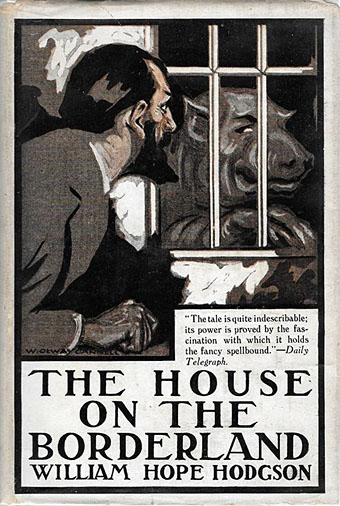
Cover art for the 1921 edition by W. Otway Cannell.

• “An exiled recluse, an ancient abode in the remote west of Ireland, nightly attacks by malevolent swine-things from a nearby pit, and cosmic vistas beyond time and space. The House on the Borderland has been praised by China Miéville, Terry Pratchett, and Clark Ashton Smith, while HP Lovecraft wrote, ‘Few can equal [Hodgson] in adumbrating the nearness of nameless forces and monstrous besieging entities through casual hints and significant details, or in conveying feelings of the spectral and abnormal.’

“‘Almost from the moment that you hear the title,’ observes Alan Moore, ‘you are infected by the novel’s weird charisma. Knock and enter at your own liability.’ The House on the Borderland remains one of Hodgson’s most celebrated works. This new edition features an introduction by Alan Moore, an afterword by Iain Sinclair, and illustrations by John Coulthart.” The long-gestating illustrated edition of William Hope Hodgson’s The House on the Borderland is now available for pre-order from Swan River Press. This is limited to 350 copies so I’d advise anyone interested to order as soon as they can; there’s been a lot of interest in the edition, and with the print run being a small one it’s liable to sell out quickly.

• “Art et Liberté was a movement that came into being in 1938 in Cairo. It was affiliated to Surrealism through contact with André Breton in Paris, and shared Surrealism’s spirit of rebellion and provocation, its desire for dream knowledge and penchant for manifestos.” Marina Warner on the neglected history of Egyptian Surrealism.

• Titan Comics follow their recent collection of Philippe Druillet’s first six Lone Sloane stories with Gail, a book which I don’t think has received an English translation until now.

• Mixes of the week: FACT mix 641 by Alva Noto, a mix by Chris Carter for Bleep/NTS, and Through A Landscape Of Mirrors Vol. I: Sweden by David Colohan.

• 200 years after the first publication of Frankenstein, the city of Bath is to unveil a plaque commemorating Mary Shelley‘s time spent there while writing the book.

• Southern Lord co-founder Gregg Anderson talks to Red Bull Radio about running a record label devoted to avant-garde metal.

• Twelve illustrated dust jackets from Martin Salisbury’s The Illustrated Dust Jacket: 1920–1970.

• At MetaFilter: Links to Hokusai’s drawing guides and similar books.

Canada Modern

Grief (1999) by Tactile | In The Cellar (2005) by Nostalgia | The House On The Borderland (2008) by Electric Wizard