Weekend links 436

cthulhusex.jpg

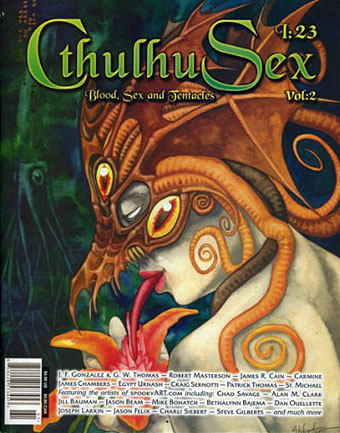
Cover for the now-defunct Cthulhu Sex magazine, volume 2, no. 23. Art by Chad Savage.

• Revising Lovecraft: The Mutant Mythos by Paul StJohn Mackintosh. Mackintosh was interviewed at Greydogtales in 2016 where he made a point that certainly chimes with my experience: “…the English-speaking genre community seems to have far more trouble with certain sexual themes than the mainstream literary community does, especially in Europe. […] A pity, because, for example, if H P Lovecraft’s worldview did owe much to sexual repression, then more mature engagement with that could really benefit the whole cosmic horror genre.”

• At Expanding Mind: Occultist and Aleister Crowley biographer Richard Kaczynski talks with Erik Davis about Jack Parsons, the “method of science,” the Agape Lodge, the women of Thelema, and the pluses and minuses of the Strange Angel TV series.

The Tell-Tale Heart (1953) is a short adaptation of the Poe story directed by JB Williams, and featuring Stanley Baker as the author. The film had been lost for 50 years but may now be seen on the BFI website.

• From July but more suited to the end of October: Paul Karasik on The Addams Family Secret: how a massive painting by Charles Addams wound up hidden away in a university library.

• Mixes of the week: Samhain Séance Seven: A Very Dark Place by The Ephemeral Man, Big Strings Attached, Oct. 2018 by Abigail Ward, and XLR8R Podcast 564 by Niagara.

• At Haute Macabre: Conjured from obscurity: lost, neglected and forgotten literature from Valancourt Books.

The Feathered Bough, a large-format collection of new fiction and art by Stephen J. Clark.

William Doyle on Music For Algorithms: in search of Eno’s ambient vision in a spotify era.

• The devils of our better nature: Daniel Felsenthal on Dennis Cooper and his new film.

Bone Mother, a short animated film by Dale Hayward & Sylvie Trouvé.

• “In Japan, the Kit Kat Isn’t Just a Chocolate. It’s an Obsession.”

Leigh Singer chooses 10 great films about the afterlife.

• “I am a haunted house,” says Sarah Chavez.

Psychedelitypes

Sex Voodoo Venus (1985) by Helios Creed | Sexy Boy (1998) by Air | Sex Magick (2002) by John Zorn
Weekend links 434

klint.jpg

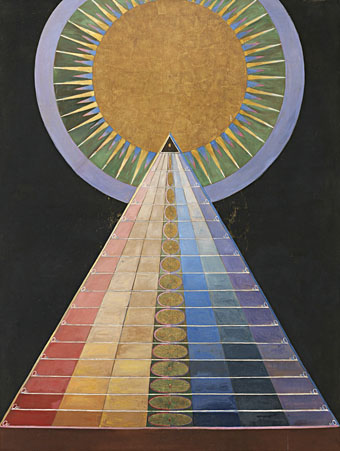
Group X, No. 1, Altarpiece (1915) by Hilma af Klint.

“Like Kandinsky, and other pioneers of abstract art, af Klint was deeply immersed in theosophy and anthroposophy. But she seems to have taken that interest much further than her male counterparts, participating in (and later leading) séances with a group of women friends. Whatever the spirits said, af Klint did.” Nana Asfour on pioneering abstract painter, Hilma af Klint.

• Four electronic artists reflect on the influence of composer Laurie Spiegel. Spiegel’s The Expanding Universe (1980) is reissued by Unseen Worlds next month. Related: Laurie Spiegel in 1977 playing the Bell Labs Digital Synthesizer.

• At Expanding Mind: Gurdjieffean writer and DuVersity director Anthony Blake talks with Erik Davis about dialogue, synergy, mind between brains, the trouble with teachers, and the gymnasium of beliefs in higher intelligence.

• Mixes of the week: Flashing Noise Mix by Tim Gane, Secret Thirteen Mix 268 by Bérangère Maximin, and Samhain Séance Seven: A Very Dark Place – Prologue by The Ephemeral Man.

Geeta Dayal on Broken Music (1989), a book about sound art edited by Ursula Block and Michael Glasmeier which is now available in a new edition from Primary Information.

• The Sainsbury Archive showcases the graphic design of several decades of the supermarket chain’s products.

• More of the usual suspects: Michael Moorcock and Alan Moore in 2006 discussing Moorcock’s career.

• “Karloff the Uncanny”: Joe Dante talks to Stephanie Sporn about the attraction of old film posters.

Mexico City, another preview (and a psychedelic one) of Randall Dunn’s forthcoming solo album.

• At Haute Macabre: Timeless Phantom Interludes: The Photography of Jason Blake.

Mark Valentine on the current state of Britain’s secondhand book shops.

• At I Love Typography: Unicorns, Frogs and the Sausage Supper Affair.

• “I never wanted to be a cult film-maker,” says John Waters.

• Artist Arik Roper chooses some favourite album covers.

Broken Head (1978) by Eno, Moebius, Roedelius | Broken Horse (1984) by Rain Parade | Broken Aura (2000) by Coil

Weekend links 427

davis.jpg

Inside an O’Neill Cylinder, an orbital megastructure. Painting by Don Davis, 1975.

• RIP Lindsay Kemp: dancer, actor, choreographer and (if we have to drop names) mentor to David Bowie and Kate Bush. Kemp’s work has been featured here on a number of occasions, particularly his landmark productions of an all-male Salomé, and Flowers, A Pantomime for Jean Genet. There was also considerable overlap with Kemp’s troupe and the films of Derek Jarman via appearances by Kemp himself, David Haughton and the irrepressible Jack Birkett. The Genet production was filmed in 1982, and is now available on DVD. (There’s also a rougher copy with unmatched audio and video.) From 1970: Pierrot in Turquoise, or The Looking Glass Murders, a Commedia dell’arte performance for Scottish TV featuring David Bowie. And reversing roles, Mick Rock’s video for Bowie’s John, I’m Only Dancing featuring Kemp and company.

• At Expanding Mind: Erik Davis in conversation with activist and writer David Nickles about “the DMT Nexus, psychedelic militancy, extraction tek, the Statement on Open Science for Psychedelic Medicines, MAPS, and the trouble with for-profit psilocybin companies”.

• From the end of August to January 2019: Spellbound at the Ashmolean; “Spellbinding stories, fascinating objects…from crystal balls and magic mirrors to witch bottles and curse poppets”.

On Earth, as on the International Space Station, the collective misperception of a flat plane helps build community and culture. We are all equal in our geometric relationship to one another. The reality, of course, is that we do not stand parallel. Each of our bodies corresponds with a distinct radial vector on the surface of a sphere, pointing away from a common center that we can never perceive or occupy. Our vectors diverge by imperceptible angles.

In “inside-out” worlds like the Bernal Sphere and the concave Earth, the situation is reversed. Our feet all point outward, into an inaccessible, but technologically habitable void, while our heads point inward, some of us apparently “upside-down.” Standing, we rise toward a visible center, which can be reached simply by climbing a hill, strapping on wings, and jumping into the air, as low-tech as Icarus.

The Shape of Space by Fred Scharmen

Michael Moorcock again, interviewed this time by Bernard Braden in 1968. I think this one was for a Braden TV series which was never broadcast.

• “Stupid things are best”: Neil Fox on Conny Plank: The Potential of Noise, a documentary about the great music producer.

• Mixes of the week: XLR8R Podcast 556 by Helios, and An Ode to Eris with An Other Ode to Eris by The Ephemeral Man.

• A monstrous primer on the works of HP Lovecraft by Emma Stefansky. With illustrations by Michael Bukowski.

Silent Agents by Julius-Christian Schreiner: photographs of hostile architecture from around the world.

• Back to the Futuro: Mark Hodgkinson on the spaceship house that landed in Yorkshire.

• The Great Chinese Art Heist by Alex W. Palmer.

Rhizome: a new recording by Drew McDowall.

The Starman Tarot

Mad Pierrot (1978) by Yellow Magic Orchestra | Spellbound (1981) by Siouxsie And The Banshees | Sphere (2011) by Emptyset

Weekend links 423

howe.jpg

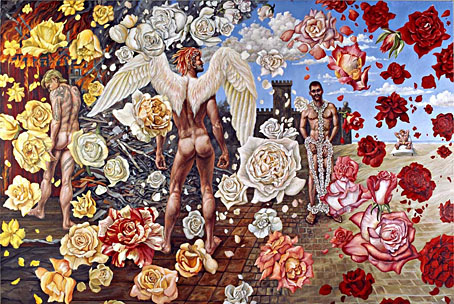
The Miracle (Genet’s Dream) (2001) by Delmas Howe.

• “Zachary Lipton, an assistant professor at the machine learning department at Carnegie Mellon University, watched with frustration as this story transformed from ‘interesting-ish research’ to ‘sensationalized crap’.” Oscar Schwartz on how the media gets AI alarmingly wrong.

• The Aesthetics of Science Fiction: what does SF look like after cyberpunk? Very Brutalist if you ask Rick Liebling, although the first example shown in his piece—the Brunel University Lecture Centre—appears briefly as future architecture in A Clockwork Orange.

• At Expanding Mind: Erik Davis talks with philosopher and religious studies professor Dustin Atlas about ancient skepticism, Madhyamaka Buddhism, the taste of honey, Montaigne, Robert Anton Wilson, and the path of doubt.

• At Muddy Colors: Part 1 of their choices for best fantasy book covers of the year so far, a list which includes my cover for Moonshine by Jasmine Gower. Thanks!

• Soundtracking with Edith Bowman, episode 84: director Todd Haynes on the music of Wonderstruck, I’m Not There, Carol and Far From Heaven.

• Mixes of the week: FACT mix 663 by Space Afrika, Secret Thirteen Mix 262 by Mieko Suzuki, and Black Minimalism, a playlist by David Toop.

• Two minutes, eight barrels: drone and GoPro footage of surfer Koa Smith riding the waves of the Namibia shoreline.

• David Lynch’s Sacred Clay: Shehryar Fazli reviews Room to Dream by David Lynch and Kristine McKenna.

Charlotte Higgins on myths, monsters and the maze: how writers fell in love with the labyrinth.

• Monstrous Geometries in the Fiction of HP Lovecraft by Moritz Ingwersen.

Listen to the mournful wails of planets and moons.

• A Peel Session by Laika

Surf Ride (1956) by Art Pepper | Surf (1976) by Tim Blake | Surfside Sex (1982) by Patrick Cowley

Weekend links 422

kolosimo.jpg

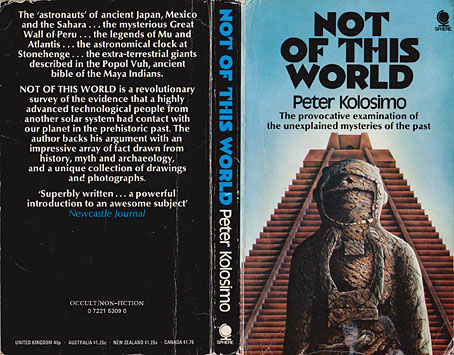
Wu Ming, a communist writing collective known for its historical fiction, sees Kolosimo as using pseudohistory as a tool to shake people from their belief that capitalist society is natural and transhistorical, opening minds to other possibilities for how humans can live. They regret that popular proponents of his theories today, like Graham Hancock and Erich von Däniken, are unable to recognize the political motivations behind his project: “Nothing of his radicality survives in today’s copycats… Every corner has been blunted, the heresy has become telegenic, but we know that the revolution will not be televised.”

The secret history of Marxist alien hunters by AM Gittlitz

I received the Sphere edition of Peter Kolosimo’s book as a Christmas present in 1974, and being 12 years old at the time took its theories fairly seriously. As a work of pseudohistory it’s as poor as the books of Erich von Däniken but I always liked the title, and it happens to be the place I first encountered the mysterious words “Popol Vuh”, a name that would acquire a very different significance a few years later. Kolosimo also joins Kenneth Grant in taking HP Lovecraft’s work as a thin fictionalisation of supposed fact. For a serious dismantling of Not of This World see this review (the first of three parts) by “skeptical xenoarchaelogist” Jason Colavito.

• The Archons are back: Erik Davis talks with Gnostic scholar Matthew Dillon about religious mourning, the Nag Hammadi library, sex-magick Jesus, the Gnostic Eden, David Icke’s lizards, and the power of the Archons as an allegory of contemporary technological and political power.

Crystal Voyager (1973) is a surfing film by David Elfick that ends with a 23-minute sequence of slow-motion waves set to Echoes by Pink Floyd. Some of the same footage later appeared in the final scenes of Peter Weir’s The Last Wave (1977).

• Sweet artifice: “Dandies in the age of decadence favoured synthetics over nature, nowhere more so than in perfumery’s fabulous counterfeits,” says Catherine Maxwell.

• Now for a lampshade solo: Pascal Wyse on how the Radiophonic Workshop built the future of sound.

• Wilde about Paris: Alex Dean on the sex, drink and liberation of Oscar Wilde’s “lost” years.

Bee in the City: the vanguard of an invading army from Planet Bee.

• Five books that most inspired Alexander McQueen.

Colin Newman‘s favourite albums.

Echoes (1969) by Leon Thomas | Echo Waves (1974) by Ash Ra Tempel | Not Of This World (1988) by Danzig