Weekend links 296

invisiblecreature.jpg

Mars (variant design): one of three new posters for NASA by Invisible Creature.

• “If the point of Sade’s work was to marry sexual frustration and release to the practice of interpersonal violence, he could confidently gaze out on the landscape of our popular culture and declare it a fait accompli.” Hussein Ibish on The United Sades of America.

• Gravitational Waves Exist: The Inside Story of How Scientists Finally Found Them by Nicola Twilley. Sean Carroll explains the importance of the discovery.

• Another This Heat interview: Bruce Tantum interrogates Charles Bullen and Charles Hayward about being a group ahead of their time.

The English word comes ultimately from Greek magike (in which the original Persian word is spliced with tekhne, “art”), while the Persian magos “one of the members of the learned and priestly class” ultimately derives from magush, “to be able, to have power”, from which we may also derive the word “machine”. So my social hierarchy is your magic, and my magic might be your craft—or even your machinery. My religion is your magic. Your religion is my fairy lore. Or your religions might be a mass of fakery and trickery and foolery. Hence in making magic into an intellectual discipline, I theorize based on my observations, which might not be mine but those of others, heritable observations. But because what I do looks very like empiricism, as I examine materials for the tricks or fooleries, or for the real alterations, checking my results against descriptions of previous experiments, what I do feels like science, feels like the template for Baconian empiricism and its great instauration.

Diane Purkiss reviewing The Book of Magic: From Antiquity to the Enlightenment, edited by Brian Copenhaver

• The Strange World Of…The Residents: Sean Kitching talks to The Residents’ resident artist, Homer Flynn.

• At Strange Flowers: film of Natalie Barney in 1962 reminiscing about Oscar Wilde and Marcel Proust.

• From Battleship Potemkin to Baker Street: Ian Christie on Sergei Eisenstein’s trip to London.

• Mixes of the week: Krautrock Mix by Tarotplane, and Mix #15 (Transversales) by Jon Brooks.

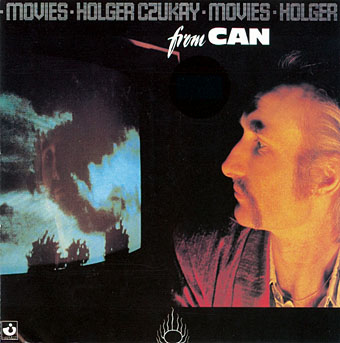
• From Rock en Stock (France, 1973): Can and Agitation Free in live performance.

• Twenty classic British folk-horror stories: a selection by Kai Roberts.

Immemory: a Flash version of Chris Marker’s CD-ROM.

Cronenberg Valentines

Static Gravity (1980) by Chrome | Zero Gravity (2001) by Monolake | Gravity (2013) by Roly Porter

Can esoterics

aumgn.jpg

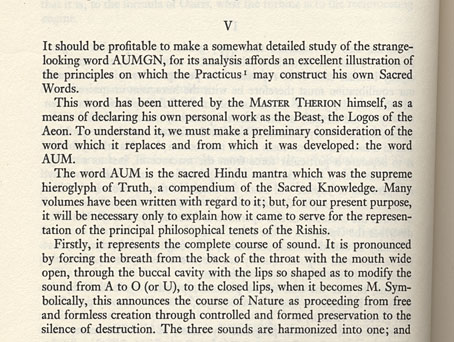
As usual, one thing leads to another. Most people who listen to Tago Mago (1971), the third album by Can, won’t be aware of the Aleister Crowley reference in the long improvisation that fills side three (track 5 on the CD). Aumgn was a spontaneous creation that includes one member of the band intoning an OM-like mantra while the other musicians clatter their way around the studio. The Crowley connection is in the unusual spelling of the title which is Crowley’s own amendment of the more familiar AUM. He explains the reasoning over several pages in Magick in Theory and Practice (1929), some of which involves the numerical values of the five letters. Not that this marks Can as Crowleyans but anyone unacquainted with Crowley’s augmented word would simply have used OM or AUM instead.

Update: I’ve been re-reading the book that came with the Can Box (1999), and came across this forgotten passage in Michael Karoli’s interview:

At the time I was very interested in magic spells, and Irmin knew of the spell “Aumgn” through me. But I had a completely different concept of what one could do with it, than to irreverently quote it in a piece of music. At the age of 21, I wouldn’t have dared to put this recklessly on an album. For me it was black magic. It was Aleister Crowley and all of that, and it gave me the creeps. I told Irmin to stop pronouncing magic spells in the room, but Irmin naturally overrode that with his arrogant grin.

futuredays.jpg

Design by Ingo Trauer & Richard J. Rudow.

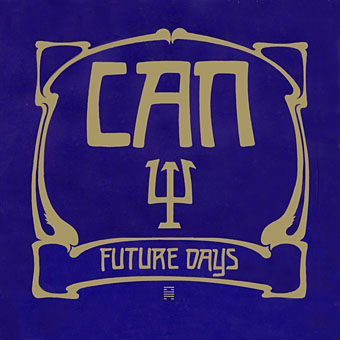
The fifth studio album, Future Days (1973) has another esoteric detail on the front and back of its elegant Art Nouveau sleeve: Hexagram 50 from the I Ching, translated in the Richard Wilhelm edition as Ting / The Cauldron. The same text has the judgement for Ting as “great good success”, and the album happens to be considered one of their best musically, although it was also the end of an era when vocalist Damo Suzuki left after its release. On a more mundane level, a cauldron is a container, as is a can.

There’s also the unexplained Greek letter in the centre of the sleeve: Psi is the 23rd letter of the Greek alphabet, and is commonly used as a symbol for psychology although it’s also used as a symbol in quantum mechanics. This last reference might be relevant given that the piece that ends their next album, Soon Over Babaluma (1974), is entitled Quantum Physics.

flowmotion.jpg

Design by Wagner Design Unit. Cover photos by Michael Karoli & Peter Hehner.

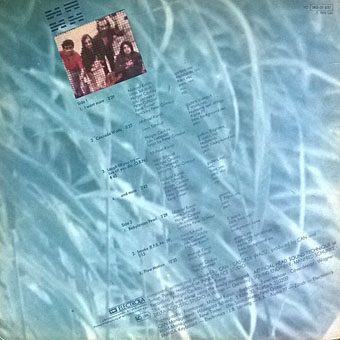
There are more I Ching hexagrams on the back of Flow Motion (1976), the group’s eighth album. Hexagram 29 is K’an / The Abysmal (Water) also known as “gorge” or “abyss”. Hexagram 59 is Huan / Dispersal (Dissolution). Taken together these could be interpreted as “flow motion” (and may well be the origin of the title—interviews with the group have seldom discussed these things) although they might also be seen as ominous signs for Can’s future. Flow Motion gave them a hit single in the UK (I Want More) but it’s also the last album that’s musically satisfying throughout. Can persevered for another two years (minus Holger Czukay) before disbanding in 1978. As to the esoterics, Rob Young is apparently writing a biography of the band so we may learn more about all of this when his book is published.

Previously on { feuilleton }
Can soundtracks
Can’s Lost Tapes

Can soundtracks

deepend.jpg

Trailer for Deep End (1970). Music: Mother Sky.

I’ve been listening to a lot of Can over the past week, and thinking—not for the first time—about their erratic soundtrack career. Their soundtrack music is very familiar from their second album, Soundtracks, and the recent Lost Tapes collection which unearthed a few pieces that were previously only available in films or TV episodes. Much less familiar is the films and TV episodes themselves so here’s a look at some of the available material. Deep End and Alice in the Cities are both acclaimed (and highly recommended) feature films available on DVD. Everything else in this collection has been less visible outside Germany.

Update: Added Das Millionenspiel.

millionenspiel.jpg

Das Millionenspiel (1970). Music: Millionenspiel.

A film for German television based on a science-fiction story (The Prize of Peril, 1958) by Robert Sheckley about a reality-TV manhunt game. IMDB has Irmin Schmidt listed as the uncredited composer but the theme was a Can production.

madchen.jpg

Trailer for Mädchen mit Gewalt (1970). Music: Soul Desert and Desert.

deadlock.jpg

Trailer for Deadlock (1970). Music: Deadlock and Tango Whiskeyman.

Another of the strange Westerns (or Western-like films) that flourished in the early 70s.

Continue reading “Can soundtracks”

Weekend links 288

gourmelin.jpg

Untitled drawing by Jean Gourmelin.

• Yet another book featuring my design work (interiors this time) has been published in the past week. Leena Krohn: Collected Fiction is an 850-page selection of novels, novel extracts and short works from a prolific Finnish author of the fantastic. Many of the selections are being published in English for the first time:

From cities of giant insects to a mysterious woman claiming to be the female Don Quixote, Leena Krohn’s fiction has fascinated and intrigued readers for over forty years. Within these covers you will discover a pelican that can talk and a city of gold. You will find yourself exploring a future of intelligence both artificial and biotech, along with a mysterious plant that induces strange visions. Krohn writes eloquently, passionately, about the nature of reality, the nature of Nature, and what it means to be human. One of Finland’s most iconic writers, translated into many languages, and winner of the prestigious Finlandia Prize, Krohn has had an incredibly distinguished career. Collected Fiction provides readers with a rich, thick omnibus of the best of her work—including novels, novellas, and short stories. Appreciations of Krohn’s work are also included.

• “Not only is the nature of Rollin’s choice of images close to [Clovis] Trouille’s, the director structures his movies in a similar fashion, crowding his movies with dreamy horror iconography. Rollin has specifically cited the influence of Trouille’s paintings on his work alongside that of other Surrealist painters working in a figurative style.” Tenebrous Kate explores the influences (and influence) of Jean Rollin’s erotic horror films.

• “[Morton] Subotnick might just have been the first person to get a club full of people—including the entire Kennedy family—dancing to purely electronic music when he played his Silver Apples Of The Moon at the opening night of New York’s legendary Electric Circus.” Robert Barry interviews the pioneering composer.

• “What I actually wanted to do was make music that contained all that was new in the 20th century,” says Irmin Schmidt in an interview with Bruce Tantum. Good to read that Rob Young is writing a biography of Can.

• “…gay mainstream culture was never really about expressing individuality, for me. It always seemed very conformist,” says Bruce LaBruce in conversation with Mike Miksche.

• At Dangerous Minds: Paul Gallagher on the making of Ken Russell’s The Devils, and Martin Schneider on the return of Paul Kirchner’s wordless comic strip, The Bus.

• Two years ago a group of Russian urban explorers climbed the Pyramid of Cheops at night. They’ve just returned from South America, and have a report here.

• In the wake of their new album, Kannon, Jason Roche asks “Are drone-metal icons Sunn O))) the loudest band on the planet?”

Junji Ito returns to horror with two new titles. Related: Fuck Yeah Junji Ito.

• Mix of the week: FACT mix 527 by Jóhann Jóhannsson.

Anna von Hausswolff‘s favourite albums.

Touch (Beginning) (1969) by Morton Subotnik | Rapido De Noir (1981) by Irmin Schmidt & Bruno Spoerri | The Gates of Ballard (2003) by Sunn O)))

Weekend links 285

graphic.jpg

Some of the art from my collage adaptation of The Picture of Dorian Gray appears on the cover of The Graphic Canon: Volume 2, published this month in a German edition by Verlag Galiani. Out next month (although possibly available now) is the same book in a Brazilian edition from Boitempo Editorial. One of the disappointments this year was having to abandon plans to contribute to Russ Kick’s forthcoming graphic canon of crime fiction. I was overstretched during the summer, and what with projects slipping their deadlines and the trip to Providence there wasn’t any time left for other things.

• For those who missed the first edition, a second and final expanded edition of the Penda’s Fen study/celebration The Edge Is Where The Centre Is.

• Whipping up a storm: how Robert Mapplethorpe shocked America; Kevin Moore on the photographer’s Perfect Moment exhibition.

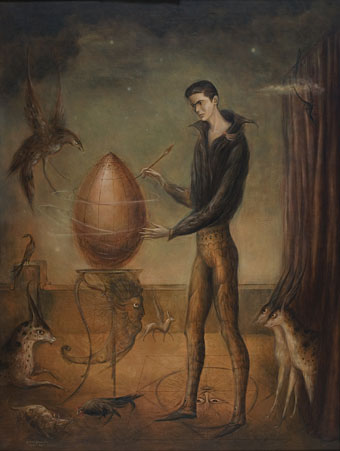
In the best scenario, metaphysical art distributes the work of understanding among cultural traditions and symbolic systems, and it is along these lines that Carrington’s work has been described as a productive combination of Mexican, Egyptian, Hebrew, Celtic, Greek, and Mesopotamian elements. Her paintings, plays, and stories mix the symbols of alchemy, astrology, Tarot, herbalism, magic, witchcraft, and a personal iconography.

Leif Schenstead-Harris on the life, art and fiction of Leonora Carrington

• Mixes of the week: Hieroglyphic Being collects favourite cosmic jazz of the 1970s; NTS Radio presents an hour of Annette Peacock.

• At Kill Your Darlings: Alexandra Heller-Nicholas enthuses about Dario Argento’s delirious masterwork, Suspiria.

Pye Corner Audio releases a new album (only limited vinyl at the moment—boooo!) and remixes Stealing Sheep.

• The Trip Planners: Emily Witt meets the founders behind Erowid, the online drug encyclopedia.

Woven Processional (1985), music on the Long String Instrument by Ellen Fullman.

• “The Paris attacks prove Charlie Hebdo’s critics wrong,” says Dorian Lynskey.

• Photographs by Danila Tkachenko of abandoned Soviet technology.

Come Wander With Me / Deliverance by Anna von Hausswolff.

• The collages of Guy Maddin.

CAN HALEN

Let’s Take A Trip (1965) by Godfrey | Trip On An Orange Bicycle (1968) by The Orange Bicycle | Last Trip (1968) by We Who Are