Whirlpools

whirlpool.jpg

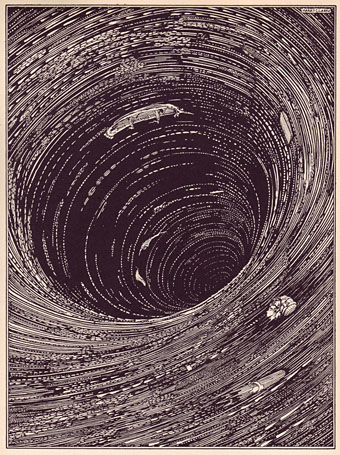
This was a surprise. My first thought on seeing the cover for Ethel Archer’s “book of verse”, The Whirlpool, was that its swirling waters were borrowed from Harry Clarke’s typically astonishing illustration for A Descent into the Maelström by Edgar Allan Poe. The problem there is that the Ethel Archer book was published in 1911 while Clarke’s first collection of Poe illustrations didn’t appear until 1919. The cover for the Archer book was by Ethel’s husband, Eugene Wieland, the publisher of Aleister Crowley’s Equinox periodical/occult treatise, and also the publisher of this volume. Crowley provided an introduction to the book. Given these occult associations it’s possible that Harry Clarke might have seen a copy of this. Clarke’s work appeared in Austin Spare’s own occult periodical, The Golden Hind, and he wasn’t averse to producing occult art of his own. This isn’t to say that Clarke necessarily took anything from the Archer book—sometimes a whirlpool is just a whirlpool—but it’s not outside the bounds of possibility.

There’s a copy of Ethel Archer’s book currently on sale at eBay, together with some original drawings by Eugene Wieland. The cover above came via John Eggeling’s Flickr page of rare book covers. The Poe illustration is via 50 Watts.

maelstrom.jpg

Previously on { feuilleton }
The Sapphire Museum of Magic and Occultism

Alembic and Ligier Richier

alembic.jpg

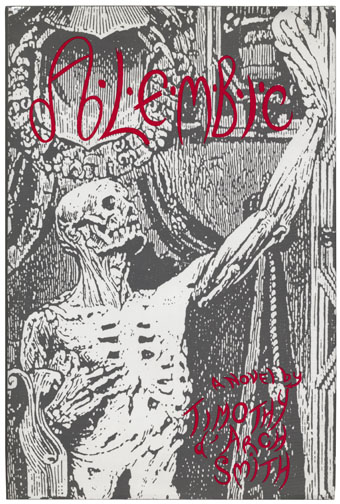
Current reading is Alembic (1992), a curious novel by Timothy d’Arch Smith whose publishings prior to this were all non-fiction, among them a study of the Uranian poets, a bibliography of Montague Summers, and The Books of the Beast, one of the many books about Aleister Crowley. Alembic reflects some of these interests and blends them with others, notably alchemy and rock music, delivering the result in a digressive, comma-strewn prose style which I imagine many readers would find off-putting. From the jacket description:

Alembic is an unsettling novel about madness and alchemy, epistemology and rock and roll, magic and perversion. Thomas Graves, a young antiquarian, works for ALEMBIC, a British government office investigating the contemporary applications of the secrets of alchemy. The strange world of alchemy, however, is as eerie as the rock and roll world of Thomas’s friend Nicholas Spark, leader of a Led Zeppelin-like band called Celestial Praylin. Moving between these worlds, colourfully conveyed in d’Arch Smith’s sonorous prose – at times elegant, at times comic – Thomas Graves feels his grip on reality constantly imperilled; his attraction to the fourteen-year-old daughter of one of his colleagues complicates his existence further. A dramatic turn of events brings all of his fears and fancies out in the open, suggesting finally that the world is as mad as Thomas thought himself to be. Alembic is itself an alembic, a vessel that allows things to disintegrate and be transformed into new, refined substances. Set largely in the early 1980s, Alembic ends in the early years of the twenty-first century as alchemy engineers a new world order of darkness and perfection, destruction and eternal life, concluding a novel of great originality and ill-boding.

I don’t mind the style, it’s preferrable to the rudimentary bestsellerese that passes for much genre writing today. D’Arch Smith’s writing is witty, and there’s enough going on to sustain the interest. I thought at first the uncredited cover design would have had little to do with the contents but Ligier Richier’s celebrated sculpture of René de Chalon is referred to early on:

Nicholas had done himself to death. That was unequivocally stated in the garish red and black drawing depicted above the lyrics. In a grotesque parody of Ligier Richier’s funerary monument at Bar-le-Duc of the skeletal knight holding out his heart to God—possibly viewed by Ma during her historical tour of Alsace-Lorraine—Nicholas had been delineated in the same mortified yet exultant posture. The original figure was macabre enough, in the flaying of the naked body and the exposure of leg and arm muscles not yet rotted from the bones, to command attention, but the figure was imbued by Richier’s art with an enduring majesty that, though his design had been closely followed, was utterly overturned by the specious caricature of Nicholas Spark emblazoned down the waitress’s white cotton vest.

Given this, it’s a safe bet that the author would have asked for the capital “A” in the title to be given the same phallic connotations as it has in Aleister Crowley’s signature.

richier1.jpg

The web has plenty of photos of Le Transi de René de Chalon (c. 1545) but this view of Richier’s sculpture shows it to better effect than those where the background reduces the impact of the figure. The photos are from Ligier Richier, l’Artiste et Son Uvre (1911) by Paul Denis. As for Alembic, that’s currently out-of-print but copies are easy enough to find online.

richier2.jpg

Elsewhere on { feuilleton }
The book covers archive

Previously on { feuilleton }
Atalanta Fugiens
Splendor Solis revisited
Laurie Lipton’s Splendor Solis
The Arms of the Art
Splendor Solis
Amphitheatrum Sapientiae Aeternae
Cabala, Speculum Artis Et Naturae In Alchymia
Digital alchemy

Weekend links 139

barnes.jpg

Lucy in the Sky with Diamonds (2012) by Lesley Barnes. She also has peacock wrapping paper.

Big thanks to Dennis Cooper for including this blog in his favourite music, fiction, poetry, film, art & internet lists for 2012. Lots of good company there. One benefit of end-of-year lists is the way they suggest things to look for in January.

• “…the best pictures of dicks that I’ve ever seen…” Rudy Rucker reviews Malcolm McNeill’s The Lost Art of Ah Pook Is Here and Observed While Falling, out at last from Fantagraphics. Rucker notes that William Burroughs’ text is still only available in out-of-print editions in which case you’ll need a book dealer. Elsewhere, Burroughs: The Movie has cleared 50% of its restoration Kickstarter goal but still needs supporters.

• Julia Holter has been a recurrent presence in these posts since the release in March of her acclaimed second album, Ekstasis. FACT has an alternate version of the album’s opening song, Marienbad, one of the extra tracks on the recent UK reissue.

Suttree’s saga carried me down, down, down to the bottom of a heightened surrogate reality, a nadir where the rarest jewels of clarity are found. The fourth time through the novel I arrived at a state of barometric equipoise, a balancing between my mental state and Suttree’s. Then, as he descended again, I began to rise. There was a hypnotic poetry to his fall — his life disintegrated, then the fragments disintegrated, then those fragments followed suit ad infinitum.

Jim White on the life-preserving qualities of Suttree by Cormac McCarthy.

• “An 18-year-old boy who discovers he has a fetish for the aged gets a job in a nursing home and develops an intimate relationship with one particular old man.” Gerontophilia, a proposed film by Bruce LaBruce, is looking for funding.

• Can’t wait for this: Groenland Records announces Who’s That Man?, a four-CD set of music produced and performed by Conny Plank. FACT has a track list.

• At BUTT magazine: Pink Courtesy Phone Mix by Richard Chartier, a great selection of electronica old and new.

• Another end-of-year list: Volumes 1 & 2 of The Graphic Canon are in NPR’s Indie Bookseller best of 2012 selection.

The Nightmare Paintings: art by Aleister Crowley currently touring Australia.

• Christmas with Monte: Colin Fleming on the ghost stories of MR James.

• “The war on drugs is a war on human nature” says Lewis Lapham.

Alan Moore: why I turned my back on Hollywood.

• More electronica: Chris Carter discusses synths.

Saul Bass poster sketches for The Shining.

• At Pinterest: The Pan Within.

Ah Pook Is The Mayan God Of Death (1975) by William Burroughs | Panic (1985) by Coil | Light Shining Darkly (1992) by Coil.

Weekend links 138

durette.jpg

Heartsick (2011) by Kelly Durette.

• Now that Scott Walker’s Bish Bosch album is out and causing the usual consternation, the spotlight-shy singer/composer has been doing a surprising amount of promotional interviews. Simon Hattenstone talked to him for the Guardian at the end of last month; this week it was John Doran’s turn at The Quietus. One quote from the latter piece stood out in the light of this week’s posts: “…the music we’re making is meant to be an aural version of the HR Giger drawings for Alien. It always sounds to me like those look.”

Satanica is a limited-edition publication curated by Gio Black Peter & Christopher Stoddard “for anyone who rejects societal norms, for those dedicated to a life of pleasure, excess and self-reflection”.

• Sci-Fi-O-Rama has put five years’ worth of blog pictures onto Pinterest. I don’t really need to do that, there’s already a diverse crowd of Pinterest users compiling their own selection of things posted here.

As Susan Sontag once observed, pornography is practical. It was designed as a marital aid, and its vocabulary should follow natural biological rhythms and stick with hot-button words in order to produce a predictable climax. It is not about sex but is sex. Whereas the great sex writers (Harold Brodkey, DH Lawrence, Robert Gluck, David Plante, the Australian Frank Moorhouse) have a quirky, phenomenological, realistic approach to sex. They are doing what the Russian formalists said was the secret of all good fiction – making the familiar strange, writing from the Martian’s point of view.

Edmund White on writing about sex in fiction

• When pirate DVDs of films by Cocteau, Bresson and Pasolini are on sale in a Mexican market, life in the 21st century increasingly resembles a William Gibson novel. Joanne McNeil investigates.

• Copies of City Fun, Manchester’s premier music fanzine/alt culture mag (founded 1978), can now be read online at the Manchester District Music Archive.

• Linked everywhere during the past few days, the astonishing map of bomb hits on London during the Blitz (October 1940 to June 1941).

• At 50 Watts: 30 Vintage Magazine Covers from Japan and Alfred Kubin’s illustrations for Lesabéndio: An Asteroid Novel (1913) by Paul Scheerbart.

• Earlier this year for Frieze Magazine Geeta Dayal talked to musical collaborators of the great German producer Conny Plank.

Invisible Ink by Christopher Fowler, “the extraordinary stories of over one hundred forgotten authors”.

Cynthia Carr talks about Fire in the Belly, her biography of American artist David Wojnarowicz.

• “Blasphemy, Filth, And Nonsense” More Aleister Crowley ephemera at Front Free Endpaper.

• At Strange Flowers: Surrealist art by Jindrich Heisler (1914–1953).

Vladimir Nabokov wrote to Alfred Hitchcock in 1964.

• Scott Walker’s four tracks from the Nite Flights album (1978): Shutout | Fat Mama Kick | Nite Flights | The Electrician.


Weekend links 137

jacobsen.jpg

Self-portrait by Jon Jacobsen from his Home series.

Steven Arnold: Cabinet of Curiosities is “a retrospective exhibition of this groundbreaking yet under-recognized queer artist at the ONE Archives Gallery & Museum in West Hollywood. The exhibition celebrates Arnold’s radical imagination, presenting many of his tableaux vivant photographs alongside never before exhibited drawings, sketchbooks, paintings and original poster art. In conjunction with the exhibition, ONE will screen Arnold’s four films, including Luminous Procuress (1970), which featured The Cockettes and was lauded by Salvador Dalí.” The exhibition runs to  January 12, 2013.

• “The boundary-pushing techno/sound design duo Emptyset will transform London’s cavernous industrial space Ambika P3 into an immersive sound installation for one night only—and here’s how they’re going to do it”.

• “At one time he was a well-known figure in Montparnasse, where he had a reputation as a master of the occult sciences.” Aleister Crowley is interviewed about his expulsion from France in 1929.

Our normal waking consciousness, rational consciousness as we call it, is but one special type of consciousness, whilst all about it, parted from it by the filmiest of screens, there lie potential forms of consciousness entirely different. We may go through life without suspecting their existence; but apply the requisite stimulus, and at a touch they are there in all their completeness… No account of the universe in its totality can be final which leaves these other forms of consciousness quite disregarded… [T]hey forbid our premature closing of accounts with reality.

William James (1842–1910) quoted in What Should We Do With Our Visions of Heaven—and Hell? by John Horgan at Scientific American.

Screws is an album of piano music by Nils Frahm that’s currently available as a free download (inc. aiffs).

• At Pinterest: Art Visonnaire. Related: Ain’t We Got Fun: The magical surrealism of Jen Ray.

Rowan Somerville “challenges the purpose and legitimacy” of the Bad Sex Awards.

Jimmy’s End: the website for the film by Alan Moore & Mitch Jenkins.

Douglas Rushkoff in conversation with Genesis Breyer P-Orridge.

• Linda Rodriguez McRobbie explores The History of Boredom.

• Recreating the sounds of the BBC Radiophonic Workshop.

Alchemical Emblems, Occult Diagrams, and Memory Arts.

Rocaille: A Blog about Decadence, Kitsch and Godliness.

• A new video for Goddess Eyes II by Julia Holter.

• The complete audio recordings of Jean Cocteau.

The Rumpus interview with Russ Kick.

Forgotten Bookmarks

• RIP Spain Rodriguez

Astradyne (1980) by Ultravox (produced by Conny Plank) | Biomutanten (1981) by Les Vampyrettes (Conny Plank & Holger Czukay) | Never Gonna Cry Again (1981) by Eurythmics (feat. Holger Czukay, produced by Conny Plank).