Weekend links 102

flannery.jpg

Flannery O’Connor with one of her many peacocks.

When the peacock has presented his back, the spectator will usually begin to walk around him to get a front view; but the peacock will continue to turn so that no front view is possible. The thing to do then is to stand still and wait until it pleases him to turn. When it suits him, the peacock will face you. Then you will see in a green-bronze arch around him a galaxy of gazing haloed suns. This is the moment when most people are silent.

Flannery O’Connor

Essay of the week was without a doubt Living with a Peacock by the great Flannery O’Connor, originally published in Holiday magazine in September 1961. I’d heard about Flannery’s peacocks before but had no idea she was such a pavonomane. Thanks to Jay for the tip!

• “‘He’s chameleon, comedian, Corinthian and caricature.’ But he was more like the very hungry caterpillar, munching his way through every musical influence he came across…” Thomas Jones reviews two new books about David Bowie for the LRB.

• In June Mute Records release The Lost Tapes by Can, a 3-CD collection. Here’s hoping this doesn’t merely repeat the outtakes that’ve been circulating for years as the Canobits bootlegs. This extract is certainly new.

• Animator Suzan Pitt, director of the remarkable Asparagus (1979), discusses her new film, Visitation, inspired, she says, by reading HP Lovecraft in a cabin while wolves howled outside.

Night Thoughts: The Surreal Life of the Poet David Gascoyne, a biography by Robert Fraser reviewed by Iain Sinclair.

oelze.jpg

The Dangerous Desire (1936) by Richard Oelze (1900–1980) at But Does It Float.

• Making the Mari: the stuff of nightmares brought into the world by Jefferson Brassfield.

• The Background to the Moorcock Multiverse: Karin L. Kross reviews London Peculiar.

Orson Welles’s lost Heart of Darkness screenplay performed for the first time.

The Erotic Films of Peter de Rome: the new BFI DVD collection reviewed.

• Page designs by Alphonse Mucha for Ilsée, Princess de Tripoli (1897).

• A Slow-Books Manifesto by Maura Kelly.

Tim Parks asks “Do we need stories?”.

Musical table by Kyouei Design.

Horror Asparagus Stories (1966) by The Driving Stupid | Peacock Lady (1971) by Shelagh McDonald | Peacock Tail (2005) by Boards of Canada.

A Moment of Inspiration, 1983

marc.jpg

Marc Almond (1983) by John Coulthart.

This, girls and boys, is how we occupied ourselves in the long nights before the advent of 24-hour television: we sat up drawing portraits of Marc Almond. A conversation on Twitter reminded me of this, a drawing that’s never before appeared in public but which is now added to the web collection. For a quick piece of art it’s actually a lot more successful than many of the more laboured things of mine that were printed far and wide at this time. The portrait was copied from a magazine photo, I forget which one, possibly Flexipop if it was still going, an increasingly wayward title that had a soft spot (so to speak) for Soft Cell. The Spanish hat identifies it as being from the Torment and Toreros period while the lettering was taken from Val Denham and Huw Feather’s cover design for the first Marc and The Mambas album, Untitled (1982). The padded-cell background refers, of course, to Marc’s former group, and was copied from the back of the Bedsitter 12″. Most of the drawing is done in black Biro pen with the hat and shirt in gouache. On the back I happened to make a note of the date, something I seldom bother with.

moment.jpg

The Twitter conversation was prompted by the appearance of Soft Cell’s notorious Sex Dwarf video at Dangerous Minds; Flexipop enjoyed the scurrilous side of Soft Cell so much they printed a still from this Bacchanal as a centre-spread in one of their issues. Meanwhile Marc himself was writing in the Guardian this week about Bowie manqué Jobriath, one of the real-life inspirations for the Brian Slade character in Todd Haynes’ Velvet Goldmine, and the subject of a feature-length documentary, Jobriath A.D., by Kieran Turner, currently showing at the BFI’s London Lesbian & Gay Film Festival.

Previously on { feuilleton }
Derek Jarman’s music videos

The art of Yoshi Sodeoka

sodeoka1.jpg

Violet Dark Spring of the Numinous Orb (2011).

Those for whom Enter the Void wasn’t enough (I know you’re out there) are advised to direct their attention to the prints and videos of Japanese artist Yoshi Sodeoka. The website has numerous screen grabs and examples of the prints while the artist’s Vimeo channel has the videos. Via Dressing the Air.

sodeoka2.jpg

Psychedelic Death Vomit (2008).

sodeoka3.jpg

The Palace Of Light (Revisited) (2011).

Previously on { feuilleton }
Enter the Void
Chris Parks
Matrix III by John Whitney
John Whitney’s Catalog
Arabesque by John Whitney
Jordan Belson on DVD
Ten films by Oskar Fischinger
Lapis by James Whitney
Expanded Cinema by Gene Youngblood

Weekend links 101

cabat.jpg

Kraken from Ernie Cabat’s Magical World Of Monsters (1992) at Monster Brains.

“I think for a lot of people who don’t read pulp growing up, there’s a real surprise that the particular kind of Pulp Modernism of a certain kind of lush purple prose isn’t necessarily a failure or a mistake, but is part of the fabric of the story and what makes it weird. There’s a big default notion that ‘spare,’ or ‘precise’ prose is somehow better. I keep insisting to them that while such prose is completely legitimate, it’s in no way intrinsically more accurate, more relevant, or better than lush prose.” China Miéville at Weird Fiction Review expressing an opinion that few in the literary world ever articulate, never mind agree with. Far more common is (to pick a recent example) Ursula K Le Guin dismissing Cormac McCarthy for “pretentious prose”.

• “Militant feminist scientists brainwash a research subject to assassinate the Welsh Minister of Prostitution. Meanwhile World War III is being fought and the USA has been invaded.” The IMDB précis for Taking Tiger Mountain (1983), a feature film directed by Tom Huckabee from a script by William Burroughs, and featuring a 19-year-old pre-Aliens/Near Dark Bill Paxton. The director discusses the film’s production at Screen Slate and attends a rare screening at Spectacle, Brooklyn, NYC, today (March 25th). YouTube has a three-minute clip. Surprising this has remained buried for so long. When can the rest of us get to see it?

• Prestel have published the catalogue for In Wonderland: The Surrealist Adventures of Women Artists in Mexico and the United States. AnOther previewed some of the contents. The exhibition runs at the LACMA, Los Angeles, until 6th May.

…gays only make up about 3% of the population so we spend our whole lives “translating” straight movies, books, ballets into gay terms and studying the heterosexuals around us—we know much more about them than they know about us, just as blacks know a lot about whites but whites know virtually nothing about blacks.

Edmund White (again) interviewed by Frank Pizzoli at Lambda Literary Review.

• New on Caroline True Records: Jon Savage’s “Fame”, Secret History of Post-Punk 1978–81. “Some of it doesn’t sound like anything that has happened since,” says Savage. Indeed. FACT has the track list which I was pleased to see includes Chrome among the usual suspects. Hear a 12-minute promo mix at Soundcloud.

guerin.jpg

The Colossi of Memnon by Jules Guerin. From Egypt and its Monuments (1908) by Robert Hichens at Golden Age Comic Book Stories.

Gay Life Stories, “a colourful compendium of same-sex love through the ages” by Robert Aldrich. Reviewed here. Related: Alice Dreger asks “Are straight people born that way?”

• Clive Hicks-Jenkins created a series of designs for a Washington DC performance of Stravinsky’s The Soldier’s Tale. Follow their evolution in reverse order at his blog.

• Hocus Pocus: Margaret Eby on the brief epistolary relationship between Harry Houdini and Arthur Conan Doyle.

Rick Poynor on more cover designs for JG Ballard’s Crash.

London, city of dreams and rivers, caught on Polaroid.

• Photo prints by Thom Ayres for sale at Society6.

B*tches in Bookshops

• Meet You In The Subway (1979) by Chrome | New Age (Version III) (1980) by Chrome | Danger Zone (1981) by Chrome | Firebomb (1982) by Chrome.

The Torchbearer by Václav Švankmajer

svetlonos.jpg

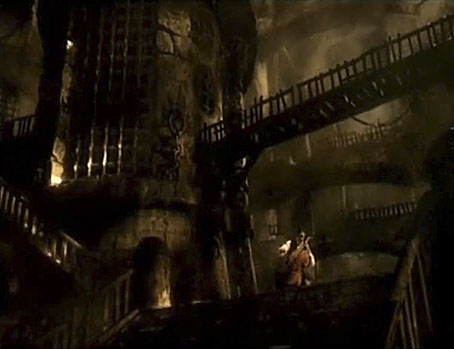
Švankmajer? Yes, Václav is the son of Czech Surrealists Jan Švankmajer and Eva Švankmajerová, and The Torchbearer (2005) is the third of three short films he’s directed. Like the celebrated films of his father this is an animated piece in which a faceless warrior navigates a ruined labyrinth where lethal traps are prepared by a group of living female statues. The style reminded me more of some of the Brothers Quay shorts than the snapping, jerking works of Švankmajer Sr.: the gliding statues are reminiscent of the tailors’ dummies in Street of Crocodiles (1986) while the mechanical traps call to mind Gilgamesh’s murderous table in This Unnameable Little Broom (1985). (And, yes…also the death machine in The Pendulum, the Pit and Hope.)

Václav Švankmajer’s website has a page devoted to the production of the film. Also on his site are several galleries of the paintings and drawings that are the focus of his attention today. Via Form is Void.

The Torchbearer on YouTube: Part 1 | Part 2

Previously on { feuilleton }
Jan Švankmajer: The Complete Short Films