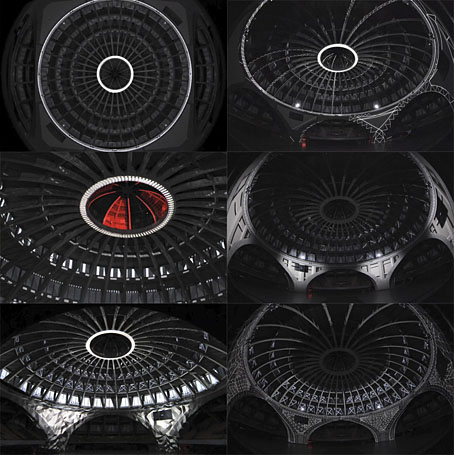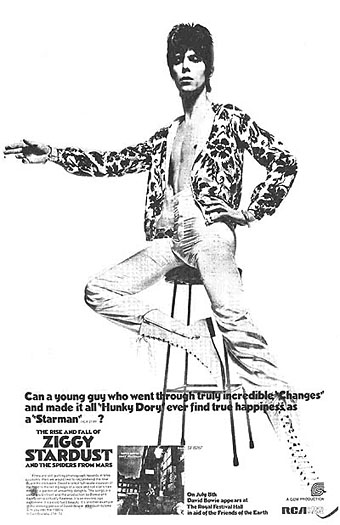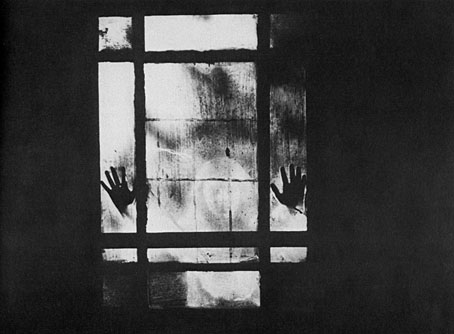
Animation of a more contemporary kind (do you detect a theme?), Metachaos is a frenetic 8-minute apocalypse by Alessandro Bavari whose Photoshop collages I recall being impressed by some years ago. His video uses computer rendering but with a lot more grit than the usual CGI. The soundtrack is the kind of quasi-Industrial thing you’d expect for the imagery but you can always mute the sound and play something else. Thanks to Paul at Dressing the Air for the tip!
Category: {film}
Film
Weekend links 103
Robert Fripp photographed by Chris Stein. Video posterization by Michael Schiess.
Scans of Synapse, “The electronic music magazine”, are posted here. Issues range from 1976 to 1979, and include interviews with the more notable synthesists of the period, Kraftwerk included. Brian Eno was regularly interviewed by synth mags despite always being reluctant to talk about what equipment he might be using; sure enough he’s featured here. Far more interesting is a longer interview with Robert Fripp that catches the guitarist as he emerged from his self-imposed retirement in the mid-70s with the extraordinary Exposure album. (See a 1979 promo video for that here.) Related: TR-808 drum sequences in poster form by Rob Ricketts.
• More electronic music from the 1970s: “[Don Buchla] showed me that the idea of playing a black-and-white keyboard with one of these instruments was completely ridiculous. It was inappropriate and had nothing to do with the way you would use an electronic instrument.” Suzanne Ciani talks to John Doran about electronic music composition. A collection of her early recordings, Lixiviation, is released by Finders Keepers. Related: The Attack of the Radiophonic Women: How synthesizers cracked music’s glass ceiling.
• “Her writing—full of immigrants, circus animals, freaks, socialists, hipsters, servants, and suffragettes—revels in the atmosphere of the ‘Yellow Nineties,’ a period characterized by Wildean decadence and art for art’s sake.” Jenny Hendrix on Djuna Barnes.
More etchings by Albin Brunovsky at But Does It Float.
• More scanned magazines: the Fuck You Press archive at Reality Studio. A trove of rare publications produced by Ed Sanders in the 1960s with contributions from world-class writers, William Burroughs included.
• “[My parents] were horrified by what I did, but they encouraged me to keep doing it because I was obsessed, and what else could I do?” John Waters writing in (of all places) the Wall Street Journal.
• A time-lapse assembly of Alfred Hitchcock’s Rear Window (1954) by Jeff Desom who explains how he did it here.
• The Occult Experience: a 95-minute documentary on the international occult scene, filmed in 1984–85.
• Compost and Height re-post A Gold Thunder, a song by Julia Holter first sent to them in 2010.
• Drawings by Bette Burgoyne.
• Fade Away And Radiate (1978) by Blondie (featuring Robert Fripp) | Exposure (1978) by Peter Gabriel (produced by and featuring Robert Fripp) | Exposure (1979) by Robert Fripp | Babs And Babs (1980) by Daryl Hall (produced by and featuring Robert Fripp) | Losing True (1982) by The Roches (produced by and featuring Robert Fripp).
Gerald Scarfe’s Long Drawn-Out Trip
Yet more animation. Long Drawn-Out Trip was Gerald Scarfe‘s first foray into the medium, produced in 1972 at the request of the BBC who sent the artist to Los Angeles to try out the new De Joux animation system. The process needed only six or eight drawings per second of film thus reducing the usual amount of labour. Scarfe says in the first book collection of his work, Gerald Scarfe (1982), that the 16-minute film was still very labour intensive.
The subject of Long Drawn-Out Trip is Los Angeles and America itself, the concerns being the same ones that Ralph Steadman was depicting the same year in his illustrations for Hunter S. Thompson’s Fear and Loathing on the Campaign Trail ’72: venality, violence, vulgarity and the omnipresent spectre of Richard Nixon, a president who had the good fortune to be drawn many times by two of Britain’s greatest living satirists although he wouldn’t have thanked them for it. In Scarfe’s film we also find Mickey Mouse being reduced to his constituent lines and colours after smoking a joint. In the 1980s Scarfe regularly drew Ronald Reagan wearing the famous mouse ears, something that nearly got him fired from his post at the Sunday Times after Rupert Murdoch saw one of the cartoons. Long Drawn-Out Trip had a more favourable effect when it was seen by Roger Waters who asked Scarfe to create some animations for Pink Floyd’s Wish You Were Here tour. The animated sequences for The Wall have their origin in this short film. Watch it here.
Brothers Quay scarcities
Igor: The Paris Years (1982).
More animation, and scarce in the sense that some of these films were omitted from the core Quay Brothers canon released in the UK by the BFI as Quay Brothers: The Short Films 1979-2003. Quay obsessives such as myself would have been happy to pay for an extra disc featuring more of their oeuvre but we can at least turn to YouTube to fill in some gaps. This is by no means everything so I may add more discoveries at a later date. Some of the DVD-issued films can be seen on the BFI’s official Daily Motion channel.
I was eager to see the Stravinsky film again having watched it one time only in a Channel 4 screening some 25 years ago. After a fresh viewing it’s not as impressive as I remembered, in part because the Quay’s distinctive approach to animation—and filmmaking generally—developed a great deal following the unforgettable Street of Crocodiles (1986). Igor: The Paris Years concerns the composer’s relationship with Jean Cocteau and Vladimir Mayakovsky, all of whom are animated as cut-out figures in a Modernist cityscape with The Rite of Spring playing on a piano.
Leos Janácek: Intimate Excursions (1983). Part 2 is here.
In a similar vein, but more successful, is this portrait of Czech composer Leos Janácek. This uses the same cut-out character style but places the composer in Eastern European settings similar (down to the floating tram pantographs) to those seen in the very first Quay film, Nocturna Artificialia (1979). Among the other puppet characters there’s one figure singing an aria who later appears as Enkidu in This Unnameable Little Broom (1985).
Old Piano (1988).
A very short (and poor quality) ident for MTV.
Achilles by Barry JC Purves
I wondered how to focus on the relationship between Achilles and Patroclus without the others getting in the way. This intense physical relationship developed into the focus of the film, rather than any more Harryhausenesque aspects of the Greek myths. Intimacy had not really been treated seriously with puppets…
Barry JC Purves
Several people seemed to appreciate the link a week or so ago to The Torchbearer by Václav Svankmajer so here’s another animated short about helmeted warriors, albeit with a very different tone. Barry JC Purves is a British animator and theatre director who produced Achilles, an 11-minute puppet animation, in 1995, back when the UK’s Channel 4 was still regularly financing animated films. Derek Jacobi narrates an exploration in the style of Ancient Greek theatre of the relationship between Achilles and his alleged lover, Patroclus. (Whether or not the pair were lovers is still a subject of dispute.) It’s rare to find any overt sexuality in the world of puppet animation unless the directors are the Brothers Quay; it’s even more rare for that sexuality to have a homoerotic aspect which is what Purves depicts. A groundbreaking piece of work, then, which can be viewed in full here. The director’s website has more about the creation of the film, and a collection of stills from the production.
Previously on { feuilleton }
• The Torchbearer by Václav Švankmajer