Secret Societies and Spirit Boards

marti.jpg

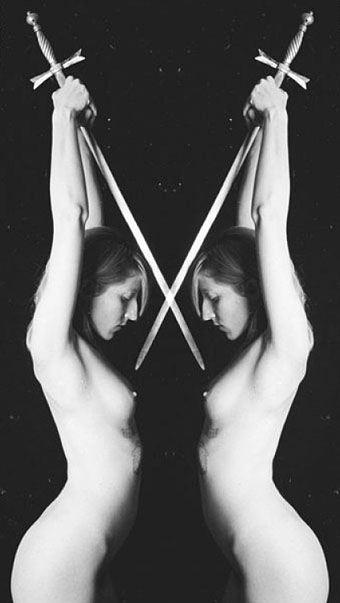
Komposition für einen Rhombus (2007) by Fabian Marti.

Fabian Marti’s print is one of the few works that stood out for me in the press materials for the Secret Societies exhibition which has just opened at the CAPC Museum of Contemporary Art, Bordeaux:

[Secret Societies] deals with the general theme of secret societies through the prism of contemporary art in the current context of media super-exposure – from WikiLeaks to Credit Rating Agencies (CRA), just to quote two current examples. Artists have always been fascinated by the unknown and the occult. But unlike journalists who are mainly focused on investigating present-day news, artists work around the mechanisms of the secret and are better equipped to question the very limits of the ideology of transparency in our era of super-exposure.

Unfortunately many of the works look like the customary state of affairs, with a bunch of contemporary artists doing their usual schtick and not really questioning (familiar gallery buzzword) anything much at all. On the plus side they have a screening of Kenneth Anger’s Invocation of My Demon Brother, and also a contribution from Cerith Wyn Evans whose Acephalé reworks in neon the André Masson design for Georges Bataille’s Surrealist secret society. Gary Lachman has created an audio guide for the exhibition which is curated by Cristina Ricupero and Alexis Vaillant, and which runs until February 26th, 2012.

For a more determinedly occult showing this month, there’s Spirit Board curated by JL Schnabel at the Articulated Gallery, San Francisco. And elsewhere I’d recommend the work of Scott Treleaven and Jesse Bransford.

Previously on { feuilleton }
The art of Scott Treleaven

Dalí’s discography

dalidisc1.jpg

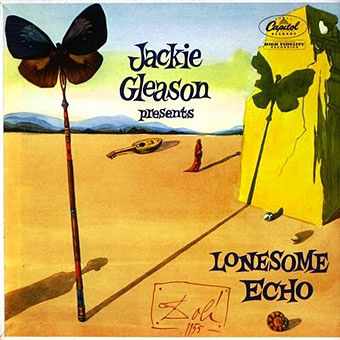
Lonesome Echo (1955) by Jackie Gleason.

Not a definitive list, I was merely browsing Discogs.com out of curiosity. For an artist eager to infiltrate every medium you’d expect there to be more involvement from Dalí with the music world. The Jackie Gleason is included here as the earliest entry for which the artist apparently provided a cover painting and a sleeve note. There’s a nice shot of the back cover on this page with its photo of Salvador and Jackie shaking hands.

dalidisc3.jpg

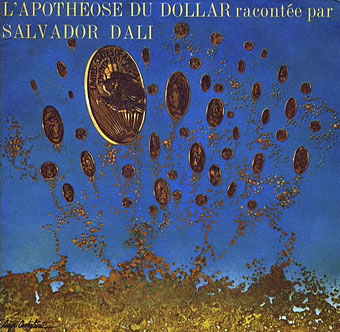
L’Apothéose Du Dollar Racontée Par Salvador Dalí (1971).

Next up is a panegyric to one of the artist’s obsessions—money—recorded on a flexidisc for Crédit Commercial de France. Difficult to imagine any bank today promoting themselves with someone dropping phrases like “divine diahrrée“. A scarce item which can however be found on Ubuweb.

dalidisc2.jpg

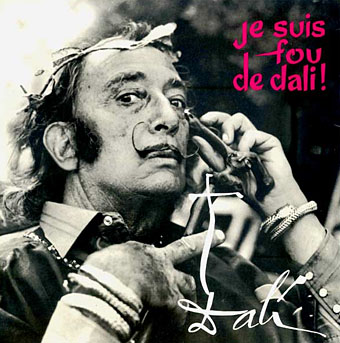
Je Suis Fou De Dalí (1975).

Here the artist extemporises (in French) to a trio of dutiful journalists. Ubuweb again has the entire album, together with a handful of other recordings. This page has some details of the discussion.

dalidisc5.jpg

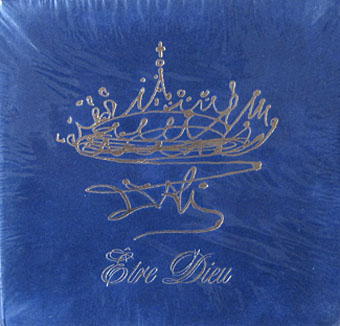
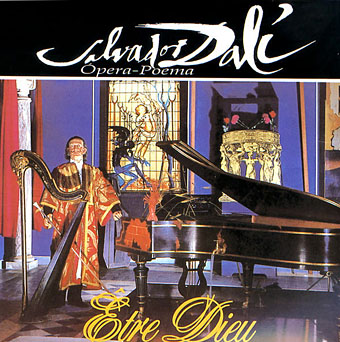
Etre Dieu has been mentioned here before owing to its connection with that cult composer of mine Igor Wakhévitch. Described as an “Opera-Poem: Audiovisual and Catarrah in six parts” it propels Dalí’s megalomania to cosmic proportions with the artist portraying a godlike version of himself. In attendance are an angel and two further Dalís, the male and female halves of an androgynous avatar with the female component being voiced by the great French actress Delphine Seyrig. The libretto is credited to Manuel Vázquez Montalban. The performance was recorded in 1974 but not released on disc until 1989. Not the best of Wakhévitch’s works at all, you’re better off with Logos or Docteur Faust.

dalidisc4.jpg

Elsewhere on { feuilleton }
The album covers archive

Previously on { feuilleton }
Soft Self-Portrait of Salvador Dalí
Mongolian impressions
Hello Dali!
Dalí and the City
Dalí’s Elephant
Dalí in Wonderland
Alejandro Jodorowsky’s Dune
Dirty Dalí
Impressions de la Haute Mongolie revisited
Dalí and Film
Salvador Dalí’s apocalyptic happening
Dalí Atomicus
Impressions de la Haute Mongolie

The art of Jindřich Štyrský, 1899–1942

styrsky1.jpg

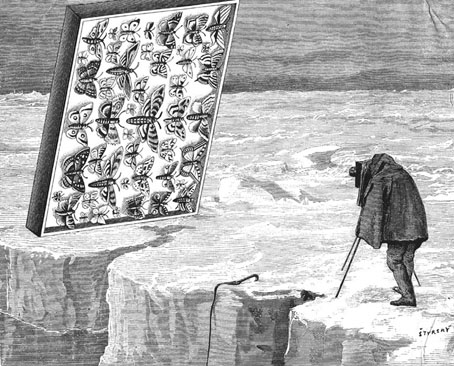
From a late Surrealist to an early one. Jindřich Štyrský is a Czech artist best remembered today for his collages but he was also a painter, a photographer and a publisher of erotic material. He illustrated and published a Czech edition of Lautréamont’s Maldoror, and helped found the Surrealismus review in Prague.

styrsky2.jpg

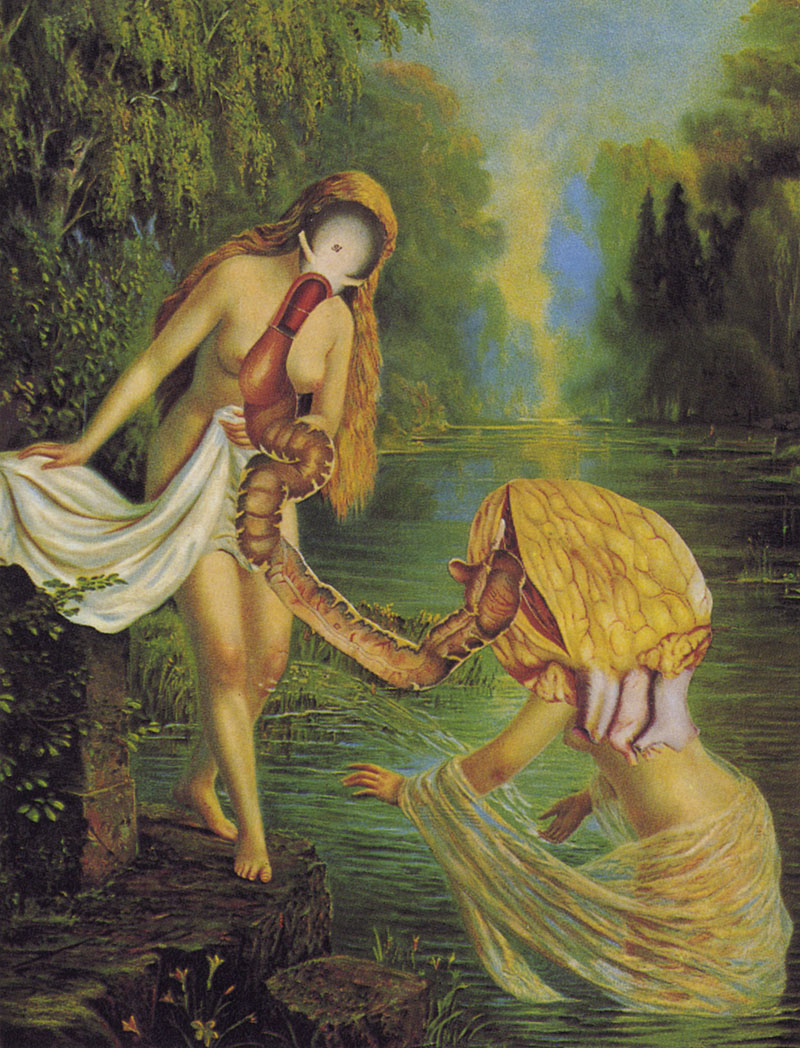
The Bathe (1934).

Regular readers won’t be surprised to hear that I’ve liked Štyrský’s collages for years, many of which subject sentimental Victorian illustration to processes of violent transmutation. Ever since seeing The Bathe I’ve found it impossible to look at one of Renoir’s fleshy nudes without wondering what happened to the exposed viscera. Weimar covered Štyrský’s career in some detail last year so that’s a good place to go for further information. There’s an extract from Štyrský’s dream diary here, and a substantial collection of the collage work and other material at this Flickr set.

styrsky3.jpg

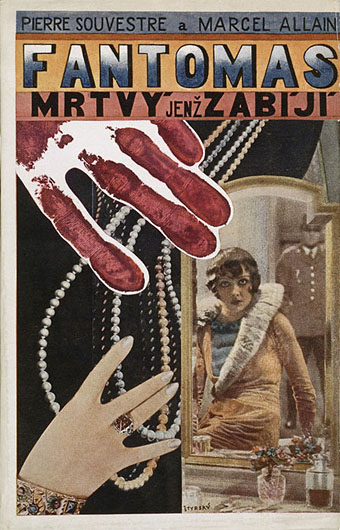
Cover for a Czech edition of Fantômas (1929).

Elsewhere on { feuilleton }
The fantastic art archive

Previously on { feuilleton }
Initiations in the Abyss: A Surrealist Apocalypse
Vultures Await
Wilfried Sätty: Artist of the occult
Illustrating Poe #4: Wilfried Sätty
Metamorphosis Victorianus
Max (The Birdman) Ernst
Gandharva by Beaver & Krause
The art of Stephen Aldrich

Klapheck versus Ballard

klaphek.jpg

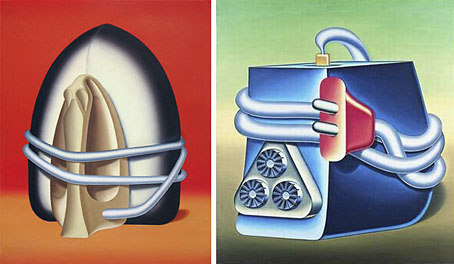
left: The Hostage (1966); right: The Female Terrorist (1971). Both by Konrad Klapheck.

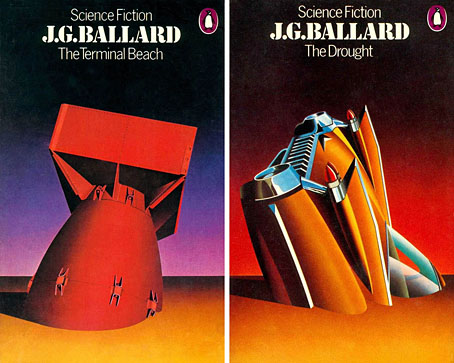
No, I’m not suggesting that David Pelham’s paintings for the Ballard covers he designed in the 1970s are inspired by the earlier work of German artist Konrad Klapheck. But it’s tempting to think of Klapheck’s isolated objects as being intended for Ballard collections that never saw the light of day. Klapheck has connections with late Surrealism, and some of his paintings prefigure the styles and concerns of Pop Art, so I’m sure Ballard would have approved.

pelham.jpg

Three of Pelham’s memorable Ballard paintings were made available as signed and numbered prints earlier this year, together with his design for A Clockwork Orange. For more about the covers see Landscapes From a Dream: How the Art of David Pelham Captured the Essence of JG Ballard’s Early Fiction, an essay at Ballardian. The designer discussed his career at some length in 2007. Then there’s the complete set of covers at the Penguin Science Fiction site, and let’s not forget Konrad Klapheck who’s still painting and who has a website here.

Elsewhere on { feuilleton }
The book covers archive

Alice in Liverpool

caterpillar.jpg

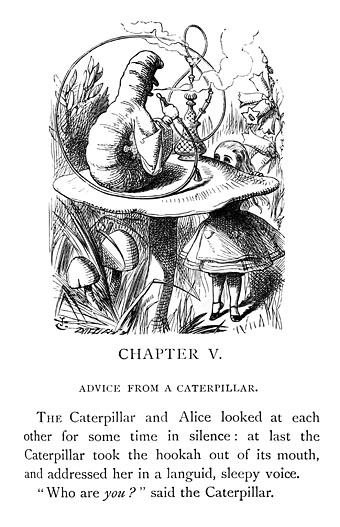
Alice and the Caterpillar (1865) by John Tenniel.

It’s perhaps surprising that an art gallery, rather than a library, is holding a huge survey exhibition about Alice, but then Carroll’s creation has been and still is the inspiration of artists, photographers, theatrical designers, animators, film-makers.

Thus Marina Warner writing about an exhibition of art based on Lewis Carroll’s Alice books opening at Tate Liverpool this Friday:

Alice in Wonderland will offer visitors a rare opportunity to view Carroll’s own drawings and photographs, alongside Victorian Alice memorabilia and John Tenniel’s preliminary drawings for the first edition of the novel.

Carroll’s stories were soon adopted by other artists. Surrealist artists from the 1930s onwards were drawn towards the fantastical world of Wonderland where natural laws were suspended. From the 1960s through the 1970s, Carroll’s Alice tales also prompted conceptual artists to explore language and its relationship to perception, and the stories inspired further responses in Pop and Psychedelic art. Expect to see works by artists ranging from Salvador Dalí and René Magritte, to Peter Blake and Yayoi Kusama. (more)

The exhibition runs to January 29th, 2012, and I suppose this gives me a convenient opportunity to point again to my psychedelic Alice calendars which have been updated for the forthcoming year.

Previously on { feuilleton }
Coulthart calendars for 2012
Scenes from a carriage
Through the Psychedelic Looking-Glass: the 2011 calendar
Jabberwocky
Alice in Acidland
Return to Wonderland
Dalí in Wonderland
Virtual Alice
Psychedelic Wonderland: the 2010 calendar
Charles Robinson’s Alice’s Adventures in Wonderland
Humpty Dumpty variations
Alice in Wonderland by Jonathan Miller
The Illustrators of Alice