Weekend links 140

cards.jpg

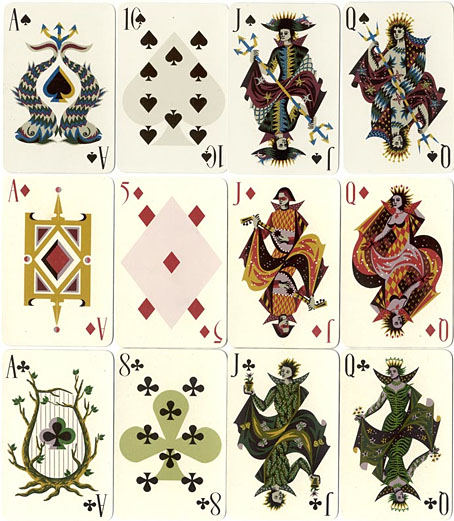
Thanks to Callum for pointing the way to a beautiful set of playing cards designed by Picart le Doux.

Of cigars and pedants by Houman Barekat, in which Vladimir Nabokov has a problem with Henry James. Tangentially related: Post-Punk’s Nabokov: Howard Devoto and Magazine, live from Berlin, 1980. (Given A Song From Under The Floorboards, and lines like “I could have been Raskolnikov / But mother nature ripped me off”, I’d say it’s more accurate to describe Devoto as Post-Punk’s Dostoyevsky.)

• “I was introduced to Kneale’s work like most kids: by a fifty-foot hologram of a psychic locust and a British colonel deliquesced by five million years of bad Martian energy.” In Keep Me in the Loop, You Dead Mechanism Dave Tompkins looks back at Nigel Kneale’s TV play The Stone Tape. I reported my own impressions at the end of October.

• At The Quietus this week, Carol Huston on Lord Horror: A History Of Savoy Publishing. Michael Butterworth is interviewed, and the piece includes some quotes from earlier interviews by yours truly.

As the Massachusetts minister Increase Mather explained in 1687, Christmas was observed on Dec. 25 not because “Christ was born in that Month, but because the Heathens Saturnalia was at that time kept in Rome, and they were willing to have those Pagan Holidays metamorphosed into Christian” ones. So naturally, official suppression of Christmas was foundational to the godly colonies in New England.

Rachel N. Schnepper on the Puritan War on Christmas.

• Maxine Peake and the Eccentronic Research Council have a seasonal song for you. Take the title, Black ChristMass, as a warning. The group recently played live on The Culture Show.

• Clive Hicks-Jenkins’ Artlog is currently hosting Alphabet Soup, an online exhibition by different artists each depicting the letters of the alphabet. Start here and click forward.

Ornate Typography from the 19th Century featuring samples from the King George Tumblr. Related: Sheaff ephemera.

saturn.jpg

Saturn at Saturnalia. A Cassini image of the planet’s nightside.

Kenneth Anger interviewed by P. Adams Sitney. A 53-minute tape recording from 1972.

• At The Outer Church: James Ginzburg of Emptyset posts a winter music mix.

When Candy Darling met Salvador Dalí.

The psychedelic secrets of Santa Claus.

• At Pinterest: Camp as…

Saturn (1956) by Sun Ra | Permafrost (live, 1980) by Magazine | Uptown Apocalypse (1981) by B.E.F.
The Magic Toyshop

toyshop1.jpg

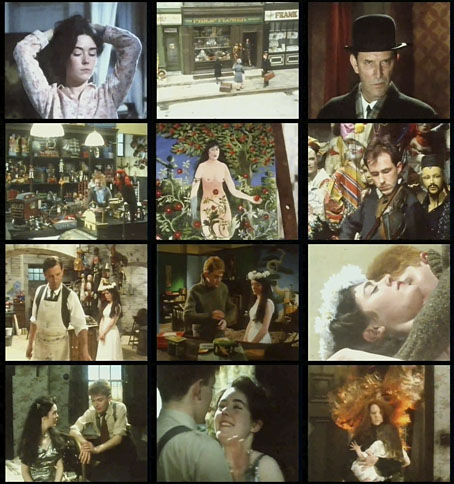
Yet more revenant TV drama. Seems like everything turns up if eventually so long as you’re prepared to wait. I’d looked for this film a couple of times after writing about TV director David Wheatley. The Magic Toyshop (1987) was a feature-length Granada Television adaptation of Angela Carter’s 1967 novel, with Wheatley directing and Carter herself supplying the screenplay. Caroline Milmoe plays Melanie, a teenage girl left in the care of her Uncle Philip after she and her younger brother and sister are orphaned. Tom Bell plays the sinister uncle who owns the toyshop of the title, a place where the toys, puppets and automata are as lively as JF Sebastian’s menagerie in Blade Runner. Melanie’s younger uncles, Finn and Francie, live in fear of the tyrannical Philip who forces them to assist with his life-size puppet shows, while Melanie’s aunt Margaret is not only cowed by her husband but also mute. The arrival of Melanie and her growing sexual awareness upsets the household’s balance of power.

toyshop2.jpg

It was good to see this film again having recently watched David Wheatley’s René Magritte film and his marvellous Borges documentary. In light of those earlier works an adaptation of Angela Carter would seem a natural progression. Aside from an overly-emphatic score, The Magic Toyshop was better than I remembered, the initial viewing no doubt suffering from an expectation that it might be a match for The Company of Wolves (1984). The Granada film had a much lower budget than Neil Jordan’s feature so it’s an unfair comparison. Wheatley and co. saved money with some careful use of the Baker Street set from Granada’s Sherlock Holmes adaptations.

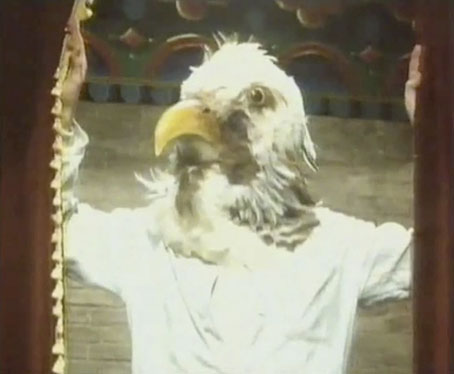
Watching The Magic Toyshop now it’s surprising it was made at all, it’s an odd piece of work stippled throughout with surreal moments, and even Surrealist references, as with Finn’s Loplop-like appearance above. What drama there is refuses the familiar shapes that a TV audience would expect, and there’s also a surprising amount of incestuous desire boiling among the major characters that goes unquestioned. I’ve not read Carter’s novel so I can’t say how it compares but the film feels like a very pure delivery of the author’s landscape of entwined sexuality, fantasy and myth. The Magic Toyshop hasn’t been reissued on DVD so the YouTube version is from a tape copy. It’s also chopped into chunks (why, oh, why, etc) but it’s highly recommended to Angela Carter readers.

The Magic Toyshop: part 1 | part 2 | part 3 | part 4 | part 5 | part 6 | part 7

Previously on { feuilleton }
Borges and I
René Magritte by David Wheatley

Weekend links 138

durette.jpg

Heartsick (2011) by Kelly Durette.

• Now that Scott Walker’s Bish Bosch album is out and causing the usual consternation, the spotlight-shy singer/composer has been doing a surprising amount of promotional interviews. Simon Hattenstone talked to him for the Guardian at the end of last month; this week it was John Doran’s turn at The Quietus. One quote from the latter piece stood out in the light of this week’s posts: “…the music we’re making is meant to be an aural version of the HR Giger drawings for Alien. It always sounds to me like those look.”

Satanica is a limited-edition publication curated by Gio Black Peter & Christopher Stoddard “for anyone who rejects societal norms, for those dedicated to a life of pleasure, excess and self-reflection”.

• Sci-Fi-O-Rama has put five years’ worth of blog pictures onto Pinterest. I don’t really need to do that, there’s already a diverse crowd of Pinterest users compiling their own selection of things posted here.

As Susan Sontag once observed, pornography is practical. It was designed as a marital aid, and its vocabulary should follow natural biological rhythms and stick with hot-button words in order to produce a predictable climax. It is not about sex but is sex. Whereas the great sex writers (Harold Brodkey, DH Lawrence, Robert Gluck, David Plante, the Australian Frank Moorhouse) have a quirky, phenomenological, realistic approach to sex. They are doing what the Russian formalists said was the secret of all good fiction – making the familiar strange, writing from the Martian’s point of view.

Edmund White on writing about sex in fiction

• When pirate DVDs of films by Cocteau, Bresson and Pasolini are on sale in a Mexican market, life in the 21st century increasingly resembles a William Gibson novel. Joanne McNeil investigates.

• Copies of City Fun, Manchester’s premier music fanzine/alt culture mag (founded 1978), can now be read online at the Manchester District Music Archive.

• Linked everywhere during the past few days, the astonishing map of bomb hits on London during the Blitz (October 1940 to June 1941).

• At 50 Watts: 30 Vintage Magazine Covers from Japan and Alfred Kubin’s illustrations for Lesabéndio: An Asteroid Novel (1913) by Paul Scheerbart.

• Earlier this year for Frieze Magazine Geeta Dayal talked to musical collaborators of the great German producer Conny Plank.

Invisible Ink by Christopher Fowler, “the extraordinary stories of over one hundred forgotten authors”.

Cynthia Carr talks about Fire in the Belly, her biography of American artist David Wojnarowicz.

• “Blasphemy, Filth, And Nonsense” More Aleister Crowley ephemera at Front Free Endpaper.

• At Strange Flowers: Surrealist art by Jindrich Heisler (1914–1953).

Vladimir Nabokov wrote to Alfred Hitchcock in 1964.

• Scott Walker’s four tracks from the Nite Flights album (1978): Shutout | Fat Mama Kick | Nite Flights | The Electrician.

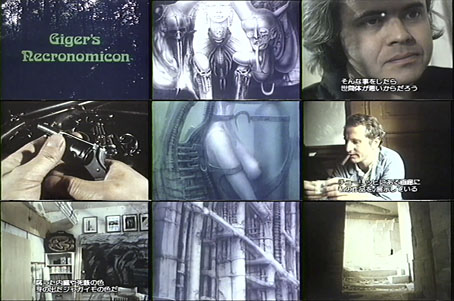
Giger’s Necronomicon

giger1.jpg

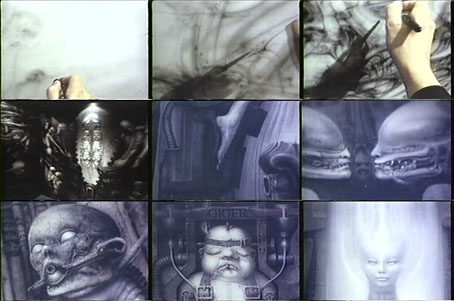
Another artist documentary only this time the artist concerned is a full participant and co-creator. Giger’s Necronomicon was filmed from 1972 to 1976 and functions as a taster for the first book collection of the artist’s work, also called Giger’s Necronomicon, which was published a year later. JJ Wittmer was the co-director. The paintings are very familiar now so it’s worth being reminded how shocking and outré Giger’s work seemed in the 1970s. In addition to interviews with the artist’s parents and some of the painting’s owners there are shots of a very modish gallery event, and we get to see inside Giger’s studio and witness one of the paintings being produced. The sound quality is somewhat erratic since the video appears to come from a Japanese tape but the voiceover is in English. The most notable thing about Giger’s Necronomicon is that all the mobile camera shots are from the artist’s point of view, we only see him when he looks in a mirror.

Giger’s Necronomicon: part 1 | part 2 | part 3 | part 4

giger2.jpg

There’s some additional interest here for Krautrock aficionados. Giger’s books mention his associations with a couple of peripheral figures from the Swiss end of Cosmic Courier/Cosmic Jokers scene: Sergius Golowin and Walter Wegmüller. Golowin is credited with one of the spacier albums on the Cosmic Courier label but he was better known in Switzerland as a writer, and he appears briefly in Giger’s Necronomicon offering some thoughts about the artist’s paintings. The music for the film sounds like the ambient jazz doodlings of Stomu Yamash’ta but is the work of Joël Vandroogenbroeck and Carole Muriel. Vandroogenbroeck recorded a lot of library music, including one release entitled Biomechanoid (1980) which has a Giger cover painting. Prior to this he was a member of German group Brainticket and plays on Cottonwoodhill (1970), an album with a (deserved) reputation as the most demented Krautrock release.

giger3.jpg

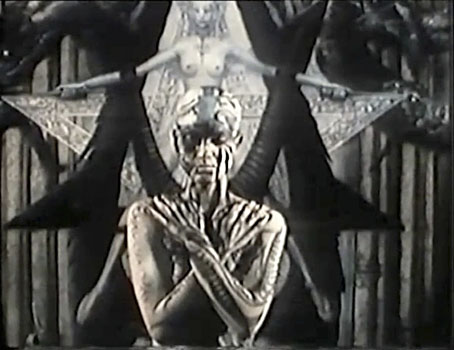
Also at YouTube is another Giger film from the same period, Giger’s Second Celebration of the Four (1977), a four-minute piece directed by JJ Wittmer showing a ritualistic club event. The combination of robes, torches and some of Giger’s more Satanic imagery resembles a black metal music video, albeit with a jazzy soundtrack.

Elsewhere on { feuilleton }
The fantastic art archive

Previously on { feuilleton }
Dan O’Bannon, 1946–2009
Alejandro Jodorowsky’s Dune
The monstrous tome

Joseph Cornell: Worlds in a Box

cornell1.jpg

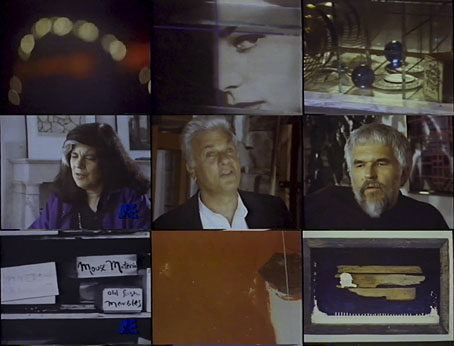
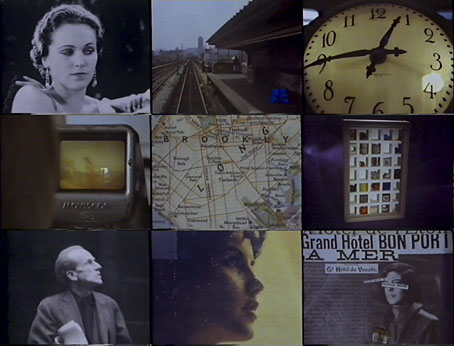
Susan Sontag, Tony Curtis and Stan Brakhage all shared an appreciation for the work of American artist Joseph Cornell (1903–1972), and all appear in a 51-minute documentary Joseph Cornell: Worlds in a Box directed by Mark Stokes for the BBC in 1991. Susan Sontag was also the subject of one of Cornell’s collages, something she discusses here. Tony Curtis collected many of Cornell’s boxes and used to visit the artist when he was in New York; in Stokes’s film he discusses their relationship and reads from Cornell’s writings.

cornell2.jpg

I’ve had a tape of this for years courtesy of Kerri Sharp who worked on the film (hi Kerri!) but it’s taken a while to turn up on YouTube. The value of films such as this isn’t so much the view they give of the works themselves—all of which are better judged in books or museums—but the way they function as mini-biographies which give a sense of the environment from which the art emerged. You can read in detail about Cornell’s life in Deborah Solomon’s Utopia Parkway: The Life and Work of Joseph Cornell (1997) but a text description of his home lacks the immediacy of the views Stokes gives us of the Cornell house, and the room where he created so much of his work. The film also follows Cornell’s train journeys into New York City, and visits the locations of his short films. Extracts of the latter appear throughout the documentary but you can see them in full at Ubuweb.

If you’re looking for an arty (and costly) Christmas present this year, Thames & Hudson have just published Joseph Cornell’s Manual of Marvels: How Joseph Cornell reinvented a French Agricultural Manual to create an American Masterpiece; two books in a box with a CD, edited by Analisa Leppanen-Guerra and Dickran Tashjian. The NYT reviews it here.

Previously on { feuilleton }
Joseph Cornell, 1967
Rose Hobart by Joseph Cornell
View: The Modern Magazine