Weekend links 185

rondelli.jpg

L’uomo che piantava gli alberi (2013) by Sofia Rondelli. Via Form Is Void.

• I’m looking forward to hearing the new album by Chrome Hoof, a band whose ambition and attitude makes many of their contemporaries seem lukewarm at best. Mick Middles gets to grips with Chrome Black Gold here. John Doran interviewed the group in 2010, a piece which includes a Chrome Hoof mix of tracks by other artists.

Jay Roberts: “I was a young Marine scout sniper, definitely his type. And for a single, unforgettable afternoon, Orange County’s most notorious serial killer coaxed me into a place from which many didn’t escape.”

Jonathan Meades: “Why I went postal … and turned my snaps into postcards.” “Meades isn’t your average architectural fanboy,” says Rachel Cooke who went to talk to him at his home in Marseille.

“Faced with a Nabokov novel,” Zadie Smith writes, “it’s impossible to rid yourself of the feeling that you’ve been set a problem, as a chess master sets a problem in a newspaper.” Certainly, while Humbert asks the reader “not to mock me and my mental daze”, the suspicion is that the power dynamic in his tale is a little different.

Tim Groenland on the difficulties of writing, publishing and reading Lolita.

Cosmic Machine is a double-disc collection of French electronic music from the 1970s & 1980s. Justice enthuse about the music here where you can also preview the tracks.

The Midnight Channel, Evan J. Peterson’s horror-poetry homage to the VHS era, is available now from Babel/Salvage. There’s a trailer here.

• “Our age reveres the specialist but humans are natural polymaths, at our best when we turn our minds to many things,” says Robert Twigger.

• Another musical Chrome: Richard Metzger on newly resurrected recordings by one of my long-time cult bands.

• Hermes Trismegistus and Hermeticism: An interview with Gary Lachman.

• A stunning set of photos of London in the sweltering summer of 1976.

Pye Corner Audio live at The Outer Church, Madrid, November 2013.

Judee Sill, the shockingly talented occult folk singer time forgot.

• Designer Jonathan Barnbrook answers twenty questions.

• Don’t trust the painting: Morgan Meis on René Magritte.

Laurie Anderson’s farewell to Lou Reed.

Philippe Druillet at Pinterest.

• The Chrome Plated Megaphone Of Destiny (1968) by The Mothers of Invention | March Of The Chrome Police (1979) by Chrome | Chrome (1981) by Debbie Harry

Belgian Autochromists

autochrome2.jpg

Misty wood (c. 1910) by Charles Corbet.

A perfect autumnal scene from Charles Corbet, one of many woodland views at the Belgian Autochromists site. As usual with autochromes it’s hard to believe that almost all these images are over a century old, the colours are so subtle. Some of the lighting is also remarkable, especially the self-portraits by Ernest van Zuylen which are lit with a single candle. Paul Sano’s lady sitting in the garden gives a foretaste of Magritte-like Surrealism, its inset eclipse appearing at first glance to be a large black sphere hovering unnoticed or ignored beside the seated woman.

Via Wood s Lot.

autochrome1.jpg

Melancholia (c. 1910) by Charles Corbet.

autochrome3.jpg

Sunset on the heath (c. 1910) by Paul Sano.

autochrome4.jpg

Lady and inset of solar eclipse (c. 1910) by Paul Sano.

Previously on { feuilleton }
Colour photography, 1908
Fred Holland Day revisited
Constantinople, 1900
Albert Kahn’s Autochromes
Gertrude Käsebier’s crystal gazer
The Dawn of the Autochrome

8 x 8: A Chess Sonata in 8 Movements

8x8-1.jpg

Continuing the Cocteau theme, this fascinating film remains (for the time being) unavailable in a better copy despite its artistic all-star cast. 8 x 8: A Chess Sonata in 8 Movements (1957) can be regarded as a follow-up to Hans Richter’s Surrealist anthology Dreams That Money Can Buy (1947), the directorial credit this time being shared between Richter, Jean Cocteau and Marcel Duchamp. The latter famously quit the art world to devote more time to chess-playing so his involvement with a chess-based fantasy (self-described as “a fairytale for grownups”) isn’t so surprising:

It explores the realm behind the magic mirror which served Lewis Carroll 100 years ago to stimulate our imagination.

The cast comprises famous friends including Cocteau himself, Max Ernst, Dorothea Tanning, Paul Bowles, Fernand Leger, Alexander Calder, Duchamp, and, in the Venetian episode, Peggy Guggenheim in her favourite sunglasses. In places it’s closer to Kenneth Anger’s Inauguration of the Pleasure Dome (1954) than Dreams That Money Can Buy, especially since Anger’s film was another assemblage of unique personalities. One detail I’ve not seen remarked upon elsewhere is the presence behind the camera of Louis & Bebe Barron who assisted with the sound. The Barrons are better known today for their still astonishing all-electronic score for Forbidden Planet (1956). Watch 8 x 8 at Ubuweb or YouTube.

8x8-2.jpg

Previously on { feuilleton }
Dreams That Money Can Buy

Weekend links 177

wickerman.jpg

A new Wicker Man poster by Dan Mumford appears on the cover of the forthcoming DVD/BR reissues. Prints are available.

• The long-awaited release of a restored print of Robin Hardy’s The Wicker Man approaches. Dangerous Minds has a trailer while The Guardian posted a clip of the restored footage. The latter isn’t anything new if you’ve seen the earlier uncut version, but the sound and picture quality are substantially better. I’ve already ordered my copy from Moviemail.

• “It’s a fairly bleak place, and it has this eerie atmosphere. East Anglia is always the frontline when there’s an invasion threatening, so there are lumps of concrete dissolving into sand, bits of barbed wire and tank tracks that act as a constant reminder. I really love it.” Thomas Dolby talking to Joseph Stannard about environment and memory.

Dome Karukoski is planning a biopic of artist Tom of Finland. Related: Big Joy, a documentary about the life and work of James Broughton, poet, filmmaker and Radical Faerie.

The desire to be liked is acceptable in real life but very problematic in fiction. Pleasantness is the enemy of good fiction. I try to write on the premise that no one is going to read my work. Because there’s this terrible impulse to grovel before the reader, to make them like you, to write with the reader in mind in that way. It’s a terrible, damaging impulse. I feel it in myself. It prevents you doing work that is ugly or upsetting or difficult. The temptation is to not be true to what you want to write and to be considerate or amusing instead.

Novelist Katie Kitamura talks to Jonathan Lee.

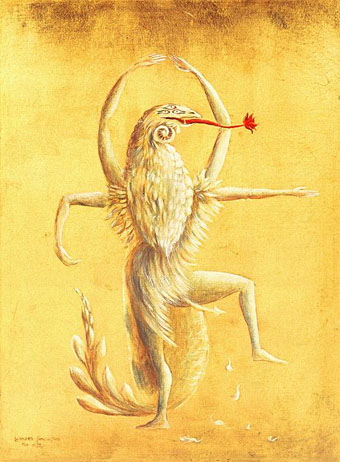
Leonora Carrington: The Celtic Surrealist opens on Wednesday at the Irish Museum of Modern Art, Dublin.

Julia Holter turns spy in the video for This Is A True Heart.

Alexis Petridis talks to graphic designer Peter Saville.

hashim.jpg

Al-Naafiysh (The Soul) by Hashim. From the Program Your 808 poster series by Rob Rickets.

Rob Goodman on The Comforts of the Apocalypse.

Post-Medieval Illustrations of Dante’s Sodomites.

• Annoy Jonathan Franzen by playing Cat Bounce!

Paolozzi at Pinterest

The Surrealist Waltz (1967) by Pearls Before Swine | The Jungle Line (1981) by Low Noise (Thomas Dolby) | Al-Naafiysh (The Soul) (1983) by Hashim

Max and Dorothea

ernst1.jpg

Photo by Arnold Newman (1942).

I love this photo of Max Ernst by Arnold Newman, one of several pictures of the artist together with Dorothea Tanning in Max Ernst: A Retrospective, a catalogue for a 1975 Guggenheim Museum exhibition at the Internet Archive. The catalogue itself isn’t so revelatory (and most of the reproductions are monochrome) but it’s good to see a connection made between Arnold Böcklin’s Isle of the Dead and Ernst’s work. It’s an obvious parallel: all those porous landscapes and “fishbone forests” which offer a kind of mutated Symbolism. Browse the book here or download it here.

ernst2.jpg

Photo by Henri Cartier-Bresson (1961).

ernst3.jpg

Photo by Frederick Sommer (1946).

ernst4.jpg

No photographer credited.

ernst5.jpg

Photo by Frederick Sommer (1946).

Previously on { feuilleton }
Dorothea Tanning, 1910–2012
Dreams That Money Can Buy
La femme 100 têtes by Eric Duvivier
A Picture to Dream Over: The Isle of the Dead
Dorothea Tanning: Early Designs for the Stage