Weekend links 197

field.jpg

Posters by Jay Shaw for Ben Wheatley’s A Field in England which receives a US release this month.

Alvin Baltrop’s Gay New York: “the clandestine activities taking place under New York piers between 1975 and 1986”. AnOther samples some of the work on display at the Open Eye Gallery, Liverpool. Meanwhile, BUTT has some shots from Texas Porno Road Trip, a photo series by Mike McLeod. Related: HBO will show you anything but a male erection, says Justin Moyer.

• “[Robert] Desnos quickly proved himself to be one of the most gifted in these experiments – eventually known as ‘the period of sleeping fits’. He was capable of writing, speaking, drawing and composing entire fantastical narratives.” Eugene Thacker on the Surrealist séances of the 1920s.

• “It’s history, not a viral feed,” says Sarah Werner. A complaint about the way the ongoing decontextualisation of images is both pernicious and potentially lucrative.

His prose is a palimpsest of echoes, ranging from Eliot’s Preludes and Rhapsody on a Windy Night (lines like “Midnight shakes the memory / As a madman shakes a dead geranium” are Burroughsian before the fact) to Raymond Chandler’s marmoreal wisecracks and Herbert Huncke’s jive. I suspect that few readers have made it all the way through the cut-up novels, but anyone dipping into them may come away humming phrases. His palpable influence on JG Ballard, William Gibson, and Kathy Acker is only the most obvious effect of the kind of inspiration that makes a young writer drop a book and grab a pen, wishing to emulate so sensational a sound. It’s a cold thrill.

Peter Schjeldahl reviews Call Me Burroughs by Barry Miles.

• “Dance music was born in LGBT communities, but has this been forgotten?” Luis-Manuel Garcia on an alternate history of sexuality in club culture.

• Avant-Grade Hallucinogens: the Poetics of Psychedelic Perception in Moving Image Art by Stuart Heaney.

No Condition Is Permanent: weekly radio shows from Count Reeshard at LuxuriaMusic and iTunes.

The Golem: where fact and fiction collide. David Barnett on 100 years of Gustav Meyrink’s novel.

• Don’t Let Harlan Ellison Hear This: Nick Mamatas on a great writer.

• Mix of the week: the Ela Orleans Mix at A Sound Awareness.

Amon Düül II playing live on French TV, 1971 & 1973.

• A soundmap of London canals and minor rivers.

The Peculiar Underworld of Rare-Book Thieves.

• At Pinterest: William Burroughs and Phalluses.

Architecture of Doom

Hallucinations (1967) by Tim Buckley | Phallus Dei (1969) by Amon Düül II | Hallucinations (In Memory of Reinaldo Arenas) (1994) by Paul Schütze

The Art of Tripping, a documentary by Storm Thorgerson

aot1.jpg

How does this sound? 100 minutes of solidly informative documentary about the use of drugs by artists from the early 19th century on; a production that calls upon a remarkable cast of contributors (see below), with music by David Gilmour, and the whole thing “devised and directed” by Storm Thorgerson, better known as one third of the great Hipgnosis design team.

The Art of Tripping was broadcast in two parts in 1993 during the Without Walls arts strand on Channel 4 (UK). David Gale was the writer, with actor Bernard Hill playing the part of the narrator and guide. The programme managed to deal with a contentious subject without indulging in hysteria or insulting the intelligence of the audience, a rare thing today. Twenty years ago it was still possible to make a documentary about a popular subject without having any low-grade celebrity-du-jour offering their wretched opinion. The contributors here who aren’t medical people are almost all writers of one kind or another; Thorgerson and Gale punctuate the proceedings with a few actors who impersonate various historical figures.

aot2.jpg

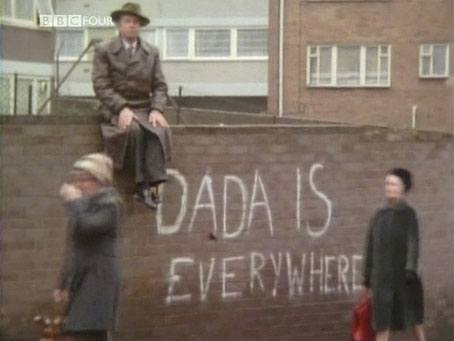
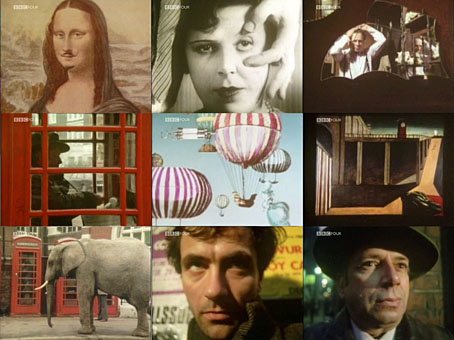
Without Walls was a very good series on the whole but this for me was a real highlight (no pun intended). In addition to it being a rare example of Storm Thorgerson working in television, the direction showed how it was possible to match the theme without recourse to cliché or flashy visuals. There isn’t a single moment of archive footage either. Thorgerson’s history of “socially unacceptable” drugs is structured as a journey through the levels of a multi-storey building, from ground floor to roof; being familiar with the director’s free-associative working methods I can imagine this being a result of thinking about getting high. Bernard Hill encounters the various commentators in successive rooms, each of which is furnished and lit to suggestively imply the drug in question. The use of lighting as a key motif is a smart one, and another metaphor, of course, for literal and symbolic (or spiritual) illumination. Editing effects are also deployed to thematically correspond to the different substances.

aot3.jpg

This would be very successful even without a wide range of contributors but Thorgerson and company assembled a stunning array of different writers, many of whom I’d never seen on TV before, and many of whom didn’t turn up again. Some of them fill dual roles, so JG Ballard is on hand to enthuse about Naked Lunch, and appears later talking about his bad LSD trip. Similarly, Brian Aldiss talks about Anna Kavan, and also about Philip K Dick. Below there’s a rough list of the drugs covered and the people involved. In the two decades since this was made many of the people involved have since died, the director included, so the film now has the feel of a historical artefact. The Art of Tripping can be see in full at YouTube. This is how good British television used to be.

Opium
Dr Virginia Berridge (author), Grevel Lindop (author), Marek Kohn (author), Dr EMR Critchley (author), Phil Daniels (as Thomas De Quincey), Dr Tony Dickenson (neuropharmacologist), Dr Ian Walker (author), Thom Booker (as Edgar Allan Poe), Dr Peggy Reynolds (author)
Hashish
Prof John Hemmings (author), Ronald Hayman (author), Patrick Barlow (as Theophile Gautier), John McEnery (as Charles Baudelaire), Jon Finch (as Gérard de Nerval), Bernard Howells (lecturer, King’s College, London), June Rose (author), John Richardson (author), Margaret Crosland (author), Danny Webb (as Jean Cocteau), Robin Buss (translator), David Gascoyne (poet), George Melly (collector, Surrealist art)
Mescaline
Prof Eric Mottram (University of London), Francis Huxley (nephew of Aldous Huxley), Jay Stevens (author), Laura Huxley (widow of Aldous Huxley),
Psilocybin
Brian Cory (as Robert Graves), Paul O’Prey (author)
Marijuana / Nitrous Oxide
Harry Shapiro (author), Carolyn Cassady (author), Prof Ann Charters (author), Allen Ginsberg (poet)
Kief
Paul Bowles (author)
Heroin
JG Ballard (author), Prof Avital Ronell (author), Hubert Selby Jr (author), Brian Aldiss (author)
LSD
Dr Oscar Janiger (experimental psychiatrist), Diana Quick (as Anaïs Nin), Prof Malcolm Lader (psychopharmacologist), Dr Timothy Leary (author), Todd Boyco (as Andy Warhol)
Amphetamine
Lawrence Sutin (author)
Cocaine
Robert Stone (author), Prof. Annette Dolphin (neuropharmacologist)
MDMA

Previously on { feuilleton }
Storm Thorgerson, 1944–2013
Hipgnosis turkeys
Enter the Void
Opium fiends
La Morphine by Victorien du Saussay
In the Land of Retinal Delights
Haschisch Hallucinations by HE Gowers
Storm Thorgerson: Right But Wrong
Demon rum leads to heroin
The art of LSD
Hep cats
German opium smokers, 1900

Les Chants de Maldoror by Shuji Terayama

terayama.jpg

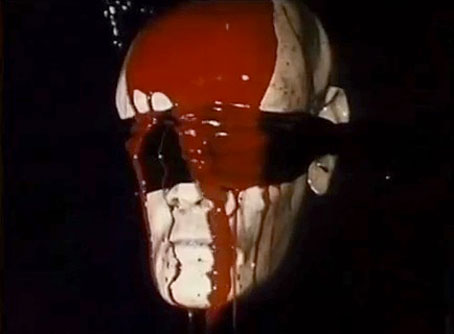
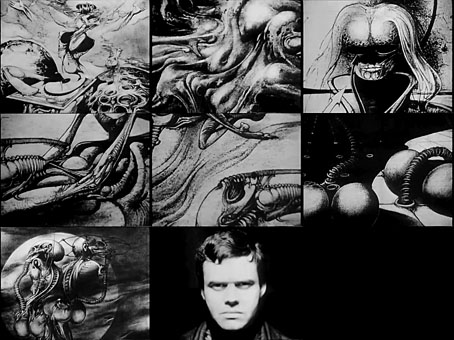
27 minutes of experimental video from 1977 in which director Shuji Terayama retrieves some predictably unorthodox images from the bottomless pit of Lautréamont’s text. The preoccupations here seem to belong as much to the director’s mind as to that of Isidore Ducasse, what with the emphasis on various forms of bondage and unusual erotics. (Not that Maldoror lacks sexual material but what there is adopts a different guise.) With a score that sounds like outtakes from a Clock DVA studio session it’s very much a product of its time, but not without interest. Terayama was (among other things) the director of Emperor Tomato Ketchup (1971), a film whose title was later swiped by Stereolab. Les Chants de Maldoror may be viewed at Ubuweb.

terayama2.jpg

Previously on { feuilleton }
Polypodes
Ulysses versus Maldoror
Maldoror
Books of blood
Magritte’s Maldoror
Frans De Geetere’s illustrated Maldoror
Maldoror illustrated

Polypodes

jianfu.jpg

Sepia (no date) by Gao Jianfu.

Quelquefois, dans une nuit d’orage, pendant que des légions de poulpes ailés, ressemblant de loin à des corbeaux, planent au-dessus des nuages, en se dirigeant d’une rame raide vers les cités des humains, avec la mission de les avertir de changer de conduite, le caillou, à l’œil sombre, voit deux êtres passer à la lueur de l’éclair, l’un derrière l’autre; et, essuyant une furtive larme de compassion, qui coule de sa paupière glacée, il s’écrie: «Certes, il le mérite; et ce n’est que justice.» Après avoir dit cela, il se replace dans son attitude farouche, et continue de regarder, avec un tremblement nerveux, la chasse à l’homme, et les grandes lèvres du vagin d’ombre, d’où découlent, sans cesse, comme un fleuve, d’immenses spermatozoïdes ténébreux qui prennent leur essor dans l’éther lugubre, en cachant, avec le vaste déploiement de leurs ailes de chauve-souris, la nature entière, et les légions solitaires de poulpes, devenues mornes à l’aspect de ces fulgurations sourdes et inexprimables.

Les Chants de Maldoror (1869) by the Comte de Lautréamont

maldoror.jpg

Sometimes on a stormy night while legions of winged squids (at a distance resembling crows) float above the clouds and scud stiffly towards the cities of the humans, their mission to warn men to change their ways—the gloomy-eyed pebble perceives amid flashes of lightning two beings pass by, one behind the other, and, wiping away a furtive tear of compassion that trickles from its frozen eye, cries: “Certainly he deserves it; it’s only justice.” Having spoken thus it reverts to its timid pose and trembling nervously, continues to watch the manhunt and the vast lips of the vagina of darkness whence flow incessantly, like a river, immense shadowy spermatozoa that take flight into the dismal aether, the vast spread of their bat’s wings obscuring the whole of nature and the lonely legions of squids—grown downcast viewing these ineffable and muffled fulgurations.

Translation by Alexis Lykiard, 1970

pennington-cthulhu.jpg

The Mask of Cthulhu, 1976 paperback reprint. Cover art by Bruce Pennington.

Above these apparent hieroglyphics was a figure of evidently pictorial intent, though its impressionistic execution forbade a very clear idea of its nature. It seemed to be a sort of monster, or symbol representing a monster, of a form which only a diseased fancy could conceive. If I say that my somewhat extravagant imagination yielded simultaneous pictures of an octopus, a dragon, and a human caricature, I shall not be unfaithful to the spirit of the thing. A pulpy, tentacled head surmounted a grotesque and scaly body with rudimentary wings; but it was the general outline of the whole which made it most shockingly frightful. Behind the figure was a vague suggestion of a Cyclopean architectural background.

The Call of Cthulhu (1928) by HP Lovecraft

Previously on { feuilleton }
Ulysses versus Maldoror
Maldoror
Vampyroteuthis Infernalis by Vilém Flusser
Books of blood
Magritte’s Maldoror
Frans De Geetere’s illustrated Maldoror
Maldoror illustrated

Big fish

undying.jpg

Illustration by Lawrence for The Undying Monster (1946) by Jessie Kerruish.

Another of those collisions between fine art and pulp fiction that I like to note now and then. The drawing above by Lawrence Sterne Stevens (from this page) I immediately recognised as borrowing its fish from the painting below by Néstor Martín-Fernández de la Torre (1887–1938), or Néstor as he’s usually known. Stevens was also usually credited by the single name Lawrence, and this is one of his many first-rate contributions to Famous Fantastic Mysteries. I’ve already noted a similar borrowing by his contemporary, Virgil Finlay, so this example isn’t too surprising. It’s unlikely that many of the readers eagerly devouring Jessie Kerruish’s tale would have been familiar with Néstor’s paintings. On the same Lawrence page there’s his illustration for Arthur Machen’s The Novel of the Black Seal which ran in the same issue.

nestor1.jpg

Poema del Mar: Noche (1913–1924).

Néstor is distinguished by a predilection for aquarian scenes and writhing figures, all of which are presented in a very distinctive and recognisable style. He also happens to be one of the few major artists to come from the Canary Islands which no doubt explains his interest in the sea. The Poema del Mar series, and other works such as this satyr head, often find him numbered among the Spanish Symbolists although he’s rather late for that movement, and this assumes that every artist has to be placed in one box or another whether they belong there or not. These giant fish could just as well make him another precursor of the Surrealists, and they do occasionally receive a mention for their similarity to (and possible influence upon) Dalí’s enormous Tuna Fishing (Homage to Meissonier) (1966–67). There’s more of Néstor’s work over at Bajo el Signo de Libra (Spanish language).

nestor2.jpg

Poema del Mar: Tarde (1913–1924).

nestor3.jpg

Poema del Mar: Reposo (1913–1924).

Continue reading “Big fish”