Salvador Dalí’s apocalyptic happening

666.jpg

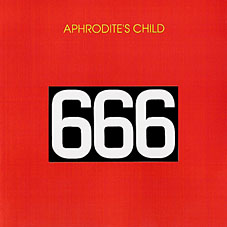
The oft-despised concept album of the 1970s doesn’t come more demented than 666, a double disc set by Greek group Aphrodite’s Child released in 1972. The group featured Vangelis and Demis Roussos among their number (Roussos later turned up on Vangelis’s score for Blade Runner) and this is about the only thing they’re now remembered for, a post-psychedelic fantasy based on the Book of Revelations. So far, so heavy. Searching for information about the album turned up a proposal by Salvador Dalí for a celebratory “happening” to be staged in Barcelona for the album’s world premiere (lyricist Costas Ferris having met Dalí in Paris shortly after the recording):

The main concept:

1. Martial Law shall be ordered on a Sunday, in Barcelona. No one shall be allowed to walk in the streets, or watch the event. No cameras, no TV. Only a young couple of shepherds will have the privilege to witness the event. So, they can later describe it to the people, by oral speech.

2. Giant loudspeakers shall be put in the streets, playing all day the work 666, by Vangelis, Ferris and the Aphrodite’s Child. No live performance.

3. Soldiers dressed in Nazi uniforms, will walk in military march in the streets of Barcelona, arresting who-ever wants to break the law.

4. Hundreds of swans will be left to move in front of the Sagrada Famiglia, with pieces of dynamite in their bellies, which will explode in slow motion by special effects. (real living swans, that should be operated for putting the dynamite inside their belly).

5. Giant Navy planes, will fly all day in the sky of Barcelona, provoking big noise.

6. At 12:00 sharp, in the mid-day, those planes will start the bombardment of the great church, throwing all of their munitions.

7. Instead of bombs, they shall throw Elephants, Hippopotami, Whales and Archbishops carrying umbrellas.

No, it didn’t happen, but if you do hear the album try and think of swans exploding in slow motion while elephants and archbishops rain down from the sky.

Previously on { feuilleton }
• The apocalyptic art of Francis Danby
• The music of Igor Wakhévitch
• Dalí Atomicus
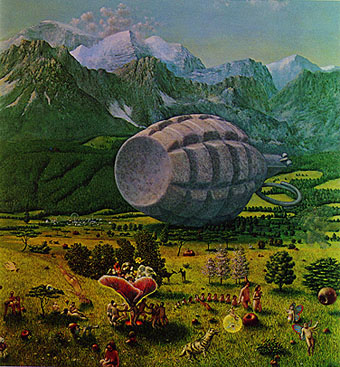
The art of Thomas Häfner, 1928–1985

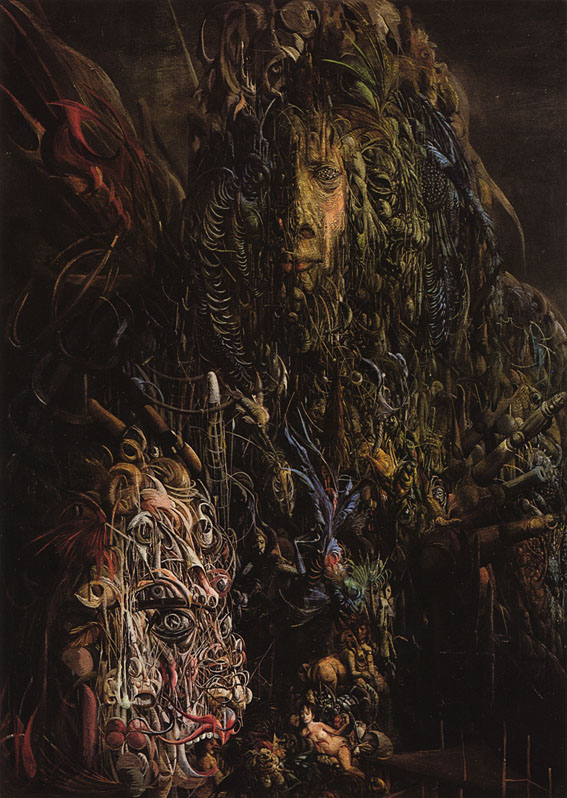
lucifer.jpg

Lucifer (no date).

…I find nothing fantastic in so-called fantastic art, it is an aspect of reality in search of sanity beyond the normal bounds. I believe that fantastic art is related to the protective dream, that it prolongs the healing dream and finds symbols that change dread into wonder, strangeness and beauty.

As in all figurative art, fantastic art must of course be judged not only by its intentions but by the quality of the execution, and by standards that have been almost totally lost in the turbulence of changing fashions, movements and politics on the art market. This has led to a noticeable helplessness among the critics, who seem to ignore a growing tendency toward the fantastic in the hope that it will fade away and die. I do not believe it will.

Thomas Häfner

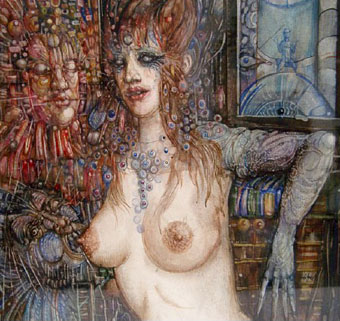
Who was Thomas Häfner? Good question, because he’s virtually invisible on the web. The painting above is scanned from David Larkin’s excellent Fantastic Art (Pan/Ballantine, 1973) and was also used as a cover image for an edition of Blaise Cendrars‘ scurrilous masterpiece, Moravagine. The Demon Woman below is a watercolour original for sale on eBay. Häfner was a member of a group of German artists who called themselves the Young Realists, formed in Düsseldorf in the mid-Fifties. Significantly, another group of young imaginative painters was active at the same time in Vienna, the Fantastic Realists, who included the great Ernst Fuchs among their number. “Realism” here can be considered as referring to a style that favoured the hard-edged realistic approach of Surrealism; Häfner’s content certainly wasn’t realistic.

These people remain neglected or unknown because art critics like to pretend there’s only one story being told in the development of art at any given time when there are usually several, often with conflicting agendas. So we’re always being informed that the dominant movement in fin de siècle Paris was Impressionism and hear little of the Symbolists who were equally—if not more—popular, productive and influential during that period.

(This laziness carries over to other areas; Debussy is continually described as “an Impressionist composer” when one of his most famous works, Prélude à l’après-midi d’un faune, was based on a Symbolist poem by Mallarmé. There are no fauns in Impressionist paintings.)

The prevailing trend in the mid-Fifties was the thin gruel of Abstract Expressionism, the complete antithesis of the kind of art being produced by Häfner, Fuchs and company. There’s a reason for the elevation of this type of work over others. Critics such as Clement Greenberg saw abstraction (which, ironically, grew out of Surrealism) as being a politically acceptable direction after the turmoil of the Second World War. The Nazis liked realism in their art, while the Soviets under Stalin and the Chinese under Mao had declared Socialist Realism to be the official art of the Communist Revolution, therefore realism of any variety was reactionary and bad. Further irony comes when the CIA agreed with this argument and secretly promoted Abstract Expressionism outside America. This has led us to the situation we have today where a Willem de Kooning painting, Woman III (1952–53), was recently sold for $137.5 million which means collecting this kind of work is now a game for billionaires. It really would be the final irony if the kind of realistic art that Clement Greenberg despised was elevated to a new popularity by over-priced Abstract Expressionism as collectors with fewer assets were forced to look elsewhere. Critics can protest all they like but these days it’s money that speaks with the loudest voice in the world of art.

demon_woman.jpg

Demon Woman (no date).

Update: added some additional works:

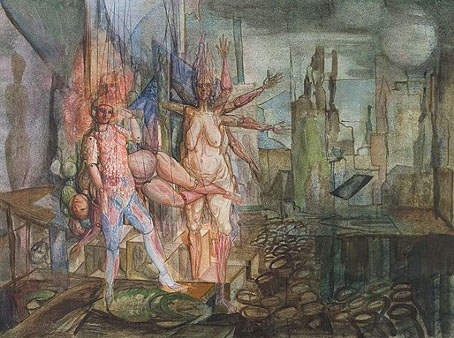
hafner2.jpg

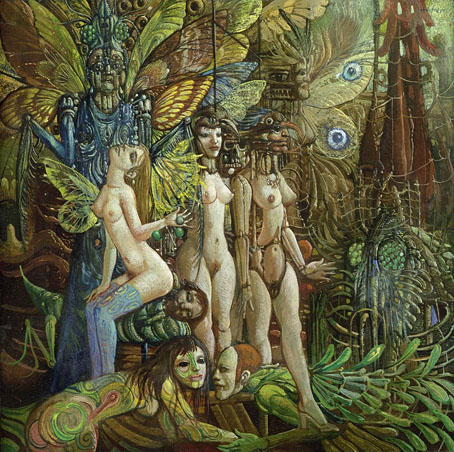
Marionetten (1964).

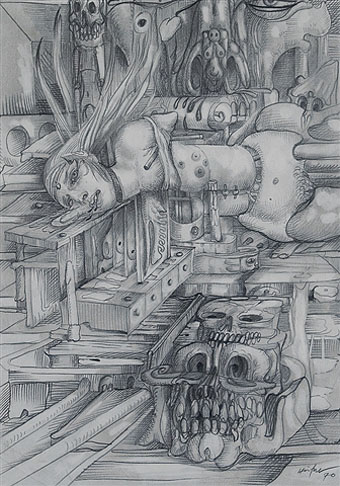
hafner1.jpg

Szene mit Schädeln (1970).

hafner3.jpg

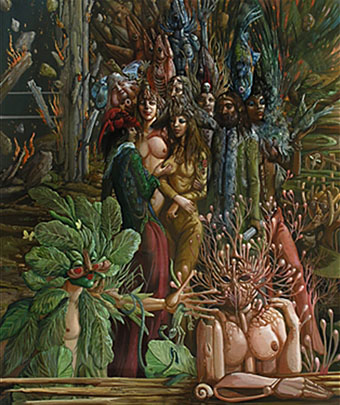
Phantastische Waldszene (1971).

hafner.jpg

Masken in zerfallener Umgebung (1974).

hafner2.jpg

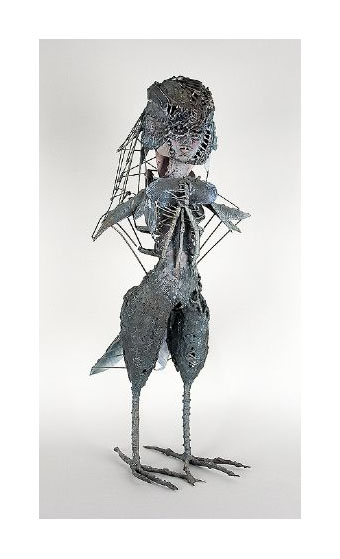
Die Harpye (no date).

Elsewhere on { feuilleton }
• The fantastic art archive

JG Ballard book covers

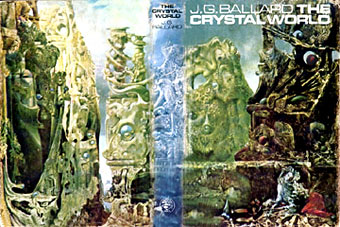
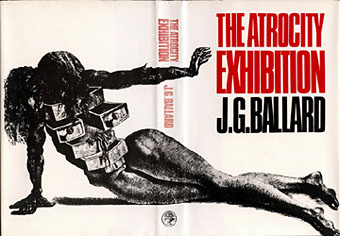
In a similar vein to the Burroughs cover gallery, Rick McGrath’s site does the same for one of Burroughs’ followers, JG Ballard. The covers below are two typical examples using Surrealist art as their illustration, The Eye of Silence by Max Ernst and City of Drawers by Dalí. I’ve always loved the pairing of Ernst’s painting (my favourite by that artist) with The Crystal World, a design that Panther carried over to their 1968 paperback edition.

ballard1.jpg

ballard2.jpg

Elsewhere on { feuilleton }
• The book covers archive