
The Quietened Bunker

bunker.jpg

Bunkers were a recurrent feature in the media of the 1980s, a consequence of increasing Cold War tensions following the election of Ronald Reagan and the Soviet invasion of Afghanistan. The decade birthed new horrors of the body-mutating variety, and also reanimated some older ones in the figure of the knife-wielding psychopath, but the omnipresent spectre of nuclear war posed a threat not only to characters in films and TV serials but to the audiences who watched them. That threat manifests most strikingly in the middle of the decade with the TV film Threads (1984), the TV serial Edge of Darkness (1985), and the comic-book serial/graphic novel Watchmen (1986–87). To these you could add feature films such as WarGames (1983) and James Cameron’s The Terminator (1984) and its sequel. Not all of these works feature bunkers but nuclear warfare by its very nature implies the existence of subterranean control centres with all their latent mythological resonances. Some of those resonances are played with in David Rudkin’s Penda’s Fen (1974) and Artemis 81 (1981), the latter featuring an extended sequence in a sinister subterranean complex. Troy Kennedy Martin’s superb nuclear thriller, Edge of Darkness, runs the gamut of underground enclaves, from labyrinthine cave systems and abandoned nuclear shelters to a dusty Cold War command centre with a telephone link to Downing Street.

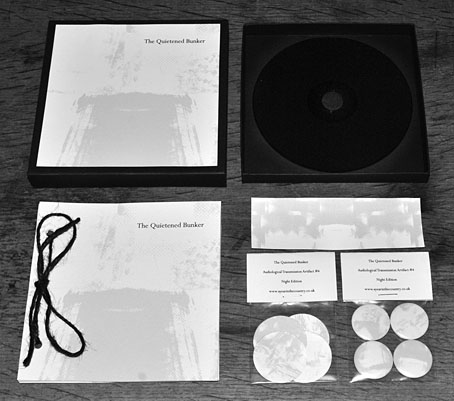
Bunkers of the abandoned variety provide the theme for the latest compilation album from A Year In The Country:

The Quietened Bunker is an exploration of the abandoned and/or decommissioned Cold War installations which lie under the land and that would have acted as selectively populated refuges/control centres if the button was ever pushed; a study and reflection on these chimeric bulwarks and the faded but still present memory of associated Cold War dread, of which they are stalwart, mouldering symbols.

Track list:
1) Lower Level Clock Room – Keith Seatman
2) Drakelow Tunnels – Grey Frequency
3) The Filter’s Gone / The Last Man Plays The Last Piano – A Year In The Country
4) Aggregates II – Panabrite
5) Bunker 4: Decommissioned – Polypores
6) Comms: Seen Through The Grey – Listening Center
7) Crafty Mechanics – Time Attendant
8) Crush Depth – Unknown Heretic
9) Waiting For The Blazing Skies – David Colohan

This is another quality collection in distinctive black-and-white packaging that will be of immediate interest to anyone who enjoys the releases on the Ghost Box label (Listening Center are already Ghost Box artists): spectral pianos, shortwave radios, ambient chords. The bunker theme connects to shared concerns among related artists with the old Civil Defence films, samples of which have been used on releases by The Advisory Circle and Mordant Music. The Cold War bunker is more than another empty space, it joins the bio-weapons lab (see The Satan Bug) as a source of contemporary horror that doesn’t require any supernatural component to chill the blood.

Previously on { feuilleton }
Fractures

Weekend links 320

liefhebber.jpg

Palm Night (2016) by Nick Liefhebber.

• “Gortner includes reference to the little known Hollywood ‘sewing circles’ (code word for lesbian communities) of which Marlene became a part. This group included Ann Warner, Lili Damita, Claudette Colbert, and Dolores del Río.” Walter Holland reviewing Marlene, a “novelization” of the life of Marlene Dietrich by CW Gortner.

• “Challenges and all, Jerusalem ensures Moore’s place as one of the great masters of the English language.” Heidi MacDonald reviewing Alan Moore’s forthcoming novel. Photos of the slipcased paperback edition (a 3-volume set) appeared last week.

• “It’s unlikely that a gnawing sense of being unborn tops the neuroses of most writers these days, but I’d argue that Beckett’s Jungian insight is more commonly known today as anxiety.” Robert Fay on nihilism and the writing life.

• “So why would I be ‘great for this cover’? Good chance it’s because the book is aimed at a female audience and I am a female designer.” Jennifer Heuer on gendered book covers and being a woman designer.

• Mixes of the week: FACT mix 562 by M. Geddes Gengras, Secret Thirteen Mix 191 by Monica Hits The Ground, and a mix by Daniel Miller.

• Strange Flesh: The Use of Lovecraftian Archetypes in Queer Fiction, an ongoing series by The Punk Writer: part 1 | part 2 | part 3 | part 4.

• “For the Sake of the Prospect”: Lily Ford on the ways in which balloon flight transformed ideas about landscape in the 18th century.

• “Why did Google erase Dennis Cooper’s beloved literary blog?” asks Jennifer Krasinski.

• From Leeds to London: portraits of English cities in the 1970s by Peter Mitchell.

Phantasm is Dune

• RIP Jack Davis

Palm Grease (live, 1974) by Herbie Hancock & The Headhunters | Phantasm (1994) by Biosphere | Fizzy Flesh (1996) by Spacer

Weekend links 315

knights.jpg

The Deluge (1920) by Winifred Knights.

Dennis Cooper‘s favourite fiction, poetry, nonfiction, film, music, art & internet of 2016 so far. (Thanks again for the nod to this blog!)

• At Literary Hub: Jonathan Russell Clark on Jorge Luis Borges, and Jon Sealy on why indie presses [in the US] are opening bookstores.

• “It’s not just about the music.” A conversation on the occult practices in the arts between poet Janaka Stucky and Peter Bebergal.

• Daisy Woodward talks to Andreas Horvath about Helmut Berger, Actor, a documentary about Visconti’s muse and lover.

• More Fritz Leiber: Brian J. Showers on his decision to republish Leiber’s horror novel, The Pale Brown Thing.

• Mixes of the week: Sextape 4 by Drixxxe, and Radio Oscillations #96 (Richard Pinhas/Heldon) by Iron Blu.

• The 5th Young One: Pay No Attention to the Girl Behind the Sofa; John Reppion on a television mystery.

• More reading suggestions: Cheerless beach reads for gloomsters and saddies by S. Elizabeth.

• Never the same film twice: Seances by Guy Maddin, Evan Johnson, Galen Johnson.

• How painter Winifred Knights became Britain’s “unknown genius”.

• The Journey & The Destination: An interview with Hawthonn.

Robert Latona goes in search of the grave of Constance Wilde.

• Invisible by Day: photos by Mikko Lagerstedt.

• A Queer Lit Q&A with Evan J. Peterson.

• RIP Michael Herr and Bernie Worrell.

Bridget Riley: The Curve Paintings.

• The typography of Blade Runner.

Japanese matchbox labels

SOS by Portishead

A Rainbow In Curved Air (1969) by Terry Riley | The Great Curve (1980) by Talking Heads | Dangerous Curves (2003) by King Crimson

Weekend links 314

alderslade.jpg

Avebury Kite (2006) by David Alderslade.

• “Klaus Mann, son of Thomas Mann, author of Mephisto, was one of the first in Germany to write gay novels and plays.” Walter Holland reviews Cursed Legacy: The Tragic Life of Klaus Mann by Frederic Spotts.

The Pale Brown Thing, a shorter/alternate version of Fritz Leiber’s supernatural masterwork, Our Lady of Darkness, is given a limited reprinting by Swan River Press next month.

• “Not only is metal not directly harmful to adolescent minds, as the thinking goes, it may actually be helpful.” Christine Ro on the reappraisal of a once-suspect musical genre.

Something of that tension between past and future is visible in Beardsley’s work. It is the art of a dying era peering, with a mixture of excitement and trepidation, into the next. For all the prancing and bravado, Beardsley’s art was really about finding something in which to believe—and if Beardsley came to believe in anything it was the deep black line. Shading held little interest for Beardsley, and color fascinated him not at all. The black line and white space were all he needed.

Morgan Meis on Aubrey Beardsley

• More of my art for Bruce Sterling’s forthcoming Dieselpunk novella, Pirate Utopia, has been revealed. Tachyon will be publishing the book in November.

• “Secretly, though, I frequent junk shops because I am wishing for some kind of transcendence,” says Luc Sante.

• Mixes of the week: Gizehcast #28 by Christine Ott, and a mix for The Wire by Asher Levitas.

• “It took centuries, but we now know the size of the Universe.” Chris Baraniuk explains.

Barnbrook Studios creates identity for Kubrick exhibition at Somerset House.

• Watch a haunting video from Subtext Recordings and Eric Holm.

• Folklore Tapes: A Rum Music Special by Joseph Burnett.

Brion Gysin’s Dreamachine is on sale again.

Rhys Chatham’s favourite albums.

A Guide to Occult London

Skulls and Bones

Zero Time (1979) by Chrome | Zero-Gravity (1996) by Sidewinder |  Zero Moment (2016) by Contact

More Things to Come

things01.jpg

The organisers of the Things to Come exhibition at the Petach Tikva Museum of Art, Israel, sent me their photos of the show earlier this week. As with the other recent exhibitions that I haven’t managed to attend it’s good to see how everything looks in situ, and also see some of the other exhibits.

things02.jpg

The art pieces are all related to science fiction old and new, with my airship illustration (as seen in The Steampunk Bible) and a couple of other works representing the old (or new-as-old) side of things. I’m not used to seeing my work enlarged to such a huge size so this was a treat. The only larger reproductions have been a window display for one of the Cradle of Filth album covers which filled a whole window of Tower Records, London, in 2001, and stage backdrops for Cradle of Filth and Melechesh. I can’t identify any of the other exhibits until the catalogue arrives but I really like the iridescent metal construction that’s lying on the gallery floor. All the photos are by Elad Sarig, and are shown courtesy of the Petach Tikva Museum of Art. My thanks again to Doreet LeVitte Harten for selecting my work, and to Avshalom Suliman for dealing with the printing and other details.

things14.jpg

Continue reading “More Things to Come”